
Buying Guides
Apparel Mailer Boxes: E-Flute or B-Flute?
E-flute or B-flute for apparel mailer boxes? Compare thickness, print quality, stacking strength and cost — with MOQ, sampling and lead times from Jeeli Packaging.
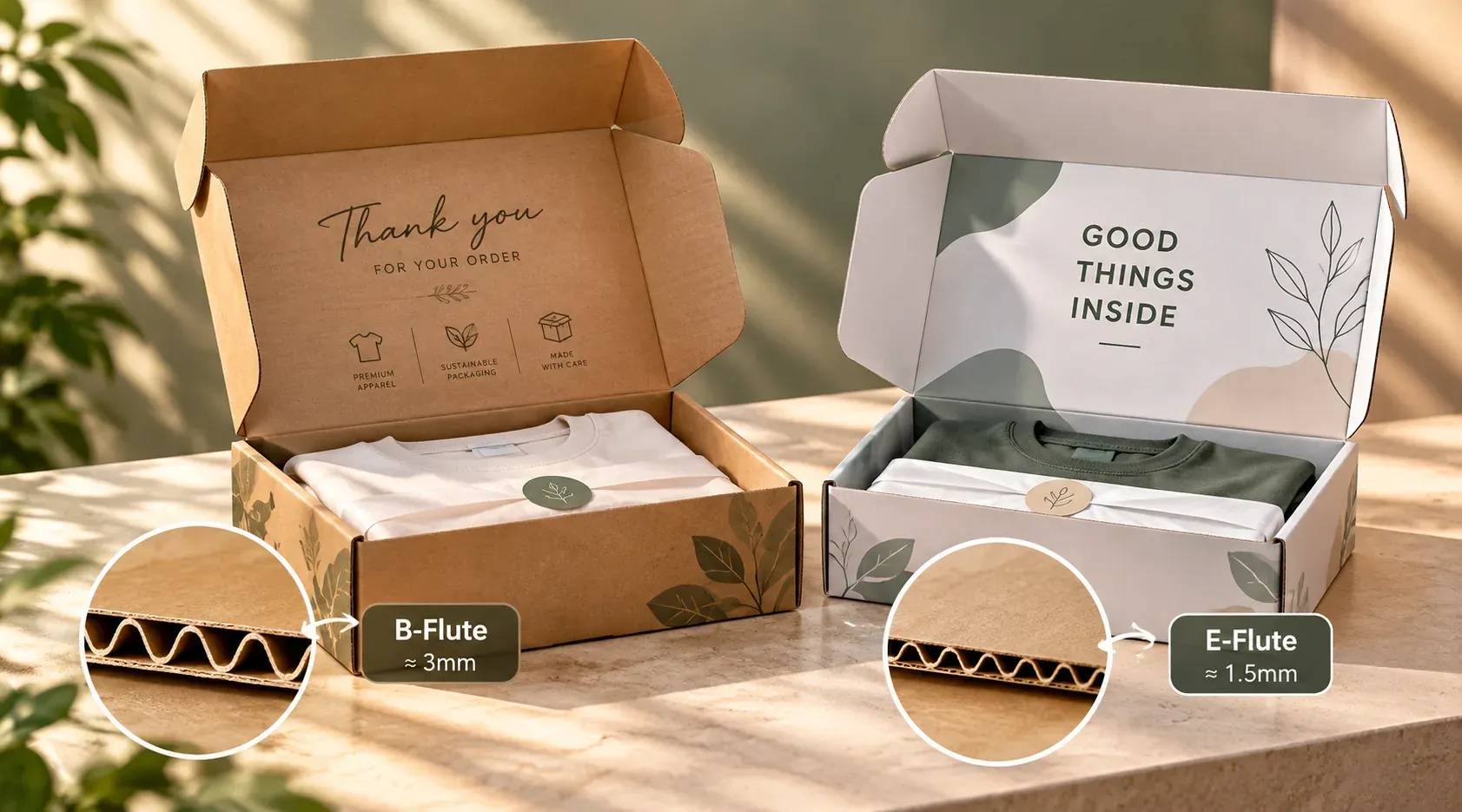
Choosing corrugated board for apparel mailer boxes usually comes down to one decision: E-flute or B-flute. Buyers often arrive at this page after comparing quotes that look similar but are actually built on different boards — and the difference shows up in print quality, stacking strength and shipping cost.
This guide compares the two flutes for apparel specifically: what changes between them, which apparel scenarios favor each, and what to confirm with your supplier before sampling.
What "Flute" Actually Means
Corrugated board is a sandwich: liner, fluted medium, liner. The flute is the wavy middle layer, and its height drives almost everything else — box thickness, stiffness, cushioning and how flat the printing surface is.
- E-flute is approximately 1.5 mm (1/16") thick, with more, smaller flutes per foot.
- B-flute is approximately 3 mm (1/8") thick, with fewer, taller flutes.
Both are "single wall" boards. Neither is automatically better — they solve different problems.
E-Flute vs B-Flute: The Practical Differences
Factor | E-Flute (~1.5 mm) | B-Flute (~3 mm) |
|---|---|---|
Print surface | Flatter, finer flutes — best for high-quality direct print | Slightly textured surface shows flute lines up close |
Box wall | Slimmer profile, cleaner on retail shelves | Bulkier profile |
Stacking strength | Lower | Higher — better column crush resistance |
Cushioning | Light | Moderate — more void protection |
Board cost per box | Lower | Higher (more material) |
Typical apparel use | Poly sets, swimwear, lingerie, accessories, subscription apparel | Denim, outerwear, folded knitwear, multi-item orders |
When E-Flute Is the Right Choice for Apparel
1. Your box is part of the unboxing experience, not just shipping.
E-flute's flat surface takes fine type, dense graphics and subtle finishes better than B-flute. For brands where the mailer doubles as retail-style packaging — poly-wrapped sets, subscription boxes, influencer kits — E-flute is usually the better print canvas.
2. You are shipping light, folded garments.
Shirts, leggings, swimwear and accessories do not need deep cushioning. E-flute protects folded apparel in polybags within a poly mailer or master carton at a lower board cost.
3. You want a slimmer box on the shelf or in the drawer.
At roughly half the thickness of B-flute, E-flute keeps the package compact — relevant for boutiques, subscription programs and any brand where the box is stored, not discarded.
When B-Flute Is the Right Choice for Apparel
1. The box does real shipping work.
Denim, coats and multi-piece orders put more weight into the same box. B-flute's taller flute resists crushing better when boxes are stacked in a courier network or on a pallet.
2. Contents need breathing room.
Taller flutes absorb more shock — useful when apparel ships with hardware, hangers or accessories, or when the box must survive longer last-mile routes.
3. You are consolidating SKUs.
If one box must work across heavy and light orders, B-flute is the safer single choice, at the cost of a bulkier box for light items.
The Decision Checklist Before You Sample
Ask yourself — and your supplier — these five questions:
- What is the heaviest single order this box will carry? Design for the heavy case, not the average one.
- Is the box shipping direct to consumers, or shelf-to-carryout? Direct-to-consumer favors B-flute; boutique retail favors E-flute.
- Is print quality a selling point? If the artwork carries the brand, E-flute's flatter surface matters.
- Kraft or white liner? Kraft reads natural and hides scuffs; white maximizes artwork contrast. This choice is independent of flute.
- Will boxes ship inside a master carton? If yes, flute choice can lean toward print quality (E-flute) because the master carton absorbs the stacking load.
One more question is worth adding if your garments carry hang tags: a tag that protrudes past the box edge bends in the first courier sort. Our guide to hang tag size for apparel boxes explains how loop length, hole position and tag width keep the tag inside the lid line.
What to Confirm With Your Supplier
Before sampling an apparel mailer box, get these in writing:
- Board specification: liner weight, flute type, and whether the board is recycled or virgin mix
- Whether the quote is for E-flute or B-flute — "corrugated mailer box" alone is ambiguous
- Printing method: flexo (economical, simpler artwork) vs offset-laminated (high detail, higher cost)
- Inside or outside print, and whether finish (matte/gloss lamination, foil, spot UV) is included in the sampling fee
- MOQ per design, sampling time and bulk lead time
How We Produce Apparel Mailer Boxes
At Jeeli Packaging, apparel mailer boxes are produced on E-flute or B-flute corrugated board, kraft or white liner, with inside and outside printing in CMYK or Pantone, plus matte or gloss lamination, foil stamping and custom inserts where needed.
Working parameters:
- MOQ: 1,000 pcs per design
- Sampling: 7–10 days after artwork approval
- Bulk production: 15–25 days after sample confirmation
- Sampling fee: USD 150–300 per design, deducted from the bulk order payment after order confirmation
- Payment / terms: T/T 50% deposit, 50% balance before shipment · FOB Shenzhen · USD quotation
Not sure which flute fits your product weight? Send us the garment types and packed weight per box — we will recommend the board and structure before you commit to sampling.
FAQ
Can I print on the inside of an E-flute mailer box?
Yes. Inside printing is available on both E-flute and B-flute mailers, and it is a common way to make a light-weight box feel more considered without changing the board.
Kraft or white liner for apparel?
Kraft suits brands positioned on natural or minimal packaging and hides scuffing in transit. White gives artwork the highest contrast. Neither affects flute choice.
Is 1,000 pcs really the minimum for a custom-size mailer?
For a fully custom size and print, yes — 1,000 pcs per design. Below that, tooling and setup costs per box stop making sense. If you need fewer, consider adapting an existing structure to reduce customization.
How do I know if my artwork needs offset or flexo?
If the design has fine type, gradients or brand-critical color matching, offset is worth the cost. If it is 1–2 spot colors or simple line art, flexo keeps unit cost down.
Not sure which flute fits your product? Send us your garment spec and we will confirm the board before sampling.