
Oct 13, 2026Buying Guides
Can Custom Mailer Boxes Ship Without an Outer Carton?
Can custom mailer boxes ship without an outer carton? Learn when direct shipping works, what can go wrong, and what to check before bulk production.
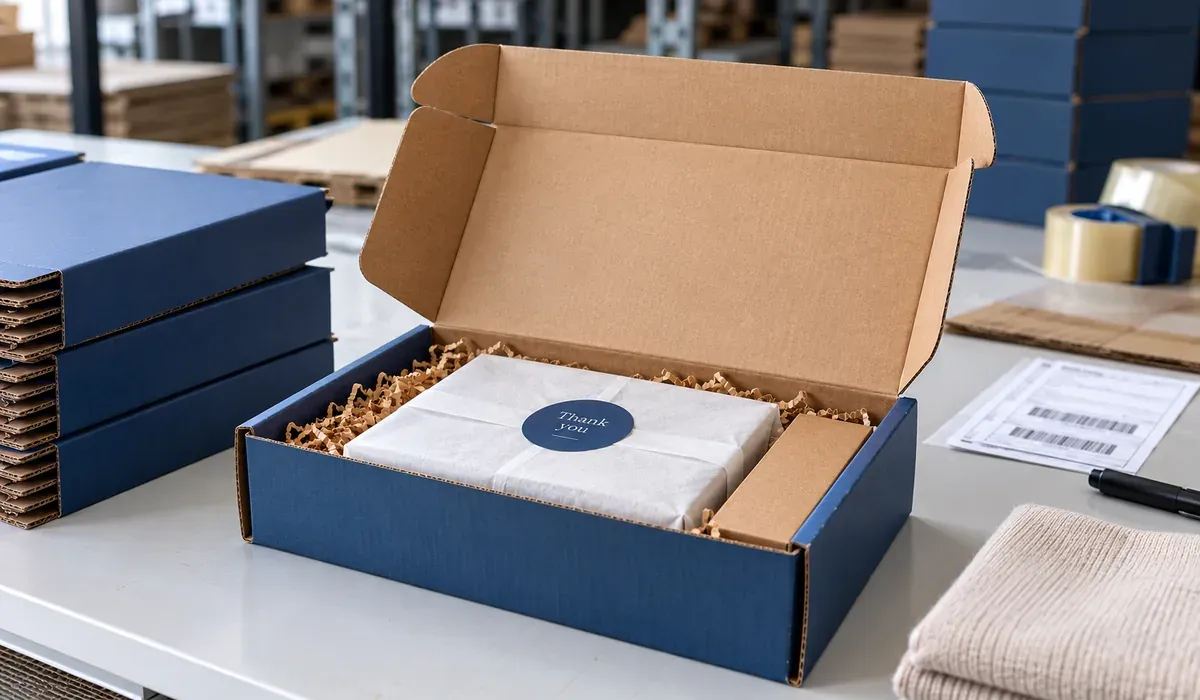
Do You Really Need an Outer Shipping Carton?
You have developed a custom printed mailer box for your brand.
The logo looks good. The box folds neatly. The product fits inside, and the unboxing experience is exactly what you wanted.
Then comes a practical question:
Can we ship this mailer box directly to customers, or do we need another shipping carton around it?
For many e-commerce brands, removing the outer carton sounds attractive.
It may reduce packaging materials, packing time and shipping volume.
But there is one important difference buyers should understand:
A mailer box that looks strong enough for product packaging is not automatically suitable for direct courier shipping.
The answer depends on the product, box structure, internal protection and shipping conditions.
Let's look at how to make that decision.
What Does Direct Shipping Mean for Mailer Boxes?
Direct shipping means the custom mailer box itself becomes the outermost package during delivery.
For example:
Option A: Mailer Box Inside an Outer Carton
Product → Custom Mailer Box → Outer Shipping Carton → Customer
Option B: Direct Shipping
Product → Custom Mailer Box → Customer
With Option B, the branded mailer box may be exposed directly to:
- Courier handling
- Conveyor systems
- Stacking pressure
- Vibration
- Drops and impacts
- Surface abrasion
- Moisture during transportation
This does not mean direct shipping is always a bad choice.
Many e-commerce businesses use corrugated mailer boxes successfully.
However, the packaging needs to be designed and evaluated for its actual distribution environment.
If you are still selecting the box structure, explore our custom mailer boxes for available materials, printing and customization options.
When Can a Custom Mailer Box Be Used for Direct Shipping?
A custom corrugated mailer box may be suitable for direct shipping when the product and packaging work together as a complete system.
Here are four situations worth considering.
1. The Product Is Not Highly Fragile
Products that are relatively resistant to normal handling may be easier to package for direct shipping.
Examples can include:
- T-shirts
- Lightweight clothing
- Fabric accessories
- Certain soft goods
- Selected non-fragile consumer products
However, product category alone is not enough to determine shipping suitability.
For example, a lightweight electronic accessory may still contain delicate components.
A skincare product may be packed in a glass container.
The actual product needs to be evaluated, not just the product category.
2. The Mailer Box Has a Suitable Corrugated Structure
Corrugated board can provide cushioning and structural support.
But not all corrugated mailer boxes offer the same level of protection.
Performance depends on factors such as:
- Paper and corrugated board combination
- Flute profile
- Box dimensions
- Panel design
- Folding and creasing
- Closure structure
- Manufacturing quality
A box that performs well at a small size may behave differently when made much larger.
This is why material selection should be based on the complete packaging design.
3. The Product Fits Properly Inside
An oversized mailer box may allow the product to move during transportation.
Excessive movement can increase the risk of impact damage.
It can also make the package feel less stable.
Depending on the product, possible solutions include:
- Adjusting the box dimensions
- Adding a paperboard insert
- Using a corrugated insert
- Improving the internal layout
- Adding suitable cushioning materials
An insert is not always necessary.
But when the product requires positioning or additional protection, the internal structure should be considered before production.
4. The Closure Is Secure
A mailer box may close neatly when empty but behave differently after the product is packed.
If the contents press against the lid, the locking areas may experience additional stress.
Some mailer box structures use folding tabs or interlocking panels.
Others may require additional sealing.
For direct shipping, the closure must remain secure under the expected handling conditions.
A neat-looking closure is not the same as a tested shipping closure.
When Is an Outer Shipping Carton Still Necessary?
An additional shipping carton may be appropriate when the branded mailer box alone cannot provide sufficient protection.
The following situations deserve particular attention.
1. Fragile or High-Value Products
Glass bottles, ceramics, delicate electronics and other damage-sensitive products may need additional protection.
A corrugated mailer box can be part of the solution, but it should not automatically be treated as sufficient.
Depending on the product, a suitable insert, cushioning system or outer carton may be required.
2. Heavy Products
Product weight affects how the packaging behaves during handling.
A heavier product may place more stress on the box bottom, corners and closure.
The weight must be considered together with the box size and structure.
Simply choosing thicker corrugated board does not guarantee that the finished package will perform adequately.
3. Long or Demanding Distribution Routes
A package shipped directly through a courier network may experience repeated handling.
International distribution, multiple transfer points and warehouse storage can introduce additional risks.
The exact conditions vary by carrier and shipping route.
For demanding distribution environments, additional protection may be justified.
4. Premium Packaging That Must Arrive in Excellent Condition
Sometimes the product is not the only thing that needs protection.
The branded box itself may be part of the customer's experience.
Imagine a premium gift box arriving with:
- Crushed corners
- Surface scratches
- Shipping labels covering the logo
- Tape across decorative printing
- Visible dirt or scuff marks
The product inside may be undamaged, but the presentation may no longer meet the brand's expectations.
If the printed box must remain clean and suitable for gifting, an outer shipping carton may be the better choice.
Direct Shipping vs. Outer Carton: What Should Buyers Compare?
There is no universal answer.
The following table provides a practical starting point.
Factor | Direct Shipping Mailer Box | Mailer Box + Outer Carton |
|---|---|---|
Packaging materials | Potentially fewer components | Additional outer carton |
Packing process | May require fewer packing steps | Requires an extra packing step |
Branding visibility | Branded box is visible during delivery | Branded box remains protected inside |
Surface protection | Printed surface is directly exposed | Outer carton helps protect the branded box |
Product protection | Depends on box and internal design | Additional packaging layer may improve protection |
Shipping volume | May reduce packaging volume | Usually adds some volume |
Damage risk | Must be evaluated for the distribution route | Also requires suitable packing and testing |
Best application | Suitable products with validated packaging | Fragile, premium or more demanding shipments |
The objective is not simply to eliminate one carton.
It is to choose a packaging system that provides sufficient protection without unnecessary cost or material use.
Why Can a Strong-Looking Mailer Box Still Fail During Shipping?
One common mistake is judging packaging strength only by how the sample feels in your hands.
A mailer box may feel rigid when empty.
But transportation introduces different types of stress.
Compression
Packages may experience stacking or localized pressure.
Large unsupported panels can deform even when the corrugated board initially feels stiff.
Impact
A package may be dropped or struck during handling.
Corrugated board can help absorb some impact, but the result also depends on the product and internal packaging.
Vibration
Repeated movement may cause the product to shift inside the box.
If the internal fit is poor, the product can repeatedly contact the box walls.
Moisture
Corrugated packaging can lose strength when exposed to elevated moisture levels.
The degree of change depends on the board construction and environmental conditions.
Closure Failure
A locking tab or lid may open if the closure is unsuitable for the packed product or shipping environment.
These problems demonstrate why packaging performance should be evaluated as a complete system.
For a closer look at material selection, read our guide to choosing corrugated thickness for mailer boxes.
Does Using Thicker Corrugated Board Solve the Problem?
Not necessarily.
Thicker corrugated board may provide advantages for certain applications.
However, it can also change:
- Folding performance
- Box dimensions
- Creasing requirements
- Packing volume
- Material consumption
- Production cost
More importantly, some shipping problems are not caused primarily by board thickness.
For example:
Problem: A cosmetic bottle moves inside the box.
Possible solution: Improve the insert or internal fit.
Problem: The lid opens after packing.
Possible solution: Review the closure structure and sealing method.
Problem: A large panel bends under pressure.
Possible solution: Review the box dimensions, board specification and structural design.
Problem: The printed surface gets scratched.
Possible solution: Review the surface finish, handling conditions or need for an outer carton.
The correct solution depends on the failure mechanism.
This is also why buyers should avoid comparing packaging quotations based only on board thickness.
What About Printing and Branding?
Direct shipping changes how the printed surface is used.
A printed mailer box shipped inside an outer carton is mainly protected during transportation.
A direct-shipping mailer box becomes both:
- The branded product package
- The external shipping package
This means the artwork and finishing requirements should reflect the shipping environment.
Keep Important Branding Away From Vulnerable Areas
Corners, edges and folding areas may experience more visible wear during handling.
Where practical, avoid placing small critical text or delicate decorative details in areas likely to be damaged.
Consider Shipping Labels
If the box will be shipped directly, think about where the carrier label will be placed.
A large shipping label may cover part of the printed design.
Brands should reserve an appropriate area for labels when necessary.
Be Realistic About Surface Finishes
Special finishes can improve presentation, but their suitability depends on the material and handling conditions.
For example, a decorative finish selected mainly for retail appearance may not be the best choice for a surface exposed directly to courier handling.
The finish should be reviewed together with the packaging structure and shipping method.
If you are considering interior branding, our article on printing inside mailer boxes explains when it adds value and when it may create unnecessary cost.
How Should You Test a Direct-Shipping Mailer Box?
Before bulk production, buyers should evaluate the actual packed package rather than only the empty box.
A practical review can include the following steps.
Step 1: Pack the Actual Product
Use the intended product, insert and packing materials.
Confirm that the product fits correctly and does not place unexpected pressure on the box.
Step 2: Check the Closure
Assemble and close the box using the intended packing method.
Check whether the lid, tabs and locking areas remain secure.
If tape or another sealing method will be used in production, include it in the evaluation.
Step 3: Inspect the Box Structure
Check for:
- Excessive panel bending
- Gaps at the corners
- Poorly formed creases
- Weak locking areas
- Distortion after packing
Step 4: Evaluate the Expected Shipping Conditions
For projects where transportation damage is a concern, consider appropriate package testing.
Depending on the distribution environment and product, this may include drop, vibration and compression evaluations.
Established package-testing procedures, such as relevant ISTA or ASTM methods, may be useful when selected and performed appropriately.
However, no single test automatically guarantees that a package will survive every shipping condition.
Step 5: Review the Result
After testing, inspect both the product and the packaging.
Look for:
- Product damage
- Movement inside the box
- Crushed corners
- Opened closures
- Surface damage
- Permanent deformation
If the results are unsatisfactory, adjust the packaging design and test again.
A sample should be evaluated in the condition in which it will actually be shipped.
How Can You Reduce Packaging Cost Without Increasing Shipping Risk?
Removing the outer carton is one possible cost-saving measure.
But it is not always the most effective one.
Other options may include:
Optimize the Box Dimensions
Avoid unnecessary empty space while maintaining adequate product clearance and protection.
Improve the Internal Structure
A properly designed insert may improve product positioning and reduce movement.
However, the insert should be evaluated as part of the complete package.
Choose the Right Corrugated Specification
Avoid selecting material solely because it is the thickest or cheapest available.
The board should match the product, structure and intended shipping conditions.
Simplify Printing Where Appropriate
For some projects, simple exterior branding may be sufficient.
Additional printing and finishing should provide clear value.
Compare Total Packaging Cost
Consider more than the unit price of the box.
The complete cost may include:
- Mailer box
- Inserts and cushioning
- Outer carton, if required
- Packing labor
- Storage and shipping volume
- Damage-related costs
A cheaper individual box is not necessarily the lowest-cost packaging solution.
Similarly, eliminating the outer carton may not save money if product damage increases.
What Should Buyers Tell Their Packaging Manufacturer?
If you want to develop a mailer box for direct shipping, provide the following information before requesting a final quotation.
Buyer Checklist
- Product dimensions
- Product weight
- Product photos
- Product fragility
- Number of items per box
- Required box dimensions, if already known
- Expected order quantity
- Shipping destination or distribution market
- Direct shipping or master-carton packing
- Existing inserts or cushioning
- Artwork and logo
- Printing and finishing requirements
- Any previous shipping damage problems
One particularly useful detail is whether the branded mailer box will be the final shipping package.
That information can influence material, structure, closure and printing recommendations.
For projects requiring both brand presentation and transportation protection, our corrugated mailer boxes are a useful starting point for discussing available structures and materials.
FAQ
Can I ship a custom printed mailer box without another box?
Yes, in some cases.
A properly designed corrugated mailer box may be suitable for direct shipping, depending on the product, internal protection, closure and distribution conditions.
The complete packed package should be evaluated before bulk production.
Are E-Flute mailer boxes suitable for direct shipping?
They may be suitable for certain products and shipping conditions.
However, E-Flute alone does not determine whether a finished mailer box is shipping-ready.
Board specification, box size, product weight, structure and testing all matter.
Is B-Flute always better for shipping?
No.
B-Flute has a different profile from E-Flute, but choosing a thicker flute does not automatically solve every packaging problem.
The appropriate material depends on the complete packaging system.
Do mailer boxes need tape for shipping?
Some mailer boxes use locking structures, while others may require additional sealing.
Whether tape or another closure method is necessary depends on the box design, product and shipping requirements.
Can a mailer box protect glass bottles?
A corrugated mailer box may form part of a protective packaging system for glass products.
However, glass containers often require carefully designed internal protection and suitable testing.
The outer box alone should not be assumed to provide sufficient protection.
Will direct shipping damage the printed surface?
It can.
When a printed mailer box is the outermost shipping package, its surface is exposed to handling, labels, abrasion and environmental conditions.
The amount of visible damage depends on the material, finish and shipping environment.
Is direct shipping always more environmentally friendly?
Not necessarily.
Using fewer packaging components may reduce material consumption, but environmental performance also depends on material selection, transportation, product damage and other factors.
A packaging design that causes more product damage or replacement shipments may create additional impacts.
The complete packaging system should be considered.
Final Thoughts
A custom mailer box can do more than present your brand.
For suitable products, it may also serve as the shipping package.
But the decision should not be based on appearance or corrugated thickness alone.
The important questions are:
- What product is inside?
- How fragile or heavy is it?
- Does it fit securely?
- Will the closure remain reliable?
- What handling conditions will the package face?
- Does the printed box need to arrive in excellent cosmetic condition?
Sometimes a well-designed direct-shipping mailer box is the practical choice.
Sometimes an additional outer carton provides worthwhile protection.
The best solution is the one that balances product protection, brand presentation and total packaging cost.
At Jeeli Packaging, we help brands develop custom paper packaging based on their product dimensions, printing requirements and intended use.
If you are considering custom mailer boxes for e-commerce shipping, send us your product size, weight, quantity and packaging design.
We can review the structure, material and customization requirements with you before sampling and production.