
Oct 12, 2026Packaging Knowledge
7 Common Problems with Electronics Folding Cartons
Discover 7 common problems with electronics folding cartons, from product fit and inserts to fold cracking, color differences and barcode issues.
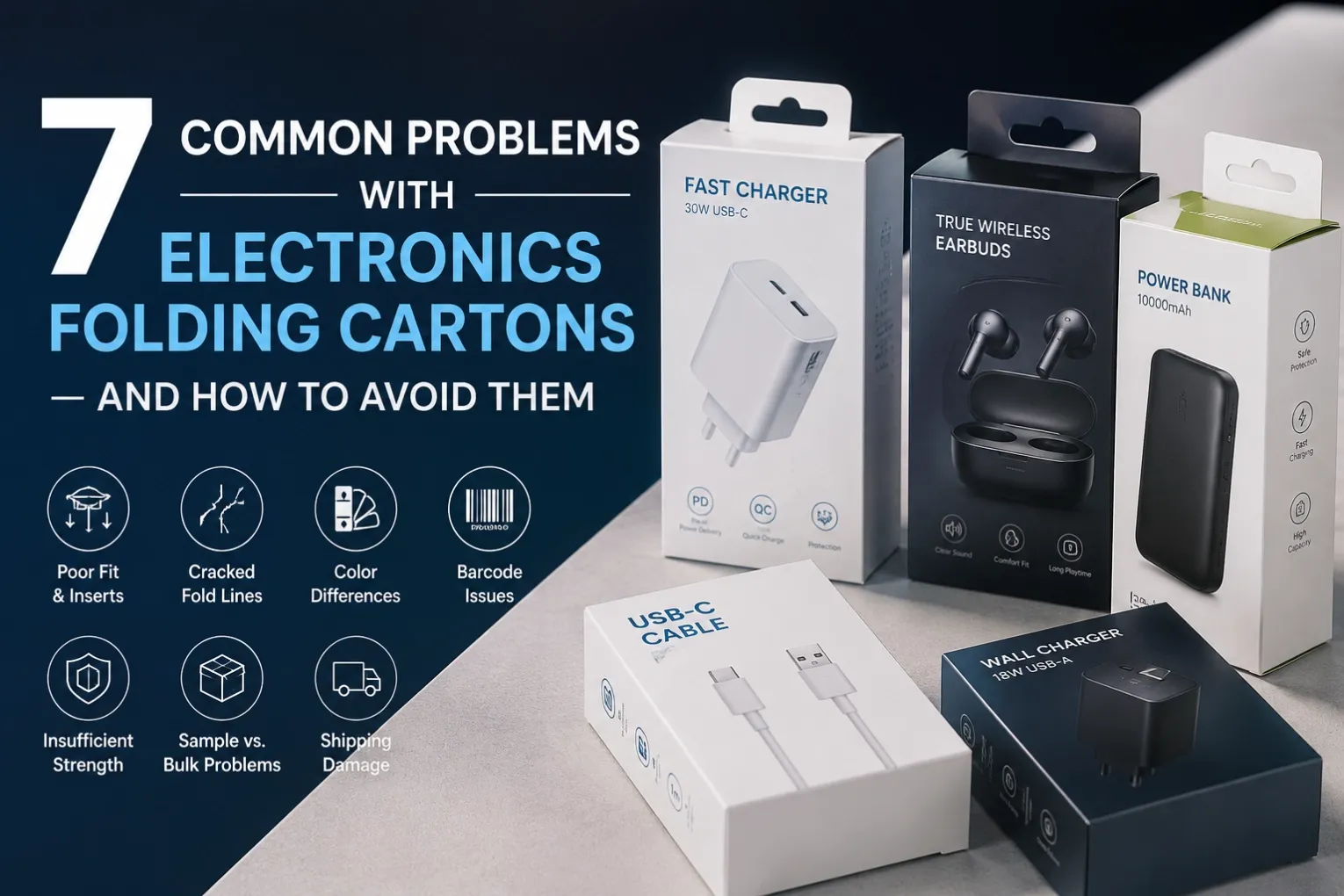
Electronics folding cartons may look simple, but small mistakes in structure, material, printing or inserts can create bigger problems during packing and shipping.
For chargers, power banks, wireless chargers, cables, earbuds and other electronic accessories, the carton must do more than look good. It needs to fit the product correctly, hold accessories in place, protect the contents and carry important product information clearly.
Here are seven common problems buyers should check before approving production.
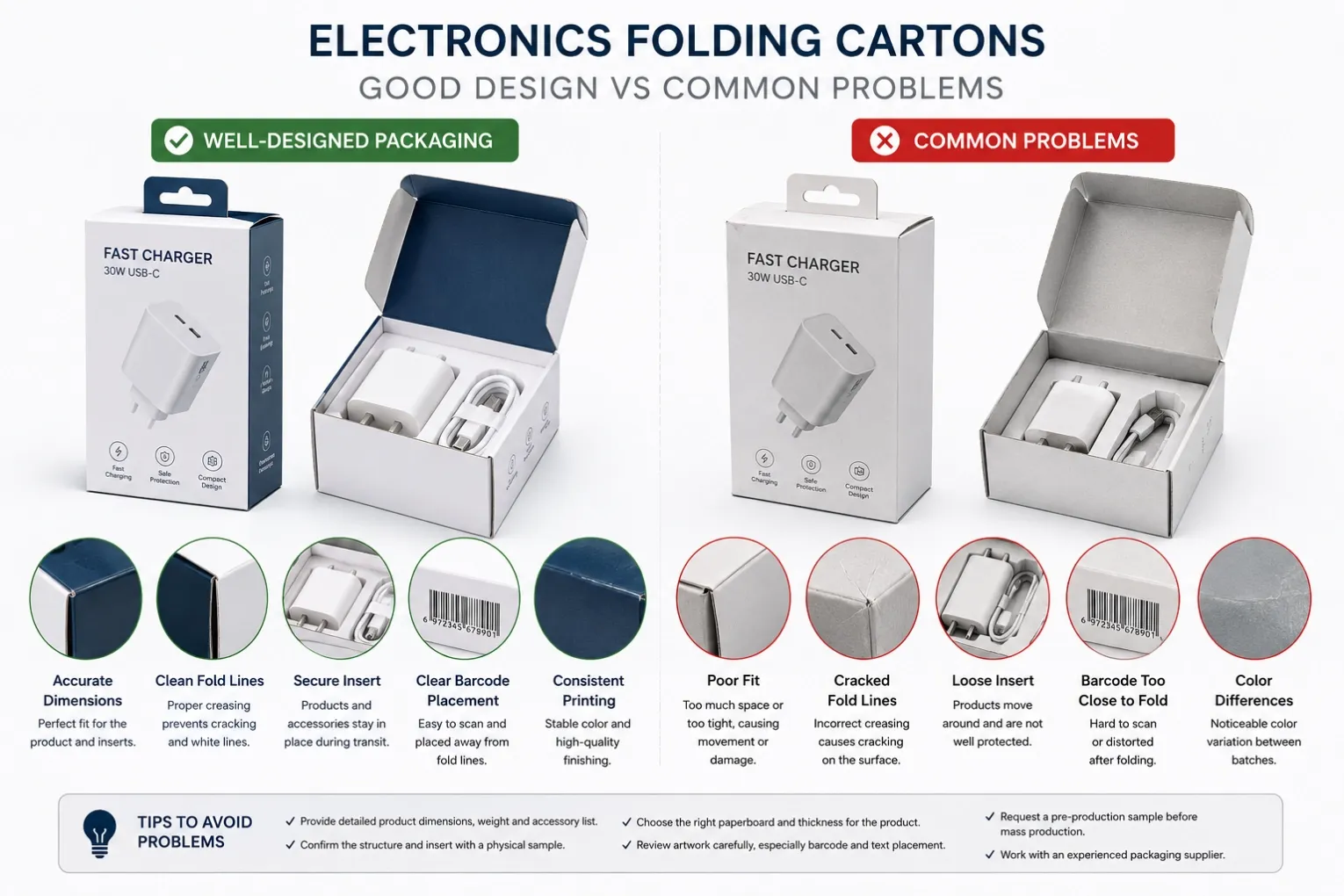
1. The Product Does Not Fit the Carton Properly
One of the most common problems starts before printing.
A buyer may provide the outer box dimensions, but the supplier may not have enough information about the actual product, accessories and packing arrangement.
For example, a wireless charger package may contain:
- Wireless charging stand
- USB cable
- Power adapter
- Instruction manual
- Additional accessories
If these components are not considered together, the finished carton may be too tight or leave too much empty space.
How to Avoid It
Before finalizing the structure, provide the supplier with:
- Product dimensions
- Product weight
- Accessory dimensions
- Photos or physical samples
- Required packing arrangement
For more complicated products, creating a structural sample before mass production is highly recommended.
2. The Insert Does Not Hold the Product Securely
The outer carton is only one part of electronics packaging.
The insert is often just as important.
If the insert is too loose, chargers, power banks or accessories can move inside the carton during transportation. If it is too tight, workers may have difficulty packing the product or customers may struggle to remove it.
Different products may require different solutions, such as:
- Paperboard inserts
- Corrugated inserts
- Molded pulp
- EVA foam
- Custom die-cut holders
A lightweight USB cable does not require the same internal structure as a heavier power bank.
How to Avoid It
Design the insert around the actual product rather than simply around the carton dimensions.
Whenever possible, test the complete package with the real product inside before approving mass production.
3. The Paperboard Is Not Strong Enough
Choosing paperboard only by GSM can be misleading.
Two electronic products may use boxes of similar dimensions but have very different weights.
A lightweight cable package may work well with a relatively simple structure, while a power bank or charging device may require stronger paperboard or a reinforced bottom.
If the combination of material and structure is not suitable, common problems include:
- Carton deformation
- Bulging panels
- Weak bottoms
- Damaged corners
- Poor shelf appearance
How to Avoid It
When requesting a quotation, tell the packaging supplier the approximate product weight as well as the carton size.
The board grade, thickness and carton structure should be selected together rather than independently.
4. The Fold Lines Crack After the Carton Is Formed
This problem is particularly visible on dark-colored electronics packaging.
A carton may look perfect while flat, but after folding, white cracks can appear along the creasing lines.
This can be related to paperboard characteristics, grain direction, lamination and incorrect creasing settings.
How to Avoid It
The supplier should match the creasing process to the selected paperboard and finishing.
Extra attention should be paid when using:
- Thick paperboard
- Dark solid colors
- Matte lamination
- Heavy ink coverage
- Special surface finishes
A properly designed crease allows the board to fold cleanly without damaging the printed surface.
5. The Bulk Production Color Looks Different from the Approved Sample
Consumer electronics packaging often relies heavily on brand colors.
Dark blue, black, green, orange and other strong solid colors are common. Small color differences can therefore become very noticeable.
Another common problem occurs when the customer provides only an RGB color from a computer screen and expects the printed carton to look exactly the same.
Screens and printed paper reproduce color differently.
How to Avoid It
Before production, clearly define the color reference.
Depending on the project, this may include:
- CMYK values
- Pantone colors
- Approved printed samples
- Physical color references
For brands with strict color requirements, color expectations should be confirmed before mass production rather than judged only from digital artwork.
6. Barcodes, QR Codes or Small Text Are Too Close to Fold Lines
Electronics packaging usually contains much more technical information than a simple gift box.
For example:
- Model number
- Product specifications
- Input / output information
- Barcode
- QR code
- Warnings
- Instructions
- Certification information
Trying to fit all this information onto a small carton can create layout problems.
If a barcode or small text is positioned too close to a crease, cut line or glue area, it may become distorted, difficult to read or difficult to scan after the carton is assembled.
How to Avoid It
Artwork should be checked against the final production dieline.
Pay particular attention to:
- Cut lines
- Crease lines
- Glue areas
- Bleed
- Safe areas
Important information should remain on stable, readable areas of the finished carton.
7. The Sample Looks Good, but the Bulk Order Has Problems
A handmade sample and a production run of thousands of cartons are very different.
A few samples can often be manually adjusted. During mass production, however, printing, die-cutting, creasing, folding and gluing must remain consistent across the entire order.
Small structural problems can become much more obvious when cartons are produced and packed at scale.
Typical issues include:
- Inconsistent folding
- Poor carton squareness
- Glue problems
- Color variation
- Difficult assembly
- Bottom closure problems
How to Avoid It
Do not evaluate a packaging sample only by appearance.
Before approval, also ask:
Can this structure be produced consistently and packed efficiently in mass production?
A good electronics package should work not only as a sample but also on the production and packing line.
What Information Should You Send Before Requesting a Quote?
Providing complete information at the beginning can prevent many of the problems above.
For custom electronics packaging, we recommend providing:
Information | Why It Matters |
|---|---|
Product dimensions | Determines internal carton size |
Product weight | Helps select board strength |
Accessories | Determines internal arrangement |
Product photos | Helps understand shape and packing |
Quantity | Affects production method and cost |
Artwork | Determines printing requirements |
Finishing | Affects material and production process |
Insert requirements | Helps secure the product |
Packing method | Helps optimize carton structure |
If the structure has not yet been decided, sending the actual product or detailed product photos can make the development process much easier.
Final Thoughts
Good electronics packaging is not simply about printing an attractive box.
The carton, product, insert, material and artwork need to work together.
For chargers, power banks, wireless charging devices and other electronic accessories, checking these details before production can help reduce packing problems, damaged cartons and unnecessary changes after mass production has started.
At Jeeli Packaging, we develop custom folding cartons according to the product size, weight, accessories, printing requirements and desired presentation.
If you are developing packaging for an electronic product, send us your product dimensions, photos, quantity and artwork. We can review the structure and recommend a suitable packaging solution.