
Oct 12, 2026Buying Guides
Does Your Product Really Need a Rigid Gift Box
Not every product needs a rigid gift box. Learn when folding cartons or mailer boxes may be a simpler, more practical packaging choice.
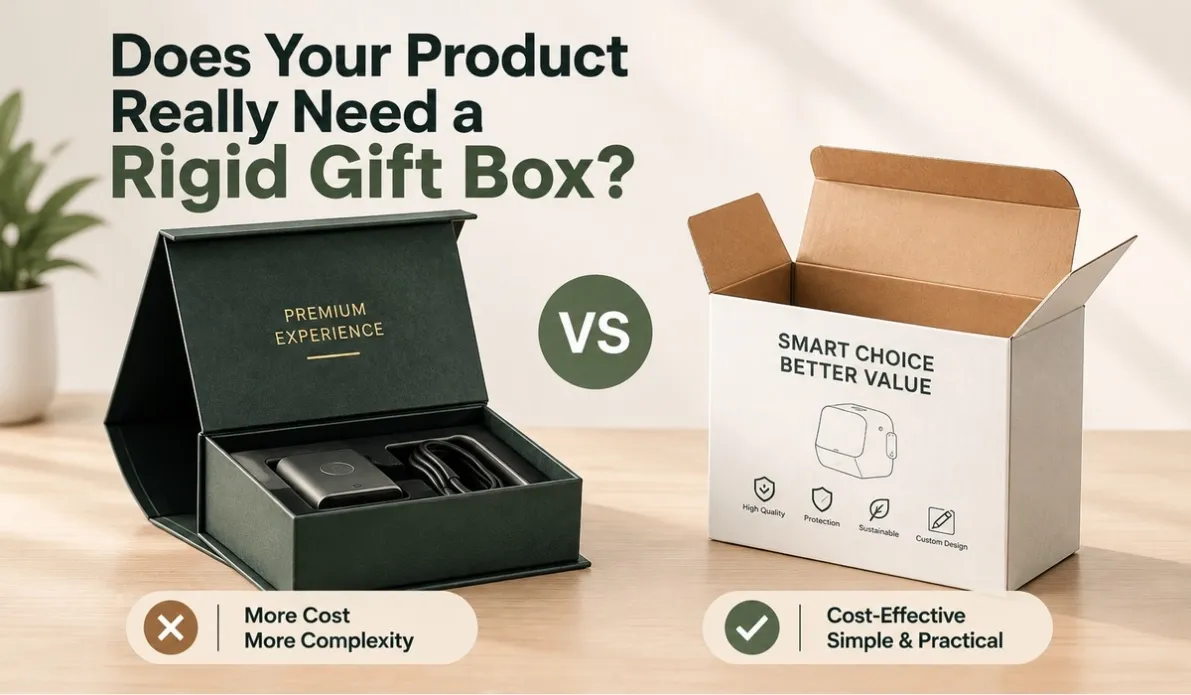
Premium packaging can make a product feel more valuable.
That is why many buyers start a new packaging project by sending their supplier a photo of a beautiful rigid gift box and asking:
“Can you make something like this?”
Usually, the answer is yes.
But there is another question worth asking first:
Does your product really need this type of box?
Rigid gift boxes can create an excellent premium presentation, but they also involve more materials, more production processes and usually a higher packaging cost.
When a rigid-box presentation is needed but storage and shipping volume matter, foldable rigid boxes can provide a collapsible alternative.
For many retail products, a well-designed folding carton or mailer box may already provide the appearance, protection and branding the product needs.
The goal should not be to choose the most complicated packaging.
It should be to choose the right packaging for the product.
Why Rigid Gift Boxes Usually Cost More
A rigid gift box is very different from a standard folding carton.
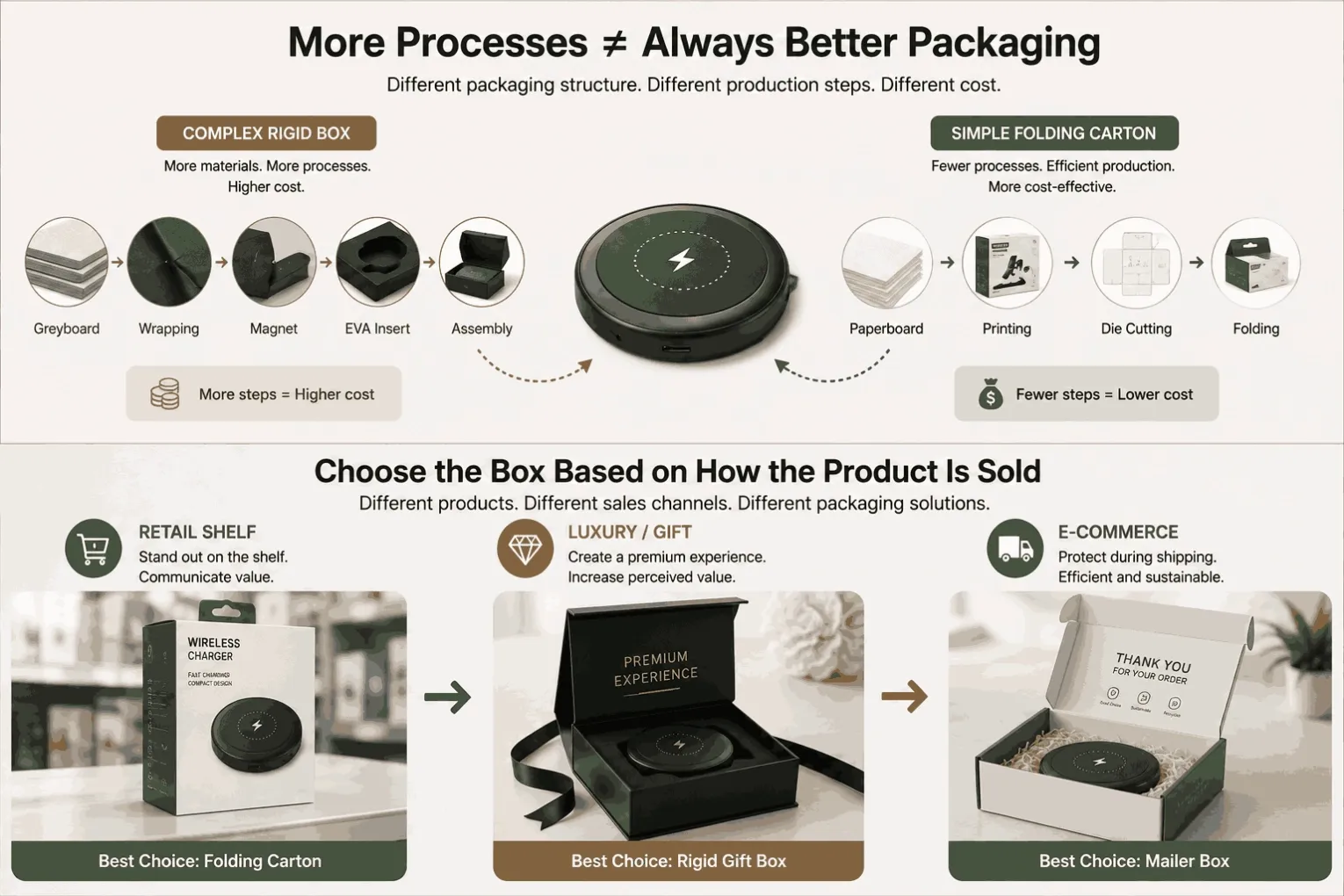
Depending on the structure, production may involve:
- Thick greyboard
- Printed or specialty wrapping paper
- Board cutting and grooving
- Paper wrapping
- Manual assembly
- Magnets
- Ribbons
- EVA or foam inserts
- Hot foil stamping
- Embossing or debossing
- Other decorative finishing
Each additional material or process adds another step to production.
For premium products, these details may be completely justified.
But for a relatively simple retail product, some of them may add cost without adding enough practical value.
The Question Isn't "Can We Make It?"
From a packaging manufacturer's perspective, many complicated structures are possible.
But buyers should consider more than manufacturing capability.
Before choosing a rigid gift box, ask:
- What is the retail value of the product?
- How important is the unboxing experience?
- Where will the product be sold?
- How much protection does the product actually need?
- What is the packaging budget?
- What is the initial order quantity?
- Will customers really notice the additional packaging cost?
These questions can lead to a very different packaging decision.
When a Rigid Gift Box Makes Sense
There are many situations where rigid packaging is worth the additional investment.
For example:
- Luxury products
- Premium jewelry
- High-end cosmetics
- Gift sets
- Limited editions
- Premium presentation kits
- High-value consumer products
- Products where the unboxing experience is part of the brand positioning
For these types of products, packaging may play a larger role in presentation and the customer experience, especially when unboxing and brand positioning are important.
A rigid box can help communicate:
quality, exclusivity and value.
In this situation, choosing a cheaper structure simply to reduce packaging cost may not be the right decision.
Many Products Can Use a Simpler Packaging Structure
Now consider a different group of products:
- Earbuds
- Chargers
- Cables
- Small electronics
- Skincare products
- Fashion accessories
- Small retail gifts
- Household products
- Everyday consumer goods
These products still need attractive packaging.
But they may not need a multi-piece rigid box with magnets, ribbons, specialty paper and a complicated insert.
A properly designed printed folding carton may already provide:
- Strong branding
- High-quality printing
- Product information
- Barcode and QR code space
- Attractive shelf presentation
- Product protection
- Custom inserts
- Premium finishing
And the structure is usually much simpler.
Simple Packaging Doesn't Have to Look Cheap
This is one of the biggest misconceptions in packaging.
Simple does not mean low quality.
A folding carton can still use:
- High-quality paperboard
- Accurate color printing
- Pantone colors
- Matte or gloss lamination
- Soft-touch finishing
- Hot foil stamping
- Embossing
- Debossing
- Spot UV
- Die-cut windows
- Custom inserts
Instead of spending the packaging budget on a complicated box structure, the budget can sometimes be used where customers actually notice it:
better material, better printing and better finishing.
A simple box with good execution can often look better than an expensive structure with poor printing or finishing.
Example: Packaging a Small Electronic Product
Imagine a brand is launching a small electronic accessory.
The first packaging concept is a premium rigid box with:
- Magnetic closure
- Wrapped greyboard
- EVA insert
- Foil stamped logo
It certainly looks premium.
But before approving it, the buyer should consider the product itself.
If the product is mainly sold on a retail shelf and the packaging needs to display:
- Product images
- Features
- Specifications
- Barcode
- QR code
- Regulatory information
a printed electronics folding carton may actually be more practical.
The structure can remain simple while the printing and internal insert provide the required presentation and protection.
The result may still look professional without using packaging that is more complicated than the product requires.
Folding Carton vs Rigid Gift Box
Here is a simple way to think about the decision:
Consideration | Folding Carton | Rigid Gift Box |
|---|---|---|
Structure | Simple | More complex |
Production processes | Fewer | More |
Manual work | Often lower | Usually higher |
Packaging cost | Generally lower | Generally higher |
Printing area | Excellent | Excellent |
Premium finishing | Available | Available |
Retail shelf use | Excellent | Suitable |
Luxury presentation | Good | Excellent |
Initial small orders | Often more practical | Can become expensive |
High-volume retail products | Excellent | Depends on positioning |
Neither structure is automatically better.
They simply solve different packaging problems.
What About Mailer Boxes?
There is another option that buyers sometimes overlook.
If the product is mainly sold through:
- E-commerce
- Shopify stores
- Subscription businesses
- Direct-to-consumer brands
- Online marketplaces
a corrugated mailer box may be worth considering.
Mailer boxes offer a different balance between presentation and structural protection.
They can be:
- Custom printed
- Branded inside and outside
- Made with different corrugated flute options
- Designed with inserts
- Shipped flat before packing
- Easy to assemble
For some products, a mailer box may provide a more practical solution than either a lightweight folding carton or an elaborate rigid gift box.
Choose Packaging Based on How the Product Is Sold
The sales channel should influence the packaging structure.
Retail Shelf
For products displayed in physical stores, folding cartons often make sense.
They provide excellent printing space for branding, specifications and retail information without requiring a complicated structure.
Premium Gift or Luxury Retail
For products where presentation is a major part of the buying experience, rigid gift boxes may justify the additional cost.
E-commerce and DTC
For products that need more structural protection during handling and delivery, mailer boxes may be worth considering.
This is why packaging should not be selected from appearance alone.
The box should fit the entire sales process.
Small Order Quantities Make This Decision Even More Important
Order quantity is another factor buyers should consider early.
Complex packaging usually involves more individual materials and production processes.
For example, a rigid box project may require separate production or setup for:
- Greyboard
- Wrapping paper
- Printing
- Foil stamping
- Magnets
- Inserts
- Assembly
When the quantity is relatively small, these setup costs are divided across fewer boxes.
That can make the unit price much higher than expected.
For a new product launch or a smaller initial order, simplifying the packaging structure may therefore be worth considering.
You can always upgrade the packaging later when sales volume increases.
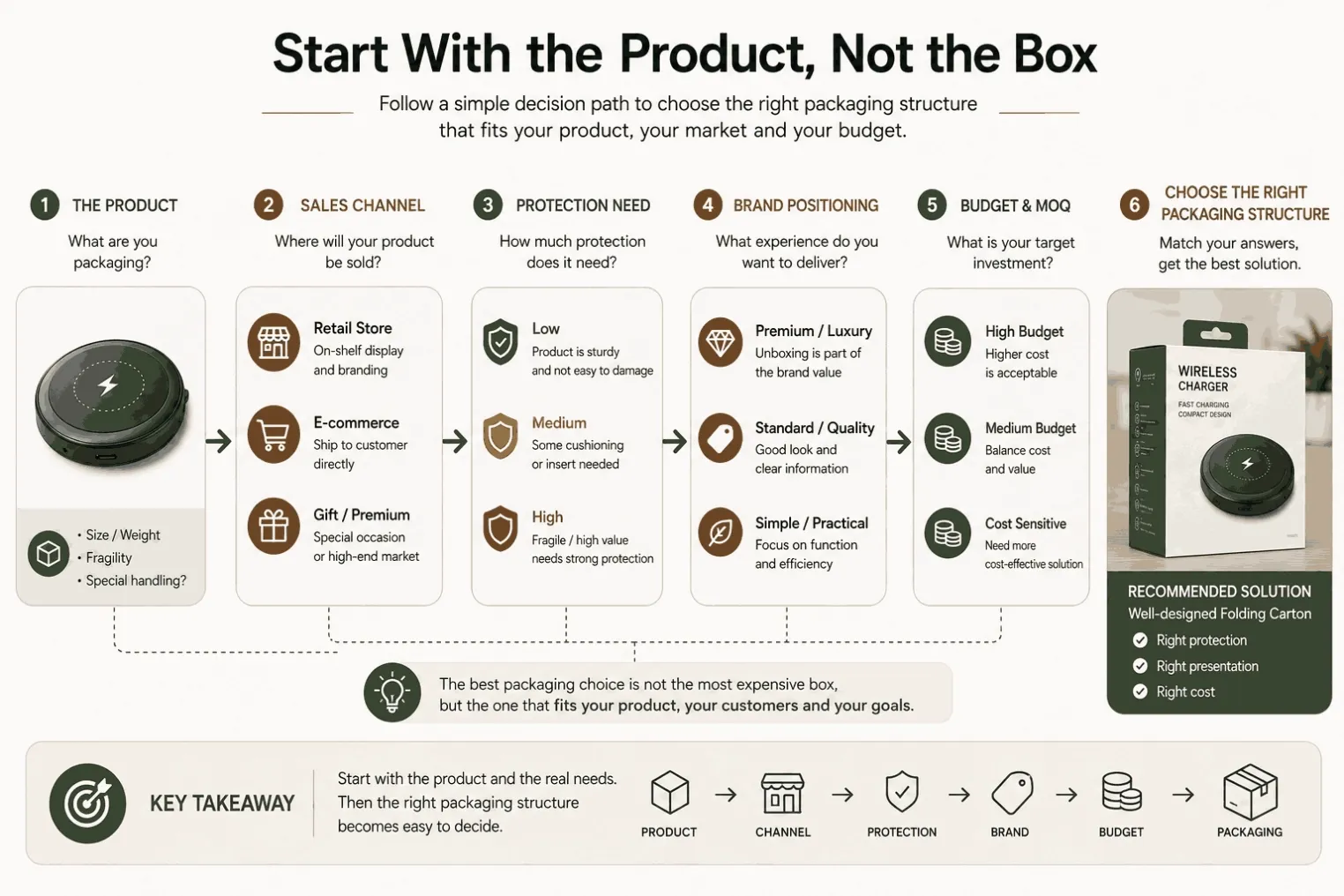
Start With the Product, Not the Box
One common mistake is choosing a packaging style first and then trying to make the product fit inside it.
A better process is:
Product → Sales Channel → Protection → Brand Positioning → Budget → Packaging Structure
For example:
Product A
Low-cost charging accessory
Sold in retail stores
Medium-to-high volume
Possible choice: Printed Folding Carton
Product B
Premium jewelry gift set
High retail price
Strong gifting experience
Possible choice: Rigid Gift Box
Product C
Fashion accessories
Sold mainly online
Needs additional protection during delivery
Possible choice: Corrugated Mailer Box
The right packaging becomes much easier to identify when you start with the product requirements.
Don't Pay for Packaging Your Product Doesn't Need
Premium packaging has value.
But more packaging is not always better packaging.
If a rigid gift box strengthens the product's positioning and customer experience, use it.
If a folding carton already provides the required branding, protection and presentation, keep the structure simple.
If the product needs additional protection for e-commerce delivery, consider a mailer box.
The objective isn't simply to reduce cost.
It is to spend the packaging budget where it creates the most value.
Simple packaging doesn't mean cheap packaging. It means choosing the right structure for the product.
Not Sure Which Box Structure to Choose?
If you already have a packaging reference, product photo or existing box, send it to us together with:
- Product dimensions
- Product weight
- Packaging quantity
- Sales channel
- Branding requirements
- Required printing or finishing
We can compare whether a folding carton, mailer box or rigid box is more suitable for the project.
Sometimes the original packaging idea is already the right solution.
Sometimes a simpler structure can achieve the same goal more efficiently.