
Buying Guides
Printed Paper Bags with Logo: A Buyer's Guide
How to specify printed paper bags with your logo — paper GSM, handle types, offset vs flexo, Pantone matching and the cost drivers most buyers miss.
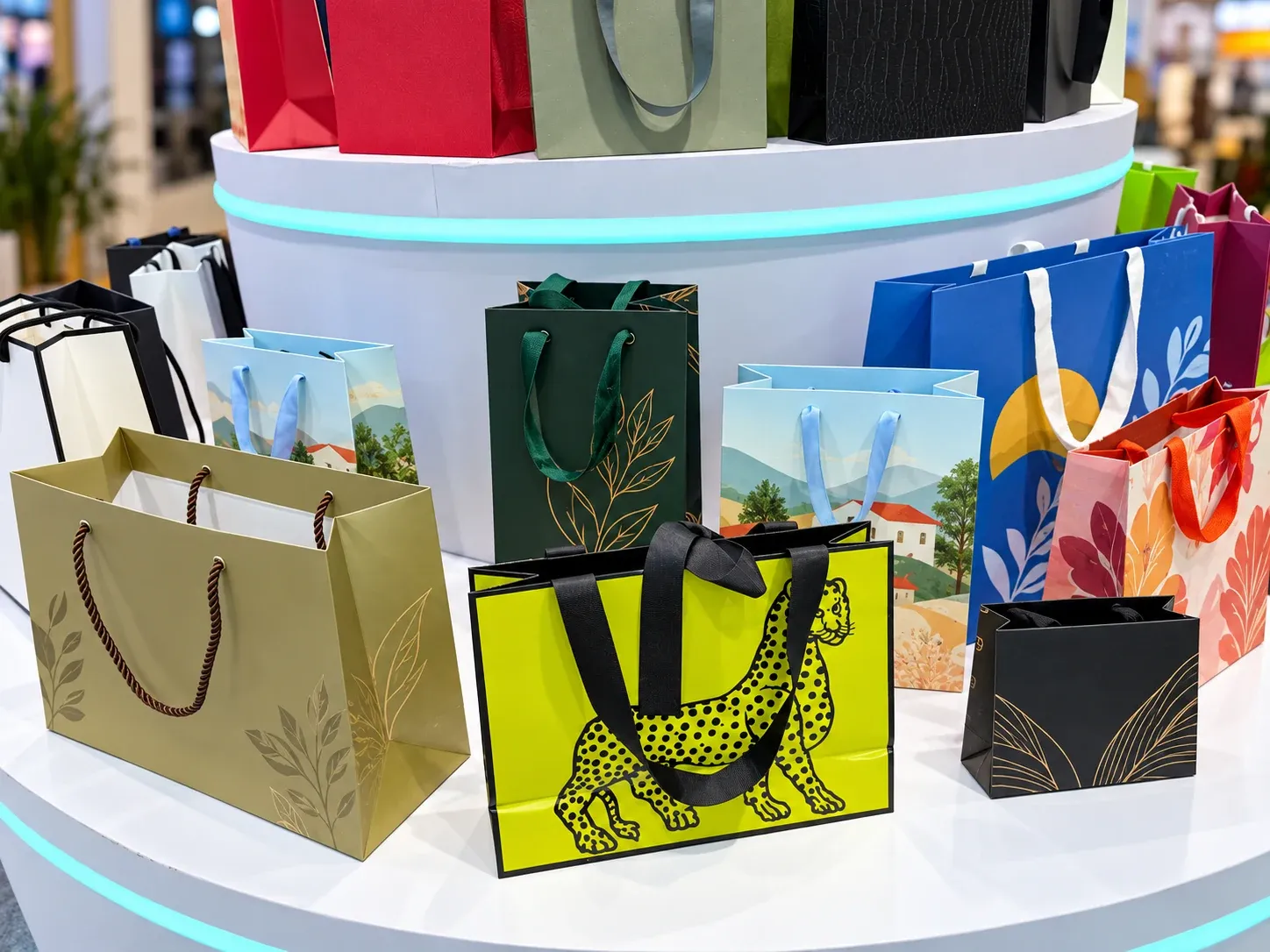
Ordering printed paper bags looks simple until the first shipment arrives: the colour is slightly off, the handles tear on heavy items, or the bag creases along the fold because the paper was too stiff.
Most of these problems are decided before production starts — in the specification. This guide covers the five decisions that determine whether a printed bag works: paper, handle, printing method, colour control, and finishing.
1. Paper GSM: The Decision Everyone Gets Wrong
Paper weight is usually quoted in GSM (grams per square metre). Common ranges for printed paper bags:
- 150–180 GSM: light retail bags, apparel, cosmetics
- 180–200 GSM: general retail, most branded shopping bags
- 200–250 GSM: heavier items, structured shapes, luxury positioning
The instinct is to go heavier for a premium feel. That is often wrong. Paper above roughly 220 GSM creases badly when the bag is folded for shipping, and the fold line becomes a visible weak point. A 180 GSM bag with good print and a reinforced top edge usually looks more expensive than a 250 GSM bag with a cracked fold.
Ask your supplier one question: what GSM do you recommend for this load and this fold? If the answer is a number without asking what goes in the bag, keep looking.
2. Handles: Where Bags Actually Fail
In the field, bags rarely fail at the print. They fail at the handle anchor.
Handle type | Load suitability | Notes |
|---|---|---|
Twisted paper | Light to medium | Comfortable, the default for retail |
Flat paper | Light | Cheapest, common on kraft bags |
Ribbon | Light, luxury positioning | Needs reinforced top edge |
Die-cut | Light | No added material, simplest look |
Two specification details matter more than the handle type:
- Top edge reinforcement — a turned top or a cardboard insert distributes load. Without it, the handle pulls through the paper.
- Anchor placement — handle holes must sit far enough from the edge and be aligned with the paper grain, otherwise the bag tears along the grain direction.
If the bag will carry bottles, books or multiple garments, say so at the quotation stage. Specifying "a paper bag, 250×100×300 mm" without the load is how failures get designed in.
3. Offset, Flexo or Digital: The Real Cost Trade-off
Method | Best fit | Where the cost sits |
|---|---|---|
Offset | Multi-colour artwork, fine type, brand-critical colour | High plate/setup cost, low unit cost at volume |
Flexo | 1–2 spot colours, bold graphics | Low setup, less fine detail |
Digital | Short runs, versioned artwork | No plates, high unit cost |
For 1,000–5,000 pcs with full-colour artwork, offset is almost always the right answer. For a 300-piece event run with four artwork versions, digital wins despite the higher unit price. The crossover point depends on your artwork complexity, not on a fixed volume.
One practical note: large solid ink areas on kraft paper show fibre texture and can look uneven. If your design is a full-bleed dark colour, a laminated art paper usually delivers the intended result better than printing directly on kraft.
4. Colour: Approve a Physical Target, Not a Screen
Pantone matching on paper is affected by three things: the base paper colour, the ink laydown, and the surface finish. A colour approved on a monitor will not match the printed bag, and a colour approved on white art paper will shift when the same ink goes onto brown kraft.
The workable process:
- Choose Pantone references (not CMYK builds) for brand colours
- Print a physical target — either a drawdown or the sample bag itself
- Approve under standard lighting, in daylight or a D50/D65 viewing condition
- Keep the approved target on file as the reference for repeat orders
If you reorder in six months, the approved physical target is what prevents a shade argument.
5. Finishing: Decide It Before Artwork, Not After
Foil stamping, embossing, spot UV and soft-touch lamination all change how the file must be prepared:
- Foil needs a separate 100% black artwork layer for the foil area
- Emboss/deboss needs its own layer, and the position must avoid fold lines
- Spot UV needs a mask layer, and it only reads against a matt background
- Lamination changes the colour slightly — approve the colour after laminating
Sending artwork without these layers is the most common cause of a two-week delay between sample approval and production.
What Actually Drives the Price
Buyers usually assume quantity is the main cost driver. In practice, five factors decide the unit price:
- Paper GSM and type — art paper costs more than kraft at the same weight
- Print method and number of colours — each additional plate adds setup
- Number of finishing processes — each one is a separate run through the machine
- Handle type and reinforcement — ribbon and reinforced top edges add material and labour
- Size — a larger bag uses more paper per unit than most buyers expect
The cheapest way to reduce cost is usually to reduce finishing processes, not to reduce paper weight. A lighter bag with cracked folds costs more in returns than it saves per unit.
Specification Checklist
Before requesting a quote, have these ready:
- Bag dimensions (W × D × H) and whether the bag must stand upright
- What goes inside, and the expected maximum load
- Paper preference: brown kraft, white kraft, laminated art paper
- Print colours: Pantone references or artwork with colour breakdown
- Finishing: foil, emboss, spot UV, lamination
- Artwork status: ready file, or needs adaptation
- Quantity and whether repeat orders are expected
- Target market (EU buyers may need FSC documentation and packaging compliance support)
How We Produce Printed Paper Bags
At Jeeli Packaging, printed paper bags are produced on brown kraft, white kraft or laminated art paper, with offset or flexo printing, twisted paper, flat paper or ribbon handles, and finishing options including foil stamping, embossing, spot UV and matt or gloss lamination.
Working parameters:
- MOQ: 1,000 pcs per design
- Sampling: 7–10 days after artwork approval
- Bulk production: 15–25 days after sample confirmation
- Sampling fee: USD 150–300 per design, deducted from the bulk order payment after order confirmation
- Payment / terms: T/T 50% deposit, 50% balance before shipment · FOB Shenzhen · USD quotation
Send the specification checklist above and we will confirm paper, handle and finishing before sampling — rather than discovering the problem in the first shipment.