
Sep 24, 2026Blog
Why Brands Change Packaging Suppliers: 5 Real Buyer Insights
Why do brands change packaging suppliers? Explore five common reasons beyond price, from slow response and inconsistent quality to communication and hidden costs.

When buyers start looking for a new packaging supplier, price is often assumed to be the main reason.
But price is only part of the decision.
In one conversation, we asked a buyer a simple question:
“Why don't you buy from them again — cost or service?”
The answer was short:
“Cost and slow service.”
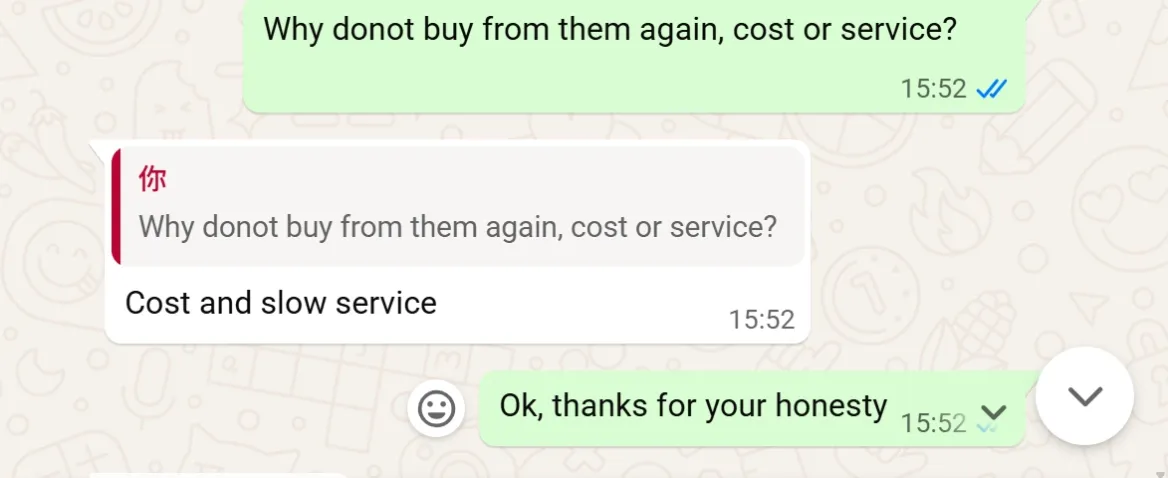
That response highlights an important point. A competitive quotation may help win the first order, but the overall working experience often influences whether the buyer wants to place the next one.
Here are five common reasons brands may reconsider a packaging supplier.
1. Slow Response Creates Uncertainty
One of the most frustrating parts of a packaging project can simply be waiting.
Waiting for a quotation.
Waiting for artwork confirmation.
Waiting for a production update.
Waiting for a shipping update.
Waiting for someone to answer a question that is holding up the project.
Packaging production often follows a schedule involving artwork approval, sampling, production and delivery. When communication slows down, the buyer may have difficulty knowing whether the project is still on track.
For procurement teams, responsiveness is therefore not only about receiving fast replies. It is also about having enough information to plan the next step.
2. Good Service Is More Than Answering Emails
Good supplier communication is not simply replying quickly.
It also means identifying important questions before production begins.
For example:
- Is the selected paper suitable for the product?
- Does the structure match the expected product weight?
- Are the artwork and finishing requirements clearly defined?
- Does the packaging need additional protection during shipping?
- Is there a simpler structure that could achieve the same purpose?
A useful packaging supplier should help clarify these points before they become production problems.
This is one reason we recommend confirming the important specifications before moving into bulk production. Our guide on custom packaging production explains some of the details that should be reviewed during this process.
3. Inconsistent Quality Makes Repeat Orders Difficult
A good first order does not automatically guarantee that every repeat order will look exactly the same.
Paper, printing, finishing and production processes can all involve normal manufacturing variation.
However, buyers still need important specifications to remain within an agreed and acceptable range.
For example:
- Paper specification
- Printing color
- Foil position
- Embossing or debossing
- Die-cutting
- Finished dimensions
- Handle or attachment details
This becomes especially important when packaging is used repeatedly across the same brand or product line.
The goal is not to promise that every piece will be microscopically identical. It is to establish clear specifications and production references so repeat orders can be evaluated against the same agreed standard.
4. Hidden Problems Can Cost More Than a Lower Unit Price
The lowest quotation does not always result in the lowest overall project cost.
Problems that appear later may create additional costs through:
- Production delays
- Rework or reprints
- Unexpected specification changes
- Shipping problems
- Additional communication
- Packaging that does not fit the product correctly
This is why quotations should be compared based on the same specification, rather than unit price alone.
Paper type, GSM, box structure, printing, finishing, inserts, quantity and packing method can all affect the final quotation.
A lower price based on a different specification is not necessarily a like-for-like comparison.
5. Buyers Need a Supplier Who Can Support the Project
For custom packaging, the supplier's role usually involves more than manufacturing what appears on the artwork.
Before production, buyers may need help confirming:
- Material
- Structure
- Dimensions
- Printing
- Finishing
- Inserts
- Packing method
- Sample requirements
- Production details
The level of support required will vary by project.
A straightforward repeat order may require very little discussion. A new structure or new material may require much more communication before production begins.
What matters is whether the supplier can identify the important questions and communicate them clearly.
What Should You Check When Choosing a Packaging Supplier?
If you're evaluating a new supplier, price is important — but it should not be the only question.
It is also useful to ask:
- How quickly do they normally respond?
- What information do they need before quoting?
- How are materials and specifications confirmed?
- What type of sample is appropriate before production?
- How are printing and finishing requirements checked?
- How will production or shipping updates be communicated?
- What happens if a problem is found before bulk production?
The answers can tell you a great deal about how the supplier approaches a project.
Price Matters — But So Does the Working Process
Brands rarely change suppliers because of one small issue alone.
More often, the decision develops after repeated problems with communication, consistency, project support, cost or delivery.
That is why supplier evaluation should consider both the quotation and the process behind it.
A competitive price may help start a business relationship.
Clear specifications, reliable communication and consistent production are what help make repeat orders easier.
If you're reviewing suppliers for an upcoming paper packaging project, you can contact Jeeli Packaging to discuss the specifications and quotation.