
Sep 23, 2026Blog
Your Gift Box May Be Cheap to Produce — But Expensive to Ship
Learn how gift box structure can affect freight, storage, assembly and total packaging cost — not just the unit price on your supplier’s quote.
When comparing custom gift box quotations, the unit price is usually the first number buyers look at.
But it is not always the number that has the biggest impact on the final cost.
A rigid box that costs slightly less to manufacture may occupy considerably more shipping and warehouse space. A foldable structure may have a different unit cost but reduce packed volume. Another design may require more assembly after delivery.
That is why gift box cost should be evaluated beyond the supplier's price per piece.
The Unit Price Is Only One Part of the Cost
Imagine you receive two quotations for the same packaging project.
Box A has the lower unit price.
Box B costs slightly more.
At first glance, Box A looks like the obvious choice.
But before deciding, compare what happens after production:
- How are the boxes packed?
- Are they shipped assembled or flat?
- How many fit into one export carton?
- What is the carton volume?
- How much warehouse space will they require?
- Does the box require assembly before use?
- How will the finished packaging be handled at your warehouse or retail location?
A small difference in unit price can become less important once freight, storage and handling are included.
Why Rigid Box Structure Can Change Shipping Volume
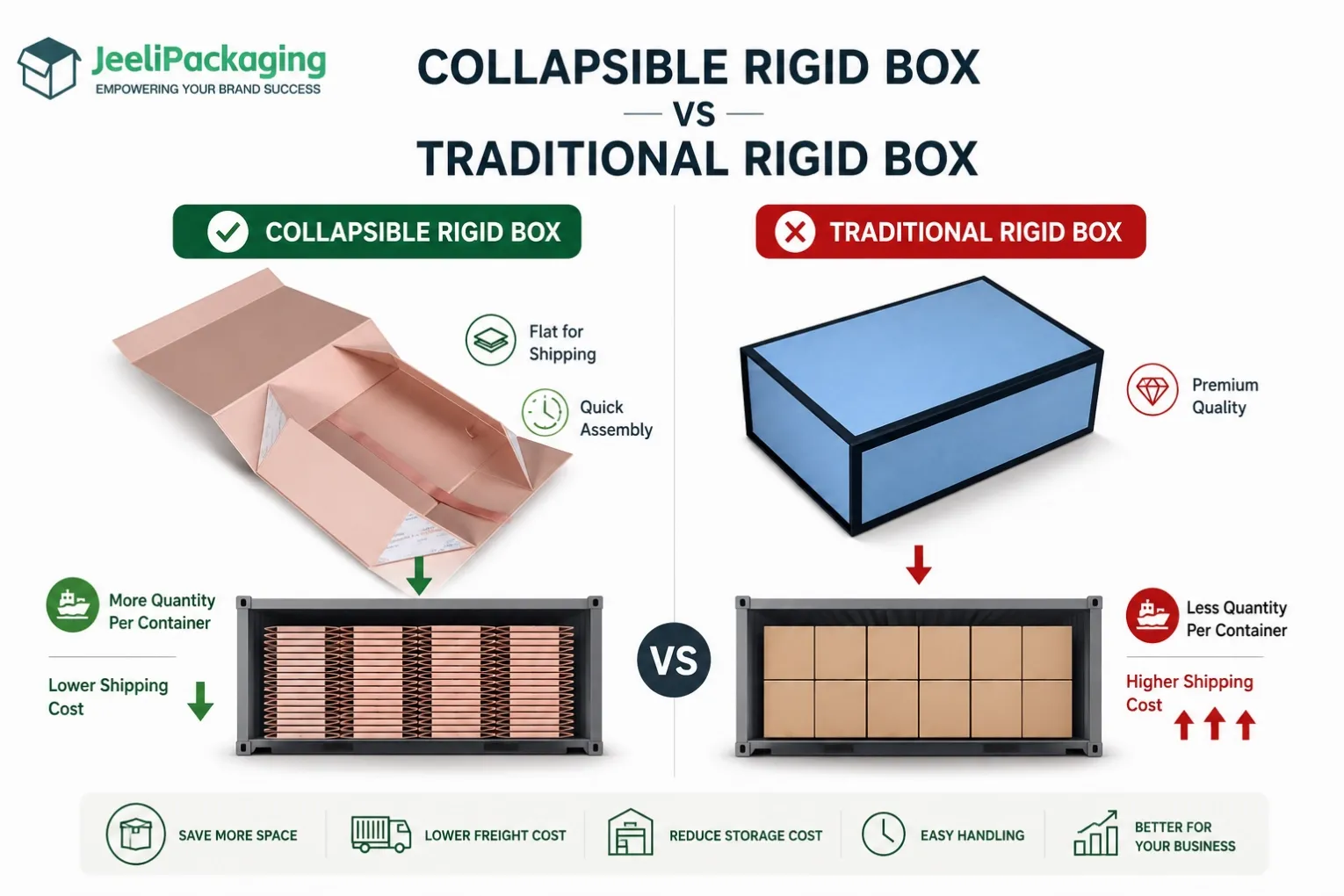
Traditional rigid boxes are normally supplied in their finished three-dimensional form.
This provides the familiar rigid presentation, but it also means that much of the shipping volume inside each box is empty space.
For some projects, that is acceptable.
For others — particularly larger boxes or higher quantities — shipping and storage volume becomes an important part of the sourcing decision.
A foldable rigid box is one alternative worth evaluating.
It can be supplied flat and assembled later, which may reduce packed volume compared with an equivalent pre-assembled structure.
However, it is not automatically the better option.
The decision should also consider:
- Required presentation
- Box size
- Assembly method
- Magnetic closure, if used
- Product weight
- Insert requirements
- Order quantity
- Shipping method
- Available warehouse space
The right structure depends on the complete project rather than freight cost alone.
Four Costs to Check Beyond the Box Price
1. Freight
Packaging volume can directly affect transportation cost.
This becomes particularly relevant when boxes are large relative to the product inside them.
Ask your supplier for the proposed packing method and export-carton information before comparing logistics costs.
Useful information can include:
- Pieces per carton
- Carton dimensions
- Gross weight
- Total number of cartons
- Estimated total volume
With this information, you can compare two packaging structures more accurately instead of comparing unit price alone.
2. Warehouse Space
Packaging does not disappear when it arrives.
If thousands of assembled boxes need to be stored before use, they can occupy significant warehouse space.
For businesses with limited storage, a flat-packed structure may therefore be worth considering.
But the saving should be evaluated against the additional assembly required after delivery.
3. Assembly and Handling
A flat-packed box may reduce shipping volume, but someone still has to assemble it.
Ask:
- How many steps are required?
- Is adhesive needed?
- How long does assembly take?
- Can the box be assembled consistently?
- Does your packing team have enough capacity?
A packaging design that saves freight but creates an inefficient packing process may simply move the cost from one part of the supply chain to another.
4. Inserts and Internal Components
The outer box is not the only part that affects packed volume and cost.
Depending on the product, the packaging may also include:
- Paperboard inserts
- Corrugated inserts
- EVA
- Foam
- Tissue paper
- Dividers
- Product supports
The insert should protect and present the product without adding unnecessary material or volume.
Before finalizing the box, review the outer structure and internal packaging together.
Traditional Rigid Box or Foldable Rigid Box?
There is no universal winner.
A traditional rigid box may be appropriate when presentation, immediate usability and a fully assembled structure are priorities.
A foldable rigid box may be worth considering when shipping and storage volume are important concerns.
The better comparison is:
Factor | Traditional Rigid Box | Foldable Rigid Box |
|---|---|---|
Delivery format | Usually assembled | Usually flat |
Assembly after delivery | Little or none | Required |
Shipping volume | Generally higher | Can be lower |
Storage requirement | More space | Can require less space |
Presentation | Classic rigid structure | Depends on construction |
Best evaluated by | Product + presentation requirements | Product + logistics + assembly requirements |
The exact result depends on the finished dimensions, construction and packing method.
This is why actual carton dimensions and packing quantities are more useful than assuming a fixed percentage of freight savings.
Don’t Ignore the Cost of Over-Specifying the Box
Hidden cost does not only come from logistics.
It can also come from specifying more packaging than the product actually needs.
For example, a project may include:
- Extra-thick board
- Multiple specialty finishes
- Complex inserts
- Oversized dimensions
- Several decorative components
Each feature may look attractive individually, but together they can increase production, packing and shipping costs.
Before adding a feature, ask:
Does this improve protection, usability or the intended brand presentation?
If not, it may be adding cost without adding meaningful value.
The Same Principle Applies to Gift Bags
Gift boxes are often sourced together with matching paper bags.
The same total-cost thinking applies.
A bag should be sized around the finished box rather than simply made larger “to be safe.”
Oversized bags can use more paper, occupy more packing space and feel poorly matched to the box.
If your project also requires premium retail bags, our luxury paper gift bags can be customized around the size and presentation of the packaged product.
What to Ask Your Supplier Before Finalizing the Structure
Instead of asking only:
“What is the unit price?”
also ask:
“How will this box be packed and shipped?”
Before approving the final structure, request or confirm:
- Finished box dimensions
- Box structure
- Delivery format: assembled or flat
- Pieces per export carton
- Export-carton dimensions
- Approximate gross weight
- Insert construction
- Assembly requirements
- Packing method
These details make it much easier to evaluate the real difference between two quotations.
Compare Total Packaging Cost, Not Just the Quote
A good packaging decision balances several factors:
- Product protection
- Brand presentation
- Production cost
- Freight
- Storage
- Assembly
- Packing efficiency
Sometimes the lowest unit price will still be the best choice.
Sometimes a different structure can make more sense once logistics and handling are considered.
The important point is to compare the complete packaging specification, not one number on the quotation.
Planning a Custom Gift Box Project?
If you are comparing traditional and foldable rigid box structures, send us:
- Box dimensions
- Product dimensions and weight
- Quantity
- Preferred structure
- Artwork
- Finishing requirements
- Insert requirements
- Delivery destination
We can review the structure and packing requirements before sampling so you can compare the production and logistics implications more clearly.
For projects where structure and shipping efficiency are especially important, our custom packaging manufacturing service explains how material, structure, printing and production requirements are reviewed before bulk production.