
Oct 12, 2026Buying Guides
Clear Window or No Window? What Should Buyers Consider Before Choosing a Window Folding Carton?
Should your folding carton have a clear window? Learn when a window helps, PET vs open windows, window size, product visibility, strength and cost.
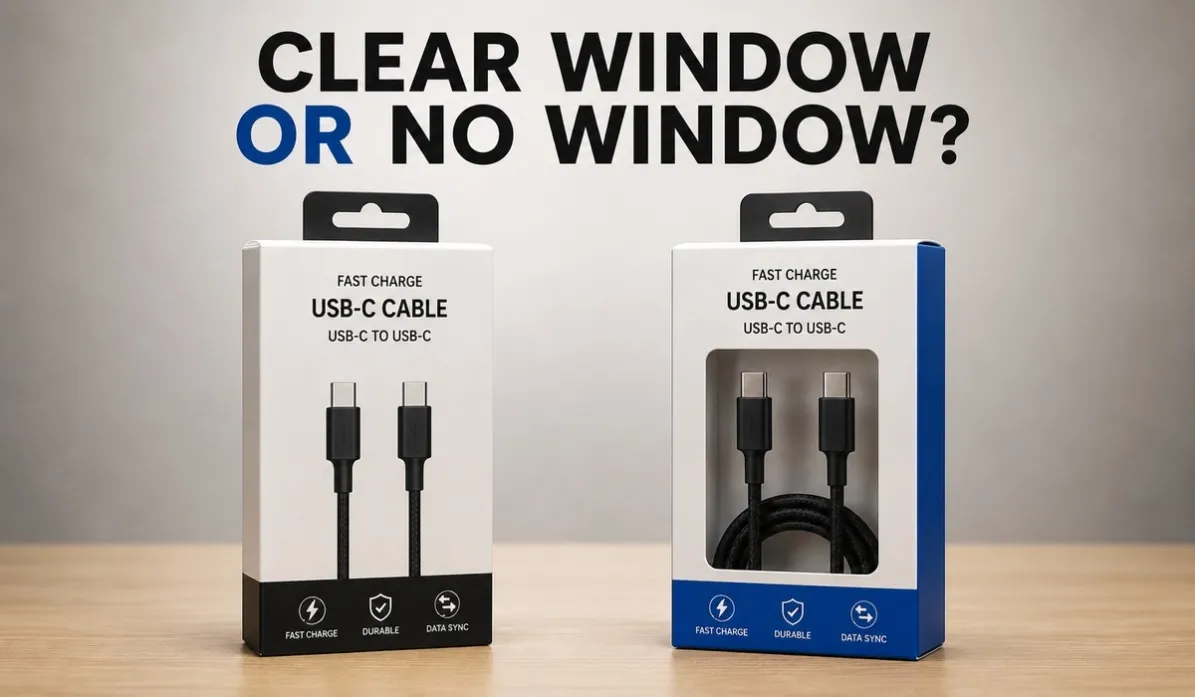
A clear window can make packaging more attractive.
Customers can see the actual product before opening the box, and retailers can display the product more clearly.
But does every product need a window?
Not necessarily.
For some products, a clear window improves product visibility and helps customers understand exactly what they are buying.
For others, it may add cost and complexity without providing much additional value.
Does seeing the actual product help the customer make a buying decision?
If the answer is yes, a window may be worth considering.
But that is only the beginning.
Window size, position, material, product protection and box structure also matter.
1. When Does a Clear Window Add Real Value?
A window is most useful when the appearance of the actual product matters.
For example:
- Phone accessories
- Charging cables
- Earphones
- Small electronic accessories
- Beauty products
- Toys
- Hardware accessories
- Small retail products
Imagine two packages for a charging cable.
One is completely closed.
The customer can only see a printed picture of the cable.
The other has a clear window.
The customer can immediately see:
- The actual cable
- Product color
- Connector style
- Approximate size
- Product presentation
In this situation, the window is doing more than making the box look different.
It is providing useful product information.
2. When Might You Not Need a Window?
This is equally important.
Sometimes buyers start a packaging project by saying:
"We want a large clear window."
But when we look at the actual product, the window may not add much value.
For example, if the product:
- Has very little visual difference
- Is already clearly explained by photography
- Needs more protection from dust
- Requires a large amount of printed information
- Is sold mainly online rather than on a retail shelf
then a fully printed folding carton may be enough.
Removing the window can also simplify the packaging structure.
So don't add a window simply because another brand uses one.
Ask:
What information does the customer gain by seeing the actual product?
If the answer is "very little," the window may not be necessary.
3. Open Window or Clear PET Window?
This is one of the most important decisions when developing window packaging.
There are generally two basic approaches.
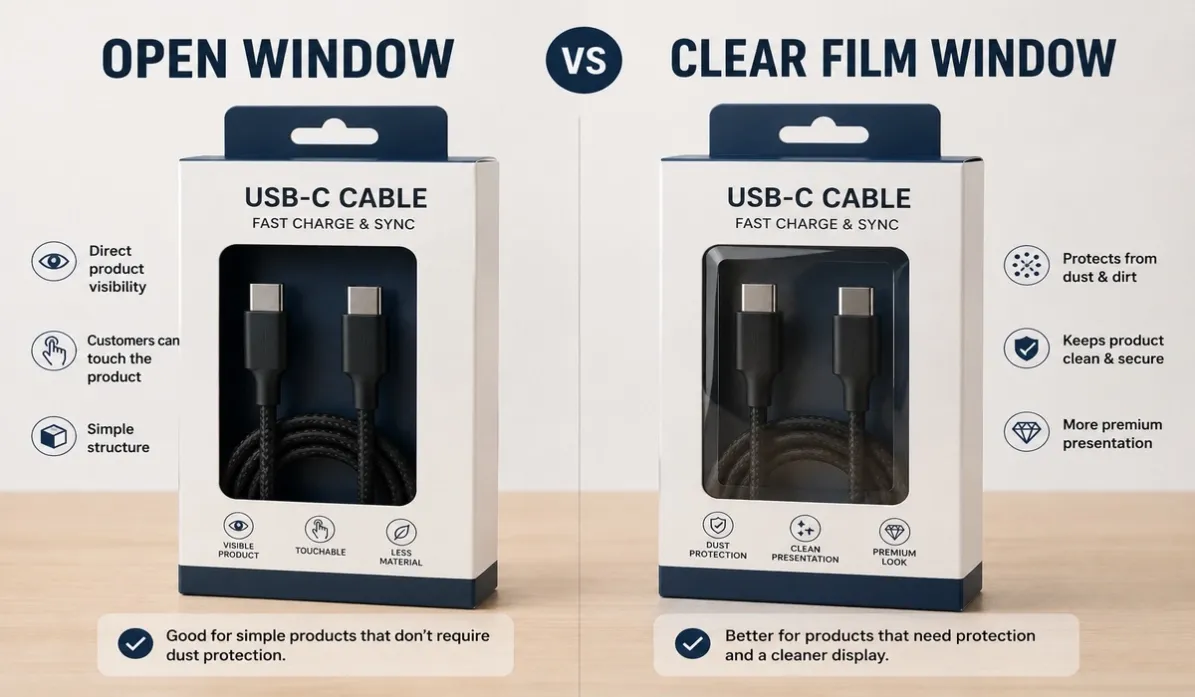
Open Die-Cut Window
The paperboard is die-cut to create an opening, but no transparent film covers it.
The customer can directly see and sometimes touch the product.
Clear Film Window
A transparent film is attached behind the die-cut opening.
The customer can still see the product, but the product remains separated from the outside environment.
Here is a simple comparison:
Feature | Open Window | Clear Film Window |
|---|---|---|
Product Visibility | Good | Good |
Dust Protection | Lower | Better |
Product Contact | Possible | Reduced |
Structure | Simpler | Additional window patching |
Material Use | Less | Additional transparent film |
Typical Use | Simple retail products | Products requiring cleaner presentation |
Neither option is automatically better.
The correct choice depends on the actual product.
4. Don't Make the Window Bigger Just Because You Can
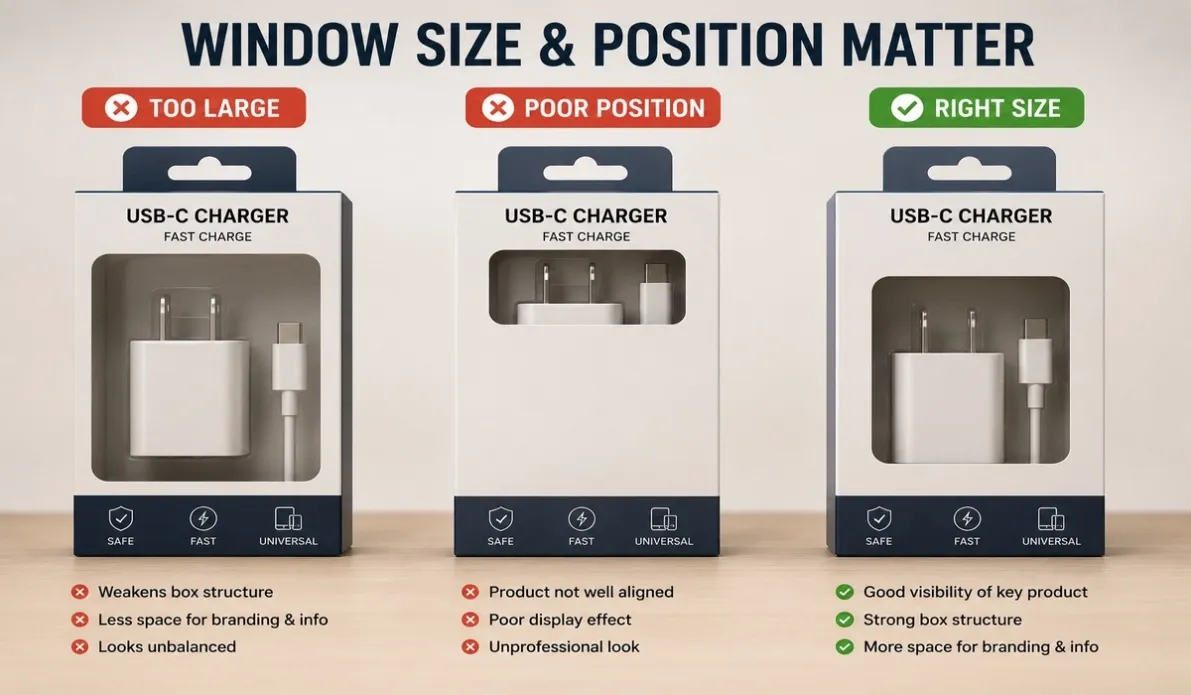
A large window can look impressive.
But bigger is not always better.
The paperboard around the window is still part of the box structure.
If too much material is removed, the front panel may become less rigid.
This is especially important when:
- The carton is relatively large
- The product is heavy
- The window is close to a fold or corner
- Very little paperboard remains around the opening
A good window should provide enough product visibility while leaving enough paperboard to maintain a practical carton structure.
Think of it this way:
Product Visibility + Box Strength
need to work together.
5. Window Position Matters Too
Another common mistake is deciding the window position only from the artwork.
On a computer screen, a centered window may look perfect.
But what happens when the real product is placed inside?
The product may sit:
- Too low
- Too high
- Too far to one side
- Behind part of the printed panel
This is especially common when an internal insert is used.
The window position should therefore be considered together with:
Product Position + Insert + Carton Structure
not as a separate graphic element.
6. Consider the Insert Before Finalizing the Window
Imagine you are packaging a pair of earphones.
You want customers to see them through the front window.
But the product also needs an insert to keep it in position.
Now the insert becomes part of the display.
If the insert is poorly designed, the earphones may:
- Move away from the window
- Sit at an incorrect angle
- Look untidy
- Become partially hidden
This means the window and insert should be developed together.
A clear window only works well if the product stays in the correct position behind it.
For many small electronic accessories, this is more important than simply making the window larger.
7. Think About What the Customer Should See
This sounds simple, but it can make a big difference.
You don't always need to show the entire product.
Sometimes the customer only needs to see:
- Product color
- Material
- Connector
- Surface finish
- Shape
- One important feature
For example, a cable package may only need to clearly show the connector and part of the cable.
A smaller, well-positioned window may therefore work better than a very large window.
Before designing the window, ask:
What part of the product actually helps the customer make a decision?
Then design the window around that.
8. Don't Forget the Printed Information
A folding carton also needs space for information.
Depending on the product, this may include:
- Brand logo
- Product name
- Features
- Specifications
- Instructions
- Barcode
- QR code
- Compliance information
- Recycling information
A very large window reduces the available printing area.
This can become a problem for electronic accessories because some products require relatively detailed technical information.
So the front panel needs a balance between:
Product Display + Branding + Required Information
9. What About Hanging Retail Packaging?
Many small electronic accessories are displayed on retail hooks.
In this case, the carton may also require:
- Euro slot
- Hanging tab
- Reinforced hanging area
Now the packaging has several jobs at the same time:
Hold the product
-
Display the product
-
Hang securely
-
Communicate product information
This is why a window folding carton should not be designed around the window alone.
The complete packaging structure needs to work together.
10. Does a Window Increase Packaging Cost?
Usually, adding a window introduces additional production steps compared with a standard printed carton.
Depending on the design, these may include:
- Window die-cutting
- Transparent film
- Window patching
- Additional material handling
But the actual cost difference depends on:
- Box size
- Window size
- Window material
- Quantity
- Carton structure
- Production method
This is why it is difficult to say:
"A window box costs X% more."
without reviewing the actual packaging specification.
If budget is important, ask your supplier whether a simpler open window or smaller window could achieve the same display purpose.
11. Clear Window Packaging Isn't Always About Looking Premium
Another misconception is that adding a window automatically makes packaging look more premium.
It doesn't.
A poorly positioned window can actually make packaging look less professional.
The final appearance depends on:
- Window shape
- Window position
- Product positioning
- Insert design
- Printing
- Material
- Overall graphic design
Sometimes a simple rectangular window works better than a complicated custom shape.
The window should support the product presentation rather than compete with it.
12. A Simple Buyer Checklist
Before requesting custom Window Folding Cartons, consider these questions:
Question | Why It Matters |
|---|---|
Does the customer need to see the product? | Determines whether a window adds value |
What part of the product should be visible? | Helps determine window size |
Open window or clear film? | Affects protection and structure |
Where will the product sit? | Determines window position |
Does the product need an insert? | Keeps the product aligned |
How heavy is the product? | Affects carton strength |
Will the box hang on a retail hook? | May require a Euro slot or hanging tab |
How much information needs printing? | Determines available print area |
What quantity is required? | Affects production and cost |
You don't need to know every technical answer before contacting a packaging supplier.
Providing the actual product information is usually more useful.
What Should You Send Your Packaging Supplier?
For a more accurate recommendation, provide:
- Product photos
- Product dimensions
- Product weight
- Required quantity
- Existing packaging, if available
- Artwork or logo
- Preferred window position
- Retail display requirements
- Insert requirements
If you already have a packaging reference, send that too.
A physical product sample can also be useful when the position of the product behind the window needs to be confirmed accurately.
Final Thoughts
A clear window can be a very useful packaging feature.
But the decision shouldn't simply be:
Window looks better, so let's add one.
A better question is:
What does the window help the customer understand about the product?
If product visibility supports the buying decision, a Window Folding Carton can be an effective packaging solution.
Then the next decisions are:
Open or clear film?
How large should the window be?
Where should it be positioned?
How will the product stay in place?
Will enough paperboard remain for strength and printing?
Good window packaging is not about creating the biggest possible opening.
It is about showing the right part of the product, while keeping the carton practical, protective and easy to understand.
Looking for Custom Window Folding Cartons?
Jeeli Packaging provides custom Window Folding Cartons for electronic accessories, consumer products and retail packaging.
We can customize:
- Box dimensions
- Paperboard
- Window size and shape
- Clear window film
- Printing
- Hanging structures
- Inserts
- Surface finishing
If you're not sure which window structure is suitable, send us your product photo, dimensions, weight and packaging requirements.
View Our Window Folding Cartons
Request a Custom Packaging Quote