
Sep 24, 2026Blog
250gsm vs 300gsm Paper Shopping Bags: Is Thicker Paper Always Better?
250gsm or 300gsm for paper shopping bags? Learn how product weight, handle fixing, paper quality, creasing and production affect the right choice.
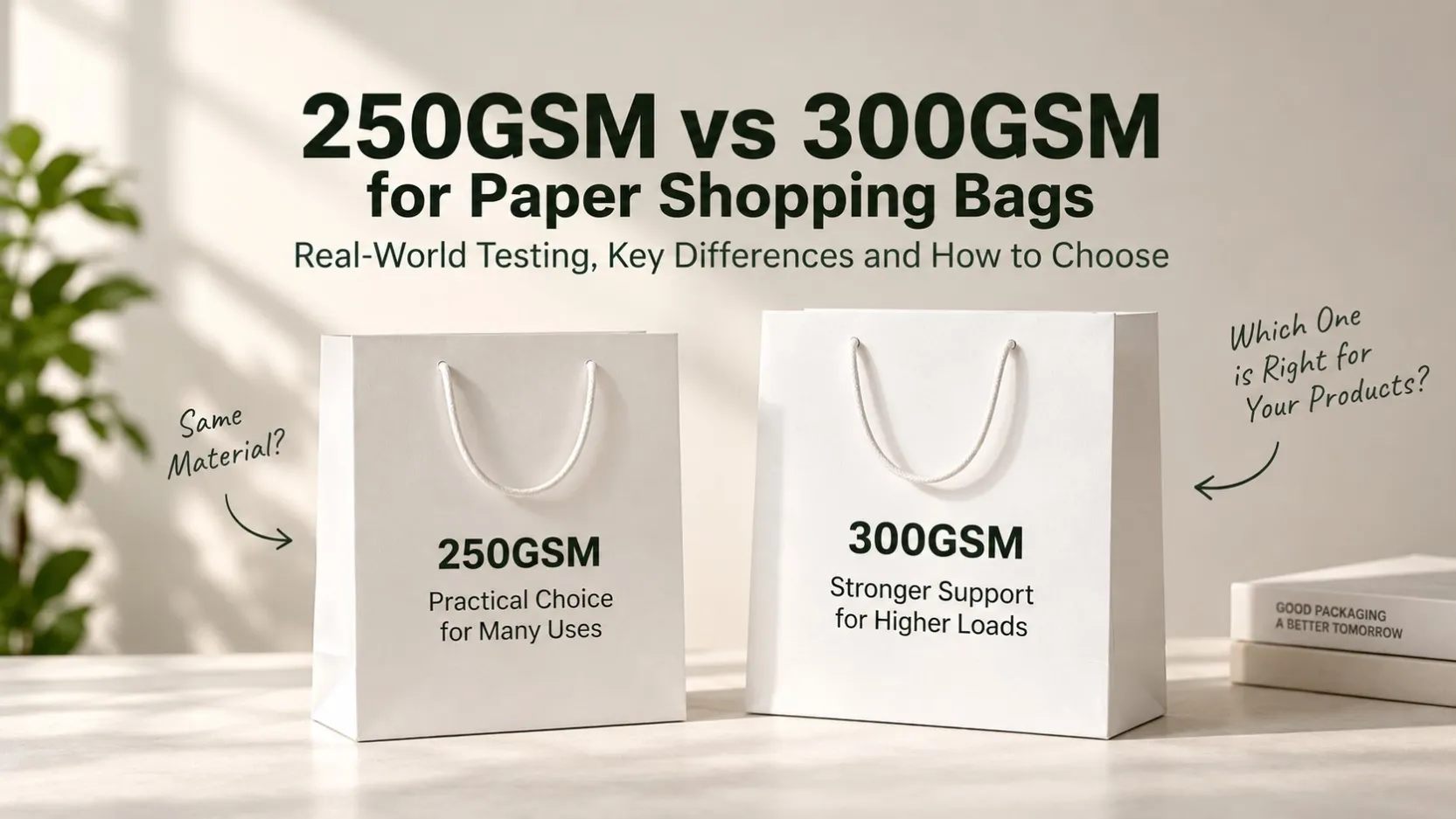
When buyers order premium paper shopping bags, thicker paper can sound like the safer choice.
If 250gsm is good, then 300gsm should be stronger and better — right?
Not necessarily.
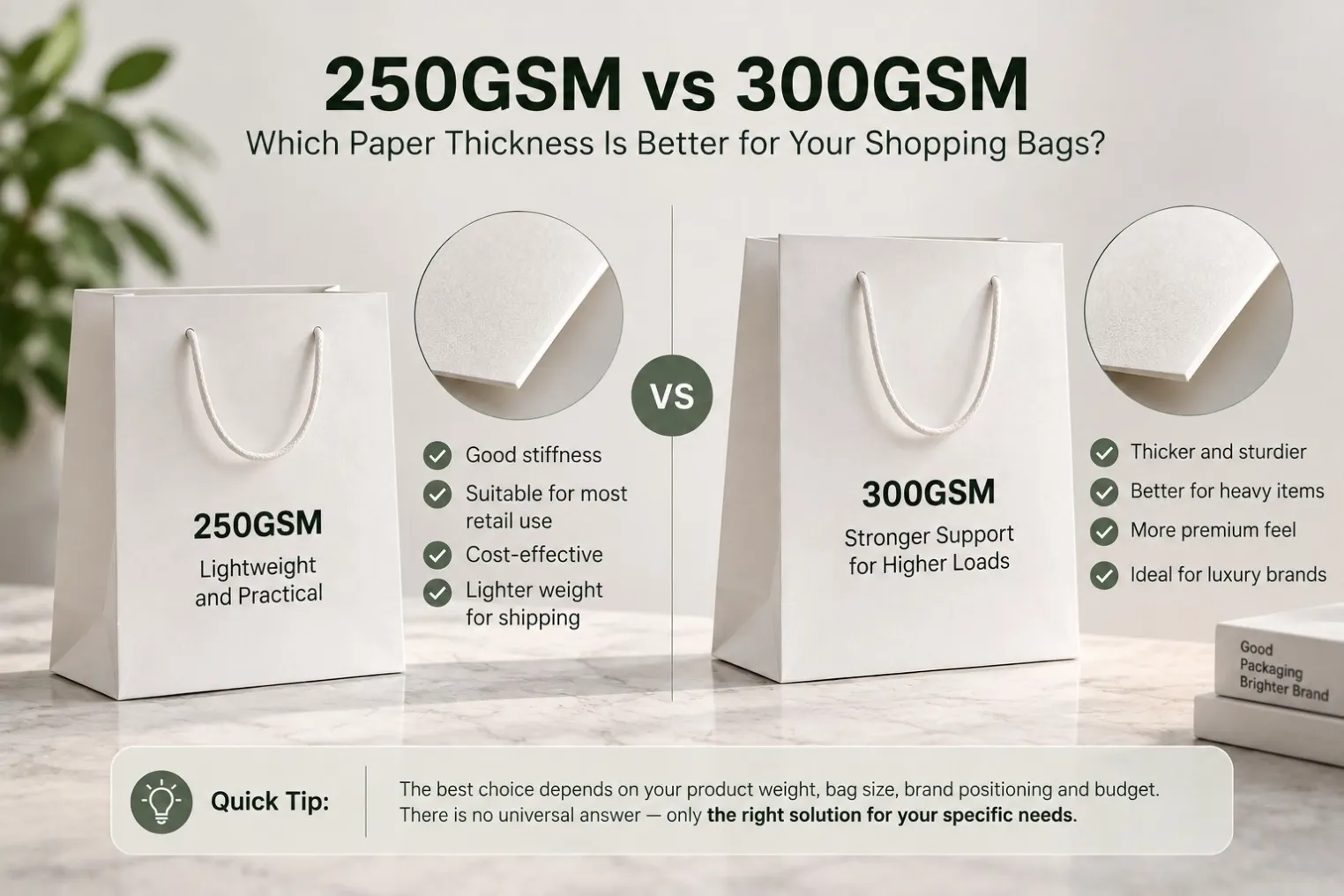
For many regular paper shopping bags, 250gsm white card can already be a practical choice. Moving to 300gsm makes the bag thicker and stiffer, but it can also affect creasing, folding, production efficiency and cost.
On the other hand, when the bag needs to carry heavier products, 300gsm may be the more appropriate option.
A recent project for the Japanese market showed why paper GSM should not be considered alone.
The existing bag used approximately 300gsm paper, but the buyer had two problems:
- the handle could come off when carrying weight
- tearing or damage appeared around the folded area
The buyer wanted to maintain the overall specification and appearance, but improve the reliability of the bag.
The solution was not simply to choose thicker paper.
We first needed to look at how the whole bag worked.
1. Is 250gsm Enough for a Paper Shopping Bag?
For many regular retail and gift paper bags, 250gsm white card can already provide a good balance between appearance, stiffness and production.
It is thick enough for many common applications while still being relatively practical for creasing, folding and bag making.
It does not tell you everything about the finished bag.
Two papers with the same GSM may behave differently depending on factors such as paper quality, stiffness, fibre characteristics and surface treatment.
So the better question is not simply:
“Is 250gsm strong enough?”
It is:
“What does this bag need to carry, and how will it be used?”
2. When Does 300gsm Make More Sense?
When the products inside the bag are relatively heavy, moving to 300gsm may provide the additional stiffness and support required for the project.
This can be relevant for products such as heavier gift sets, multiple retail products or other items that place greater stress on the bag.
But choosing 300gsm should normally be based on the actual application rather than simply trying to make the bag feel more premium.
For a heavier bag, we need to consider:
Product Weight → Bag Size → Paper → Bottom Reinforcement → Handle Reinforcement → Handle Fixing
3. Why Isn't Thicker Paper Always Better?
300gsm paper is thicker and usually stiffer than 250gsm paper.
That can be useful for heavier products, but thicker material can also make some production processes more demanding.
The paper still needs to be:
- die cut
- creased
- folded
- glued
- formed into the finished bag
As the paper becomes thicker and stiffer, the folding areas require more attention.
If the paper, crease and folding process do not work well together, problems may appear around the folded areas.
Production can also become slower compared with a more conventional paper specification, depending on the bag structure and manufacturing process.
There may also be a higher material and processing cost.
This means moving from 250gsm to 300gsm should have a reason.
If the bag does not need the additional support, using heavier paper may add cost and production difficulty without providing a meaningful benefit to the buyer.
4. Why Can a 300gsm Paper Bag Still Tear Around the Fold?
This was one of the problems in our Japanese market project.
The existing bag already used approximately 300gsm paper, yet damage still appeared around a folded area.
At first, this may seem surprising.
But paper thickness is only one factor.
Possible causes can include:
- paper quality
- paper stiffness
- fibre direction
- crease position and pressure
- folding conditions
- printing coverage
- surface finishing
- interaction between the material and bag structure
A thicker sheet also needs to bend through the crease during bag forming.
If the crease is not appropriate for the material, the stress around the fold may increase.
This is why simply specifying:
“300gsm white card”
does not fully define the performance of the finished paper bag.
The material and converting process need to work together.
5. Can Cracking Still Happen in Bulk Production?
A good sample is important, but bulk production involves repeated printing, die cutting, creasing, folding and gluing.
Paper is also a natural fibre-based material, so production behaviour can vary.
This does not mean cracking or tearing should simply be accepted.
Instead, areas that are more sensitive to folding should be identified during sampling and checked during production.
This becomes particularly important when using thicker paper or when the design has demanding folds and finishing requirements.
If a previous bag has already shown cracking or tearing, showing the supplier the damaged bag or clear photos can also be useful.
The supplier can then review the actual failure point instead of simply reproducing the previous specification.
6. Why Do Paper Bag Handles Come Off?
The second problem in this project was the handle.
The handle was fixed using adhesive.
For many paper shopping bags, adhesive fixing can work well when the handle structure, reinforcement and expected load are appropriate.
However, the stress does not disappear just because the outer paper is 300gsm.
When someone lifts a loaded bag, much of that force is transferred through the handles into a relatively small area of the bag.
This means handle performance depends on several factors:
Handle → Fixing Method → Reinforcement Area → Paper → Product Weight
If the bag is expected to carry a relatively heavy load, the handle attachment deserves particular attention.
7. Is Glue Enough for a Bag Carrying Around 5kg?
In this particular project, the expected carrying weight was around 5kg.
At that point, we would not evaluate the bag only by asking whether 300gsm paper is strong enough.
The handle fixing method also needs to be reviewed.
Depending on the bag structure and appearance requirements, additional reinforcement or mechanical fixing may be considered instead of relying only on adhesive.
For example, a reinforced or stapled fixing method may provide additional security for a heavier-load application.
However, this should not be interpreted as:
Every 5kg paper bag must use staples.
Bag dimensions, handle type, reinforcement board, adhesive area, paper and actual loading conditions can all affect performance.
The more useful approach is to test the proposed construction with the expected product weight.
8. What About the Bottom of the Bag?
Handles are not the only area under stress.
A heavy product also places load on the bottom of the paper bag.
This is why heavier paper shopping bags may use additional reinforcement at critical areas.
Depending on the structure, this may include reinforcement around the handle area and additional board at the bottom.
Again, the important point is that the bag works as a complete structure.
A 300gsm outer sheet does not automatically compensate for weak handle fixing or insufficient bottom support.
9. 250gsm or 300gsm: Which Should Buyers Choose?
There is no single GSM that is right for every paper shopping bag.
For many normal retail applications, 250gsm white card may already be sufficient and can offer a practical balance of appearance, production and cost.
When the bag needs to carry heavier products, 300gsm may be more appropriate, but the entire bag structure should then be reviewed together.
A useful decision process is:
Product → Actual Weight → Bag Size → Paper GSM → Reinforcement → Handle Fixing → Finished Bag Test
This is more reliable than choosing the thickest paper available

10. What Should Be Tested Before Bulk Production?
If carrying strength is important, buyers should not evaluate only an empty sample.
The sample should ideally be reviewed under conditions that are reasonably close to actual use.
For example:
- Put the actual product or equivalent test weight inside the bag.
- Check whether the bottom remains stable.
- Lift the bag using the handles.
- Check the handle fixing and reinforcement areas.
- Inspect the folds and creases for signs of damage.
- Confirm whether the bag still maintains its intended appearance and structure.
If the bag will regularly carry heavier products, the expected weight should be communicated to the supplier before production.
That gives the supplier much more useful information than GSM alone.
A Real Buyer Lesson From This Project
The original request could easily have been treated as:
“Please make another 300gsm paper bag.”
But copying the existing specification would also risk copying the existing problems.
The buyer had already provided something more valuable than a material specification: evidence of where the previous bag had failed.
That changed the questions we needed to ask.
Instead of only asking:
“What GSM should we use?”
we needed to ask:
Why did the fold tear?
Why did the handle come off?
How much weight does the finished bag actually need to carry?
Those answers help determine whether the solution should involve paper selection, creasing, reinforcement, handle fixing — or a combination of them.
Final Thoughts
For paper shopping bags, thicker paper is not automatically better paper.
250gsm can be a practical choice for many regular shopping bags, while 300gsm may be more suitable when additional stiffness and carrying support are needed.
But GSM is only one part of the decision.
For a bag that needs to carry heavier products, the better way to think about the specification is:
Product Weight → Paper → Bag Structure → Reinforcement → Handle Fixing → Creasing & Folding → Actual Load Test
A reliable paper shopping bag is not simply about choosing a higher GSM. The paper, structure, handle fixing and actual carrying weight need to work together.