
Oct 12, 2026Buying Guides
The Buyer's Guide to Matte vs. Gloss Gold Foil Stamping on Custom Garment Tags
Learn how to choose between matte and gloss gold foil stamping for custom garment tags. Compare paper options, artwork requirements, and production tips for luxury fashion packaging
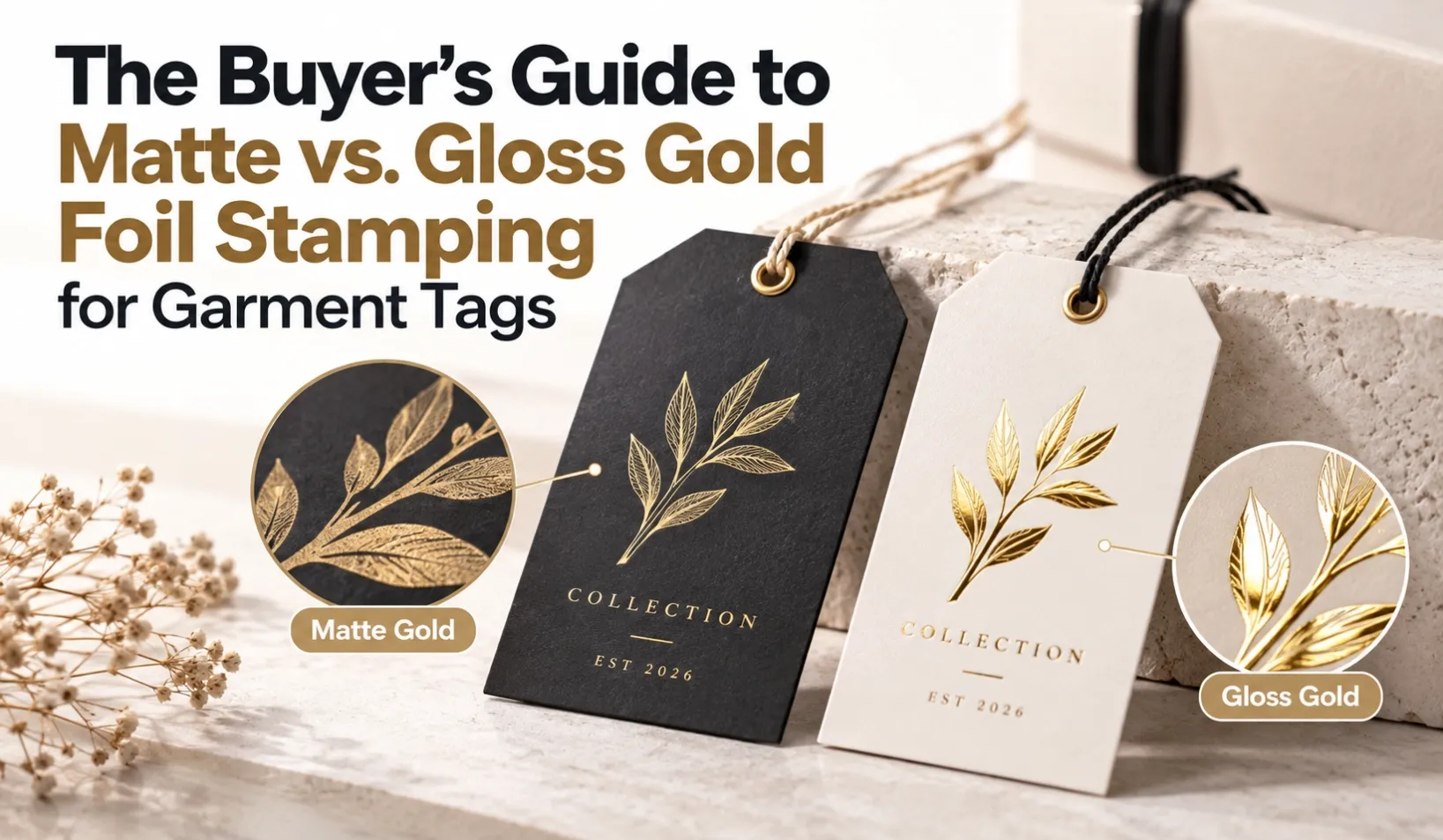
When designing garment tags, fashion brands often focus on the logo, typography, paper colour and finishing details.
But one decision can significantly change the final appearance of the tag: the choice between matte gold and gloss gold foil stamping.
The difference is not simply about choosing a gold colour. The final result also depends on the paper surface, artwork, foil details and the overall tag design.
Two tags can use similar gold tones but create very different impressions.
One may look brighter and more eye-catching. The other may feel softer and more understated.
Understanding these differences before production can help reduce unnecessary sampling changes and make it easier to select a finish that works with the complete design.
Matte Gold vs. Gloss Gold Foil Stamping: What's the Difference?
Both matte gold and gloss gold create a metallic effect, but they reflect light differently.
Gloss Gold Foil
Gloss gold foil has a brighter, more reflective surface.
It catches light more easily and can create a stronger metallic contrast, especially when used on dark paper.
It may work well when the design calls for:
- A noticeable metallic logo
- Strong contrast
- A brighter decorative effect
- A more traditional gold appearance
Because gloss foil reflects more light, its appearance can also change noticeably under different lighting conditions.
Matte Gold Foil
Matte gold foil has a softer metallic appearance with less reflection.
Instead of creating a strong shine, it can produce a more restrained visual effect.
It may work well with:
- Minimalist layouts
- Simple logos
- Dark or neutral paper colours
- Designs where the metallic detail should complement rather than dominate the tag
Neither option is automatically more premium. The better choice depends on the complete tag design.
Matte Gold vs. Gloss Gold: Quick Comparison
Feature | Gloss Gold Foil | Matte Gold Foil |
|---|---|---|
Visual Effect | Brighter metallic reflection | Softer metallic appearance |
Light Reflection | Higher | Lower |
Overall Style | Bold and eye-catching | Subtle and understated |
Black Paper | Strong visual contrast | Softer visual contrast |
Textured Paper | Depends on surface texture | Depends on surface texture |
Fine Details | Depends on artwork, paper and production setup | Depends on artwork, paper and production setup |
The comparison above is a general visual reference. Actual results should be evaluated with the selected paper, artwork and foil.
How Paper Choice Changes Gold Foil Appearance
Many buyers focus mainly on the foil colour.
However, the same foil can look noticeably different depending on the paper underneath.
Paper colour, texture and surface characteristics all affect the final result.
Gold Foil on Black Card Paper
Black card creates strong contrast with metallic gold.
Gloss gold can create a brighter and more noticeable metallic effect, while matte gold can create a softer contrast.
Both can work well.
The choice depends on whether the design calls for stronger visibility or a more restrained appearance.
Gold Foil on Soft-Touch Surfaces
A soft-touch surface already creates a distinctive tactile effect.
Matte gold can complement this with a softer metallic appearance, while gloss gold creates stronger contrast between the surface and the foil.
The final result depends on the material, coating or lamination system and the foil used, so sampling is useful before bulk production.
Gold Foil on Natural and Textured Papers
Natural and textured papers can create a very different result from smooth coated materials.
The surface texture may influence how fine foil details appear, so artwork that works well on a smooth paper may need adjustment when used on a more textured stock.
This is why paper and foil should be evaluated together rather than selected separately.
The Most Common Mistake: Designing Foil Artwork Only for the Screen
Artwork that looks perfect on a computer screen does not always translate directly into foil stamping.
Digital artwork can display extremely fine details, but physical production has practical limitations.
Potential issues include:
- Extremely thin logo lines
- Tiny text
- Narrow gaps between letters
- Complex decorative patterns
- Highly detailed illustrations
Depending on the artwork and material, these details may result in:
- Foil filling between small areas
- Broken fine lines
- Uneven transfer
- Loss of detail
Artwork for foil stamping should therefore be reviewed for the actual production process, not only for digital appearance.
Before finalizing fine lines, small text or finishing layers, use our hang tag artwork checklist to review the artwork before production.
How Thin Can Gold Foil Lines Be?
There is no single minimum line width that works for every foil stamping project.
The result depends on factors such as:
- Paper surface and texture
- Foil material
- Artwork complexity
- Die quality
- Stamping pressure and production setup
For some garment tag projects, around 0.3 mm may be used as an initial artwork reference, but the final workable line width should be confirmed according to the actual paper, foil and design.
Very thin strokes, tiny text and narrow gaps between design elements should be reviewed carefully before production.
This is one reason physical sampling is useful before bulk production.
Why Sampling Matters Before Mass Production
A digital design can show colour, layout and shape, but it cannot fully reproduce how metallic foil behaves on a physical material.
A physical sample allows buyers to evaluate:
- Reflection
- Paper texture
- Contrast
- Fine details
- Interaction between paper and foil
- Overall appearance under real lighting
When matte and gloss gold are both being considered, one useful approach is to compare them using the same or similar artwork and paper.
The difference is often easier to judge on a physical sample than on a computer screen.
Buyer Checklist Before Ordering Gold Foil Garment Tags
Before approving the final design, consider:
- Does the foil finish work with the overall brand design?
- Does the selected paper complement the foil?
- Are fine logo lines suitable for foil stamping?
- Is small text readable at finished size?
- Have important foil areas been reviewed on a physical sample?
- Does the finish still look appropriate after normal handling?
- Are other finishing processes compatible with the foil design?
These checks can help identify potential issues before bulk production.
How to Choose Between Matte Gold and Gloss Gold
There is no universally better option.
Gloss gold usually creates stronger reflection and a more noticeable metallic effect, while matte gold creates a softer and more understated appearance.
The better choice depends on the overall design, including:
- Brand visual style
- Paper colour and texture
- Logo size
- Artwork complexity
- Other finishing processes used on the tag
Instead of asking which foil looks more expensive, ask:
Which finish works better with the complete tag design?
Whenever the difference is difficult to judge on screen, comparing physical samples is the safer approach.
Combining Gold Foil Stamping With Other Finishes
Gold foil stamping can also be combined with other finishing techniques, depending on the artwork and material.
Common combinations include:
- Gold foil stamping + embossing
- Gold foil stamping + debossing
- Gold foil stamping + soft-touch lamination
- Gold foil stamping + custom die cutting
- Gold foil stamping + edge colouring
For many designs, one or two carefully selected finishes can create a cleaner result than combining too many decorative processes.
How Jeeli Packaging Supports Gold Foil Tag Projects
For custom hang tag projects, we can review the combination of:
- Paper selection
- Artwork structure
- Foil finish
- Other finishing processes
- String and attachment requirements
When matte and gloss gold create noticeably different results, physical samples can also be compared before bulk production.
This allows the foil, paper and artwork to be evaluated together rather than selecting each element separately.
Quick Summary
When choosing gold foil stamping for garment tags:
- Gloss gold creates stronger reflection and visual impact.
- Matte gold creates a softer metallic appearance.
- Paper selection affects the final result.
- Artwork should be prepared for the physical foil stamping process.
- Fine lines and small details may require adjustment.
- Physical sampling can help confirm the final appearance before bulk production.
Frequently Asked Questions
Is matte gold more luxurious than gloss gold?
Not necessarily. Matte and gloss gold create different visual effects. Matte gold is generally softer and less reflective, while gloss gold creates stronger metallic reflection. The better option depends on the complete tag design.
What paper works well with gold foil stamping?
Black card, smooth coated or uncoated papers, textured papers and other specialty stocks may all be considered. The result depends on the paper surface, foil and artwork, so the combination should be evaluated for the specific project.
Can gold foil stamping be combined with embossing?
Yes. Foil stamping can be combined with embossing or other finishing processes, but the artwork, paper and production sequence should be reviewed before production.
Why does foil stamping sometimes look different from the design file?
A digital design cannot fully reproduce metallic reflection, paper texture or the interaction between foil and the physical material. A physical sample provides a more useful reference for the final appearance.
What line thickness should be considered for gold foil stamping?
There is no universal minimum. Around 0.3 mm may be used as an initial reference for some designs, but the workable line width depends on the paper, foil, artwork and production setup.
Final Thoughts
Gold foil stamping is more than adding a metallic colour to a garment tag.
The final result depends on how the foil finish, paper surface, artwork and other finishing processes work together.
Gloss gold may be suitable when stronger reflection and contrast are desired, while matte gold may work better when the design calls for a softer metallic effect.
Rather than choosing the foil in isolation, evaluate it as part of the complete hang tag.
You can explore our custom hang tags or contact Jeeli Packaging to discuss the paper, artwork and finishing requirements for your project.