Sep 23, 2026Blog
What Size Should a Clothing Hang Tag Be? A Practical Guide for Fashion Brands
Not sure what clothing tag size to choose? Compare common hang tag dimensions and learn how garment type, artwork, QR codes and hole position affect the final size.
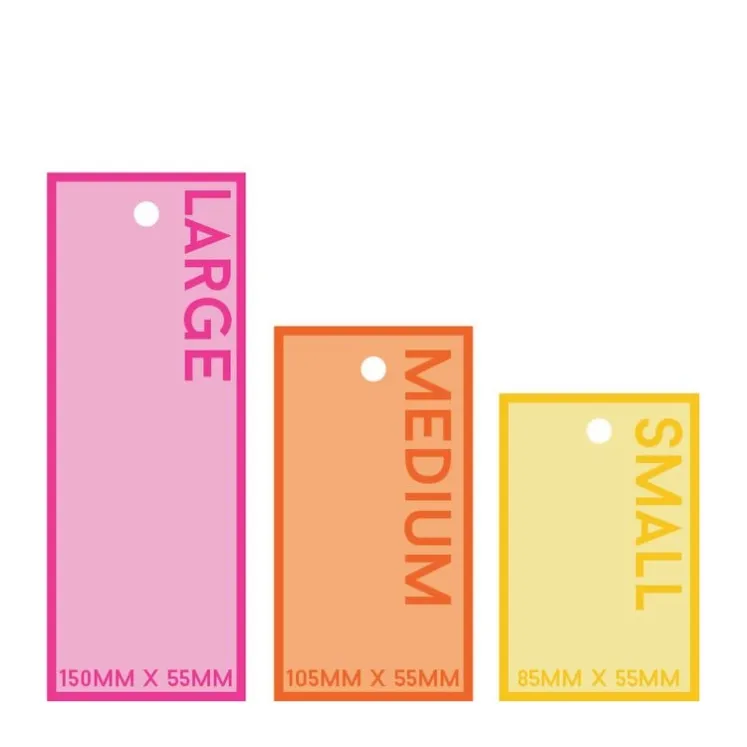
Choosing a clothing hang tag size can look like a small decision — until you see the tag attached to the actual garment.
A layout that looks perfectly balanced on a computer screen may feel too small on a jacket, too large on a lightweight T-shirt, or too crowded once a barcode, QR code and product information are added.
That is why there is no single “standard” hang tag size that works for every fashion brand.
A better starting point is to consider the garment, the amount of information on the tag and the overall visual proportion.
Why Does Clothing Hang Tag Size Matter?
A clothing hang tag needs enough usable space for the information your brand actually wants to show.
Depending on the product, this may include:
- Brand logo
- Product name
- Size
- Price
- Barcode
- QR code
- Website or social information
- Material or product information
- Other required or brand-specific content
If the tag is too small, the artwork can quickly become crowded.
If it is unnecessarily large, it may overpower a lightweight or small garment.
The goal is not to choose the biggest tag possible. It is to find a size that gives the artwork enough breathing room while remaining proportional to the product.
Common Clothing Hang Tag Sizes
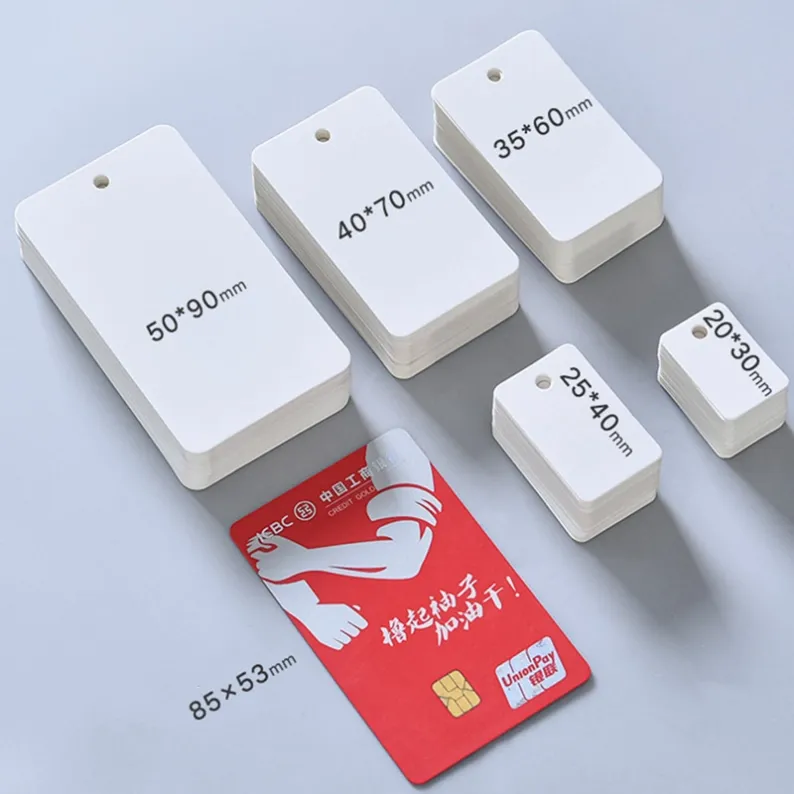
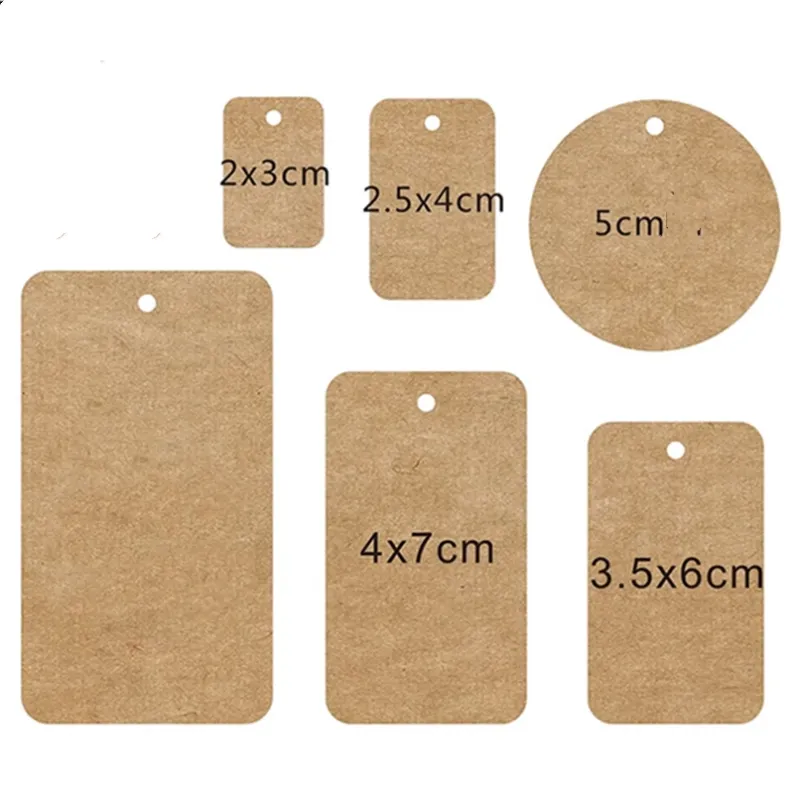
There is no universal size standard for fashion hang tags, but the following dimensions can be useful as reference points when developing a new tag.
Tag Size | Possible Applications |
|---|---|
35 × 55 mm | Small accessories, children's products or simple layouts |
40 × 70 mm | Accessories, underwear or compact tag designs |
50 × 90 mm | T-shirts, casual apparel and general fashion applications |
55 × 100 mm | Apparel requiring slightly more branding or product information |
60 × 120 mm | Hoodies, denim, jackets and larger garments |
70 × 140 mm | Larger-format tags or designs requiring more visual space |
These dimensions are starting points rather than fixed rules.
The right size depends on your artwork, garment and the information that needs to fit on the tag.
Start With the Content, Not the Dimensions
Before deciding that your tag should be 50 × 90 mm or 60 × 120 mm, list everything that needs to appear on it.
For example, a simple front-and-back design with a logo and short website address may require relatively little space.
A tag containing a barcode, QR code, product information and several lines of text will need a different layout.
Instead of squeezing the artwork into a predetermined size, compare the content requirements first.
If you are still deciding what information belongs on the tag, our guide to what fashion designers should put on a hang tag can help you simplify the content before finalizing the dimensions.
Match the Tag Proportion to the Garment
The physical relationship between the tag and garment matters too.
Here are some useful starting points:
Garment Type | Size Range Worth Testing |
|---|---|
T-shirts and casual tops | Around 50 × 90 mm |
Hoodies and sweatshirts | Around 55 × 100 mm to 60 × 120 mm |
Denim and jackets | Around 55 × 100 mm to 60 × 120 mm |
Children's clothing | Smaller formats such as 35 × 55 mm |
Hats, scarves and accessories | Compact formats such as 40 × 70 mm |
Larger premium presentation tags | Larger formats may be considered depending on the design |
These are reference dimensions, not mandatory specifications.
A minimalist brand may deliberately choose a smaller tag for a large garment, while another brand may use a larger tag because the artwork requires more space.
Check the Hang Hole Before Approving the Size
Hole position is easy to overlook during artwork design.
If the hole is positioned too close to an edge, the remaining paper around it may be weaker. If it is placed too far inward, it can interfere with the logo or other artwork.
When reviewing the hole position, consider:
- Hole diameter
- Distance from the cut edge
- Paper thickness and stiffness
- Eyelet size, if used
- String or cord thickness
- Artwork around the hole
- Finished tag shape
Rather than applying one fixed margin to every project, the hole position should be reviewed together with the tag material, dimensions and attachment method.
Adding a QR Code? Test It at Actual Size
QR codes are increasingly common on clothing hang tags, but there is no single physical size that guarantees reliable scanning in every situation.
Scanning performance can be affected by:
- Amount of data encoded
- Printing resolution
- Contrast
- Quiet zone around the code
- Paper texture
- Surface finishing
- Final printed size
- Smartphone and scanning conditions
Do not rely only on the enlarged QR code shown on your computer screen.
Print the artwork at 100% actual size and test the code with several phones before approving production.
Avoid placing important embossing, debossing, foil or other visual elements too close to the QR code if they interfere with its clear printed area.
Bigger Does Not Automatically Mean More Premium
A larger or thicker tag is not automatically a more luxurious tag.
Premium presentation can also come from:
- Paper texture
- Good typography
- Controlled spacing
- Simple artwork
- Foil details
- Embossing or debossing
- Well-matched strings and eyelets
A compact tag on the right specialty paper can look more considered than an oversized tag filled with unnecessary information.
This is especially important for minimalist brands. Our guide to minimalist clothing hang tags explains how size, spacing, paper and finishing work together when the design itself is intentionally simple.
An Easy Size Test Before You Order Samples
One of the easiest ways to evaluate tag size does not require special equipment.
- Print your artwork at 100% actual size on ordinary paper.
- Cut it to the proposed finished dimensions.
- Make the hole approximately where it will appear on the final tag.
- Attach it to the actual garment.
- Look at it both close up and from normal viewing distance.
Check whether:
- The logo feels too large or too small
- Text remains readable
- The QR code can be scanned
- The tag feels proportional to the garment
- The hole position looks balanced
- There is enough clear space around important information
This simple test can reveal proportion and layout problems that are difficult to notice on a digital mockup.
What If the Artwork Feels Too Crowded?
If your design feels cramped at the planned size, reducing the font size is not always the best solution.
Consider:
- Increasing the tag dimensions slightly
- Removing unnecessary information
- Moving some information to the reverse side
- Using two coordinated tags
- Simplifying decorative elements
- Reconsidering the QR code or barcode position
Sometimes a small dimensional adjustment gives the artwork enough space without significantly changing the overall look of the tag.
Before approving your final file, you can also review our hang tag artwork checklist to catch common artwork and production issues.
Frequently Asked Questions About Clothing Hang Tag Sizes
What is a common clothing hang tag size?
Sizes around 50 × 90 mm and 55 × 100 mm are useful reference points for many apparel projects, but they should not be treated as universal standards.
The final dimensions should be based on the garment and artwork.
What size works for premium clothing hang tags?
There is no specific size that makes a tag premium.
Larger formats can provide more visual space, while smaller formats can work well for restrained or minimalist designs.
Material, typography, spacing and finishing are often just as important as size.
Can clothing hang tags be made in custom sizes?
Yes. Hang tag dimensions and shapes can be customized according to the artwork and product requirements.
Before choosing a custom size, consider how the tag will be printed, cut, punched and attached.
How small can a clothing hang tag be?
There is no universal minimum size.
Very small tags provide less room for branding, text, barcodes and QR codes, so the practical minimum depends on what needs to appear on the tag.
For a very compact design, test the artwork at actual size before production.
Choose the Size Around the Real Product
The right clothing hang tag size is not determined by a single industry chart.
Use common dimensions as a starting point, then evaluate:
- Garment size and type
- Artwork
- Required information
- Hole position
- QR code or barcode
- Paper
- Finishing
- Attachment method
Most importantly, test the tag at actual size against the garment before approving production.
If you are developing custom hang tags, send us your proposed dimensions, artwork, quantity and garment type. We can review the specification before sampling.