
Buying Guides
How to Choose the Right Mailer Box Size: A Buyer's Guide
Learn how to measure your product, tell internal from external dimensions, and leave the right clearance when specifying custom mailer box sizes.
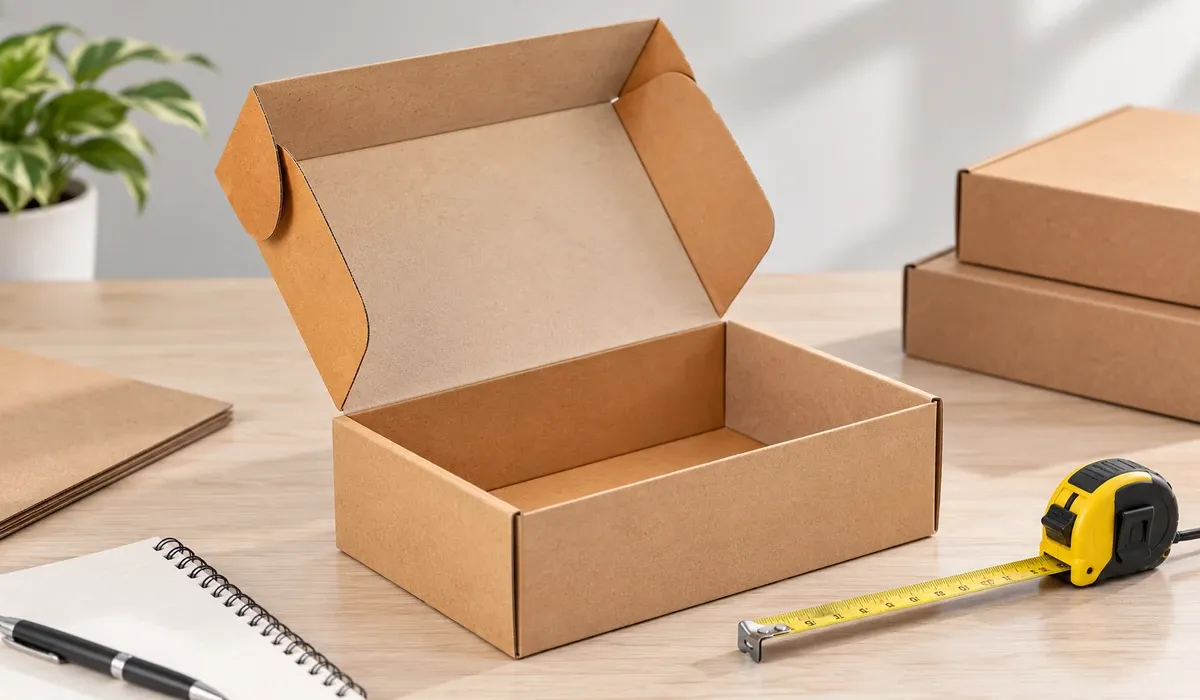
Getting the size wrong is one of the most expensive mistakes in e-commerce packaging — and one of the easiest to avoid. Order too large and you pay to ship air on every single order. Order too tight and products arrive damaged, or your packing team loses seconds on every unit.
Sizing is only half the decision - how to choose the right custom shipping box for your brand walks through structure, print method and the cost levers.
This guide covers how to measure a product correctly, the difference between internal and external dimensions, how much clearance to leave, and what to send a supplier so the quote comes back right the first time.
Why Mailer Box Size Deserves More Attention Than It Gets
Box size is usually settled in a few minutes, somewhere between choosing a board grade and approving artwork. But it drives four things that show up in your costs every month:
Freight. Carriers price on dimensional weight, not just actual weight. A box that is 30 mm too large on each side can push you into the next pricing tier — and that difference is multiplied across every shipment.
Damage rates. A product with no clearance absorbs the full impact of every knock in transit. A product with too much clearance slides around inside, which causes a different kind of damage.
Packing speed. If a carton is a tight fit, your team spends extra seconds easing each unit in. At 10,000 units, three extra seconds is more than eight hours of labour.
Storage and inbound freight. Larger boxes mean more warehouse space and fewer units per pallet, which raises your landed cost per unit.
Internal vs External Dimensions: Settle This First
Almost every sizing problem starts here.
Internal dimensions (sometimes called inside or clear dimensions) are the usable space inside the box — the space your product and any protective material occupy.
External dimensions are the outside measurements, including board thickness.
The difference is roughly two board thicknesses per dimension. For a single-wall mailer:
Board | Typical caliper | Added to each dimension |
E-flute | ~1.0–1.6 mm | +2–3 mm |
B-flute | ~2.5–3.2 mm | +5–6 mm |
EB-flute (double-wall) | ~4.0–4.8 mm | +8–10 mm |
So if you need 300 mm of internal length on B-flute board, the external length will be about 306 mm.
Two rules worth following:
- Always state which one you mean. "300 × 200 × 100" on its own is ambiguous. "300 × 200 × 100 mm internal" is not.
- Product fit is decided by internal dimensions; freight is decided by external ones. Checking whether something fits? Use internal. Estimating shipping cost? Use external.
Board grade also matters for how much the box can carry — see our guide on corrugated thickness for mailer boxes for how E-flute and B-flute compare on strength and print surface.
How to Measure Your Product (the Standard Order)
The industry standard is length × width × height, and the order matters — get it wrong and the box is made with the opening in the wrong place.
- Length — the longest horizontal side of the box as it will sit when opened
- Width — the shorter horizontal side
- Height — the vertical dimension, from the base to the top of the lid
For a mailer box that opens from the top, length and width describe the footprint and height is the depth of the box.
Three situations that trip people up:
Soft products. For apparel, measure the product as it will be packed — folded, rolled or flat — not laid out. A folded T-shirt and a flat-laid T-shirt need very different boxes.
Irregular shapes. Measure to the widest points. A bottle with a pump or a jar with a wide lid: the widest part defines the internal space you need.
Multi-packs. Measure the grouped set, not the single item, and decide up front whether units sit side by side or stacked. That choice changes the box proportions entirely.
How Much Clearance Should You Leave?
Clearance is the gap between product and box wall. Too little and the product jams; too much and it rattles.
Product type | Clearance per side | Notes |
Rigid, flat-packed items | 3–5 mm | Books, flat apparel, printed inserts |
Rigid items needing inserts | 5–8 mm | Accounts for insert wall thickness |
Items with bubble wrap | 15–25 mm | Depends on number of wrap layers |
Glass, ceramic or fragile | 25 mm + dedicated insert | Corrugated or moulded pulp insert |
Loose-fill (paper, chips) | 25–50 mm | Needs volume for the fill to work |
Two corrections people rarely make until something breaks:
- Inserts consume internal space. A corrugated insert with 3 mm walls reduces the usable cavity on each side. Size the internal dimensions for product plus insert, not the product alone. If you are unsure whether an insert is needed at all, this breakdown of when packaging needs an insert covers the decision.
- Lid and tape add height. Closing a mailer adds a small amount of height. Usually negligible on a single-wall mailer, but it matters if you are close to a carrier limit.
Typical Mailer Box Sizes by Product Type
These are starting points for quoting, not fixed rules. Confirm against a physical sample before production.
Application | Common Internal Size (L × W × H mm) | Typical board |
T-shirt / single apparel item | 250 × 180 × 40 – 300 × 220 × 60 | E-flute |
Apparel gift set | 300 × 220 × 80 – 350 × 250 × 100 | E-flute or B-flute |
Serum / small cosmetic | 80 × 80 × 120 – 120 × 120 × 160 | E-flute |
Cosmetic gift set | 250 × 200 × 80 – 350 × 250 × 100 | B-flute |
Phone accessories | 150 × 100 × 50 – 200 × 150 × 70 | E-flute |
Monthly subscription box | 300 × 220 × 100 – 400 × 300 × 120 | B-flute |
Books and media | 220 × 150 × 50 – 300 × 220 × 80 | E-flute |
Need a custom size or a dieline template?
If your product doesn't fit into these typical dimensions, no problem. At Jeeli Packaging, we manufacture custom size mailer boxes to your exact specifications without extra die-cut fees.
Five Sizing Mistakes That Cost Money
1. Specifying the box to the exact product size. Zero clearance means every unit has to be forced in, and the product takes the full impact in transit.
2. Forgetting protective material needs space. Bubble wrap or loose fill is not accounted for, so the lid bulges or the box will not close cleanly.
3. Mixing internal and external dimensions. A box quoted as "300 mm" externally gives you roughly 294 mm of usable space on B-flute — easily enough to jam a snug product.
4. Ignoring carrier dimension limits. Crossing a longest-side or length-plus-girth threshold can change your rate sharply. Check before committing to a size.
5. Not designing for the packing line. A box optimised for hand-packing often runs badly on automated equipment, and the reverse is also true.
What to Send Your Supplier
You do not need a finished die-line to get a usable quote. Send:
- Product dimensions (length × width × height) at the widest points
- Product weight, and whether it is fragile or contains glass
- Quantity per box and your target order quantity
- Packing method — hand-packed or automated line
- Whether an insert is needed, and what it has to hold
- Print requirements — outside, inside, or both; number of colours
- Board preference if you have one, or the weight the box has to carry
For standard custom mailer boxes, those seven items are usually enough for a supplier to return a specification and a price. If you have artwork, share it at quoting stage — it catches fit problems while they are still cheap to fix.
Print finish also affects the specification. If you are planning printed mailer boxes, whether you print inside changes what you need to tell the factory about the interior surface. And if you want the natural brown look, our kraft mailer boxes take the same sizing approach — the board colour does not change how you measure, but it does change the print result.
FAQ
What is the standard order for box dimensions? Length × width × height. Length is the longest horizontal side, width the shorter horizontal side, and height runs from the base to the top of the lid.
Should I quote internal or external dimensions? Whichever you use, say so explicitly. Internal dimensions determine whether the product fits; external dimensions determine freight and pallet counts.
How much clearance does a mailer box need? Around 3–5 mm per side for rigid flat items, and more if you are using bubble wrap, loose fill, or a protective insert.
Can I use the same box size across different products? Only if the dimensions are close. Otherwise pick one size and use inserts to adapt it — that also simplifies inventory.
Does a bigger box always cost more to ship? Usually yes. Carriers bill dimensional weight, so extra volume is charged even when actual weight is unchanged.
Not sure which size fits your product? Send us the dimensions and weight and we will recommend a specification, with the reasoning behind it. "Need help calculating the right internal dimensions? The Jeeli Packaging engineering team can review your specs and recommend the best structure. [Contact us today]."