
Sep 24, 2026Blog
Why Your Kraft Paper Bag Quote Isn't Accurate Without GSM
Why do kraft paper bag quotes vary between suppliers? Learn how GSM affects material usage, cost and quotation accuracy — and how to compare prices fairly.
If you've requested quotations for custom kraft paper bags, you may have experienced something confusing.
You send several suppliers the same:
- Bag size
- Quantity
- Printing artwork
A few days later, the prices come back — and they can be surprisingly different.
The first assumption may be:
“Why is one supplier so much more expensive?”
But before comparing prices, there is another question worth asking:
Are all of the suppliers actually quoting the same bag specification?
One detail that is often missing from an inquiry is the paper weight, or GSM.
And that can make a significant difference.
Why GSM Can Change a Paper Bag Quotation
GSM stands for grams per square meter.
For the same type of paper, a higher GSM generally means more paper material is used.
That can affect:
- Material consumption
- Finished bag weight
- Unit cost
- Shipping weight
- The feel and rigidity of the finished bag
But GSM should not be viewed in isolation.
The final bag also depends on the paper type, dimensions, handle structure, reinforcement and expected product weight.
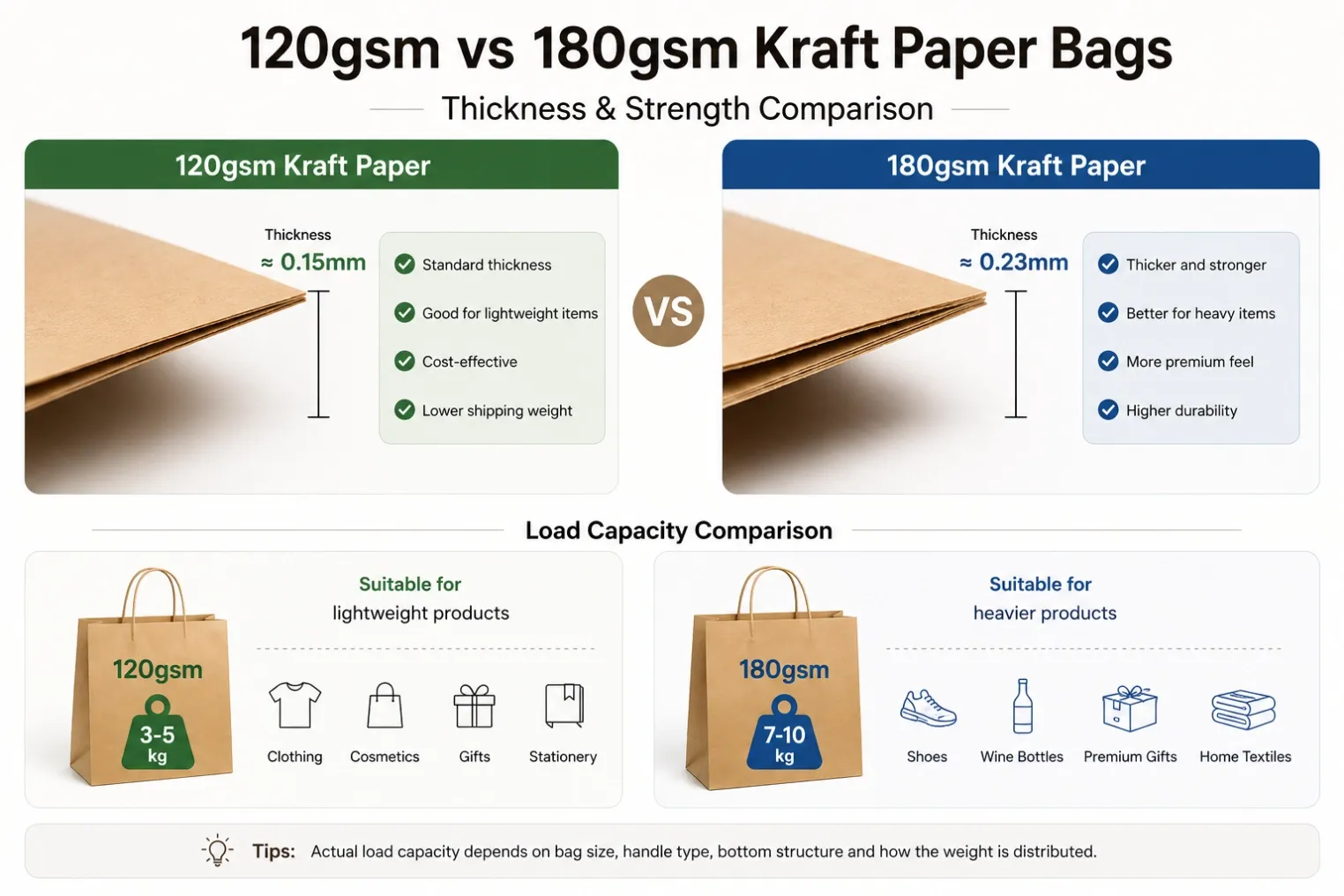
This means a quotation based on 120gsm paper is not directly comparable with one based on 180gsm paper, even if the bag dimensions and printing look identical on the quotation sheet.
A Real Quotation Example
In one of our paper bag inquiries, a customer provided the bag size, quantity and artwork but did not specify the paper weight.
Before preparing the quotation, we asked what product the bags would carry.
The customer explained that they would be used for lightweight clothing.
Based on the application and the other project requirements, we discussed whether a lighter paper specification could meet the intended use rather than automatically selecting a heavier option.
The important point was not that one particular GSM is always correct.
It was that the product, expected load and bag structure should be considered before the paper weight is finalized.
This can prevent buyers from paying for a heavier specification that the project may not require.
Why Two Suppliers Can Quote Different Prices
Imagine three suppliers receive the same inquiry:
Bag size: same
Quantity: same
Artwork: same
But GSM is not specified.
Supplier A may calculate the quotation using one paper weight.
Supplier B may use a heavier paper.
Supplier C may select another specification based on its interpretation of the application.
All three quotations may look like they are for the same paper bag.
But they are not necessarily based on the same material specification.
This is why comparing only the final unit price can be misleading.
A Higher GSM Isn't Automatically Better
It is easy to assume:
Higher GSM = better quality.
But packaging does not work that simply.
A heavier paper may be appropriate when the bag is larger, carries more weight or requires a more substantial feel.
For another project, that additional paper weight may provide little practical benefit while increasing material usage and cost.
The appropriate GSM should therefore be considered together with:
- Bag dimensions
- Product type
- Expected product weight
- Paper type
- Handle construction
- Reinforcement
- Brand presentation
- Budget
If you specifically want to compare different paper weights, see our guide to 120 GSM vs 180 GSM kraft paper bags.
Why Suppliers May Choose Different GSM Specifications
When buyers do not specify GSM, suppliers have to make assumptions.
One supplier may choose a heavier specification to reduce the risk of the finished bag feeling too light for the intended application.
Another may choose a lighter specification because the expected product weight does not require additional material.
Neither approach automatically proves that one quotation is better than the other.
The important question is:
What specification is each supplier actually quoting?
Before comparing prices, confirm that the quotations are based on comparable materials and structures.
What Should Be Included in a Paper Bag Inquiry?
To receive a more meaningful quotation, provide as much of the following information as possible:
- Finished bag dimensions
- Quantity
- Product type
- Approximate product weight
- Preferred paper type
- Preferred GSM, if known
- Handle type
- Printing requirements
- Finishing requirements
- Special structural requirements
- Delivery destination
If you don't know the appropriate GSM, that is fine.
Tell the supplier what the bag will carry and how it will be used. The paper specification can then be discussed based on the actual project rather than selected from GSM alone.
How to Compare Paper Bag Quotations Fairly
Before deciding which supplier has the better price, compare the underlying specifications.
Check whether each quotation uses the same:
- Paper type
- GSM
- Finished dimensions
- Printing method
- Number of printing colors
- Surface finishing
- Handle type
- Reinforcement
- Quantity
- Packing requirements
- Delivery terms
If these details are different, the prices are not truly like-for-like.
This is particularly important when one quotation appears significantly cheaper than the others.
The difference may come from the supplier's margin — but it may also come from a different specification.
Better Specifications Lead to Better Quotations
A useful quotation is not simply the lowest number on a spreadsheet.
It should clearly tell you what you are buying.
When several suppliers quote the same paper type, GSM, printing, finishing, handles and construction, the buyer has a much better basis for comparing prices.
Clear specifications also reduce misunderstandings later in the project.
For more information about paper types, handles and customization options, see our Custom Kraft Paper Bags.
Before You Compare the Price, Compare the Specification
When paper bag quotations vary, don't immediately assume that one supplier is expensive and another is cheap.
First check whether they are quoting the same product.
A difference in GSM, paper type, handle construction or finishing can change the quotation even when the bag dimensions look identical.
The simplest rule is:
Same specification first. Price comparison second.
If you're preparing a kraft paper bag project and are unsure which paper specification to use, contact Jeeli Packaging with the bag dimensions, quantity, expected product weight and printing requirements.