
Oct 9, 2026Blog
How to Choose the Right Paper Material for Custom Packaging SEO Title Packaging Paper Materials: How to Choose the Right One
Compare six common packaging paper materials, including white paperboard, kraft paper, greyboard and corrugated board, to choose the right option for your packaging.
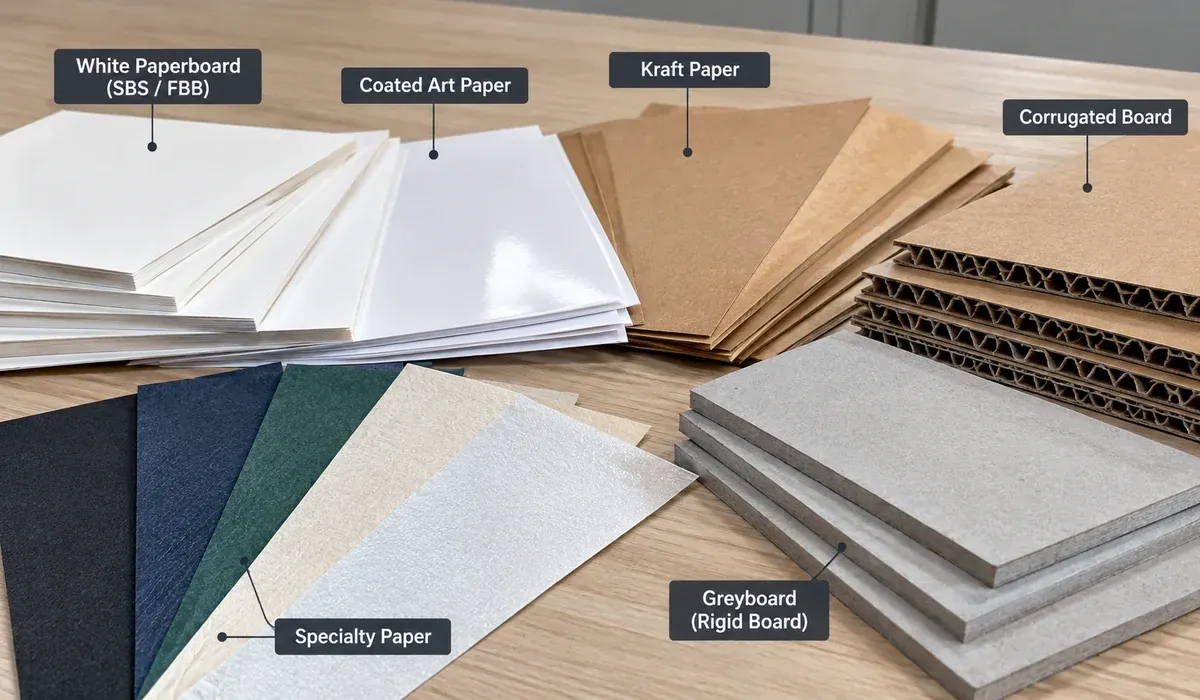
Choosing paper for custom packaging sounds simple until you start comparing materials.
A supplier recommends 350 GSM white paperboard. Another suggests coated paper. A third offers kraft paper or corrugated board. The prices are different, but it may not be obvious whether the materials will produce the same result.
The problem is that packaging paper is not selected by appearance or GSM alone.
The right choice depends on what you are making, how the packaging will be printed, how much weight it needs to support, and what happens to it after production.
This guide compares six common paper-based packaging materials and explains where each one works best.
First, Understand the Difference Between Paper, Paperboard and Corrugated Board
Before comparing individual materials, it helps to separate three terms that buyers often use interchangeably.
Paper generally refers to thinner flexible sheets used for printing, wrapping, and various packaging applications.
Paperboard is generally thicker and stiffer. It is commonly used for folding cartons, retail packaging, and some paper shopping bags.
Corrugated board is a layered material with one or more fluted paper layers between flat liners. Its construction provides cushioning and structural strength for mailer boxes and shipping cartons.
Rigid gift boxes use another construction: thick rigid board covered with wrapping paper.
These materials are not automatically interchangeable, even if they have similar surface colors or printing effects.
1. White Paperboard: A Common Choice for Folding Cartons
White paperboard is widely used for retail packaging because it can combine a printable surface with enough stiffness for many folding carton structures.
However, “white card” or “white paperboard” is a broad description, not one exact international material specification.
You may encounter terms such as:
- SBS (Solid Bleached Sulfate): A bleached paperboard grade often selected for its white appearance and printing characteristics.
- FBB (Folding Box Board): A multilayer folding carton board designed to provide a useful balance of stiffness, weight, and converting performance.
- CCNB or other coated recycled boards: Options that may have a white coated printing surface and a grey or recycled-fiber reverse side.
These grades can differ in thickness, stiffness, surface finish, and cost even when their GSM values are similar.
Where It Works Best
White paperboard is commonly considered for cosmetic boxes, electronics accessory cartons, retail product boxes, and other printed folding cartons.
For example, a small skincare carton may need a smooth printing surface, clean creasing, and enough stiffness to hold its shape during retail handling.
A larger carton carrying a heavier product may need a different board grade, stronger bottom structure, or an insert.
What Buyers Should Check
Ask for the actual board grade, GSM, thickness, and intended box structure.
Also confirm whether the carton will be packed manually or on an automated line, because folding and gluing performance may matter as much as appearance.
Cost level: Medium to higher, depending on grade, thickness, sourcing, and printing requirements.
2. Coated Art Paper: Best Understood as a Printing and Wrapping Material
Coated art paper has a treated surface designed to support printing.
It is available in different weights and finishes, including gloss and matte varieties.
A smooth coated surface can help reproduce detailed graphics, photographs, and fine text, although the final result still depends on the printing process and color management.
Where It Works Best
Coated art paper is commonly used for printed wrapping sheets on rigid boxes, brochures, inserts, sleeves, and certain paper bag constructions.
It can also be laminated to corrugated board as a printed facing layer.
This distinction is important.
A sheet of coated art paper does not become a protective mailer box simply because it is printed and folded. For a typical corrugated mailer, the corrugated structure provides much of the required strength.
Similarly, a rigid gift box usually gets its rigidity from the underlying board, not from its decorative wrapping paper.
What Buyers Should Check
If a quotation specifies coated art paper, ask whether it is:
- The complete packaging material
- A printed sheet laminated to another board
- An outer wrapping paper
- A separate printed insert or sleeve
These constructions can have very different costs and performance.
Cost level: Economy to medium for many standard grades, but specialty coatings, printing, and converting can increase the price.
3. Kraft Paper: A Natural Look With Important Material Differences
Kraft paper is commonly associated with brown paper bags and natural-looking packaging.
It is available in natural brown, bleached white, and other variations.
Kraft materials are often selected for their appearance, folding characteristics, and strength, but their performance depends on the specific paper grade and construction.
Where It Works Best
Kraft paper and kraft paperboard can be used for shopping bags, retail cartons, wrapping, and selected branded packaging applications.
Kraft liners are also widely used in corrugated board.
For a shopping bag, the correct paper selection depends on more than the bag's appearance.
The bag dimensions, product weight, handle type, top reinforcement, bottom board, and carrying conditions all affect performance.
A paper bag that works well for lightweight apparel may not be suitable for a heavy gift set without structural changes.
Does Kraft Paper Always Mean Eco-Friendly?
Not necessarily.
Brown kraft paper is not automatically recycled paper. It may contain virgin fibers, recycled fibers, or a combination, depending on the grade.
Recyclability also depends on coatings, attachments, contamination, and the available collection and recycling systems.
If environmental requirements are important, ask for the actual material specification and supporting documentation rather than relying on the paper's brown color.
What Buyers Should Check
Confirm the paper grade, GSM, strength requirements, printing method, and bag construction.
Remember that printing directly onto brown kraft paper will produce a different color appearance from printing onto a bright white surface.
Cost level: Economy to medium for many standard grades; specialty or high-performance kraft materials may cost more.
4. Specialty Paper: When Texture and Appearance Matter
Specialty paper is a broad category covering papers with distinctive colors, textures, surfaces, or visual effects.
Examples include textured papers, pearlescent papers, colored uncoated papers, and selected translucent materials.
These papers are often considered when brands want a particular tactile or visual identity.
Where It Works Best
Specialty papers can be used as outer wrapping for rigid gift boxes, premium sleeves, hang tags, decorative inserts, and selected folding carton designs.
A textured paper with a simple debossed logo, for example, can create a different impression from a smooth printed board with multiple decorative finishes.
But a distinctive surface does not automatically make a paper suitable for every production process.
Common Production Considerations
Textured surfaces may affect fine-detail printing.
Deep-colored papers may require alternative printing or foil-stamping methods to achieve sufficient contrast.
Some papers may need additional testing for folding, cracking, gluing, or wrapping around corners.
Certain finishes can also change the way the paper looks or feels.
What Buyers Should Check
Before finalizing artwork, confirm that the selected specialty paper is compatible with the intended printing, creasing, gluing, and finishing processes.
For new or unusual combinations, a physical sample is particularly useful.
Cost level: Medium to high, with considerable variation between paper types.
5. Greyboard: The Structural Core of Many Rigid Boxes
Greyboard, sometimes called rigid chipboard or grey cardboard, is widely used to build the main structure of rigid gift boxes.
Unlike a typical folding carton, a traditional rigid box is not usually made from one thin printed sheet that folds into shape.
Instead, rigid board is cut and assembled into a solid structure, then covered with printed paper, coated paper, or specialty paper.
Where It Works Best
Greyboard is commonly used for lid-and-base boxes, magnetic closure gift boxes, drawer-style rigid boxes, and other premium presentation packaging.
It can also be used for certain reinforcing components and inserts.
Why Thickness Matters More Than GSM Alone
For rigid boxes, suppliers often discuss board thickness in millimeters.
The appropriate thickness depends on the finished dimensions, product weight, opening structure, and required rigidity.
Two greyboards with the same GSM may have different thicknesses because of differences in density and construction.
A larger box is not automatically better simply because the supplier uses a heavier board. The board and structure need to work together.
What Buyers Should Check
Ask for the board thickness, wrapping paper specification, and completed box structure.
For a magnetic rigid box, also confirm the closure design and any insert requirements.
See our foldable rigid boxes for an example of how rigid board, wrapping materials, and structure are considered together.
Cost level: The raw board may be economical, but a finished rigid box generally involves additional wrapping, assembly, and finishing costs.
6. Corrugated Board: The Practical Choice for Many Mailer Boxes
Corrugated board consists of fluted paper combined with flat linerboard.
This structure helps provide stiffness, cushioning, and protection while keeping material weight relatively manageable.
For custom mailer boxes, common options include E-flute and B-flute constructions.
E-Flute vs. B-Flute
E-flute has a relatively fine flute profile and is often considered for compact retail mailers where a neat appearance and manageable board thickness are important.
B-flute generally has a thicker flute profile and may be considered when additional cushioning or structural performance is needed.
However, flute type alone does not determine box strength.
Liner grades, board construction, box dimensions, product weight, and shipping conditions also matter.
Where It Works Best
Corrugated board is widely used for e-commerce mailer boxes, subscription boxes, shipping cartons, and protective retail packaging.
For printed mailers, the outer surface may be white or kraft, or it may use a separately printed sheet laminated to the corrugated board.
This allows brands to balance printing requirements with structural performance.
What Buyers Should Check
Confirm the flute type, board construction, liner materials, box size, product weight, and expected shipping conditions.
If the packaging will be shipped directly to consumers, consider whether the product needs an additional insert or cushioning.
Cost level: Economy to medium for many standard constructions, but heavier board, specialty liners, printing, and finishing can increase costs.
Packaging Paper Materials Compared
The following table provides a starting point, not a universal material specification.
Material | Main Advantage | Typical Use | Relative Cost |
|---|---|---|---|
White paperboard | Printable, foldable, available in different stiffness grades | Folding cartons | Medium–Higher |
Coated art paper | Smooth surface for detailed printing | Wrapping, sleeves, printed facing sheets | Economy–Medium |
Kraft paper | Natural appearance and multiple packaging applications | Paper bags, kraft cartons, liners | Economy–Medium |
Specialty paper | Distinctive texture or appearance | Premium wrapping, hang tags, sleeves | Medium–High |
Greyboard | Rigid structural support | Rigid gift boxes | Depends on construction |
Corrugated board | Lightweight structural protection | Mailer boxes, shipping cartons | Economy–Medium |
These cost levels are broad comparisons only. Actual quotations depend on the material grade, dimensions, quantity, printing, finishing, and production process.
Which Material Should You Choose for Your Packaging?
Instead of asking which paper is best, start with the packaging format.
Packaging Type | Common Material Direction | Main Consideration |
|---|---|---|
Folding cartons | SBS, FBB, coated recycled paperboard, or suitable kraft board | Stiffness, creasing, printing, product fit |
Paper shopping bags | Suitable white, kraft, or coated paper grades | Carrying weight, handles, reinforcement |
Mailer boxes | E-flute, B-flute, or other suitable corrugated board | Product protection, box strength, shipping |
Rigid gift boxes | Greyboard with printed or specialty wrapping paper | Rigidity, presentation, assembly, inserts |
For example, if you are packaging a lightweight cosmetic bottle for retail display, a folding carton may be appropriate.
If the same product will be shipped individually through an e-commerce delivery network, a corrugated mailer or additional protective packaging may be needed.
If the product is part of a premium gift set, a rigid box with a fitted insert could be considered.
The material choice changes because the packaging's job changes.
Five Questions to Ask Before Approving a Packaging Material
1. What is the exact material grade?
A description such as “300 GSM white card” may not be enough.
Ask for the board type, thickness, surface characteristics, and any relevant performance requirements.
2. Is this material suitable for my box structure?
A paper that prints beautifully may not fold cleanly around a tight crease.
A board that works for a small carton may not be suitable for a much larger box.
3. Will my artwork print as expected?
The same ink can appear different on white coated paper, brown kraft paper, and textured specialty paper.
Confirm critical brand colors using an appropriate physical reference.
4. Does the material need extra finishing?
Lamination, coatings, foil stamping, or other finishes may affect appearance, cost, production, and end-of-life handling.
Use them where they serve a clear purpose.
5. Can I compare samples before making the final decision?
When possible, request material swatches or a structural sample.
Comparing actual paper and board samples is often more useful than choosing from a photograph or a GSM number alone.
Frequently Asked Questions
Is 350 GSM paper always stronger than 300 GSM paper?
No. GSM measures mass per unit area. Strength and stiffness also depend on the paperboard grade, thickness, density, and construction.
Can coated art paper be used to make a mailer box?
Coated art paper can be used as a printed facing sheet laminated to corrugated board. It is not normally a direct substitute for the structural corrugated board in a shipping mailer.
What is the difference between white paperboard and greyboard?
White paperboard is commonly used for printed folding cartons. Greyboard is often used as the thicker structural core of rigid gift boxes and is usually covered with another paper.
Is kraft paper always cheaper than white paperboard?
No. Prices depend on grade, strength, thickness, quantity, sourcing, and production requirements. A specialty kraft material may cost more than a standard white paperboard grade.
Which packaging paper is the most environmentally friendly?
There is no single answer for every product or market. Material sourcing, recycled content, coatings, weight, manufacturing, transport, and actual recycling systems all influence environmental performance.
Can I request a quotation without knowing the paper material?
Yes. You can start with the product dimensions, weight, packaging type, order quantity, artwork, and required presentation or shipping performance. A manufacturer can then discuss suitable material options.
Final Thoughts
The right packaging material is not necessarily the thickest, most expensive, or most visually impressive one.
It is the material that works with your product, packaging structure, printing requirements, budget, and delivery conditions.
For folding cartons, focus on paperboard grade and folding performance. For paper shopping bags, consider the complete bag construction. For mailer boxes, evaluate the corrugated structure. For rigid gift boxes, consider the board and wrapping paper together.
At Jeeli Packaging, we help brands and packaging buyers develop custom paper packaging around their actual product and production requirements.
If you are comparing materials for a new project, send us your packaging size, product details, expected quantity, and design reference. We can discuss suitable material and structural options before preparing a quotation.