
Oct 9, 2026Blog
10 Packaging Printing Terms Every Buyer Should Know Before Ordering
Learn 10 essential packaging printing terms, including GSM, bleed, CMYK, dielines, MOQ and sampling, before ordering custom packaging.
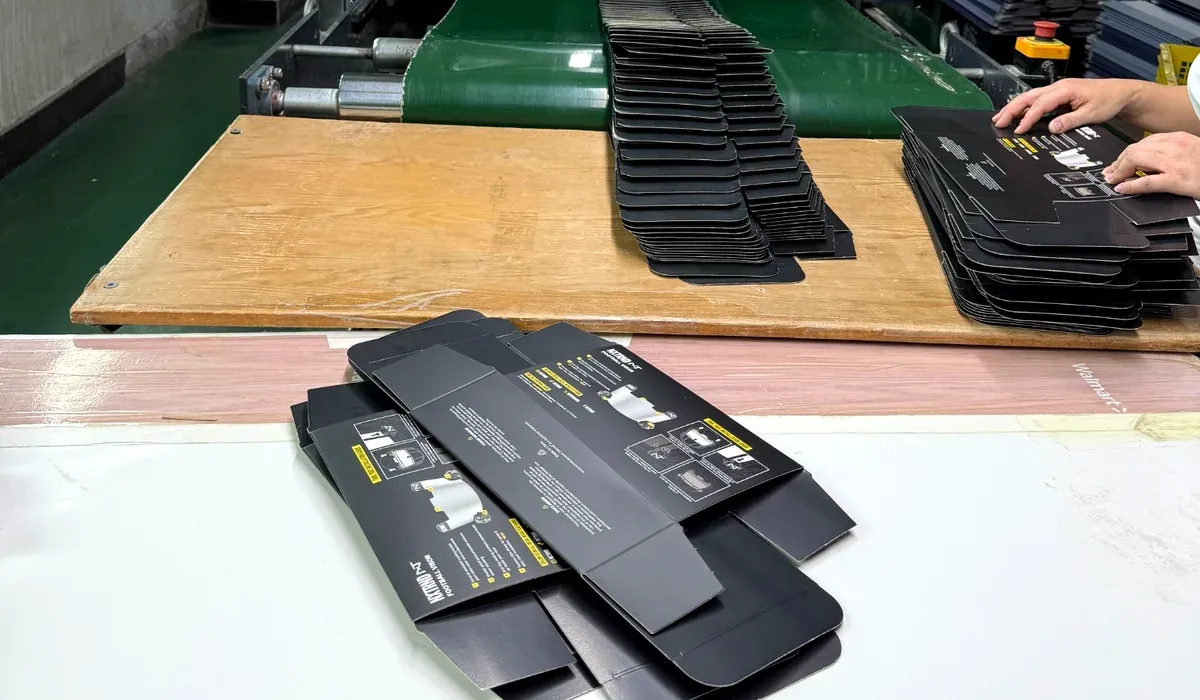
Most custom packaging projects start with a few simple questions: What material should we use? Can the logo color be matched? How much will the boxes cost? And how long will production take?
Then the quotation arrives, filled with unfamiliar terms: 300 GSM, CMYK, 3 mm bleed, spot UV, dieline, MOQ.
You don't need to become a printing expert to order custom packaging. But understanding a few basic terms can help you prepare better artwork, compare quotations more accurately, and avoid unexpected changes during production.
Here are 10 packaging printing terms worth knowing before placing your next order.
1. GSM: Paper Weight, Not Paper Thickness
GSM (grams per square meter) measures the weight of one square meter of paper.
For example, 300 GSM paperboard weighs 300 grams per square meter. However, that does not mean every 300 GSM board has the same thickness or stiffness.
Two paperboards with identical GSM values can behave differently because of their fiber composition, density, coating, and manufacturing process.
This matters when choosing materials for:
- Folding cartons: The board must be suitable for the box size, product weight, and folding structure.
- Paper shopping bags: The paper must work with the bag dimensions, handles, and expected carrying weight.
- Rigid gift boxes: The outer wrapping paper and the rigid board underneath serve different purposes.
Before ordering: Don't select paper based on GSM alone. Ask your supplier about the actual board thickness, stiffness, and suitability for your packaging structure.
A heavier material is not automatically the better choice.
2. Bleed: The Extra Artwork Beyond the Cutting Edge
Bleed is the part of a printed design that extends beyond the final cutting line.
During printing and die cutting, small production tolerances are unavoidable. If a background color or image stops exactly at the cutting edge, a narrow unprinted strip may appear after trimming.
A common artwork requirement is 3 mm bleed, although the correct allowance depends on the printing process and the manufacturer's specifications.
There is another important term: safe area.
Bleed extends artwork outside the cutting line. The safe area keeps important content inside the cutting line.
For example, if your folding carton has a full-color background and a small logo near the edge:
- Extend the background into the bleed area.
- Keep the logo and essential text away from cutting and creasing lines.
- Check that artwork does not interfere with glue flaps or other structural features.
Before ordering: Request the manufacturer's approved dieline and artwork guidelines rather than applying a generic bleed setting to every box.
3. Lamination: A Protective Film, but Not Always Necessary
Lamination adds a thin film to the surface of printed paper or paperboard.
Two common options are:
Gloss lamination: Creates a reflective surface that can make printed colors appear more vibrant.
Matte lamination: Produces a less reflective finish, often selected for minimalist or premium-looking packaging.
Lamination can improve resistance to scuffing and moisture exposure, but the performance depends on the film, adhesive, material, and intended use.
It also adds another material layer.
For brands considering recyclability, packaging regulations, or material reduction, it is worth comparing film lamination with suitable alternatives such as water-based coatings.
These options do not necessarily provide identical protection or appearance.
Before ordering: Ask what the lamination is intended to achieve. Is it needed for surface protection, appearance, or both?
If a coating can meet your requirements, an additional plastic film may not be necessary.
4. Foil Stamping, Spot UV, Embossing and Debossing
These are four common finishing processes used to add visual or tactile details to custom packaging.
Finishing | What it does | Common application |
|---|---|---|
Foil stamping | Transfers decorative foil onto selected areas | Metallic logos, lettering, decorative accents |
Spot UV | Applies a glossy coating to selected areas | Logos, patterns, contrast against matte surfaces |
Embossing | Raises a design above the surrounding surface | Raised logos and tactile details |
Debossing | Presses a design below the surrounding surface | Recessed logos and understated branding |
The effect depends on the paper surface, design size, line detail, and finishing process.
For example, a very fine embossed logo may not produce the same result on every paperboard. A deeply debossed design can also require additional consideration around material thickness and structure.
Spot UV is not automatically a raised finish. The amount of visible or tactile build depends on the application.
Before ordering: Share a reference image showing the effect you want, and ask whether the chosen paper and structure can achieve it.
A finishing process should support the design, not create unnecessary production risks.
5. Dieline and Die Cutting: From Flat Artwork to a Finished Box
A packaging dieline is a technical layout showing how the packaging will be cut, creased, folded, and assembled.
It may include:
- Cutting lines
- Creasing or folding lines
- Glue areas
- Panels and flaps
- Finished dimensions
- Bleed and artwork boundaries
Die cutting is the manufacturing process used to cut and crease the material according to the approved structure.
The dieline is the design reference; the physical cutting tool is a separate production component.
This distinction matters because a beautiful box rendering does not necessarily provide enough information to manufacture the box.
Consider a custom folding carton. Its appearance may be straightforward, but the glue flap width, tuck-end clearance, board thickness, and folding direction must work together.
A corrugated mailer box introduces additional considerations, including flute direction, panel clearance, and closure fit.
Before ordering: Confirm the box structure and manufacturer-approved dieline before finalizing artwork.
If you only have a product photo or packaging concept, a manufacturer can often discuss the structure and provide a preliminary quotation before the final dieline is ready.
6. MOQ: Why Order Quantity Changes the Unit Price
MOQ (Minimum Order Quantity) is the smallest quantity a manufacturer is willing or able to produce under particular conditions.
Custom packaging involves setup work that may include artwork preparation, printing plates, machine adjustment, die-cutting tools, and finishing preparation.
These costs are spread across the order quantity.
That is why the unit price for 500 custom boxes may be noticeably different from the price for 2,000 boxes.
However, there is no universal MOQ for all packaging products.
A simple printed folding carton, a corrugated mailer box, and a complex rigid gift box may have different minimum quantities.
Before ordering: Ask for quotations at two or three realistic quantities, using the same specifications.
For example, comparing 500, 1,000, and 2,000 pieces may help you understand whether ordering more actually makes sense for your inventory and budget.
Don't increase the quantity just to achieve a lower unit price if the additional stock will not be used.
7. RGB and CMYK: Why Screen Colors May Print Differently
RGB (Red, Green, Blue) is a color model commonly used by digital screens.
CMYK (Cyan, Magenta, Yellow, Black) is commonly used in process printing.
Screens create color using light. Printed packaging creates color through inks interacting with the printing material.
As a result, a bright color displayed on your monitor may not be reproduced exactly in print.
Converting artwork from RGB to CMYK can also change its appearance, particularly when the original design contains colors outside the printable range of the selected process.
But simply changing a design file to CMYK does not guarantee accurate printing.
The final result also depends on:
- Paper color and coating
- Printing equipment and inks
- Color profiles and file preparation
- Approved color references
- Finishing processes
Before ordering: Tell your supplier which colors are most important to your brand and how they should be approved.
For color-sensitive packaging, a printed proof or approved production reference is more useful than relying on a phone or computer screen alone.
8. Sampling: What Does an Approved Sample Actually Confirm?
Sampling allows buyers to evaluate packaging before committing to bulk production.
However, not every sample confirms the same things.
A white sample can help check dimensions, folding, product fit, and structural details without final printed artwork.
A digital printed sample may help evaluate layout and overall appearance, but its colors and finishes may differ from those produced using the intended mass-production process.
A production-method sample can provide a closer reference when the specified materials, printing, and finishing processes are used.
Before approving a sample, check the details that matter to your project:
- Finished size and product fit
- Box opening and closing
- Paperboard and surface finish
- Printed artwork and important colors
- Foil, embossing, or other special finishing
- Insert position and packing method
For paper shopping bags, handle attachment and carrying performance may also need evaluation.
Before ordering: Ask which characteristics the sample is intended to confirm and which may still differ in bulk production.
Sample approval is an important reference for manufacturing, but it does not eliminate normal production tolerances.
9. CMYK vs. Pantone: Choosing the Right Color Printing Method
CMYK process printing combines cyan, magenta, yellow, and black inks to reproduce a wide range of colors.
It is commonly used for packaging containing photographs, illustrations, gradients, or multicolor artwork.
Spot color printing uses a separately prepared ink color. Pantone is a widely used color reference system for specifying many of these colors.
Spot colors can be useful when a particular brand color is important or difficult to reproduce consistently using CMYK alone.
But there are two misunderstandings worth avoiding.
First, CMYK cannot reproduce every visible color.
Second, specifying a Pantone color does not guarantee that the final appearance will be identical on every paper or under every finishing process.
A color printed on white coated paperboard may look different from the same color printed on natural kraft paper.
Spot colors can also add setup costs, depending on the printing arrangement and number of colors.
Before ordering: Ask whether your design needs CMYK, spot colors, or a combination of both.
For a simple one-color logo, the most suitable production method may be different from that of a fully illustrated retail box.
10. Production Lead Time: When Does the Clock Actually Start?
Production lead time is the time needed to manufacture an order once the agreed production requirements are ready.
It should not automatically be confused with the total time from the first inquiry to delivery.
A custom packaging project may include several stages:
- Specification and structural confirmation
- Dieline and artwork preparation
- Sampling and approval, if required
- Production scheduling
- Printing and finishing
- Die cutting, gluing, assembly, and packing
- Quality checks and shipment preparation
- Transportation to the destination
The actual schedule depends on the packaging structure, quantity, materials, finishing processes, production capacity, and shipping method.
A straightforward folding carton may require a different schedule from a magnetic rigid box with a custom insert.
Before ordering: Ask your supplier to confirm when the production lead time begins.
Does it start after artwork approval? After sample approval? After the deposit and all production details are confirmed?
Also confirm whether the quoted timeline includes transportation.
This is particularly important for seasonal launches, retail promotions, and new product releases.
A Quick Packaging Printing Checklist Before Requesting a Quote
Understanding the terminology is useful, but preparing complete specifications is even more important.
Use this checklist before sending an inquiry:
Item | What to provide |
|---|---|
Packaging type | Folding carton, mailer box, paper bag, or rigid box |
Size | Finished dimensions and measurement unit |
Product details | Product type, dimensions, weight, and packing method |
Material | Preferred paperboard or required performance |
Quantity | Expected order quantity and possible alternatives |
Printing | Artwork, number of colors, and brand color references |
Finishing | Lamination, coating, foil, embossing, or other requirements |
Structure | Existing dieline, sample, reference photo, or concept |
Sampling | Whether a physical sample is required |
Delivery | Destination and required delivery date |
If some specifications are not finalized, explain what you know and what still needs to be developed.
A good packaging discussion does not require the buyer to know every technical answer in advance. It requires the supplier and buyer to identify the important questions together.
Frequently Asked Questions
Is higher GSM always better for packaging?
No. Higher GSM means greater paper weight per unit area, but packaging performance also depends on material construction, thickness, stiffness, and box design. Choose the board based on the finished packaging requirements.
Is 3 mm bleed always required?
Three millimeters is a common allowance, but not a universal requirement. Use the artwork specifications supplied for your particular packaging structure and printing process.
Should I use CMYK or Pantone for my packaging logo?
It depends on the design, material, and color requirements. CMYK may be suitable for many applications, while spot colors can be useful for specific brand colors. Confirm the expected result with your supplier.
Can I get a packaging quotation without final artwork?
Often, yes. A preliminary quotation may be possible using the box dimensions, quantity, material preferences, printing requirements, and a reference image. The final price may change when the production specifications are confirmed.
Do I need a physical sample before mass production?
A physical sample is especially valuable for new structures, inserts, unusual materials, and special finishes. Discuss the type of sample needed and what it will confirm before approving production.
Final Thoughts
Packaging printing becomes easier when both sides understand the same specifications.
Terms such as GSM, bleed, dieline, CMYK, MOQ, and sampling are not just technical vocabulary. They influence how your packaging looks, how it performs, how much it costs, and when it can be delivered.
You do not need to memorize every printing term before contacting a manufacturer. Start with your product, your packaging goals, and the details you already know.
At Jeeli Packaging, we support brands and businesses with custom folding boxes, mailer boxes, paper bags, and other printed paper packaging.
If you are planning a new packaging project, share your product details, quantity, and design ideas with our team. We can discuss suitable materials, structures, printing options, and quotation requirements before production.