
Packaging Knowledge
Printing on Black Mailer Boxes: Foil, Spot UV and White Ink
How to make a logo read on black mailer boxes: foil stamping, spot UV, white ink and blind deboss compared, plus which finishes survive transit best.
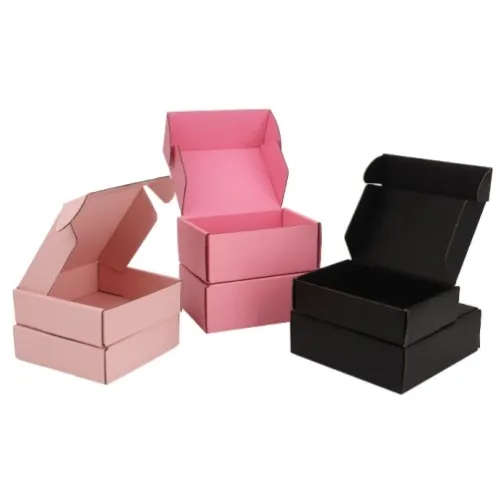
Black is the most requested colour in e-commerce packaging — and the most misunderstood to print. A black mailer box is not one product but two different constructions, and the print method that works on one can fail on the other. This guide covers the four ways to make artwork read on a black surface, what each costs, and how each survives the journey to your customer.
Two Ways a Black Mailer Box Is Made
The first is a printed black: a standard white or kraft box printed with heavy black coverage. It is cheaper and works for most runs, but the flute pattern or board tone can show faintly under the ink, and large solid areas show scuffs more readily.
The second is black-dyed paper laminated to the board. The colour is in the material, not the print, so it is deeper and perfectly even, and the inside can stay natural. It costs more per sheet but needs no black ink coverage at all. If your budget allows, dyed paper is the safer choice for premium programmes; if not, printed black with matte lamination gets surprisingly close.
Method 1: Foil Stamping
Foil is the default answer for a logo on black. A heated brass die presses metallic foil into the surface, so the mark reads by reflection, not ink — and nothing reads brighter on black than gold, silver or copper foil. Details that matter:
Foil needs bolder lines than print. Thin serif faces below about 1 mm stroke width tend to fill in; simplify the artwork for the die.
Each foil colour adds a setup cost, not a per-unit cost — one gold logo costs the same to set up as three gold logos in different positions.
On a textured or dyed paper, ask for a foil sample first; adhesion varies by stock.
Method 2: Spot UV
Spot UV is a gloss varnish applied only to selected artwork, cured to a high shine. On a matte-laminated black box it creates a tone-on-tone effect: the logo is invisible from one angle and glossy from another. It is a quiet, premium look — but it is the subtlest of the four methods, so it works best as a second layer (gloss logo over matte black) rather than the only branding on the box. Spot UV costs less than foil and needs no metal die, which makes it attractive for mid-volume runs.
Method 3: White Ink — and Why It Is Usually an Underprint
White ink is the only way to print a light-coloured design on black without foil. On its own, one pass of white over black usually looks grey and patchy; the standard practice is two passes or a white underprint beneath the actual design colours. That adds a print pass, so quote it as a two-colour job rather than a one-colour job. When the design is, say, a white line-art logo, white ink is cheaper than foil at higher volumes — the crossover is usually somewhere in the low thousands of units, which is exactly why we quote both.
Method 4: Blind Deboss
A blind deboss presses the logo into the surface without any ink or foil at all. On black it reads as a shadow — visible up close, quiet from a distance. It suits brands whose whole aesthetic is restraint, and it is the most durable option because there is literally nothing to scratch off. The limitation is contrast: on soft, uncoated black paper a deboss can almost disappear under shop lighting.
Which Finish Survives Transit?
Dark packaging shows handling marks more than light packaging — that applies to every method above. Matte lamination is the single most effective protection for printed black, because it takes the scuffs that would otherwise sit in the ink layer. Foil and deboss are the most abrasion-tolerant decorations; uncoated spot UV areas can scuff white if rubbed hard against liner.
If dark artwork is central to your brand, it is worth reading why dark printed cartons show scuff marks so easily before fixing the coating spec — the same physics applies to mailers.
What to Send for a Quote
For black boxes we quote fastest with: size (L × W × H), quantity, construction choice (printed black or dyed paper), the decoration method per position, and whether the inside is black too. If you are still choosing the base specification, start from the custom mailer boxes overview — decoration is the last variable to lock, not the first. For programmes that run continuously, the pricing logic is the same as any other repeat order; see how custom mailer boxes wholesale pricing breaks down before committing to a finish that adds setup cost to every reorder.