
Sep 30, 2026Blog
Why Do Dark Printed Cartons Show Scuff Marks So Easily?
Why do black and dark printed cartons show scuff marks? Learn how ink coverage, matte finishes, handling and packing affect surface wear before bulk production.
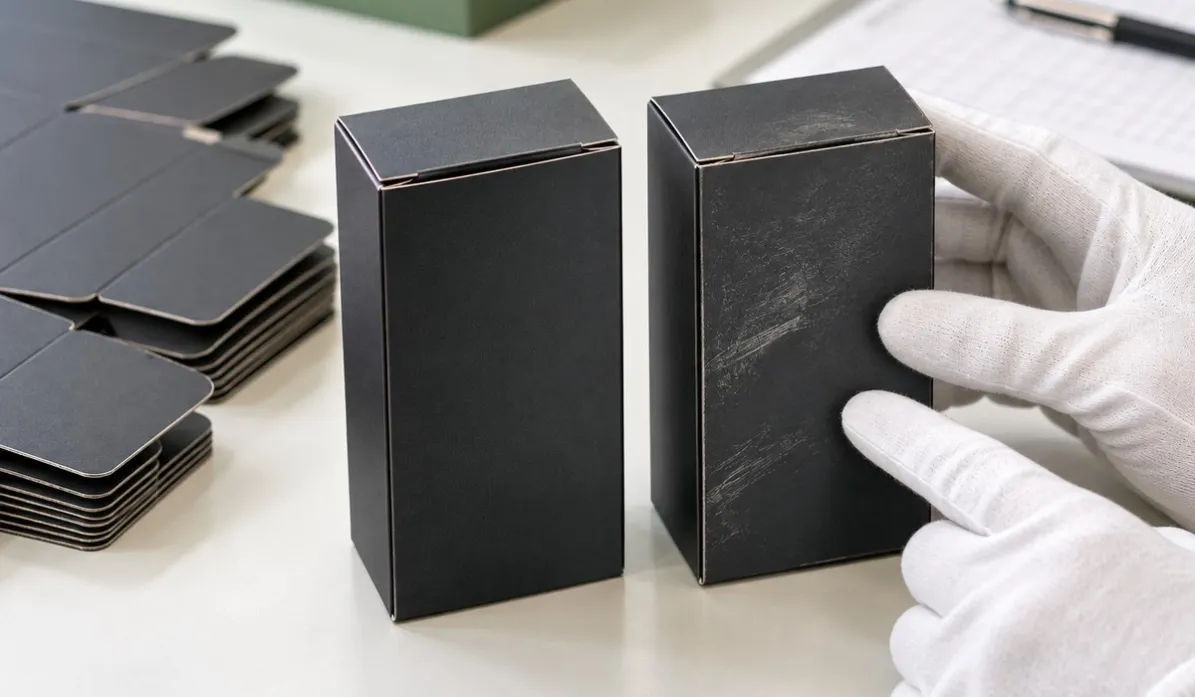
A black folding carton can look almost perfect when it comes off the printing press.
The color is deep and even. The surface looks clean. The finish gives the packaging exactly the premium appearance the brand wanted.
Then the cartons are handled, stacked, folded or packed.
Small pale lines begin to appear.
Some areas look scratched. Others develop shiny rub marks. On a dark matte surface, even a minor mark can suddenly become very noticeable.
So what happened?
The problem is often described simply as scuffing, but the visible mark can come from different combinations of printing, surface finishing, friction, pressure and handling.
And there is another important point:
Dark packaging does not necessarily scuff more than light packaging — but the same surface damage can be much easier to see.
For buyers developing black, navy, dark green or other heavily printed folding cartons, surface performance should therefore be evaluated before mass production rather than judged only from a clean presentation sample.
Why Are Scuff Marks More Visible on Dark Packaging?
Imagine two cartons receive a similar light rub during handling.
One is white.
The other is matte black.
The physical contact may be similar, but the visual result can be very different.
On a light-colored carton, a minor surface change may blend into the background.
On a dark carton, the same change can create stronger contrast.
Depending on the surface, it may appear as:
- a pale streak
- a shiny patch
- a dull patch
- a scratch-like line
- ink or coating wear
- a burnished area where the surface has been rubbed
This is one reason dark premium packaging deserves additional attention during sampling.
The issue is not simply:
Black ink = poor durability.
The better question is:
How will this particular printed and finished surface behave during the actual production, packing and distribution process?
First Identify What Kind of Mark You Are Seeing
Before changing the paper or adding another finish, look closely at the defect.
Not every white or pale mark has the same cause.
For example, a carton may show:
Surface Scuffing
The printed or finished surface has rubbed against another surface during handling, converting, packing or transportation.
Scratching
A harder or sharper contact has physically marked the surface.
Burnishing
A matte or low-gloss surface has been repeatedly rubbed and becomes shinier in one area.
Ink or Coating Damage
The surface layer itself has been disturbed or worn.
Crease Whitening
The mark appears specifically along a fold because the paperboard and printed surface are being stressed during folding.
That last problem is different.
If the white line appears mainly along the folds, see our guide to why folding cartons crack along the crease.
Correctly identifying the defect matters because a solution for crease cracking may not solve surface scuffing — and vice versa.
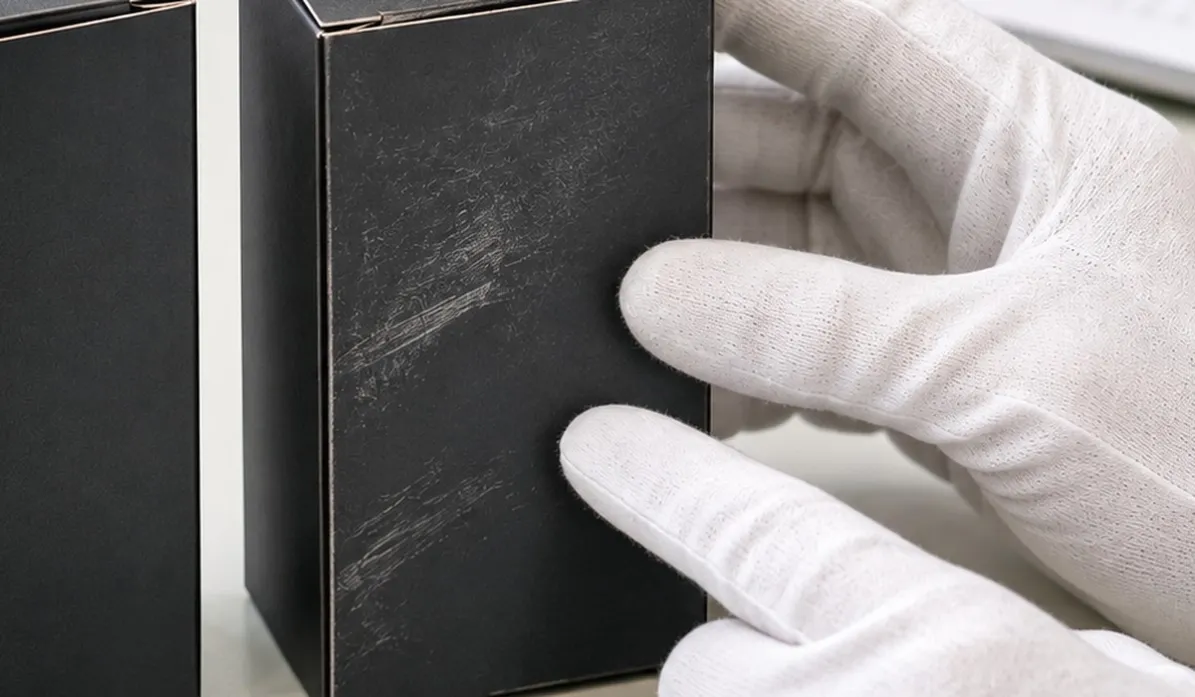
Large Dark Printed Areas Can Be Less Forgiving
Dark packaging often uses large areas of solid color.
Examples include:
- matte black cosmetic cartons
- dark navy electronics packaging
- deep green skincare boxes
- burgundy gift cartons
- charcoal fashion packaging
These designs can create a strong premium appearance.
But they also leave fewer places for small surface variations to hide.
A highly detailed graphic may visually disguise a minor mark.
A large uninterrupted black panel does not.
This does not mean brands should avoid dark packaging.
It simply means the visual sensitivity of the artwork should be considered when the material and finishing are selected.
For color-sensitive packaging, it is also worth understanding why packaging colors can look different from approved artwork.
Does Matte Finishing Make Scuffing Worse?
Not automatically.
“Matte” can describe different finishing systems, and they do not all behave in exactly the same way.
Depending on the project, a carton may use:
- matte varnish
- matte aqueous coating
- matte lamination
- soft-touch coating
- soft-touch film
- other specialty surface treatments
These finishes are chosen for different reasons.
Some create a low-gloss appearance.
Some provide additional surface protection.
Some are mainly selected for tactile feel.
And different formulations can have different resistance to rubbing, scratching and fingerprints.
That is why it is risky to assume:
“Matte is matte.”
or:
“Lamination will solve every surface problem.”
The actual finish should be evaluated together with the ink coverage, paperboard, carton structure and expected handling conditions.
For premium cartons using foil, embossing, spot UV or soft-touch effects, our Luxury Folding Cartons page shows some of the finishing options that can be combined with folding carton structures.
What About Soft-Touch Finishes?
Soft-touch surfaces are popular for premium packaging because they create a distinctive tactile effect.
They are often used for:
- cosmetics
- skincare
- electronics
- fragrance
- fashion accessories
- premium retail products
But tactile appearance should not be evaluated separately from handling performance.
A finish that feels excellent in a presentation sample still needs to survive the way the cartons will actually be:
stacked → converted → packed → case-packed → transported → handled
For a dark soft-touch carton, even relatively minor surface changes may be visually distracting.
This does not mean soft-touch should be rejected.
It means the sample should answer two questions:
- Does the finish look and feel right?
- Is its surface performance suitable for the actual packaging process?
Both matter.
Scuffing Can Happen After Printing
When a buyer sees a scratched carton, it is easy to assume the printing itself was defective.
But the printed sheet still goes through several processes after printing.
Depending on the carton, these may include:
Printing → Finishing → Die Cutting → Creasing → Folding/Gluing → Bundling → Packing
Surface contact can occur at several stages.
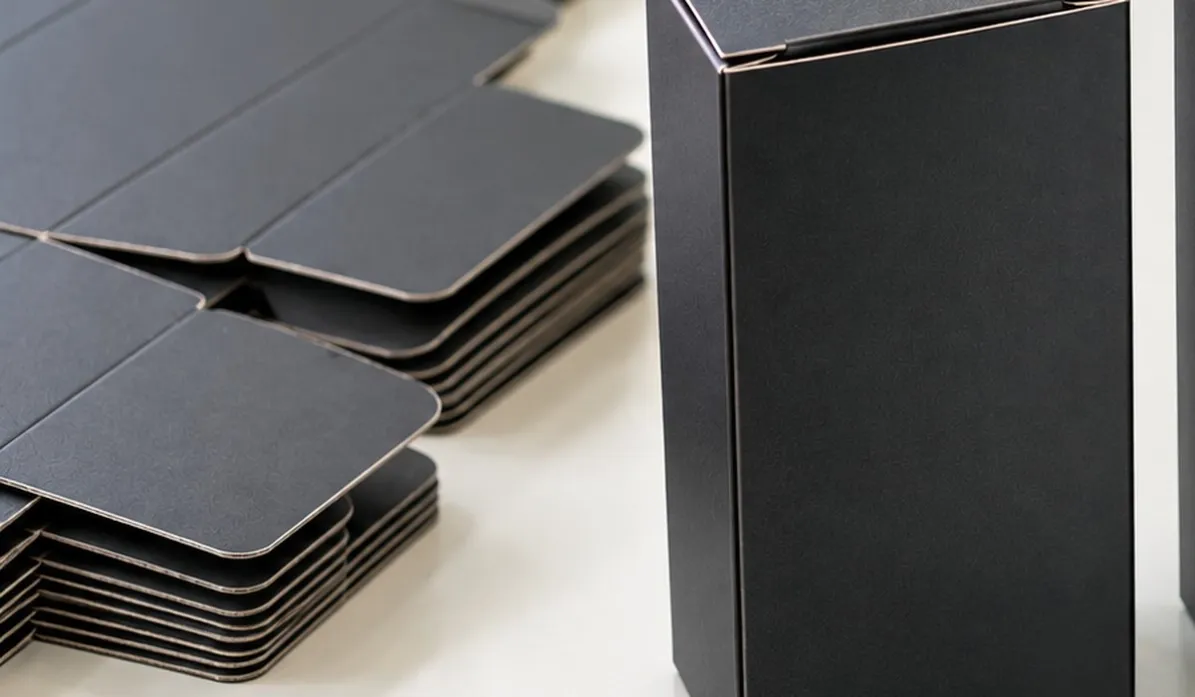
For example, printed surfaces may rub during:
- stacking
- die cutting and stripping
- folding and gluing
- bundling
- movement inside the shipping carton
- product packing
- warehouse handling
- transportation
This is why the location and pattern of the marks can provide useful clues.
If every carton has a similar mark in the same position, investigate the production or handling path.
If marks appear randomly after transportation, the packing method and carton movement may deserve more attention.
Quality control should therefore consider the complete production process rather than only the printing stage. Our guide to custom packaging quality control and printing checks explains this broader approach.
Packing Method Can Matter More Than Buyers Expect
Imagine 500 beautifully printed black folding cartons are packed tightly into an outer shipping carton.
During transportation, the cartons experience vibration and movement.
If finished surfaces repeatedly rub against each other, visible marks may develop even though the cartons looked perfect before packing.
The solution is not always simply to make the surface harder.
Depending on the packaging and required quality level, the supplier may also need to review:
- carton orientation
- bundle quantity
- movement inside the outer carton
- surface-to-surface contact
- separators or interleaving where justified
- outer carton fit
- handling during packing
Adding protection also has a cost.
So the objective should not be to add unnecessary packing material everywhere.
The objective is to identify where damaging contact is actually occurring and use an appropriate level of protection.
Should You Simply Add Lamination?
Sometimes lamination is appropriate.
But it should not become an automatic answer to every scuffing complaint.
Lamination changes more than surface protection.
It can also affect:
- appearance
- tactile feel
- folding behavior
- cost
- finishing compatibility
- material construction
- recyclability considerations
A premium brand may deliberately choose lamination because the desired appearance and protection justify it.
Another project may prefer a coating or varnish because its performance, cost or material strategy is more suitable.
The right decision depends on the complete packaging specification.
This is why Printed Folding Cartons should be specified as a combination of paperboard, printing, structure and finishing rather than treating the printed artwork as the only important variable.
Test the Finished Surface, Not Just the Artwork
A digital mockup cannot tell you whether a dark matte surface will mark during handling.
Neither can a PDF.
Even a printed flat sheet does not reproduce every condition the finished carton will experience.
For appearance-sensitive packaging, review a representative finished sample.
Then handle it.
Fold it.
Assemble it.
Pack the actual product where relevant.
Place several finished cartons together.
Look at the high-contact areas.
The objective is not to deliberately destroy the sample.
It is to evaluate the packaging under conditions closer to how it will actually be used.
Pay particular attention to:
- large dark panels
- corners and edges
- areas touched during assembly
- panels facing another carton during packing
- matte or tactile surfaces
- foil or spot-finished areas
- high-contact retail surfaces
A sample that looks beautiful when untouched is only part of the evaluation.
What If the Sample Looks Good but Bulk Cartons Show Marks?
This situation deserves investigation rather than an immediate assumption about the cause.
Ask:
When did the marks first appear?
Were the cartons clean immediately after finishing?
Did marks appear after die cutting?
After folding and gluing?
After bundling?
After packing into master cartons?
After transportation?
Also check whether the bulk production used the same:
- paperboard
- ink specification
- surface finish
- production process
- packing method
as the approved reference.
The timing of the defect can help narrow down the cause.
For example:
Marks before packing
→ review printing, finishing, converting and production handling.
Marks mainly after packing
→ review carton-to-carton contact and packing method.
Marks mainly after transportation
→ review movement, vibration and outer packing.
White lines only on folds
→ investigate crease whitening or cracking rather than general surface scuffing.
Diagnosis should come before changing the specification.
What Should Buyers Check Before Approving Dark Packaging?
For black or other dark premium cartons, ask the supplier to confirm more than the color.
Review:
Check | Why It Matters |
|---|---|
Paperboard | Affects printing and surface behavior |
Dark ink coverage | Large solid areas can make marks more visible |
Surface finish | Changes appearance, feel and surface performance |
Folding areas | Helps separate scuffing from crease cracking |
Finished sample | Shows the actual material and finish together |
Handling | Reveals high-contact areas |
Packing method | Helps control carton-to-carton rubbing |
Outer carton | Affects movement during transportation |
Approved reference | Gives production a physical quality benchmark |
For a particularly appearance-sensitive project, discuss acceptable surface appearance before mass production rather than after delivery.
A Premium Finish Still Has to Survive the Real Packaging Process
A premium folding carton is not finished when it looks good immediately after printing.
It still needs to pass through:
Finishing → Die Cutting → Folding → Packing → Transportation → Retail Handling
That is why the most visually attractive finish is not automatically the most suitable finish for every project.
The better decision balances:
Appearance + Surface Performance + Production + Packing + Cost
For dark packaging, this becomes especially important because small surface changes can be highly visible.
The objective is not to make a carton that can never be marked under any condition.
It is to select and test a surface that is appropriate for the way the packaging will actually be produced, packed and handled.
Planning a Dark or Premium Printed Folding Carton?
If your packaging uses black, navy, dark green or another large solid color, send us the project details before finalizing the material and finish.
Useful information includes:
- box dimensions
- product dimensions and weight
- order quantity
- artwork
- Pantone or color requirements
- paperboard preference
- matte, gloss or soft-touch requirements
- foil, embossing or spot UV requirements
- packing method
- appearance expectations
Jeeli Packaging can review the paperboard, printing, finishing and carton structure together before sampling and bulk production.