
Sep 23, 2026Blog
Strong for Shipping, Easy to Open: How Should Shelf-Ready Packaging Be Designed?
How can shelf-ready packaging stay strong during shipping but tear open cleanly for retail display? Learn what to consider before production.
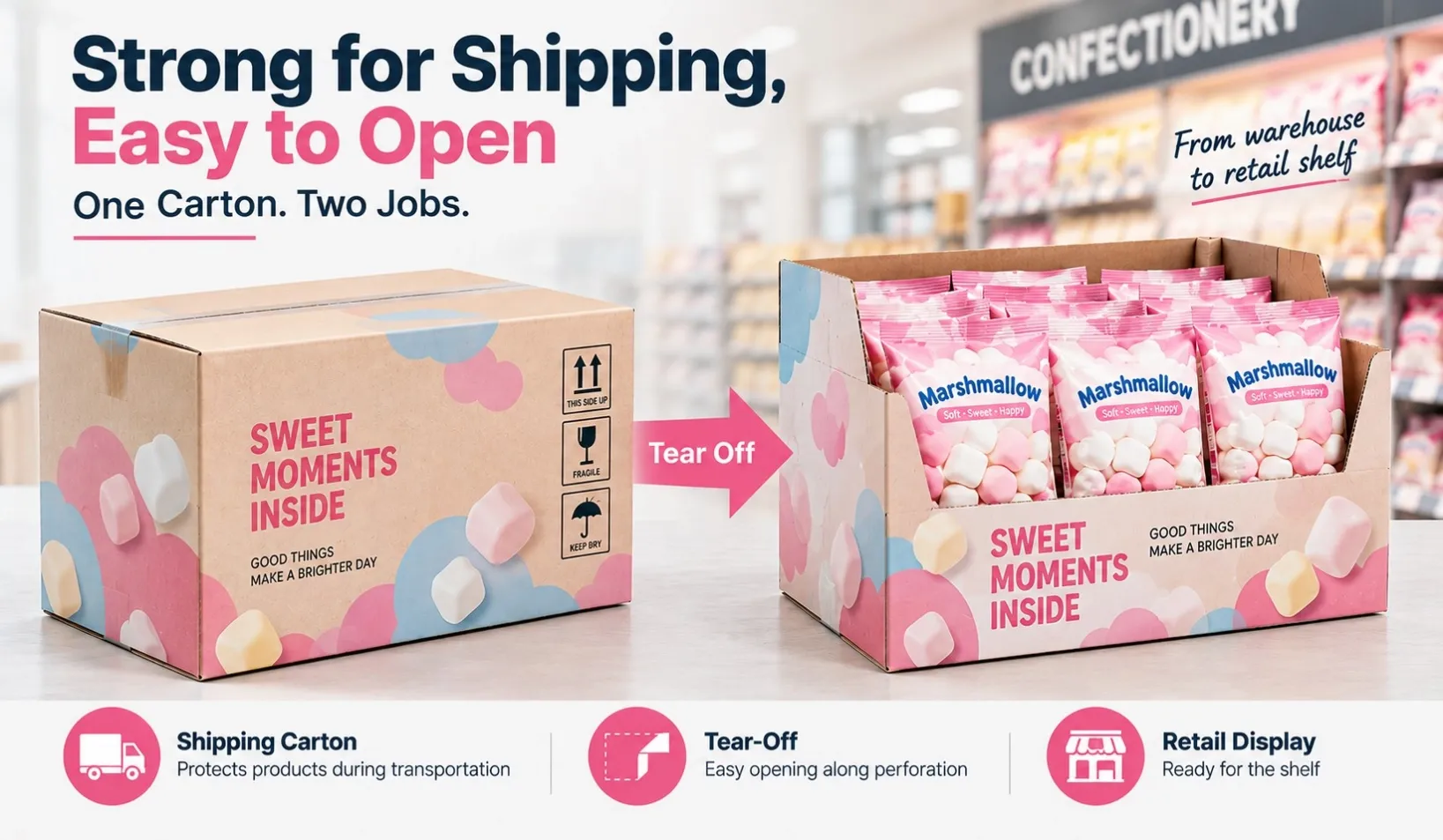
A shelf-ready carton has to do something that sounds contradictory.
It needs to be strong enough for packing, stacking and transportation, but once it reaches the store, part of the carton should be easy to tear away cleanly so the remaining section can become a retail display.
And after the top is removed, the lower section still needs to hold the products securely and look presentable on the shelf.
So the real challenge is not simply choosing a stronger corrugated board.
It is finding the right balance between:
Shipping Strength + Easy Opening + Display Stability + Print Presentation
A useful way to evaluate the complete carton is:
Board Construction + Carton Size + Product Arrangement + Perforation + Remaining Structure + Printing + Actual Load
What Is Shelf-Ready Packaging?
Shelf-ready packaging, also called retail-ready packaging in some applications, is designed to protect products during distribution while also making in-store stocking and display easier.
Shelf-ready packaging (SRP) is a shipping carton designed to transport products and then convert into a retail display by opening or removing part of the outer carton.
For a tear-away design, store staff remove the upper section along a perforation line while the lower section remains on the shelf holding the products. This 2-in-1 shipping and display structure is commonly used in custom retail POP display packaging when products need to move from transportation directly into retail presentation.
A typical process may look like this:
Packing → Transport → Stacking → Tear-Off → Retail Display
This type of packaging is commonly used for snacks, packaged foods, beverages and other fast-moving retail products.
Similar shelf-ready packaging formats can also be seen in warehouse-club and large retail environments such as Sam’s Club, where packaging may need to support both transportation and efficient in-store display.
The important point is that the carton should be evaluated in two conditions:
- before opening, as a shipping carton;
- after opening, as a retail display.
Why Is the Perforation Line So Important?
The perforation may look like a simple dotted cutting line.
But in a shelf-ready carton, it is part of the structure.
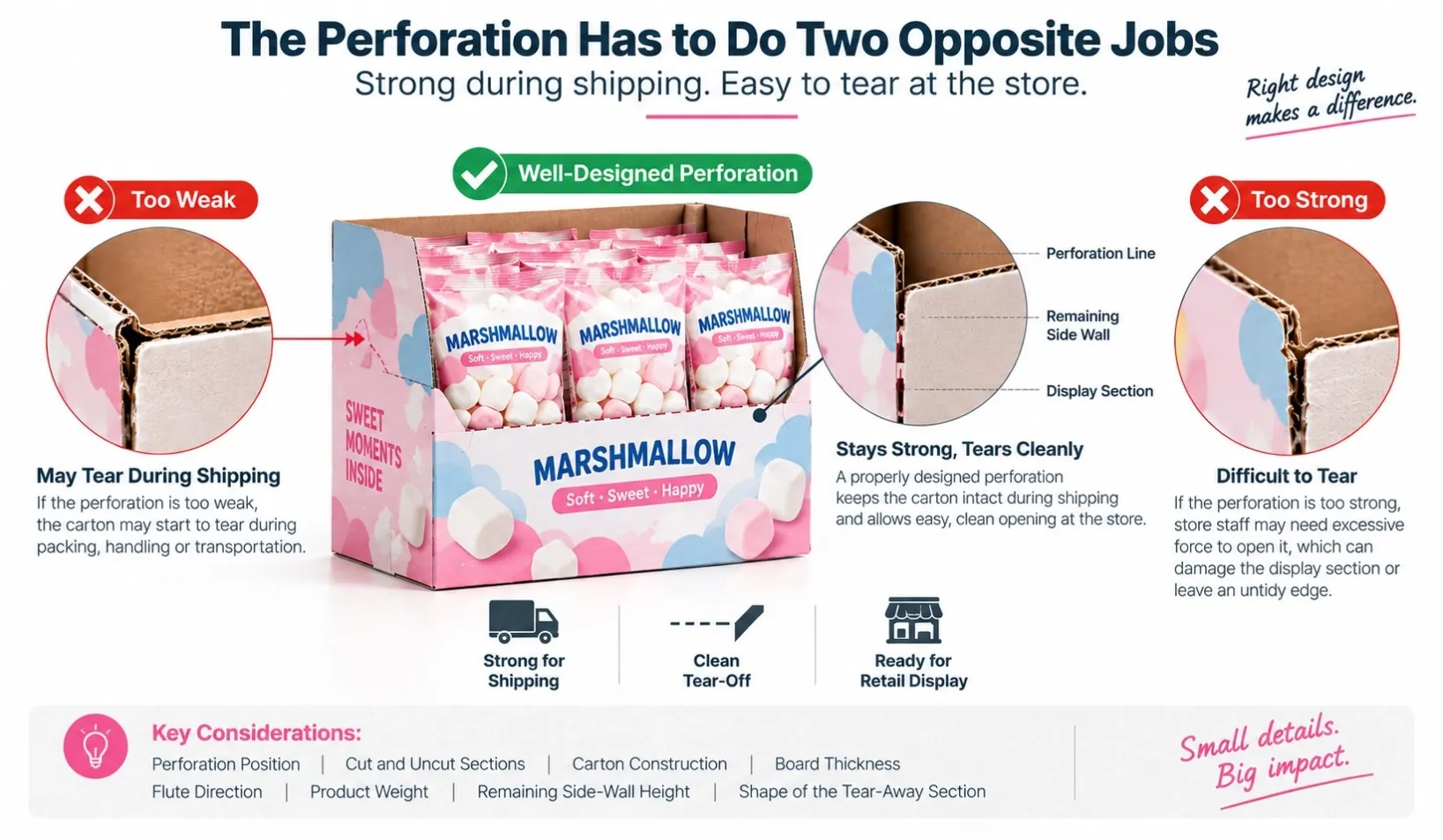
If the perforation is too weak, the carton may begin to tear during packing, handling or transportation.
If it is too difficult to tear, store staff may need excessive force to open it. The remaining display section can then be damaged or left with an untidy torn edge.
Several factors may affect perforation performance:
- perforation position;
- cut and uncut sections;
- carton construction;
- board thickness;
- flute direction;
- product weight;
- remaining side-wall height;
- shape of the tear-away section.
This creates another design balance:
Strong Enough During Shipping ↔ Easy Enough to Open at the Store
The perforation should therefore be considered together with the carton structure rather than added as an afterthought.
Why Is a Shelf-Ready Carton More Difficult to Design?
A conventional shipping carton is mainly expected to protect its contents through packing, storage and transportation.
A shelf-ready carton has another job after transportation.
During shipping, it may need to be:
- stable;
- stackable;
- resistant to normal handling and compression;
- capable of keeping the products properly arranged.
At the retail location, the same carton may need to:
- open easily along a defined perforation;
- tear cleanly without damaging the display area;
- keep the remaining products supported;
- maintain a clean front and side profile.
This is why simply making every part of the carton stronger does not necessarily create a better shelf-ready package.
A good shelf-ready carton should be strong where it needs protection, but easy to tear where it needs opening.
Why Can't Material Selection Be Based on Flute Type Alone?
A buyer may initially specify a particular corrugated flute because the package also needs to function as a shipping carton.
For example, B-flute may be considered when transportation protection and carton rigidity are important.
But when the same carton also needs a controlled tear-off opening, full-colour graphics and an attractive retail display, flute type is only one part of the decision.
The buyer should also consider:
How will the carton perform during stacking?
How will the perforation behave?
Will the lower section remain stable after opening?
How will the printed graphics look at the point of sale?
What type of product and load will be inside?
A useful way to compare the requirements is:
Requirement | What to Consider |
|---|---|
Shipping strength | Corrugated structure, carton size and stacking conditions |
Retail display | Surface appearance and remaining display structure |
Easy opening | Perforation position and tear performance |
Lower section stability | Remaining wall height and structural support |
Full-colour graphics | Printing method and visible surface |
Product protection | Product weight, shape and arrangement |
The best construction depends on the complete application rather than one board specification. If you are still comparing different paper and board options, our packaging material selection guide explains why material choice should be based on the product, structure and actual packaging requirements.
Standard Corrugated Board vs Printed Paperboard Laminated to Corrugated Board
There is no single material construction that is suitable for every shelf-ready packaging project.
Standard Corrugated Construction
Corrugated board can provide transportation protection and structural support.
Depending on the printing method, artwork requirements and order quantity, it may also provide an economical solution for many retail-ready applications.
However, when the carton has a strong branding or point-of-sale function, buyers may place greater importance on print detail and surface presentation.
Printed Paperboard + Corrugated Reinforcement
Another option is to print the graphics on a smoother coated paperboard and laminate it to a suitable corrugated structure.
For example, a project may use:
300 gsm coated paperboard + full-colour printing + corrugated reinforcement
This type of construction can be considered when the package needs to combine:
Retail Presentation + Structural Support + Full-Colour Printing + Tear-Away Function
The smoother outer surface can support detailed graphics, while the corrugated layer provides structural support.
However, 300 gsm is not a universal specification, and a reinforced laminated structure is not automatically the right choice for every shelf-ready carton.
The paper weight and corrugated construction should still be selected according to:
- carton dimensions;
- product weight;
- product arrangement;
- stacking requirements;
- transportation conditions;
- printing requirements;
- perforation design.
A construction that works well for lightweight snack bags may not be suitable for bottles or heavier packaged products.
Why Does Product Arrangement Matter?
Product arrangement is easy to overlook when discussing carton material.
But it can significantly affect how the carton performs.
For example, a shelf-ready carton may contain:
20 flexible product bags arranged in 5 columns × 4 rows.
That load behaves differently from 20 bottles or 20 rigid boxes.
Buyers should therefore consider:
- product dimensions;
- quantity per carton;
- product weight;
- product orientation;
- empty space inside the carton;
- how tightly the products are packed;
- whether the products support each other during transportation.
Even when two cartons have similar external dimensions and similar total weight, the internal load can behave differently.
Soft bags may shift during transportation.
Bottles may create more concentrated loads.
Rigid boxes may distribute pressure differently again.
This is why material and structural decisions should start with the actual packed product, not only the external carton dimensions.
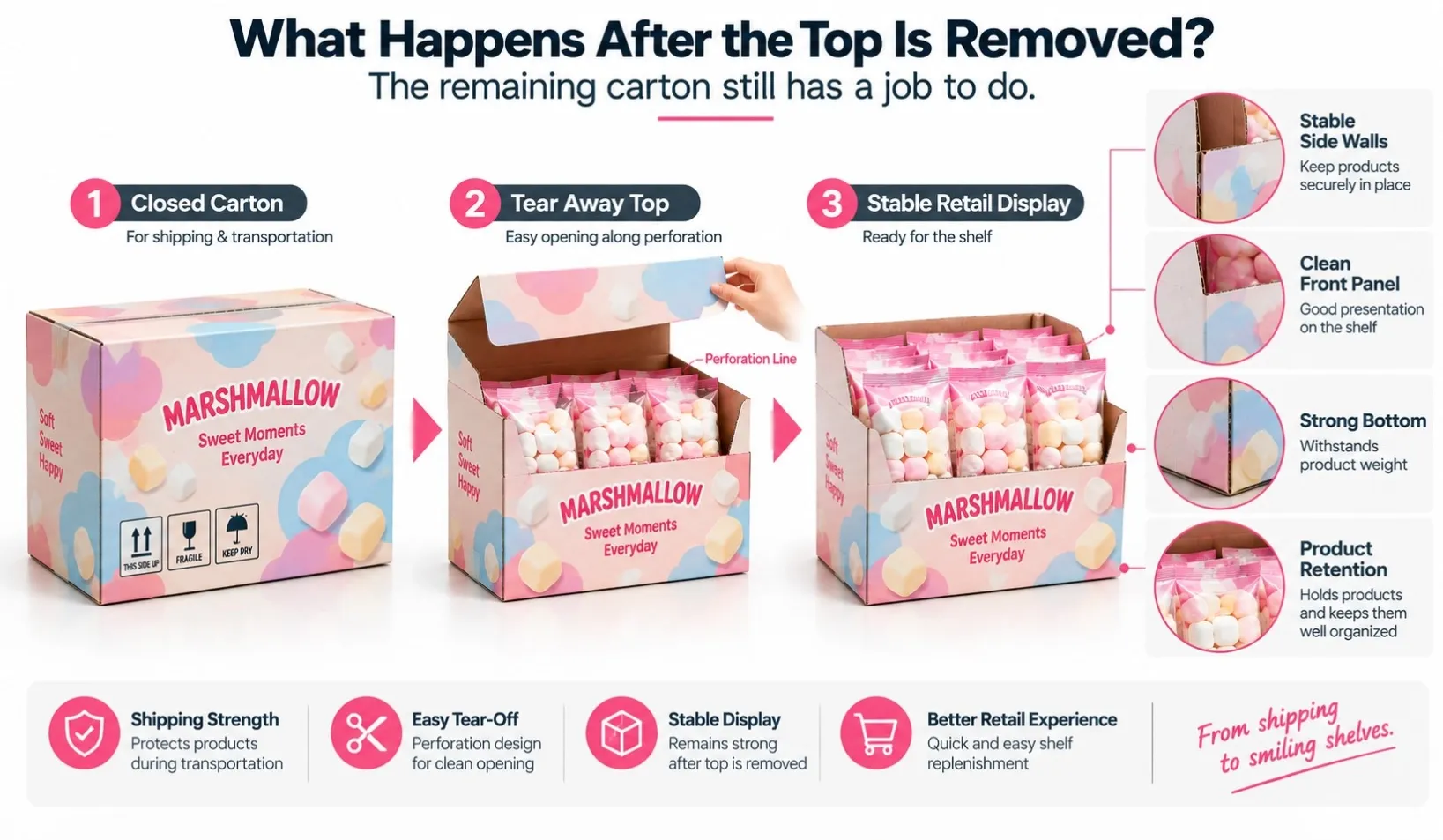
What Must Remain Strong After the Top Is Removed?
This is one of the most important questions in shelf-ready packaging development.
A carton may perform perfectly while it is completely closed.
But what happens after the tear-away section is removed?
Removing part of the carton changes the structure.
The lower section should therefore be evaluated as a display structure of its own.
Front Panel
Does it remain straight and presentable after opening?
Side Walls
Do they continue to support the products, or do they spread outward?
Bottom Panel
Does it remain flat and stable under the product load?
Corners
Does the remaining structure retain enough rigidity after part of the carton has been removed?
Product Retention
Are the products still held securely while remaining easy for shoppers to see and remove?
The lower section should not be treated as simply:
“what is left after tearing.”
It still has an important job to do.
The shipping carton may disappear, but the retail display needs to keep working.
Why Does Full-Colour Printing Affect the Material Decision?
Some shelf-ready cartons are mainly functional.
Others also become part of the brand presentation.
For example, snack packaging may use bright colours, illustrations, product graphics or promotional artwork to attract attention at the point of sale.
In this situation, buyers are no longer choosing the material based only on shipping strength.
They are balancing:
Printing Quality + Structural Performance + Cost + Display Appearance
A smoother printed surface may provide better reproduction for detailed full-colour artwork, while the corrugated layer underneath provides structural support.
This is one reason why the visible printed layer and the structural layer may sometimes be considered separately during packaging development.
The goal is not simply to make a shipping carton look better.
It is to make sure the package still looks appropriate when it becomes part of the retail display.
Where Is Shelf-Ready Packaging Commonly Used?
Shelf-ready and retail-ready cartons are commonly associated with retail environments where efficient shelf replenishment is important.
Typical applications may include:
- snack foods;
- confectionery;
- packaged foods;
- beverages;
- household products;
- personal-care products;
- other fast-moving consumer goods.
They can be particularly useful when retailers want to reduce the amount of unpacking and individual product handling required before products are displayed.
For smaller products displayed at checkout areas or on retail counters, a similar concept can also be used in custom counter display boxes, where the shipping structure can be converted into a ready-to-use display after opening.
Warehouse clubs and large-format retailers may also use similar retail-ready packaging concepts because products often move from distribution to selling areas with minimal repacking.
However, the exact structural, printing and testing requirements can vary significantly between products, retailers and distribution systems.
Why Is Prototype Testing Important?
For shelf-ready packaging, testing only the unopened carton tells only half the story.
The prototype should ideally be evaluated as both:
a closed shipping carton
and
an opened retail display.
A prototype can help buyers evaluate several important points.
Product Fit
Do the products fit the intended arrangement without excessive empty space or compression?
Transport Stability
Does the closed carton remain stable when fully packed?
Stacking
Does the structure provide suitable stability under the intended packing and distribution conditions?
Tear-Off Performance
Can the perforated section be removed cleanly without excessive force?
Display Stability
After the upper section is removed, does the remaining carton continue to support the products properly?
Retail Appearance
Does the opened carton present the artwork and products as intended?
A shelf-ready package can perform well during transportation but still fail as a display.
The opposite can also happen: an attractive display structure may not provide enough protection during distribution.
The prototype should therefore be evaluated both before and after the tear-away section is removed.
What Information Should Buyers Provide Before Prototyping?
Providing complete product information can make structural development much more efficient.
Before requesting a prototype, buyers should ideally provide:
Product Dimensions
The dimensions of each individual product or retail pack.
Product Weight
Both the individual product weight and approximate total packed weight.
Quantity per Carton
For example:
20 units per carton
Product Arrangement
For example:
5 units × 4 rows
Target Carton Dimensions
If the required outer dimensions have already been determined.
Printing Requirements
For example:
- full-colour artwork;
- spot colours;
- brand graphics;
- other finishing requirements.
Display Opening
Which part of the carton should be removed and how much of the product should remain visible after opening?
Distribution Requirements
How will the cartons be packed, stacked, transported and handled?
With this information, the supplier can evaluate the carton as a complete packaging system rather than simply quoting a flute type or board specification.
FAQ
What is shelf-ready packaging?
Shelf-ready packaging is designed to protect products during distribution and then support efficient retail display. In a tear-away design, part of the shipping carton is removed so the remaining section can hold and present the products on the shelf.
What is the difference between shelf-ready packaging and a normal shipping carton?
A normal shipping carton is mainly designed for protection during storage and transportation. Shelf-ready packaging also needs to function properly after opening, when part of the carton may become the retail display.
Is B-flute suitable for shelf-ready packaging?
B-flute can be suitable for some shelf-ready packaging applications, but flute type alone does not determine whether the final carton will perform well. Carton dimensions, product weight, stacking, printing, perforation and the remaining display structure should also be considered.
Can a shelf-ready carton use full-colour printing?
Yes. The appropriate printing method and material construction depend on the artwork, quantity, required appearance and structural requirements. For some projects, a printed coated paperboard can be laminated to corrugated board to combine a smoother printed surface with structural support.
Why does the lower section need to be tested after opening?
Removing the upper section changes the carton structure. The front panel, side walls, bottom and corners may have less support, so the opened display should be evaluated with the intended products inside.
Should I make a prototype before mass production?
For a new shelf-ready structure, prototype testing is highly useful. It allows product fit, transport stability, perforation performance and the remaining display structure to be evaluated before mass production.
Final Thoughts
Shelf-ready packaging should not be designed as a shipping carton first and a retail display second.
The two functions need to be considered together from the beginning.
The most suitable solution depends on:
Board Construction + Carton Size + Product Arrangement + Perforation + Remaining Structure + Printing + Actual Load
So instead of asking only:
“Which flute should I use?”
a more useful question is:
“What structure will protect my products during transportation, tear open cleanly at the store and remain stable as a retail display?”
If you're developing a shelf-ready or retail-ready display carton, send us:
- your product dimensions;
- product weight;
- quantity per carton;
- target carton size;
- preferred display opening.
We can review the board construction, perforation design and remaining display stability before prototyping and production.