
Buying Guides
A-Flute vs B-Flute: Why Box Thickness and Strength Can Differ
Why can A-flute, B-flute and 250gsm paperboard vary in thickness and strength? Learn what buyers should check before approving corrugated box materials.
When comparing corrugated packaging materials, buyers often start with two specifications: flute type and paper weight.
For example, a supplier may recommend changing a printed corrugated box from B-flute to A-flute. The buyer then asks a reasonable question:
"Isn't A-flute about 5mm thick?"
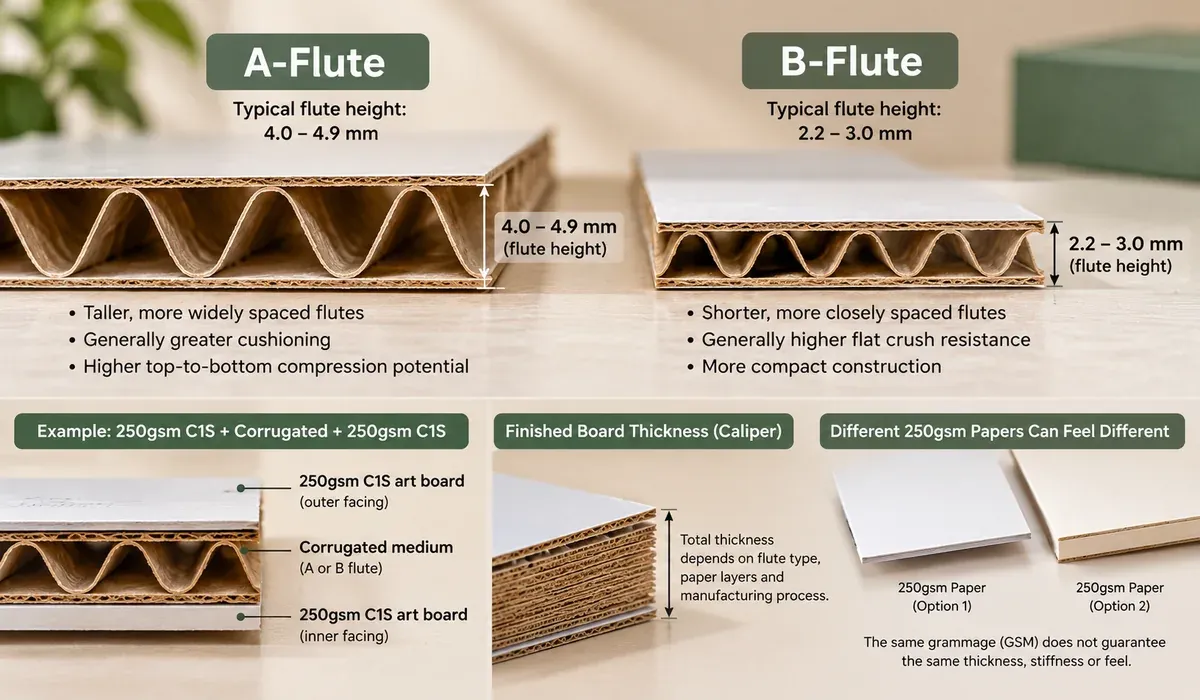
According to commonly published flute specifications, conventional A-flute is around 4–5mm high, while B-flute is around 2–3mm. Yet a flute name alone does not guarantee the thickness or performance of the finished board.
To make a sound purchasing decision, it helps to understand the difference between flute geometry, finished board thickness, paper quality and the strength of an assembled box.
A-Flute vs B-Flute: What's the Difference?
The flute is the wave-shaped paper layer bonded between flat facing layers in corrugated board.
Its height and spacing affect cushioning, board thickness and how the structure responds to pressure.
Feature | A-Flute | B-Flute |
|---|---|---|
Typical flute height* | Approx. 4.0–4.9mm | Approx. 2.2–3.0mm |
Typical flute pitch* | Approx. 8.0–9.5mm | Approx. 5.5–6.5mm |
Flute profile | Taller, more widely spaced | Shorter, more closely spaced |
Cushioning potential | Generally greater | Generally lower |
Flat crush resistance | Generally lower | Generally higher |
Top-to-bottom compression potential | Generally higher under comparable conditions | Generally lower under comparable conditions |
Finished box performance | Depends on materials and box construction | Depends on materials and box construction |
These are commonly cited dimensional ranges, including those referenced in DIN 55468-related technical information. Other standards and suppliers may use somewhat different ranges.
A-flute may provide useful cushioning and compression characteristics. B-flute's denser profile may offer better resistance to flat crushing.
Neither is automatically the stronger choice for every product or box design.
Is A-Flute Always 5mm Thick?
Not exactly. Conventional A-flute is commonly described as approximately 4–5mm high, but buyers should distinguish two measurements:
- Flute height: The height of the corrugated wave within the board.
- Finished board thickness (caliper): The thickness of the complete board, measured under a defined method and pressure, including its facing layers.
These values are related, but they are not interchangeable.
For example, a printed corrugated board may use 250gsm C1S art board + corrugated medium + 250gsm C1S art board.
The two printed facing layers, the actual flute geometry, bonding and manufacturing processes all affect the finished construction.
A supplier may also use a local or internal material designation that differs from a buyer's reference chart. This is a reason to clarify the specification—not to conclude that conventional A-flute is normally only 3mm thick.
If a board is described as A-flute but its finished thickness is approximately 3mm, ask for clarification before approving it.
That measurement is substantially below the commonly published flute-height range for conventional A-flute.
Possible explanations include a different flute designation, a modified profile, processing-related flute compression or a misunderstanding about which dimension was measured.
Without inspecting the material, none of these should be assumed.
Ask the supplier to confirm:
- Actual flute height and pitch
- Finished board thickness and measurement method
- Corrugating medium grade and grammage
- Inner and outer facing paper specifications
- Any processing that may change the flute profile
Thickness is only half the story — the flute also decides how the box prints: offset, flexo or lamination on corrugated explains which print methods each flute can take.
The safest approach is to agree on measurable specifications and approved samples, not a flute name alone.
Why Two Corrugated Boards Can Have Different Strength
The flute letter is only one part of the material specification.
1. Corrugating Medium Quality
The corrugating medium forms the wave-shaped structure inside the board.
Its grade, grammage, fiber characteristics and mechanical properties affect how the flute withstands pressure.
Two boards with similar flute profiles can perform differently when the corrugating media are not equivalent.
2. Flute Height and Spacing
A-flute and B-flute differ in geometry, not just in the strength of the paper used for the medium.
Flute height, pitch and flute count can influence cushioning, resistance to flat crushing and compression behavior.
That is why changing from B-flute to A-flute should be treated as a structural change rather than simply a material upgrade.
3. Facing Paper Quality
The flat facing layers contribute to stiffness, appearance and overall board performance.
For premium printed corrugated packaging, a manufacturer may laminate printed C1S art board to the corrugated structure.
But specifying "250gsm C1S" on a quotation does not tell the buyer everything about the paper's physical properties.
4. Manufacturing and Box Construction
Bonding quality, flute crushing during conversion, die-cutting, folding and box geometry can all affect performance.
The same corrugated board may behave differently when used in boxes with different dimensions, locking structures or internal supports.
For a meaningful comparison, evaluate the finished box with the intended product, not just two flat sheets.
Why Two 250gsm Papers Can Feel Different
This issue is not limited to corrugated board.
When comparing custom paper bags, two bags made from paper specified as 250gsm may feel noticeably different.
One may feel firm and structured, while the other bends more easily.
That does not necessarily mean either supplier has quoted the wrong paper weight.
GSM measures mass per square metre. It does not directly specify paper thickness or bending stiffness.
Different mills and paper grades can produce different results because of fiber composition, bulk, density, grain direction, moisture content and manufacturing conditions.
That is why physical samples matter when appearance, rigidity or surface feel are important.
What Should Buyers Check Before Changing Flute Type?
Suppose a supplier recommends changing a box from B-flute to A-flute.
Before accepting the change, ask what the new structure is intended to improve.
Is the goal better cushioning, a different compression response, improved protection for a heavier product or a particular feel in the finished box?
Then compare materials and finished samples under relevant conditions.
Specification | What Buyers Should Confirm |
|---|---|
Flute type | Actual flute geometry, not just the supplier's label |
Finished board thickness | Measured caliper, method and agreed tolerance |
Facing paper | Paper grade, grammage and relevant stiffness characteristics |
Corrugating medium | Grade, grammage and mechanical properties |
Board strength | Relevant edge crush, flat crush or other test results where needed |
Finished box | Product fit, folding, closures and performance in expected handling |
Production sample | Representative material from the intended supplier and process |
Not every project needs every laboratory test. The useful tests depend on the packed product, shipping method and performance requirements.
Also remember that a thicker board can change internal dimensions, creasing, folding, shipping volume and cost.
More thickness is not always a better result.
Why Actual Samples Matter More Than Material Names
Flute charts are useful starting points. They help buyers understand the typical differences between A-flute, B-flute and other profiles.
But they cannot confirm what a particular factory is supplying.
When the distinction matters to your order, request representative material and finished-box samples.
Check the board edge, measure caliper using an appropriate method, assemble the carton and evaluate the packed product.
If shipping protection or load-bearing performance is critical, arrange suitable testing.
Frequently Asked Questions
Is A-flute always 5mm thick?
No single measurement should be assumed. Conventional A-flute is commonly around 4–5mm high, but the actual flute profile and finished board caliper should be specified and verified.
Is A-flute stronger than B-flute?
Not in every respect. Under comparable conditions, A-flute may offer greater cushioning and top-to-bottom compression potential, while B-flute generally offers greater flat crush resistance.
B-flute is also the workhorse for printed retail pieces: counter display boxes typically run on B-flute or E-flute for flat-crush strength and a smoother print surface.
Actual performance depends on materials, manufacturing and box design.
Can a 3mm finished board be called A-flute?
A 3mm finished caliper would be unusually low for conventional A-flute.
Ask the supplier for the actual flute geometry and material specification rather than accepting or rejecting the designation without checking the sample.
Does 250gsm paper always have the same thickness or stiffness?
No. Paper weight per square metre does not uniquely determine caliper, bulk or bending stiffness.
Different paper grades and mills can produce noticeable differences.
Should buyers approve a material change without a sample?
When the change can affect strength, protection, appearance or box fit, a representative sample should be checked before bulk production.
Final Thoughts
Flute names and GSM figures are useful, but they are only the beginning of a packaging specification.
A-flute and B-flute differ in geometry and mechanical behavior. Two papers with the same grammage can also feel and perform differently.
The practical question is not simply "Which flute is thicker?" but "Does this exact board construction perform as required for our product?"
For buyers, agreeing on measurable specifications and approving representative samples is more reliable than comparing flute names alone.
Need Help Comparing Corrugated Materials?
Jeeli Packaging supplies custom printed corrugated boxes and paper packaging solutions.
If you're considering a change in flute type or facing paper, send us your product dimensions, weight, box design, quantity and any existing material sample.
We can review the construction and help identify which specifications and sample checks are important before quotation or production.