
Sep 28, 2026Blog
How to Choose Paperboard for Folding Cartons: Why GSM Is Not Enough
How do you choose the right paperboard for a folding carton? Learn how GSM, thickness, stiffness, product weight, carton size, structure, printing and finishing affect material selection.
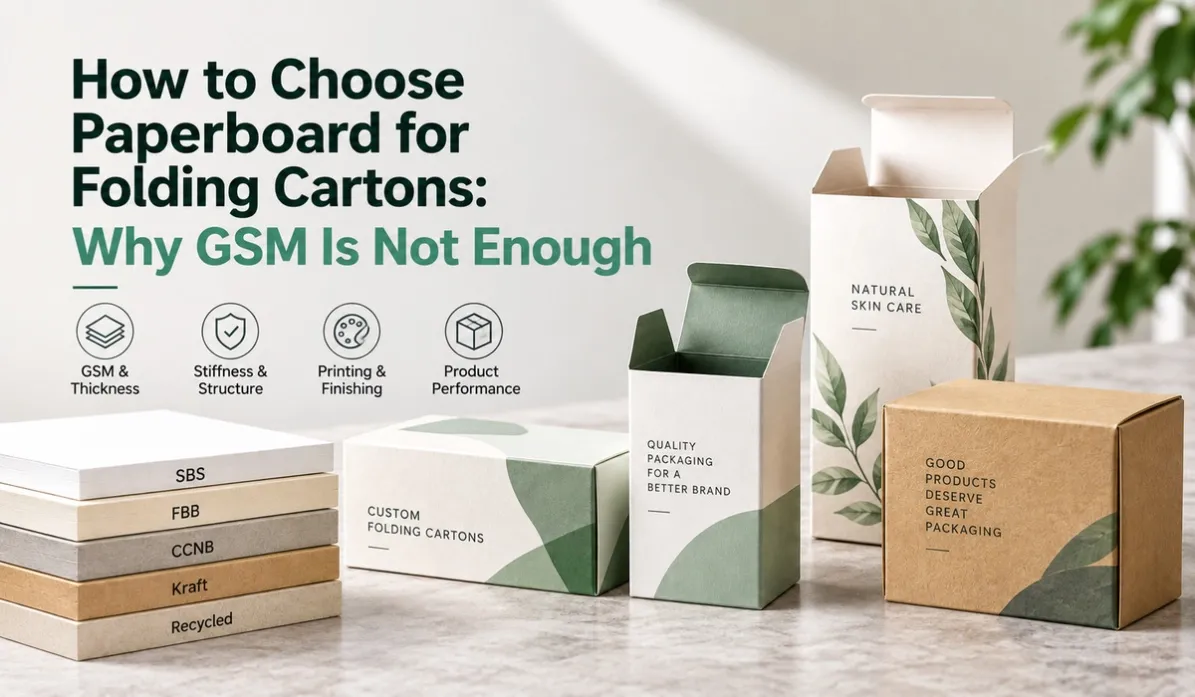
Choosing paperboard for a folding carton may seem simple.
A buyer might ask:
“Should I use 250gsm, 300gsm or 350gsm?”
It sounds like a reasonable place to start.
But GSM alone does not tell you whether a folding carton will be stiff enough, fold cleanly or work well with the actual product.
Two paperboards with a similar GSM can feel very different.
One may be thicker but relatively soft. Another may be thinner but stiffer.
And the same paperboard may perform well for a small lightweight carton but behave very differently when used for a larger box or a heavier product.
The right paperboard depends on the product, carton size, structure, printing requirements and production process — not simply on GSM.
So before choosing the thickest board available, it is better to understand what the carton actually needs to do.
Why Does Paperboard Selection Matter for Folding Cartons?
Paperboard is not only the surface that carries the printing.
It is also part of the carton structure.
The selected board can affect:
- Panel stiffness
- Folding performance
- Crease quality
- Tuck flap fit
- Bottom strength
- Printing appearance
- Foil stamping and embossing
- Gluing
- Packing efficiency
- Final shelf appearance
This means paperboard selection should not be separated from structural design.
A beautiful material may not be suitable if it is difficult to crease, fold or glue.
Likewise, a very thick board does not automatically create a better carton.
The goal is to find a material that works with the product, structure and production process together.
If you are still deciding between tuck-end, auto-lock and other carton styles, start with our guide on how to choose the right folding carton structure.
Why GSM Alone Is Not Enough
GSM means grams per square metre.
It tells you the weight of the paperboard per unit area.
For example:
- 250gsm
- 300gsm
- 350gsm
- 400gsm
These numbers are useful when discussing material specifications.
But they do not tell the whole story.
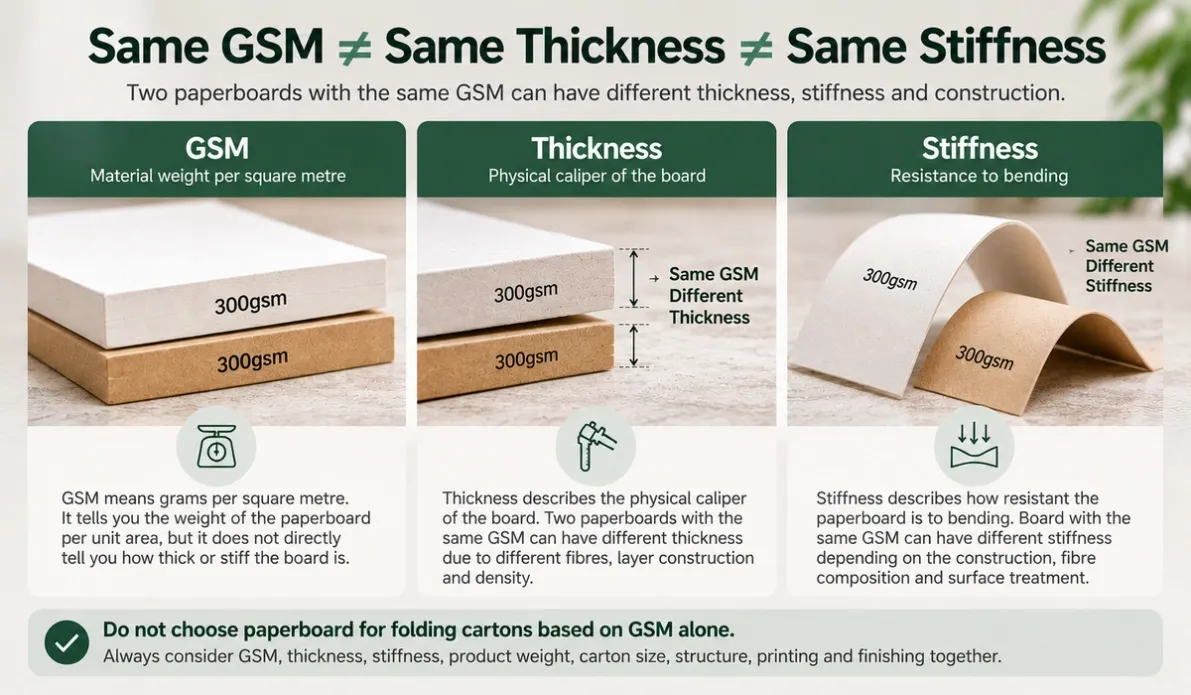
Two boards with a similar GSM can still have different:
- Thickness
- Density
- Fibre composition
- Layer construction
- Stiffness
- Surface coating
- Folding behaviour
This is why approving a carton simply because the quotation says “350gsm paperboard” can be misleading.
GSM
GSM describes the mass of the paperboard per square metre.
It is useful for identifying and comparing material specifications, but it does not directly tell you how thick or rigid the board will feel.
Thickness
Thickness describes the physical caliper of the board.
This matters because paperboard occupies space when it is folded.
Thickness can affect:
- Internal dimensions
- Tuck flap fit
- Overlapping panels
- Locking areas
- Creasing requirements
This becomes particularly important for small cartons with tight product tolerances.
If your carton looks correct on the dieline but the actual product is difficult to insert, our guide to folding carton product fit explains how clearance, inserts and paperboard thickness affect the finished internal space.
Stiffness
Stiffness describes how resistant the paperboard is to bending.
Suitable stiffness can help carton panels remain flat and maintain their shape.
But stiffness also needs to work with the carton structure.
A very stiff material may require more attention to creasing and folding, especially around small or complicated panels.
So instead of thinking:
Higher GSM = Better Carton
a more useful approach is:
Product + Carton Size + Structure + Board Characteristics = Suitable Material
Why Can the Same GSM Feel Different?
A buyer may have used 300gsm paperboard before and expect every other 300gsm board to feel exactly the same.
But different mills, board grades and constructions can produce different combinations of:
- Thickness
- Density
- Stiffness
- Surface feel
- Shade
- Folding behaviour
So when changing suppliers, it is better not to approve the material based only on:
“We used 300gsm before.”
If matching an existing package is important, providing the previous carton or a physical material sample can be much more useful.
What Types of Paperboard Are Commonly Used for Folding Cartons?
There is no single paperboard that is best for every folding carton.
Different board types provide different combinations of appearance, stiffness, printability and cost.
SBS Paperboard
SBS, or Solid Bleached Sulfate, is made from bleached virgin fibres and is commonly selected when a clean white appearance and good printing surface are required.
It can be suitable for applications such as:
- Cosmetics
- Personal care products
- Healthcare packaging
- Premium retail products
- Small consumer goods
However, the exact performance still depends on the specific board grade rather than the SBS name alone.
FBB Paperboard
FBB, or Folding Box Board, normally has a multi-layer construction.
It is often selected for folding cartons because it can provide a useful balance between weight, thickness and stiffness.
Depending on the board grade and local supply, FBB can be used for a wide range of consumer packaging.
When comparing FBB with another board, buyers should not compare GSM alone.
The actual thickness, stiffness, surface and folding performance should also be reviewed.
Kraft Paperboard
Kraft paperboard is often chosen when the brand wants a natural or less heavily processed appearance.
It can work well for:
- Natural products
- Handmade products
- Sustainable-style branding
- Food and lifestyle packaging
- Simple retail cartons
However, the natural brown surface changes how printed colors appear.
White ink, solid colors and fine artwork may behave differently compared with printing on a white coated surface.
Material appearance therefore needs to be considered together with the artwork.
Recycled Paperboard
Recycled paperboard can be useful when recycled content is part of the packaging requirement.
But recycled board is not one single material.
Surface color, stiffness, printability and consistency can vary between grades.
For projects where appearance or performance is important, the actual material should be evaluated rather than selecting it only because it is described as recycled.
Specialty Paper
Specialty papers can add:
- Texture
- Color
- Tactile effect
- Premium appearance
They can be useful for luxury or brand-focused cartons.
But special surfaces may also affect printing, foil stamping, gluing, lamination and folding.
A material that looks excellent as a flat sheet should still be tested as a finished carton.
For a broader look at how appearance, structure and production should be balanced across different packaging formats, see our packaging material selection guide.
How Does Product Weight Affect Paperboard Selection?
Product weight is one of the first things the packaging supplier should know.
Imagine two cartons with similar dimensions.
One contains a lightweight skincare tube.
The other contains a compact electronic device.
Although the boxes may look similar from the outside, their structural requirements may be different.
A heavier product can place more stress on:
- Bottom panels
- Locking tabs
- Side walls
- Glue areas
- Inserts
In some cases, increasing the paperboard specification may help.
But sometimes changing the carton structure or adding internal support is more effective than simply using thicker paper.
This is why product weight and carton structure should be considered together.
How Does Carton Size Affect the Required Paperboard?
Carton dimensions also matter.
A board that feels sufficiently rigid in a small box may feel much more flexible when the same material is used for a larger carton.
Larger panels have a greater unsupported area.
This can make them more likely to:
- Bow
- Bulge
- Flex
- Lose their square appearance
For example, a 300gsm board may behave very differently in:
Small carton:
80 × 50 × 25 mm
compared with:
Large carton:
300 × 200 × 80 mm
The GSM has not changed.
The structure around the material has.
This is another reason why paperboard should not be selected from GSM alone.
How Does Carton Structure Affect Paperboard Choice?
Paperboard and carton structure work as one system.
A simple tuck-end carton does not place exactly the same demands on the board as a carton with:
- Auto-lock bottom
- Snap-lock bottom
- Large window
- Internal partitions
- Double-layer panels
- Special locking tabs
The bottom structure becomes particularly important when the product is relatively heavy.
Instead of asking only:
“Should we change from 300gsm to 350gsm?”
it may be more useful to ask:
“Does the current combination of material and structure provide enough support?”
The correct solution may involve the board, structure or both.
Is Thicker Paperboard Always Better?
No.
Thicker paperboard can provide additional rigidity in some applications, but it can also create new production challenges.
Increasing board thickness may affect:
- Creasing
- Folding resistance
- Tuck flap fit
- Locking areas
- Gluing
- Finished dimensions
- Packing efficiency
For a small carton with several tight folds, unnecessarily thick board may make assembly more difficult.
It can also increase material usage and cost without providing a meaningful benefit to the product.
The objective is not to use the thickest board possible.
It is to use the board that provides the required performance efficiently.
How Do Printing and Finishing Affect Paperboard Selection?
The carton still needs to look right after printing and finishing.
Different paperboard surfaces can affect:
- Ink appearance
- Color saturation
- Fine text
- Solid color coverage
- Foil stamping
- Embossing
- Debossing
- Spot UV
- Lamination
- Varnish
For example, printing the same artwork on white coated board and natural kraft board will not produce the same visual result.
Surface texture can also influence fine details.
Heavy finishing may create additional considerations around folds and crease lines.
This becomes particularly important when the design includes:
- Dark solid colors
- Heavy ink coverage
- Lamination
- Foil close to a crease
- Embossing near a fold
- Specialty textured papers
The artwork, finishing and paperboard should therefore be reviewed together before production.
If white lines or cracking appear after folding, do not assume that thicker paperboard will automatically solve the problem. Our guide to folding carton crease cracking explains how board characteristics, grain direction, crease settings, printing and finishing can interact at the fold.
Should the Dieline Be Reviewed When the Paperboard Changes?
Yes, especially when the material change is significant.
A folding carton dieline is developed around a three-dimensional finished structure.
Paperboard thickness affects how panels behave when they are:
- Creased
- Folded
- Overlapped
- Locked
- Glued
Changing to a substantially different board may affect the way the carton closes or fits.
This does not mean every material change requires a completely new structure.
But the existing dieline should be reviewed rather than assuming it will behave exactly the same way.
This becomes particularly important when:
- Product fit is tight
- The carton is very small
- Several panels overlap
- The board becomes significantly thicker
- The locking structure is sensitive to material thickness
If the assembled carton develops an unexpected opening or a flap no longer sits correctly, the problem may involve material allowance rather than simply the finished dimensions. See why folding cartons develop gaps after assembly for the main areas to check.
A dieline and its paperboard should be treated as connected parts of the same packaging system.
Quick Paperboard Selection Checklist
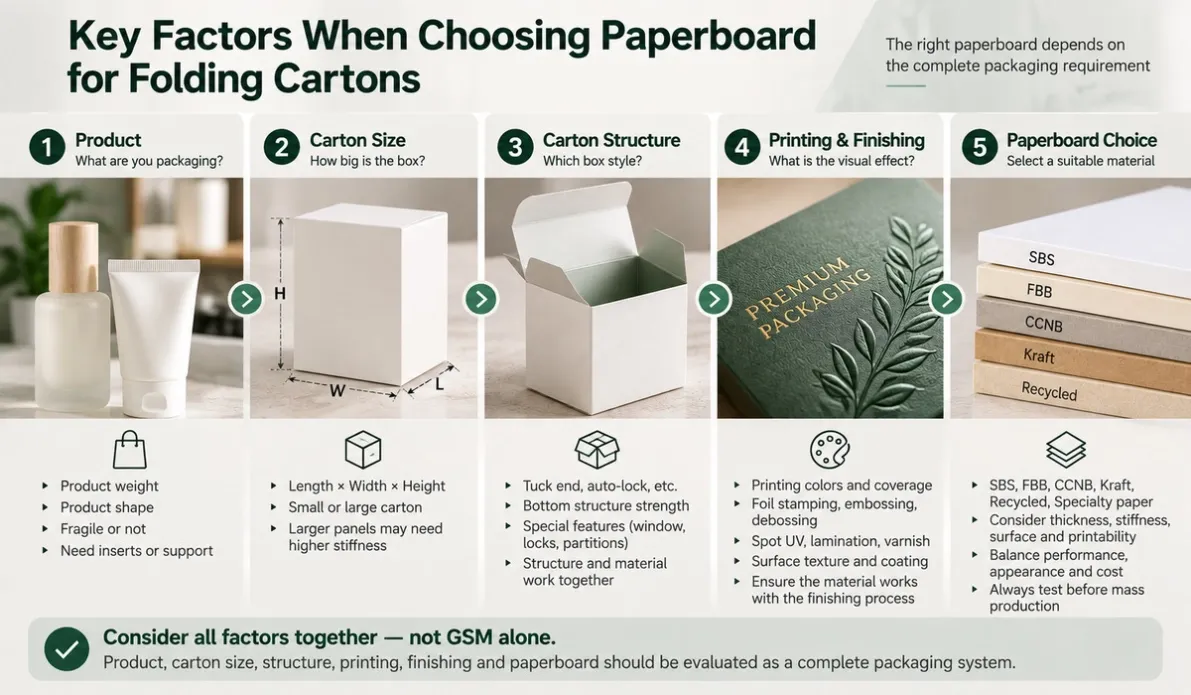
Before choosing a paperboard, review the complete packaging requirement rather than comparing GSM alone.
Check | Why It Matters | Common Buyer Pitfall |
|---|---|---|
Product weight | Affects structural support | Choosing board by GSM only |
Carton size | Larger panels may flex more | Copying material from a smaller box |
Carton structure | Different structures load the board differently | Ignoring bottom and locking design |
Board thickness | Affects folding and internal fit | Assuming GSM equals thickness |
Board stiffness | Affects panel rigidity | Assuming thicker always means stiffer |
Printing | Different surfaces reproduce artwork differently | Selecting material before checking artwork |
Finishing | Foil, embossing and coatings interact with the board | Treating finishing as a separate decision |
Packing process | Affects folding and assembly efficiency | Testing the flat sheet but not the finished carton |
There is rarely one material specification that is automatically correct for every folding carton.
The board needs to be evaluated as part of the complete packaging system.
What Should Buyers Provide When Asking for a Paperboard Recommendation?
Instead of asking only:
“How much is a 300gsm folding carton?”
provide enough information for the supplier to understand the actual packaging requirement.
Information | Why It Matters |
|---|---|
Product dimensions | Helps determine the finished carton size |
Product weight | Helps evaluate structural support |
Carton dimensions | Larger panels may require different stiffness |
Product shape | Irregular products can create concentrated pressure |
Carton structure | Different structures place different demands on the board |
Insert requirement | Inserts affect fit, support and internal dimensions |
Printing | Surface characteristics affect print appearance |
Finishing | Foil, embossing, lamination and other finishes may affect material selection |
Packing method | Manual or repetitive packing can influence carton performance |
Order quantity | Can affect material and production options |
Previous packaging sample | Useful when matching an existing material or performance level |
The more complete the information, the more useful the material recommendation can be.
Why Should You Test the Actual Paperboard Before Mass Production?
A material specification on paper cannot show everything about the finished carton.
Sampling allows you to evaluate how the material behaves after it has been:
Printed → Die-Cut → Creased → Folded → Glued → Packed
During sample approval, check:
- Does the carton feel sufficiently rigid?
- Does the actual product fit correctly?
- Do the panels remain flat?
- Do the tuck flaps close properly?
- Does the bottom support the product?
- Are the folds clean?
- Does the printed surface look correct?
- Do foil, embossing or other finishes perform as expected?
- Is the carton easy to assemble?
- Does the complete package look and feel right with the product inside?
If the paperboard is changed after the sample is approved, the relevant performance should be checked again.
Approve the finished packaging system — not only the GSM written on the specification.
FAQ
What GSM Is Best for Folding Cartons?
There is no single GSM that is best for every folding carton.
The appropriate material depends on the product weight, carton size, structure, board grade, printing, finishing and required performance.
Is 350gsm Always Stronger Than 300gsm?
A higher GSM means more material weight per square metre, but it does not by itself define stiffness, thickness or finished-carton performance.
The actual board grade and construction also matter.
What Is the Difference Between SBS and FBB Paperboard?
SBS and FBB use different board constructions.
SBS is typically made from bleached virgin fibres, while FBB normally uses a multi-layer structure that can provide a different balance of thickness, stiffness and weight.
The better option depends on the carton size, printing requirements, structure, availability and target performance rather than the board name alone.
Is Thicker Paperboard Better for Heavy Products?
Sometimes, but not always.
A heavier product may require stronger board, a different bottom structure, an insert or a combination of these.
The complete packaging structure should be evaluated.
Can I Use the Same Dieline If I Change the Paperboard?
Possibly, but the dieline should be reviewed when the material changes significantly.
Different board thicknesses can affect folding, overlapping panels, tuck flaps and finished fit.
Why Does My New 300gsm Carton Feel Different From My Old 300gsm Carton?
The two boards may have different thickness, density, stiffness, fibre composition or construction even though their nominal GSM is similar.
If matching the previous carton is important, provide a physical sample whenever possible.
Should I Approve Paperboard From a Flat Printed Sample?
A flat sample is useful for checking printing and color, but it cannot fully show folding and structural performance.
For important projects, evaluate the carton in its finished form with the actual product inside.
Final Thoughts
Choosing paperboard for a folding carton is not simply a matter of selecting 250gsm, 300gsm or 350gsm.
The material needs to work with the:
Product → Carton Size → Structure → Printing & Finishing → Production → Packing
A heavier board may sometimes be appropriate.
In other cases, better structural design or a different board grade may provide a more effective solution.
The most useful question is therefore not:
“What is the thickest paperboard I can use?”
It is:
“Which paperboard works best with this product, carton structure and production process?”
When the material and structure are developed together, the finished carton is more likely to perform as intended from sampling through mass production.
If you are selecting paperboard for custom folding cartons, send us your product dimensions, product weight, target carton size, artwork and expected quantity. We can review the material together with the carton structure and recommend a practical option for sampling.