
Custom Tissue Paper: GSM, Printing and When One Colour Is Enough
One colour is enough for custom tissue paper. Use 17–22 gsm for wrapping, 25–30 gsm for lining, and add a second colour only when your logo needs it.
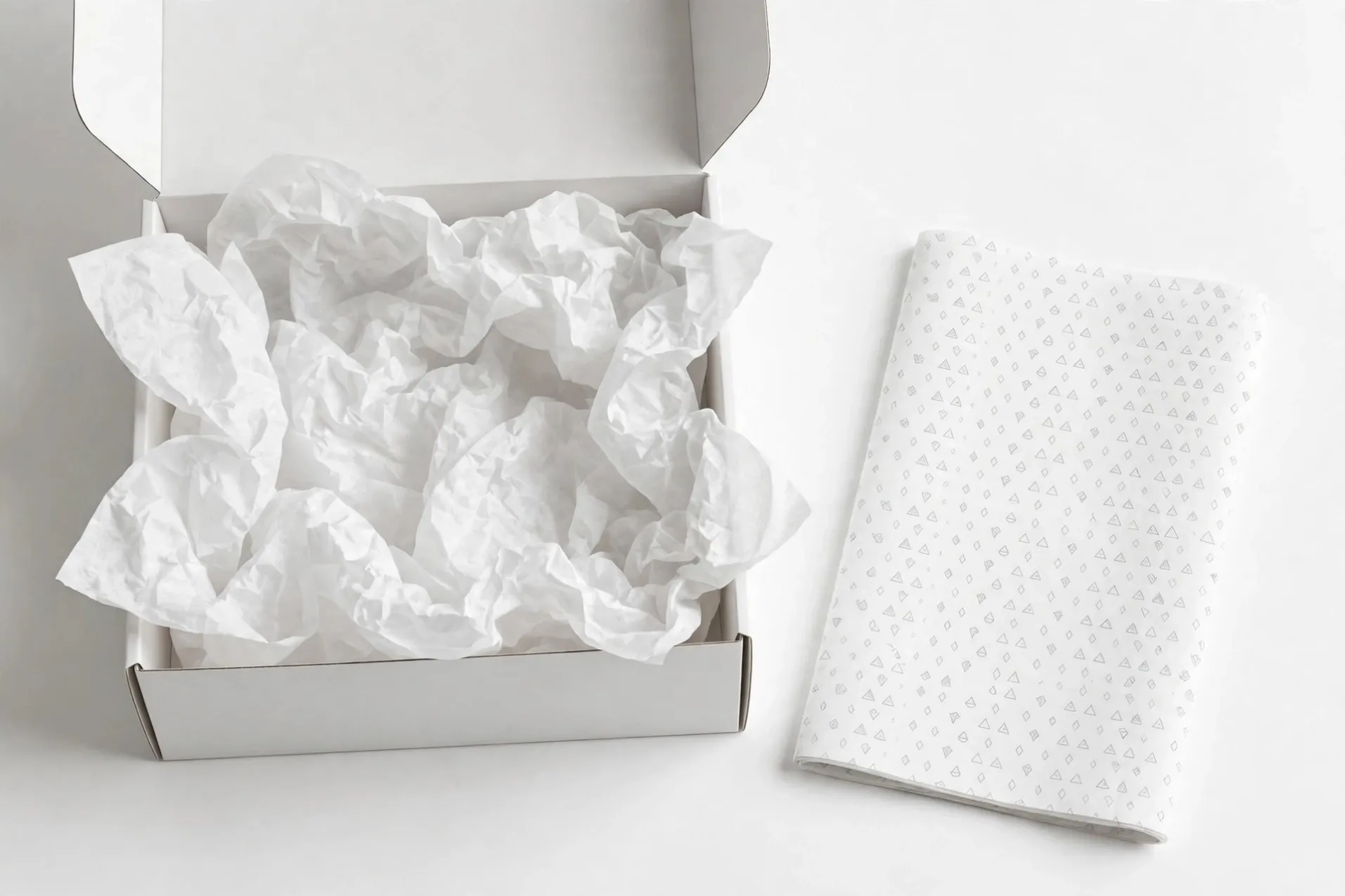
One colour is enough for most custom tissue paper — and the right GSM matters more than the number of colours. If the tissue is there to wrap a product, protect it inside a box or bag, and carry your logo, a single well-placed colour on the right weight of paper does the job. This guide explains which GSM to choose for wrapping, lining and layering, when a second colour earns its cost, and what to check on a sample first.
What GSM Means for Tissue Paper
GSM stands for grams per square metre: the weight of one square metre of the paper. It is the most useful number when you order tissue paper: it decides how the sheet feels, drapes, cushions, and prints. Most printed tissue paper falls between 17 and 40 gsm — far lighter than carton board, and that lightness is the point. Tissue is supposed to crumple softly around a product, not hold its own shape.
Think of GSM in three bands. At 17–22 gsm the paper is light, soft and flexible: it wraps, crumples and cushions well. At 25–30 gsm it is noticeably firmer, lies flatter, and takes a cleaner print. Above 30 gsm it starts behaving more like wrapping paper than tissue — stiffer, more opaque, and harder to crumple into a box. The exact grades available vary by supplier, so confirm the GSM range with the quotation rather than assuming a grade is in stock. Our custom tissue paper is made for gift boxes, retail bags and e-commerce orders, with a minimum order of 1,000 sheets and sampling in 7–10 days.
17–22 gsm: For Wrapping and Crumpling
This is the workhorse band, and the right choice when the tissue will be crumpled around a product or tucked into a bag. Light tissue drapes over curves instead of fighting them, so it wraps a candle, a bottle or a folded garment without springing open. Crumpled, it makes a soft nest that stops a product shifting inside a gift box — the same job as an insert, but cheaper and prettier. See our guide to packaging insert materials if you need rigid protection as well.
There are two trade-offs. First, print shows through: a dark logo on 17 gsm tissue is faintly visible from the back, and a dark product underneath can dull a light-coloured print. That is normal for tissue, not a defect — but it means bold, simple artwork works better than fine detail at this weight. Second, very light tissue tears more easily when pulled, so it suits gentle hand wrapping rather than high-speed machine packing. If your packing line pulls sheets fast, ask for a sample and test it at line speed.
25–30 gsm: For Lining and Layering
Choose this band when the tissue will be seen flat rather than crumpled: lining the inside of a box lid, layering between stacked products, or sitting as a neat top sheet in an open gift box. The extra weight keeps the sheet lying flat instead of curling, and the better opacity means your print reads cleanly even over a dark product.
This is also the band to choose when the print itself is the point. A heavier sheet absorbs less ink into its fibres, so edges stay sharper and solid areas look more even. If your logo has small text or a fine line pattern, 25–30 gsm gives the print a much better chance than 17 gsm. The cost is a slightly stiffer feel and a little less cushioning when crumpled — a fair trade when presentation matters more than protection. It pairs well with custom paper bags and holiday gift boxes, where the tissue is part of the unboxing moment. See our guide to matching paper bags and gift boxes as a set.
Above 30 gsm: When Tissue Stops Behaving Like Tissue
Above 30 gsm, tissue becomes stiff enough to hold a fold and resist crumpling. That suits a few specific uses: a structured top sheet in a luxury box, a printed wrap that must stay crisp around a flat product, or tissue used as a decorative band rather than a wrap. For most orders it is the wrong choice — you pay more per sheet, lose the soft drape that makes tissue feel like tissue, and gain little in print quality over 25–30 gsm. If a supplier suggests a heavy grade, ask what problem it solves that 25–30 gsm does not.
One Colour, Two Colours, or Full Coverage?
Colour count is where most tissue paper budgets are won or lost, so decide it by what the customer actually sees. A single colour — your logo or a repeating pattern in one ink — is enough for the great majority of orders. It reads clearly on white tissue, costs the least, and keeps sampling simple. One colour also suits the way tissue is used: it is unwrapped and discarded, so the print is a brief brand moment, not a keepsake.
Add a second colour only when your logo truly needs it — for example, a two-colour brand mark that looks wrong in one ink, or a pattern that depends on contrast between two colours. A second colour adds a print pass, cost, and a registration risk: on soft, absorbent tissue, two colours can shift slightly against each other. If you do go to two colours, keep the design simple and avoid fine alignment between the two inks.
Full-coverage printing — ink across the whole sheet — is rarely worth it on tissue. Heavy ink coverage stiffens the paper, raises the cost sharply, and can transfer onto the product or the box. If you want a coloured tissue, ask about pre-dyed tissue paper instead: the colour runs through the sheet, the paper stays soft, and a one-colour logo on top still reads well. Confirm the dyed colours available with the quotation.
5 Checks Before You Approve a Tissue Paper Sample
Run these five checks on every sample, using the real product and the real box or bag it will ship in.
1. The crumple test. Wrap the product the way your packing team will, then unwrap it. The tissue should fold without cracking or tearing at the creases, and crumpled tissue should spring back enough to cushion the product. If it tears at the fold, the GSM is too light for the job — or the sheet is too small.
2. The show-through test. Hold a printed sheet up to the light, then lay it over your darkest product. If the logo is clearly visible from the back, or the product colour dulls the print, move up a GSM band or simplify the artwork. Judge this in daylight, not under warehouse lighting.
3. The rub test. Rub the printed area firmly with a dry finger, then with a slightly damp one. Some ink transfer on tissue is normal, but the logo should stay readable and should not mark the product. If it smudges badly, ask about the ink and drying used for the sample.
4. The size test. Check the sheet size against the box or bag, not against the product alone. A sheet that wraps the product perfectly but leaves the box looking empty is too small; a sheet that needs folding twice to fit wastes paper and looks untidy. Confirm the sheet size with the quotation, and test it in the actual box.
5. The colour test. Compare the printed colour with your brand colour in daylight, on the tissue itself — not on a screen. Ink on absorbent tissue always looks softer than on coated paper, so expect a muted result and approve the sample, not the screen proof. Keep one approved sheet as your colour reference for repeat orders.
What to Send Your Supplier
Send these six things with your next order: the sheet size, or the box or bag it must fit; the GSM band you want, or the use case so the supplier can recommend one; the number of print colours and your artwork, kept bold and simple for tissue; the quantity — our minimum is 1,000 sheets; the product it will wrap and whether it will be crumpled, layered or used as a lining; and your acceptance rule in plain words, for example, that the logo must pass the rub test and match the approved sheet. When you are unsure about any figure — GSM grade, sheet size or ink — ask for it to be confirmed with the quotation rather than guessing. Our paper bags buying guide lists the same kind of checklist for the bag the tissue will go into.
FAQ
What GSM is best for wrapping a gift box?
17–22 gsm is the usual choice for wrapping and crumpling inside a gift box: it drapes softly and cushions the product. Choose 25–30 gsm if the tissue will lie flat as a lining or top sheet, or if the print has fine detail.
Will the print show through to the other side?
On light tissue it will, to some degree — that is normal for tissue paper, not a fault. Heavier GSM reduces show-through, and bold, simple artwork is affected far less than fine detail. Test it with the show-through check above.
Can printed tissue paper be recycled?
Most uncoated tissue paper is recyclable with paper recycling, but it depends on the inks used and on local recycling rules. If recyclability matters to your brand, raise it at quotation stage and confirm what the specific tissue and inks allow.
How many sheets do I need to order?
Our minimum order is 1,000 sheets. Because tissue is light and cheap per sheet, most brands order well above the minimum so the unit price falls and seasonal peaks are covered.
How long does sampling take?
Sampling takes 7–10 days. Test the sample with the real product and the real box or bag before approving it — a sample judged empty can hide a size or show-through problem that only appears when packed.
Get a Custom Tissue Paper Quote
If you are choosing tissue paper for a gift box, a retail bag or an e-commerce order, send us your sheet size, GSM band and artwork and we will quote it. Jeeli Packaging makes custom tissue paper from 1,000 sheets, with sampling in 7–10 days, and we can match it with custom paper bags and gift boxes so the whole set arrives together. To start, visit our contact page or email info@jeelipackaging.com.
Jeeli Packaging
Jeeli Packaging provides custom paper packaging and commercial printing solutions with a focus on reliable quality, responsive service and dependable delivery. Based in Shenzhen, China, we manufacture custom rigid boxes, folding cartons, mailer boxes, paper bags, hang tags and labels for brands worldwide, from 500 pcs with sampling in 7–10 days.