
Sep 23, 2026Blog
Why Do Folding Cartons Crack Along the Crease?
Why do folding cartons crack or turn white along the crease? Learn how paperboard, grain direction, creasing, printing and finishing affect folding performance.
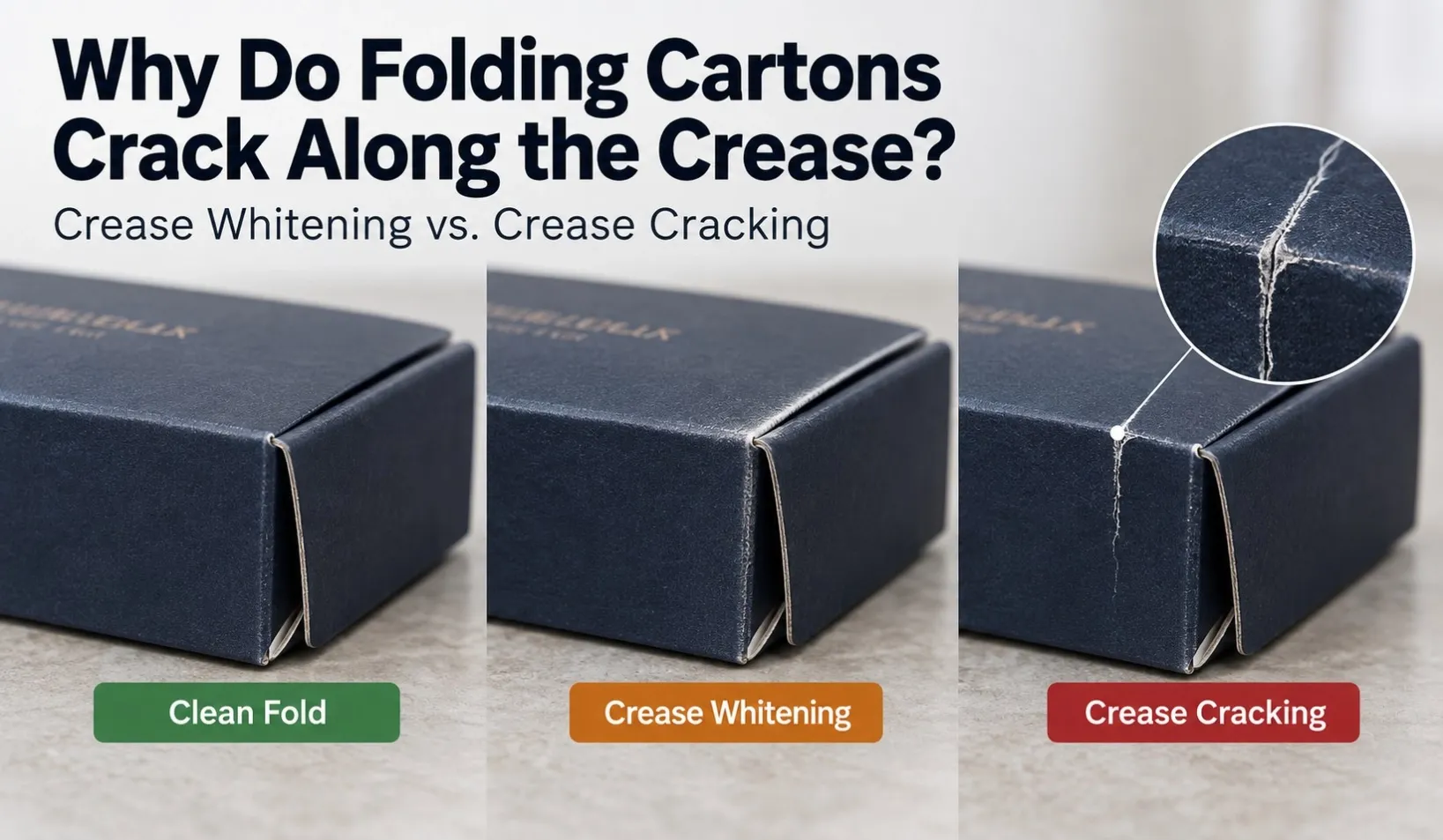
The printed carton looks fine while it is flat.
The color is correct. The surface looks smooth. The die-cutting looks clean.
Then the carton is folded.
A white line appears along the crease — often described as crease whitening. In more serious cases, the printed surface or even the paperboard fibers begin to crack or split.
The buyer's first question is often:
"Is there something wrong with the paper?"
Possibly. But the paperboard itself is only one part of the problem.
Folding carton crease whitening and cracking can be affected by the paperboard, grain direction, crease settings, printing and finishing, material condition and the way the carton is folded.
Before changing the material, it is useful to understand what is actually happening along the crease and when the problem appears.
Is It Crease Whitening or Crease Cracking?
Buyers sometimes use crease whitening and crease cracking to describe a similar visible problem, but they are not always the same.
Crease whitening usually describes a light or white line that becomes visible after folding, especially on dark printed cartons.
Crease cracking indicates that the printed surface, coating or paperboard fibers may have fractured along the fold.
What looks like one simple "white line" can therefore come from different parts of the packaging structure.
Printing or Coating Surface
Sometimes the paperboard itself is still intact, but the printed or coated surface develops a visible white line after folding.
This can be especially noticeable on black, dark blue, burgundy or other heavily printed areas because the lighter surface underneath creates stronger contrast.
Paperboard Fibers
In a more serious case, the surface fibers of the paperboard may begin to break along the fold.
The crease may look rough rather than clean, and the damage can extend beyond the printed surface.
Lamination or Other Surface Finishing
If the carton has lamination or another surface treatment, the finishing layer can also affect how the folded area behaves.
Depending on the material and process, the problem may appear as whitening, lifting, cracking or separation around the crease.
Paperboard Layer Separation
Sometimes the problem is not limited to the surface. Layers within the paperboard can begin to separate around the folded area.
These conditions may all look similar at first, but they do not necessarily have the same cause.
Before changing the paper or adjusting production, first identify what you are actually seeing.
1. The Paperboard and Crease Settings Do Not Match
One of the first things to check is the relationship between the paperboard and the crease.
A crease is not simply a line pressed into the carton.
It creates a controlled area where the paperboard is expected to bend during folding. The crease therefore needs to work with the actual characteristics and thickness of the board.
If the board changes but the creasing setup is not reviewed, the carton may behave differently when folded.
This is also why GSM alone does not tell the whole story.
Two paperboards with a similar GSM can have different thickness, stiffness and construction. Their folding performance may therefore be different.
Using a heavier paperboard does not automatically solve crease whitening or cracking.
In some cases, changing to a thicker board without reviewing the crease can make the carton more difficult to fold.
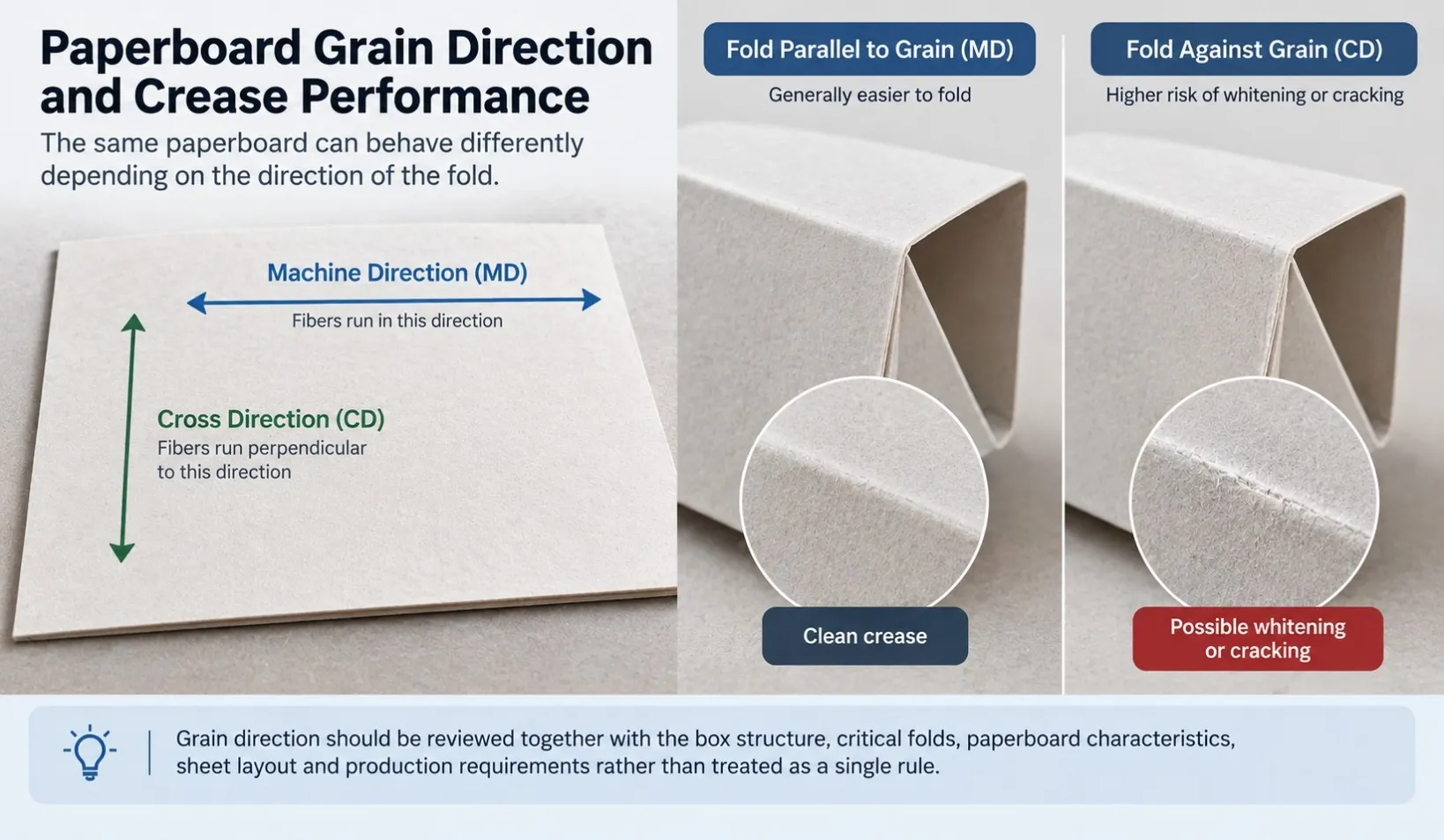
2. Grain Direction Can Affect the Fold
Paperboard has a grain direction created during the papermaking process.
Because the fibers are not arranged identically in every direction, the board can behave differently depending on how a crease and fold are positioned relative to that direction.
This can affect:
- folding resistance
- panel stiffness
- crease performance
- the appearance of the folded edge
However, grain direction should not be treated as one simple rule that applies to every carton.
The box structure, critical folds, paperboard characteristics, sheet layout and production requirements also need to be considered.
A useful clue is consistency.
If whitening or cracking repeatedly appears on folds running in one direction while other folds perform normally, grain direction is one of the factors worth checking.
The dieline and material should therefore be reviewed together before mass production.
3. The Crease Setting Is Not Suitable for the Board
Even when the paperboard itself is suitable, the crease still needs to be appropriate for that material.
The creasing process is intended to create a controlled folding zone.
If the crease is too shallow, too narrow or otherwise unsuitable for the board, the paperboard may resist the fold.
That resistance can concentrate stress around the outer surface of the crease.
The result may be:
- crease whitening
- an uneven fold
- a rough folded edge
- visible surface cracking
- spring-back after folding
- distortion around the panel
This is why a clean fold begins before the carton is actually folded.
The die-cutting and creasing stage already has a major influence on how the finished carton will behave during assembly.
4. Printing and Surface Finishing Can Make Whitening More Visible
Crease whitening can become much more noticeable on heavily printed cartons.
Imagine a similar small change along the folded surface on two boxes.
One carton has a light-colored design.
The other has a solid black, dark blue or burgundy printed surface.
If a lighter area becomes visible along the fold, the contrast on the dark carton can make the crease whitening much easier to see.
This does not automatically mean that dark ink is causing the problem.
It means that artwork and surface coverage can affect how visible the problem becomes.
Finishing processes also need to be considered, including:
- lamination
- coatings
- spot UV
- foil stamping
- embossing or debossing near folding areas
A design may look excellent while the sheet is flat but behave differently after die-cutting, creasing and folding.
For printed folding cartons, artwork, material, finishing and structure should therefore be reviewed as parts of the same package rather than as completely separate decisions.
5. The Paperboard Has Become Too Dry or Brittle
Paperboard can respond to changes in storage and production conditions.
If its condition changes significantly, its folding behavior may also change.
Material that has become relatively dry or brittle may be less tolerant of the stress created during folding, especially when combined with demanding crease conditions or heavy surface coverage.
This does not mean that every white crease or crack is a humidity problem.
It means material condition should be included in the investigation, particularly when a carton previously folded well but begins behaving differently after storage or under different production conditions.
Before changing the dieline or blaming the artwork, check whether the material itself is behaving consistently.
6. Folding or Assembly Adds Too Much Stress
The final factor is the folding process itself.
A well-developed crease is intended to guide the paperboard into the correct fold.
If the carton is forced into position rather than folding naturally along the crease, additional stress can develop.
This may happen when:
- the carton is folded too aggressively
- the panels are not pre-folded as required
- the assembly sequence creates unnecessary resistance
- the board is relatively stiff
- the structure is already tight
- several demanding material and finishing conditions occur together
The important point is that crease whitening or cracking is often not caused by one isolated factor.
For example:
Thicker board + unsuitable crease + dark printing + difficult fold
may create a much more visible problem than any one of these factors alone.
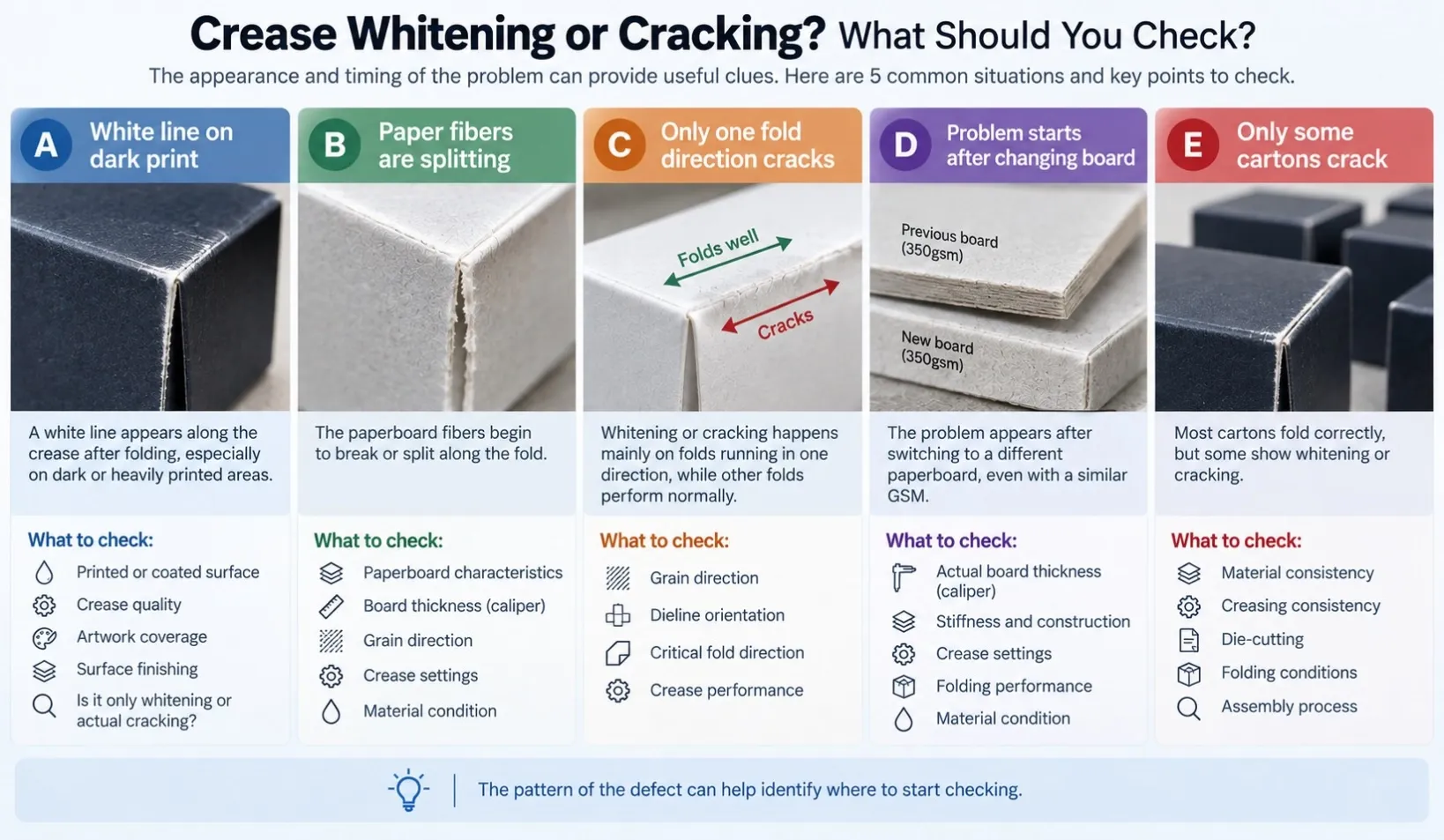
How Can You Tell What May Be Causing the Problem?
The appearance and timing of the problem can provide useful clues.
Situation A: Dark Printed Areas Show White Lines After Folding
If the problem is mainly visible where there is heavy or dark printing, check:
- whether it is crease whitening or actual cracking
- the printed or coated surface
- crease quality
- artwork coverage around the fold
- surface finishing
- whether the paperboard fibers are actually damaged
The high contrast may be making a relatively small surface change much easier to see.
Situation B: Paperboard Fibers Are Visibly Splitting
If the fibers themselves are breaking, check:
- paperboard characteristics
- board thickness
- grain direction
- crease settings
- material condition
This may indicate a deeper folding problem rather than only a cosmetic surface issue.
Situation C: Whitening or Cracking Happens Mainly in One Fold Direction
Check:
- grain direction
- dieline orientation
- critical fold direction
- crease performance
A directional pattern can help narrow down the possible causes.
Situation D: The Problem Appeared After Changing Paperboard
Do not compare only the GSM.
Also review:
- actual board thickness
- stiffness and construction
- crease settings
- folding performance
- material condition
A replacement board with the same nominal GSM does not necessarily behave exactly like the previous material.
Situation E: Only Some Cartons Have the Problem
If most cartons fold correctly but some show whitening or cracking, the issue may be related to consistency rather than the basic structural concept alone.
Areas worth checking include:
- material consistency
- creasing consistency
- die-cutting
- folding conditions
- assembly
The pattern of the defect is often as useful as the defect itself.
What Should Buyers Check Before Approving the Sample?
A flat printed sheet or flat die-cut sample cannot show everything about the final carton.
Before approving mass production, the sample should be folded and evaluated in its finished form.
Check:
- Are the main crease lines folding cleanly?
- Are there visible white lines on dark printed areas?
- Is it only crease whitening, or are the paperboard fibers actually splitting?
- Are laminated or finished areas behaving normally around the folds?
- Does the carton stay square after assembly?
- Does the carton still fold correctly after the actual product is inserted?
- Do multiple samples behave consistently?
If the material is changed after sampling, folding performance should be reviewed again.
A flat printed sample can look perfect and still reveal problems only after folding.
Does Using Thicker Paperboard Solve Crease Cracking?
Not necessarily.
This is an important point because increasing paperboard thickness can sound like an easy solution.
But a thicker board changes more than the perceived strength of the carton.
It may also change:
- the folded geometry
- crease requirements
- resistance during assembly
- panel stiffness
If the original problem is caused by an unsuitable crease, grain direction or folding condition, simply increasing the board thickness may not solve it.
In some cases, it may create another problem.
The better approach is to identify what is happening along the crease first and then review the material and production settings together.
How Can Crease Whitening and Cracking Risk Be Reduced?
There is no single adjustment that solves every case.
A practical review normally starts with:
Is it whitening, surface cracking or fiber damage?
↓
What paperboard is being used?
↓
How is the grain direction positioned?
↓
Does the crease suit the actual board?
↓
Does printing or finishing cross the critical fold?
↓
Has the material condition changed?
↓
How does the carton behave during actual folding and assembly?
This is more useful than assuming:
White line = bad paper
or:
Crack = use thicker paperboard
Packaging performance comes from the combination of material, structure and production.
A Good Carton Must Work After It Is Folded
A folding carton is not finished when the printing looks good on a flat sheet.
It still needs to survive die-cutting, creasing, folding, gluing, packing and handling.
That is why sample evaluation should include the finished carton rather than focusing only on artwork and color.
A small white line along a crease may be mainly a visual issue, while deeper cracking can indicate a more serious mismatch between the paperboard, structure or production process.
Finding the difference during sampling is much easier than discovering it after mass production.
Need Help Reviewing a Folding Carton Project?
If you are developing a custom folding carton and are concerned about crease whitening, cracking, material, structure or folding performance, send us the basic project information.
Useful information includes:
- product dimensions
- box dimensions or dieline
- quantity
- preferred paperboard
- artwork
- printing requirements
- finishing requirements
- product photos
Jeeli Packaging can review the material, printing and carton structure together before production.