
Digital Proof vs Physical Packaging Sample: Which to Choose?
Learn the differences between digital proof and physical packaging samples. When to use each, costs, turnaround time & quality comparison. Read now!
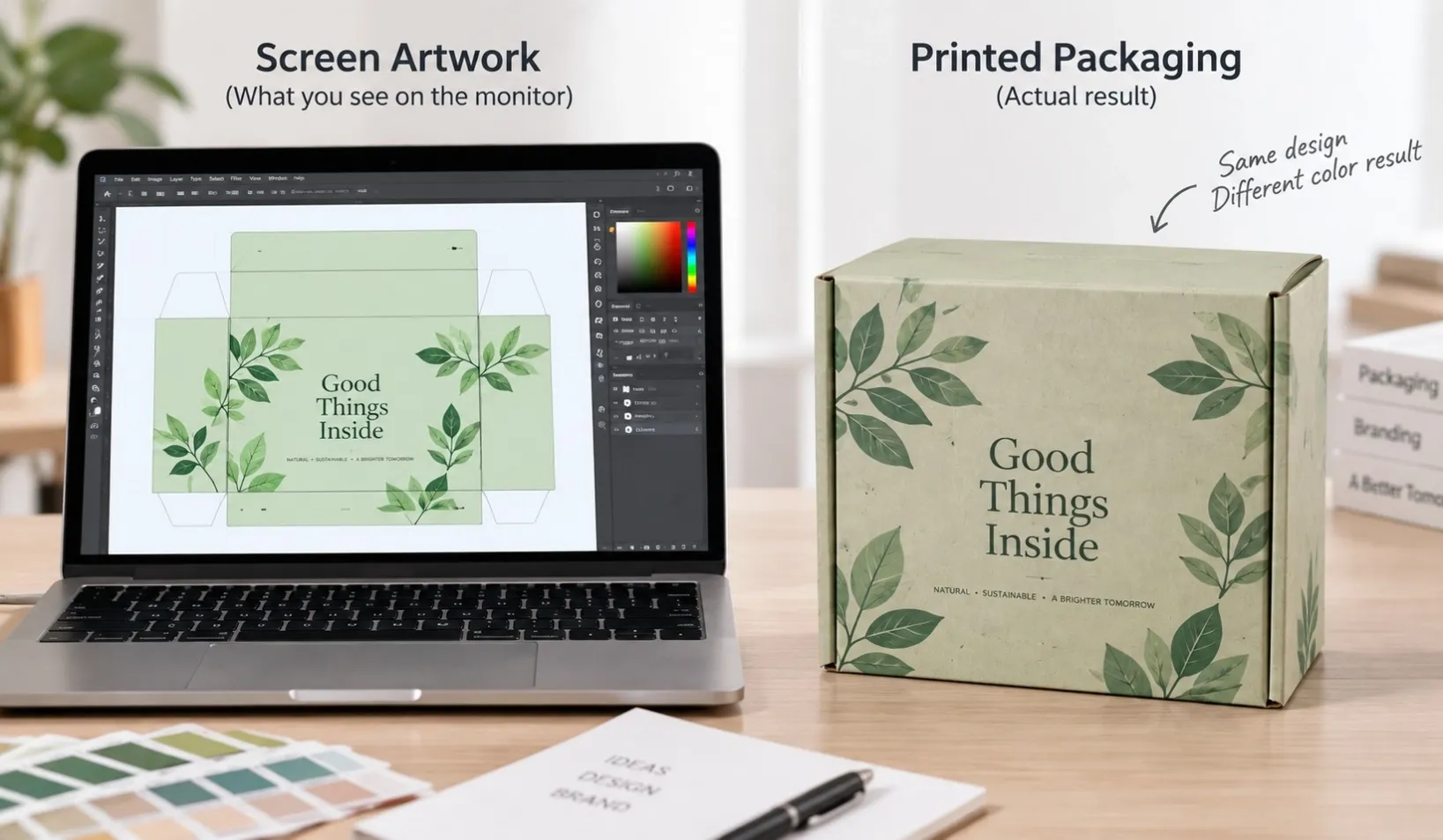
A brand team may receive a PDF, a color print and a handmade box during the same project, then call all three an “approved proof.” The danger appears later when production color, product fit or finishing was never demonstrated by the item everyone signed. This guide helps packaging, brand, procurement and quality teams separate digital artwork approval, managed color evidence, structural samples and finished packaging samples.
It applies when the buyer can define the artwork, material and approval questions; it is not a method for guaranteeing exact color from an ordinary monitor or approving bulk production from an unrepresentative prototype. You will leave with an approval matrix, a list of unresolved evidence and an RFQ checklist for the required proof and sample route. The result supports a scoped approval decision—not a quotation, color guarantee or production authorization.
When one approval item is asked to prove everything
- Actor: A brand manager approves artwork while procurement and quality also need evidence about color, structure and finishing.
- Trigger: A PDF approval is treated as if it covers every packaging question.
- Evidence gap: The file may confirm copy and position, but it cannot physically show paper, fit, folds or surface effects.
- Rework: If a later sample reveals a mismatch, the team may need to reopen artwork, reset color expectations or repeat sampling.
- Consequence: The approval trail can become ambiguous, risking delay and uncertainty about what was actually accepted.
- Decision: Match each risk to evidence that can demonstrate it and record unresolved questions before the next approval stage.
“Proof” and “sample” are not interchangeable
Packaging teams often use the word proof for several different items: an annotated PDF, a rendered mockup, a soft proof on a monitor, a printed color proof, an unprinted structural sample or a finished printed sample. Each answers different questions.
Before approving anything, label the evidence by purpose. Is it for text and layout, color direction, structural fit, finishing position, or full production reference? If the approval scope is not written down, one team may approve spelling while another assumes the same file approves color and construction.
Jeeli Packaging’s custom packaging manufacturing overview places artwork, sampling, printing, finishing and production in a connected sequence. The approval method should follow that sequence.
What a digital artwork proof can confirm
A digital artwork proof—often a PDF or equivalent review file—can confirm content and position. Buyers can check copy, language, barcode content, logo version, panel assignment, dimensions shown on the dieline, orientation and which areas are assigned to print or finishing.
It is useful for controlled comments because reviewers can refer to named panels and marked locations. It also creates a revision record when the file name, date and approval status are maintained.
However, an ordinary screen view does not prove final printed color, paper feel, coating, foil appearance, emboss depth, cut accuracy, crease behavior or assembled fit. Its role is artwork control, not physical-product approval.
What soft proofing adds—and what it still cannot do
Soft proofing uses color-management settings to simulate how an image may appear under a defined output condition. Adobe’s official guidance explains that proofing depends on the display, output profile and viewing setup; a desktop display or print does not automatically reproduce a commercial press result. See Adobe’s guidance on soft-proofing colors and preparing images for commercial printing.
A managed soft proof can help a trained team anticipate gamut changes and compare color intent. It is still a simulation. Monitor calibration, ambient light, profiles, substrate and production conditions affect the relationship to the final package.
Use it to identify color-risk areas and guide discussion, not to promise exact physical color.
What a printed color proof can confirm
A printed color proof provides a physical color reference under stated proofing conditions. It can be more useful than an uncalibrated screen for evaluating image balance, tonal relationships and expected process-color direction.
The proofing device, inks, paper and surface may differ from the packaging press and final substrate. Therefore, record what the supplier says the proof represents. If a proof is intended as a color target, define the viewing light and which colors or images are critical. If special colors, metallic inks, foil or textured paper are involved, a generic printed proof may not reproduce them.
For why artwork and production can differ, use the dedicated guide Why Do Packaging Colors Look Different From the Approved Artwork?.
What an unprinted structural sample can confirm
An unprinted white or plain sample can test dimensions, product fit, insertion and removal, opening sequence, tab engagement, lid depth, handle position and basic packing workflow. It is especially useful before expensive artwork or finishing decisions are locked.
The material may be representative rather than final, so stiffness, surface and fold behavior must be interpreted carefully. Label the sample with the board or substitute used and list any known differences from the proposed production material.
An unprinted sample does not approve color, graphics or surface finishes. Its value is structural learning.
What a finished physical packaging sample can confirm
A finished sample combines more variables: actual or representative material, printing, finishing, cutting, creasing, gluing, assembly and product fit. It lets reviewers see artwork across folds, check finishing registration, handle the opening sequence and inspect the package under realistic light.
Even then, ask how the sample was made. A digitally printed prototype may not match an offset-printed production run. Hand-applied finishing or manually assembled components may differ from the bulk route. The sample should state which features are production-representative and which are visual or structural approximations.
For a detailed structural checklist, see What Should You Check Before Approving a Folding Carton Sample?.
Approval matrix: choose evidence by question
| Approval question | Digital artwork proof | Managed soft proof | Printed color proof | Structural sample | Finished physical sample |
|---|---|---|---|---|---|
| Copy and logo version | Strong check | Not the primary purpose | Not the primary purpose | Usually unavailable | Confirm against approved artwork |
| Panel position and orientation | Strong check | Can support visual review | Can support print review | Shows physical panels | Shows artwork on physical panels |
| Exact production color | Cannot confirm | Simulation only | Reference within stated conditions | Cannot confirm | Must still be tied to production route |
| Product fit and removal | Cannot confirm | Cannot confirm | Cannot confirm | Strong check | Strong check |
| Foil, embossing or texture | Position only | Limited simulation | Often limited | Usually unavailable | Best physical evidence when representative |
| Folding and assembly | Dieline review only | Cannot confirm | Cannot confirm | Strong check | Strong check |
The most efficient approval path often uses more than one item because no single proof answers every question.
Build an approval ladder before ordering samples
Start with the lowest-cost evidence that can answer the current question. Approve copy and layout before requesting a finished sample. Check product fit with a structural sample before locking graphics that cross folds. Resolve critical color targets before assuming the final sample will fix an undefined expectation.
Then document what remains unresolved at each stage. A simple approval record can list evidence type, file or sample ID, date, reviewer, approved points, rejected points and open questions. This prevents an early artwork approval from being treated as blanket approval for production.
RFQ checklist for proofing and sampling
Prepare these details for a sampling discussion:
- Packaging type, finished dimensions and intended material
- Product dimensions, weight and orientation
- Current dieline and artwork revision
- Critical copy, barcodes, logo and panel relationships
- Color references and which colors require closer control
- Printing method under consideration
- Lamination, foil, UV, embossing, windows or other finishes
- Required evidence: PDF, soft-proof review, printed color proof, structural sample or finished sample
- What each item must approve and what may remain approximate
- Required number of artwork versions and approval owners
- Whether the sample route differs from proposed bulk production
Send the checklist through Jeeli Packaging’s contact page to discuss a clearly labeled proofing and sampling path. Before sending confidential artwork, confirm the file-transfer method with the team.
Frequently asked questions
Is a PDF proof enough to approve custom packaging?
It can approve defined artwork details, but it cannot confirm physical structure, product fit, paper feel, finishing or exact production color.
Can a calibrated monitor guarantee printed color?
No. Calibration and profiles improve managed viewing, but the monitor, lighting, output process, ink, paper and finishing still affect the relationship to the final package.
Is a digitally printed sample a reliable offset color standard?
Not automatically. Ask what the digital sample is intended to approve and which offset proof or production reference will control bulk color.
Do buyers always need a finished sample?
The necessary evidence depends on risk. Novel structures, critical product fit, complex finishing or strict appearance requirements can make a representative finished sample particularly valuable.
What should be written on a sample approval?
Record the sample identifier, material and process, approved features, accepted limitations, open issues, revision status and whether approval is structural, visual, color-related or production-related.
Approve one question at a time
Do not ask one file or sample to prove everything. Use a digital proof for artwork questions, suitable color evidence for color questions and a representative physical sample for structure and finish. Bring the approval matrix and RFQ fields to Jeeli Packaging’s contact page and ask which proof and sample route fits your project.