
Sep 28, 2026Blog
What Should You Check Before Approving a Folding Carton Sample?
Received your folding carton sample? Use this practical checklist to review product fit, structure, paperboard, printing, finishing and assembly before approving mass production.
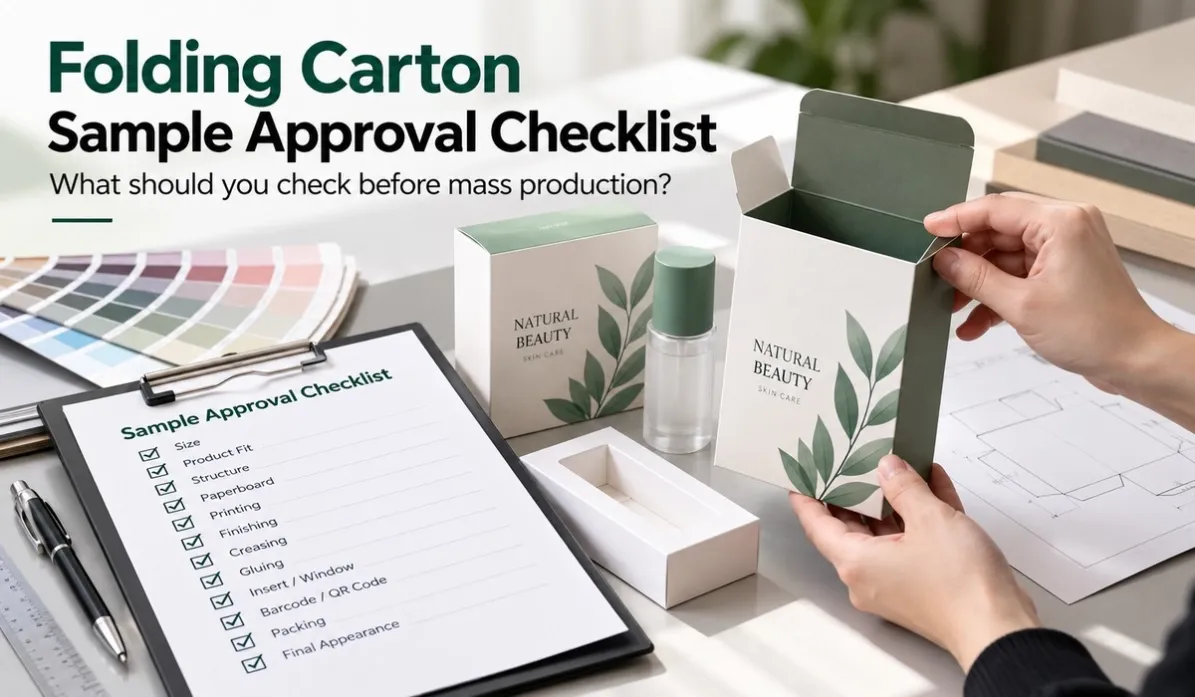
Receiving a folding carton sample is an important step in a packaging project.
The printing may look good. The box may look clean. The logo may be in the right position.
But that does not necessarily mean the carton is ready for mass production.
A sample should answer a more important question:
Does the complete carton work correctly with the actual product and packing process?
Before approving a folding carton sample, buyers should evaluate more than appearance.
A practical sample review should follow the complete packaging system:
Product → Fit → Structure → Paperboard → Printing → Finishing → Assembly → Packing
What Does a Folding Carton Sample Need to Confirm?
A good sample review should help confirm three things.
1. Does It Look Right?
Check the artwork, colors, text, finishing and overall appearance.
2. Does It Fit and Function Correctly?
Check the actual product, insert, carton dimensions, opening, closing and assembly.
3. Is the Specification Ready for Production?
Confirm the material, structure, printing, finishing and other approved requirements that will be used as the basis for mass production.
A carton can pass the first check and still fail the second.
For example, a sample may look excellent when empty but become distorted after the product is inserted.
Sample approval should not be based on appearance alone.
1. Check the Finished Carton Dimensions
Start by confirming the finished dimensions:
Length × Width × Height
But do not stop with a ruler.
Paperboard thickness, folding, glued seams, inserts and structural overlaps can all affect the usable internal space.
For cartons with a close product fit, the assembled sample is more useful than checking only the flat dieline.
2. Test the Sample With the Actual Product
Whenever possible, place the actual finished product inside the carton.
Check:
- Is the product easy to insert?
- Is the fit too tight?
- Is there too much empty space?
- Does the product move unnecessarily?
- Does the carton bulge after packing?
- Can the carton close naturally?
- Is the product easy to remove?
If an insert is used, test:
Product + Insert + Folding Carton
together.
Do not approve these components independently if they need to function as one packaging system.
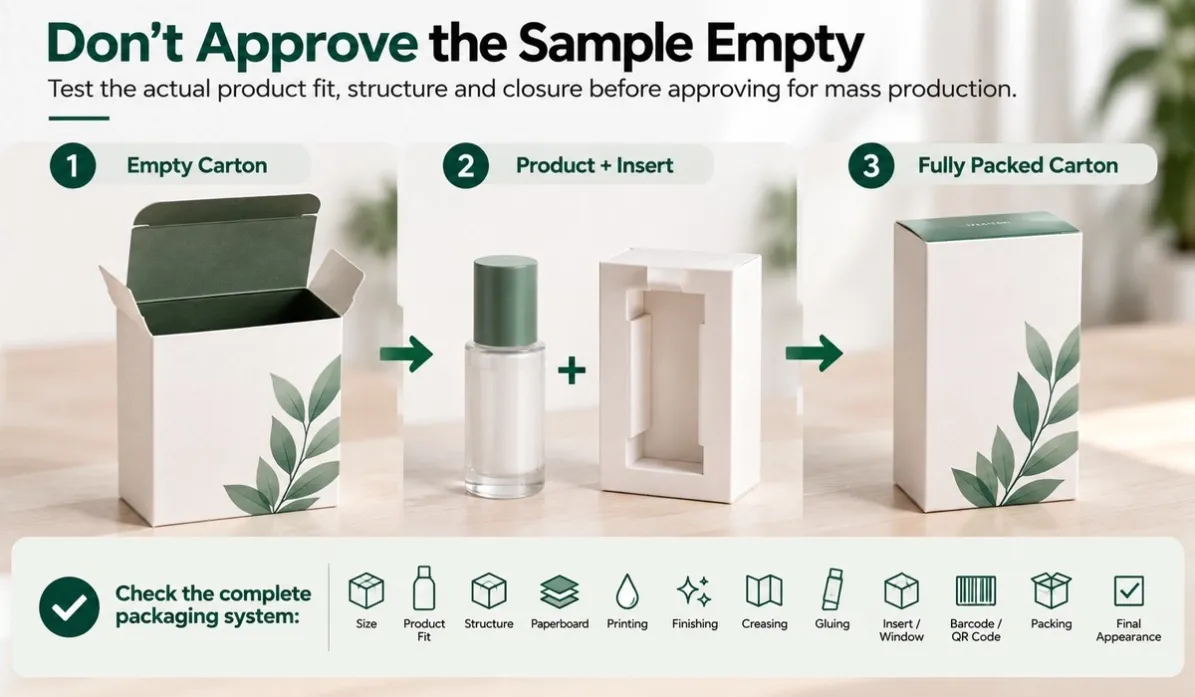
This is especially important for products such as cosmetics, electronics, bottles and accessories.
3. Check Whether the Carton Structure Works in Real Use
Do not check only whether the box matches the dieline.
Assemble the carton several times.
Check whether:
- tuck flaps insert naturally
- locking areas engage correctly
- the bottom feels secure
- panels align properly
- the carton stays square
- opening and closing feel natural
- excessive force is required
Also consider how the carton will actually be packed.
A structure that is easy to assemble once may still be inefficient when thousands of cartons need to be packed.
4. Confirm the Actual Paperboard
Do not approve the material based only on a specification such as:
300gsm
Check the actual paperboard used for the sample.
Consider:
- paperboard type
- GSM
- thickness
- stiffness
- surface quality
- whiteness or natural shade
- folding performance
- overall feel
Two boards with the same GSM can have different thickness, stiffness and construction.
The approved sample should therefore establish the actual material expectation, not only the GSM written on the quotation.
5. Review Printing, Artwork and Color
Review the printed information carefully.
Check:
- logo position
- artwork position
- text and spelling
- product information
- warning or legal text where applicable
- CMYK or Pantone requirements
- inside printing if required
- registration
- small graphic details
Do not judge color only from a computer screen.
The final printed appearance can be affected by:
Color System → Paperboard → Printing → Surface Finishing
A color printed on smooth white paperboard can look different from the same color printed on kraft or another surface.
Finishing can also change the final appearance.
Our guide on why packaging colors can look different from approved artwork explains these variables in more detail.
6. Check Foil, Embossing, Spot UV and Other Finishing
If the carton uses special finishing, check each process separately.
Depending on the project, review:
- foil stamping
- embossing or debossing
- spot UV
- lamination
- varnish or coating
- soft-touch effect
- window application
Check both the position and the finished effect.
Pay particular attention to finishing near crease lines, cut edges, locking areas and glue areas.
A finishing effect can look excellent on a flat panel but behave differently after the carton is folded.
7. Fold the Carton and Inspect the Crease Lines
Do not approve a folding carton only while it is flat.
Fold it.
Then inspect the critical crease lines for:
- visible whitening
- surface cracking
- broken paperboard fibres
- coating damage
- lamination lifting
- rough folded edges
- excessive spring-back
Dark printed cartons deserve particular attention because white lines along the fold can be much more visible.
If the sample looks good while flat but develops problems after folding, the relationship between the paperboard, grain direction, crease settings, printing and finishing may need to be reviewed.
8. Check Gluing, Alignment and Carton Squareness
Assemble the carton and place it on a flat surface.
Check:
- Is the glued seam straight?
- Are the panels aligned?
- Does the carton stand squarely?
- Do the top and bottom flaps meet correctly?
- Are there visible gaps?
- Does one panel push outward?
- Does the carton twist after assembly?
Then repeat the check with the actual product inside.
If the empty carton is square but becomes distorted after packing, the problem may be related to product fit or the insert rather than the glued seam itself.
9. Check the Insert or Window
If the carton includes an insert, test the complete system:
Product → Insert → Carton
Check product fit, insert movement, locking tabs, orientation and ease of packing.
For a window carton, check:
- window size
- window position
- product visibility
- film attachment if film is used
- alignment with the artwork
- distance from crease and cut areas
Evaluate the final appearance with the actual product in position.
10. Test Barcodes, QR Codes and Small Text
Something can look correct and still fail in real use.
If the packaging includes a barcode or QR code, scan it from the finished assembled sample.
Do not check it only from the artwork file.
Also make sure important text is not:
- too close to a crease
- distorted around a corner
- hidden by a flap
- affected by a glue area
- cut too close to the edge
- difficult to read against the printed background
11. Simulate the Actual Packing Process
A sample is often assembled slowly and carefully.
Mass packing is different.
Try to pack the sample in the same way the production or fulfillment team will use it.
Ask:
- Is assembly intuitive?
- Is the product easy to load?
- Does the insert take too long to assemble?
- Do the flaps close without excessive force?
- Is the packing direction clear?
A few unnecessary seconds may not matter for one sample.
They can matter when thousands of cartons need to be packed.
12. Review the Final Packed Appearance
Finally, evaluate the carton in the condition the customer will actually see:
Finished Carton + Actual Product + Insert + Final Closure
Check whether the carton remains square, the panels stay aligned, the product does not cause bulging, and the overall presentation matches the intended packaging appearance.
A carton that looks good when empty should still look and function correctly after packing.
Not Every Folding Carton Sample Confirms the Same Things
Before approving a sample, first understand what type of sample you are reviewing.
Sample Type | Useful for Checking | Does Not Fully Confirm |
|---|---|---|
Blank Structural Sample | Size, product fit, structure, insert fit and assembly | Final printing, color and decorative finishing |
Digitally Printed Sample | Artwork, text, layout, general appearance, structure and fit | Exact bulk printing color if production uses a different printing process |
Production-Representative Sample | Material, printing, finishing and construction closer to the intended bulk specification | Every possible variation during mass production |
This distinction matters.
For example, a blank sample may be perfectly suitable for confirming product fit and carton structure, but it cannot confirm the final foil stamping or printed color.
A digitally printed sample may show the artwork clearly, but if bulk production uses offset printing, it should not automatically be treated as an exact prediction of the final production color.
A production-representative sample can provide a closer reference when more of the intended materials and processes are used.
Do not ask only whether the sample is approved. Ask what the sample is actually being approved for.
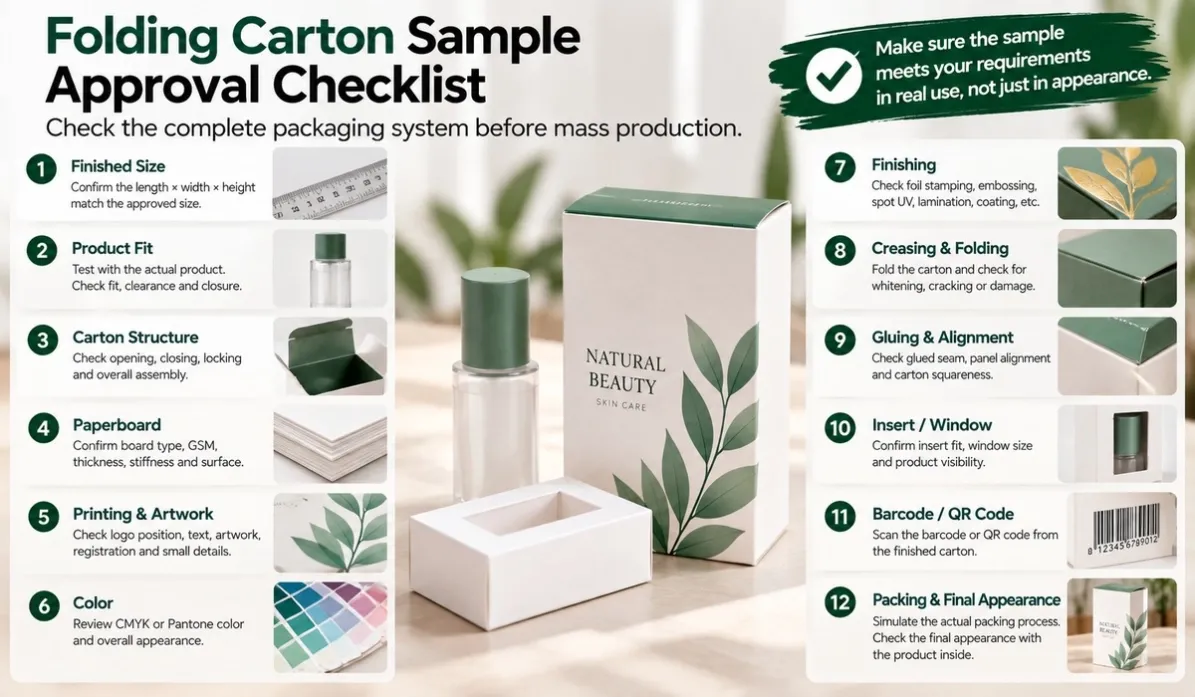
Folding Carton Sample Approval Checklist
Before giving final approval, review the complete packaging system.
Check | What to Confirm |
|---|---|
Finished Size | Length × width × height are correct |
Product Fit | Actual product fits and can be packed easily |
Insert Fit | Product, insert and carton work together |
Carton Structure | Opens, closes and locks correctly |
Paperboard | Type, GSM, thickness, stiffness and surface |
Artwork | Position, text, spelling and layout |
Color | Approved color expectation is understood |
Printing | Registration and coverage are acceptable |
Finishing | Foil, UV, embossing, coating, window, etc. |
Creasing | Folds cleanly without unacceptable damage |
Gluing | Seam is aligned and secure |
Squareness | Assembled carton remains properly shaped |
Barcode / QR | Scans correctly from the finished carton |
Packing | Practical for the intended packing process |
Final Appearance | Looks and functions correctly with the actual product inside |
The purpose is not simply to create a longer approval list.
It is to make sure the sample has been checked in the same condition in which the packaging will actually be used.
What Should Be Recorded When the Sample Is Approved?
Sample approval should create a clear production reference.
Depending on the project, record the approved:
- finished dimensions
- dieline version
- paperboard specification
- artwork version
- printing requirements
- Pantone colors where applicable
- finishing requirements
- insert or window details
- packing method
- physical approved sample where required
If something changes after approval — for example the paperboard, dieline, artwork or finishing — review the affected parts of the carton again.
An approved sample is most useful when the approved specification is also clearly recorded.
FAQ
Should I Approve a Folding Carton From a Flat Sample?
Not if the carton needs to be evaluated for fit, folding or assembly.
A flat sample can help check artwork and basic die-cutting, but the carton should also be assembled and tested with the actual product whenever fit or structure matters.
Should I Put the Actual Product Inside the Sample?
Whenever practical, yes.
The actual product can reveal tight fit, excessive movement, insert problems, bulging and closure issues that may not appear when the carton is empty.
Is a Digital Sample the Same as a Mass-Production Sample?
Not necessarily.
A digitally printed sample can be useful for reviewing artwork, layout and general appearance, but the printing process may differ from bulk production.
Confirm which material, printing and finishing processes the sample represents before using it as a production reference.
What Is a Production-Representative Folding Carton Sample?
A production-representative sample uses paperboard, printing, finishing and construction that are closer to the intended bulk-production specification.
It can provide a more realistic reference for the final carton than a blank structural sample or a digitally printed mock-up.
However, buyers should still confirm which materials and production processes the sample actually represents before approval.
What If the Paperboard Changes After Sample Approval?
Review the affected carton performance again.
Even when the new paperboard has the same GSM, differences in thickness, stiffness and construction can affect fit, folding, creasing and the final assembled carton.
Should I Test the Barcode Before Mass Production?
Yes.
Scan barcodes and QR codes from the finished assembled carton rather than checking only the artwork file.
Folding, positioning, print quality and surface finishing can affect real-world readability.
Final Thoughts
A folding carton sample should not be approved simply because:
“It looks good.”
The better question is:
“Does this sample confirm that the complete packaging system is ready for production?”
Review the carton in the same sequence in which it will actually be used:
Assemble → Insert Product → Close → Inspect → Scan → Pack
A problem found during sampling can be reviewed before thousands of cartons are produced.
If you are preparing a sample for custom folding cartons, send us your product dimensions, product weight, target box size or dieline, artwork, paperboard preference and finishing requirements.
We can review the product fit, carton structure, paperboard and finishing requirements before sampling, so the approved sample provides a clearer reference for bulk production.