
Oct 12, 2026Packaging Knowledge
Your Folding Carton Looks Right — So Why Doesn't the Product Fit?
Product size alone isn't enough to determine carton size. Learn how clearance, inserts, paperboard and structure affect the final fit of folding cartons.
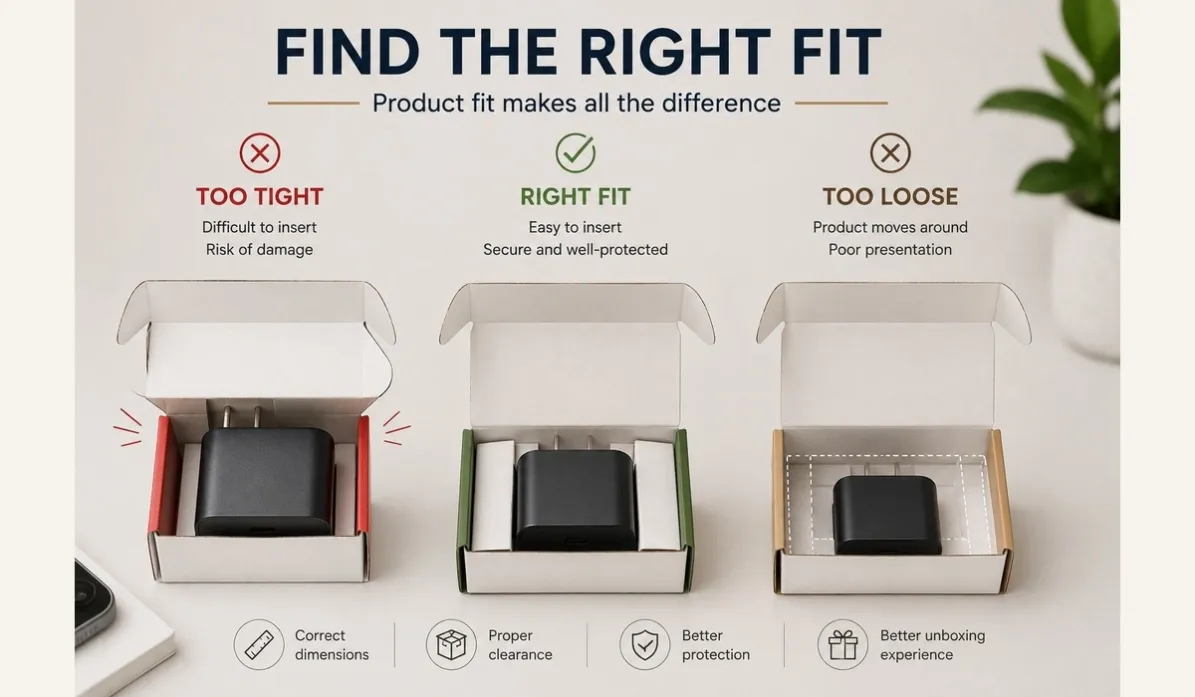
The product measures:
100 × 60 × 25 mm.
So should the inside of the folding carton also be:
100 × 60 × 25 mm?
It sounds logical.
But when the sample arrives, you may discover a problem.
The product is difficult to insert.
Or the opposite happens:
There is too much empty space, and the product moves inside the box.
This is a common packaging problem.
The reason is simple:
Product dimensions and finished box dimensions are not always the same thing.
A good folding carton needs enough room for the product to fit properly — but not so much room that the product moves around unnecessarily.
Getting that balance right requires more than copying the product dimensions.
Why Product Size Alone Isn't Enough
Imagine your product measures exactly:
100 × 60 × 25 mm
If the internal box dimensions are also exactly:
100 × 60 × 25 mm
there is theoretically no extra space.
That can create problems during actual packing.
The product may:
- Be difficult to insert
- Rub against the inside of the carton
- Push against the side panels
- Distort the box
- Become difficult for customers to remove
But simply making the box much larger isn't a good solution either.
Too much space can allow the product to:
- Move during transportation
- Hit the sides of the box
- Look poorly fitted
- Require unnecessary filler
- Make the packaging larger than needed
So the objective isn't simply:
Make the carton bigger than the product.
The objective is:
Allow the right amount of space for the product, structure and packing process.
1. Start With the Actual Product Dimensions
This sounds obvious, but it is where many packaging projects begin to go wrong.
When requesting a quote for custom folding cartons, buyers sometimes provide dimensions from:
- A product specification sheet
- An online listing
- A CAD drawing
- An old packaging file
These dimensions may not always represent the actual finished product.
For example, a supplier specification may say:
100 × 60 × 25 mm
but actual production pieces may vary slightly.
That small difference matters when the packaging fit is tight.
Whenever possible, provide your packaging supplier with:
- Actual finished product dimensions
- Product photos
- Product weight
- Physical samples for final fitting when necessary
For products with an irregular shape, dimensions alone may not be enough.
2. Products Need Some Clearance
A product generally needs some space between itself and the inside of the folding carton.
This space is often called clearance.
You don't need to know the technical calculation yourself.
The important thing is to understand why it exists.
Without enough clearance, the product may be difficult to pack.
With too much clearance, it may move around.
The amount of clearance depends on the product.
For example:
A Soft Product
A flexible textile accessory can tolerate a tighter fit.
A Rigid Electronic Product
A hard plastic electronic device has almost no flexibility.
It may require more carefully controlled internal dimensions.
A Glass Bottle
A glass cosmetic bottle may also need room for an insert or protective structure.
So there isn't one universal rule such as:
“Always add 2 mm.”
The correct allowance depends on the actual product and packaging design.
3. Don't Forget the Insert
This is especially important for electronics, cosmetics, accessories and gift products.
Sometimes the product doesn't sit directly inside the folding carton.
Instead, it sits inside an:
- Paper insert
- Cardboard insert
- Corrugated insert
- Molded pulp insert
- EVA or foam insert
- Plastic tray
Now the calculation changes.
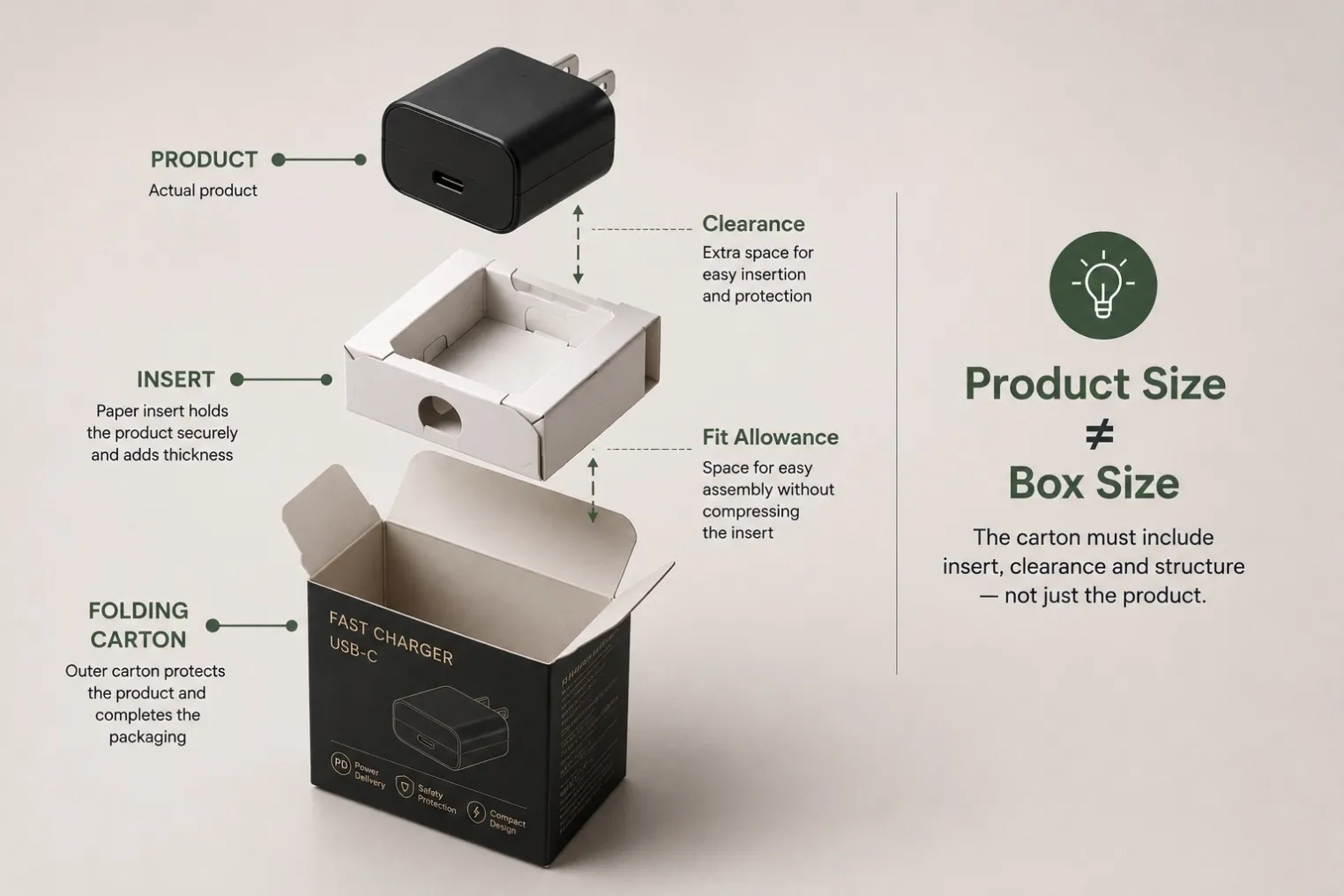
You are no longer designing a box only around the product.
You are designing:
Product → Insert → Folding Carton
The insert itself needs space.
And the product needs to fit correctly inside the insert.
If the carton size is correct but the product still needs positioning support, the next step is to decide when a packaging insert is actually needed.
Example: Small Electronic Accessory
Imagine a small charger measures:
80 × 50 × 25 mm
The buyer wants a paper insert to hold the charger securely.
If the folding carton is designed only around the charger's dimensions, there may not be enough space for the insert.
The correct process should be:
- Confirm the product dimensions
- Design the insert around the product
- Confirm how the insert folds and locks
- Design the outer folding carton around the completed insert
This is much safer than designing all three separately.
The product, insert and outer carton should be treated as one packaging system.
4. Paperboard Thickness Also Takes Up Space
Paper may look thin, but folding cartons are three-dimensional structures.
Paperboard has thickness.
When it is:
- Folded
- Creased
- Glued
- Overlapped
that thickness affects the finished structure.
This becomes more noticeable when:
- The box is small
- The board is relatively thick
- Several panels overlap
- The product fit is very tight
For a large carton, a small dimensional difference may not matter much.
For a small electronics carton with a close-fitting insert, it can matter a lot.
This is one reason why copying a dieline and simply changing the dimensions can sometimes create unexpected fitting problems.
5. Folding and Creasing Affect the Finished Size
A folding carton starts as a flat sheet.
Then it is:
Die-cut → Creased → Folded → Glued → Assembled
Every fold changes the geometry of the structure slightly.
A box that looks correct as a flat dieline still needs to work after it is folded into its final three-dimensional shape.
This is especially important around:
- Corners
- Locking tabs
- Bottom closures
- Dust flaps
- Insert locking areas
A carton isn't just six flat dimensions around a product.
It is a working structure.
6. How the Product Is Loaded Matters
Another question buyers may overlook is:
How will the product actually go into the box?
Consider a long rectangular product.
It might technically fit inside the carton.
But if the opening is too narrow, workers may struggle to insert it efficiently.
This matters even more during mass production.
Packing one sample by hand is easy.
Packing:
5,000, 10,000 or 50,000 pieces
is different.
A carton should not only fit the product.
It should also be practical to pack.
A Box Can Be "Correct" but Still Be Difficult to Pack
This is an important distinction.
Imagine a product fits inside the carton with almost no extra space.
Technically:
The dimensions are correct.
But if every packing worker needs extra time to push the product into the box, the difference can become significant across thousands of units.
The packaging becomes inefficient.
A small structural adjustment may make packing much easier without making the finished box noticeably larger.
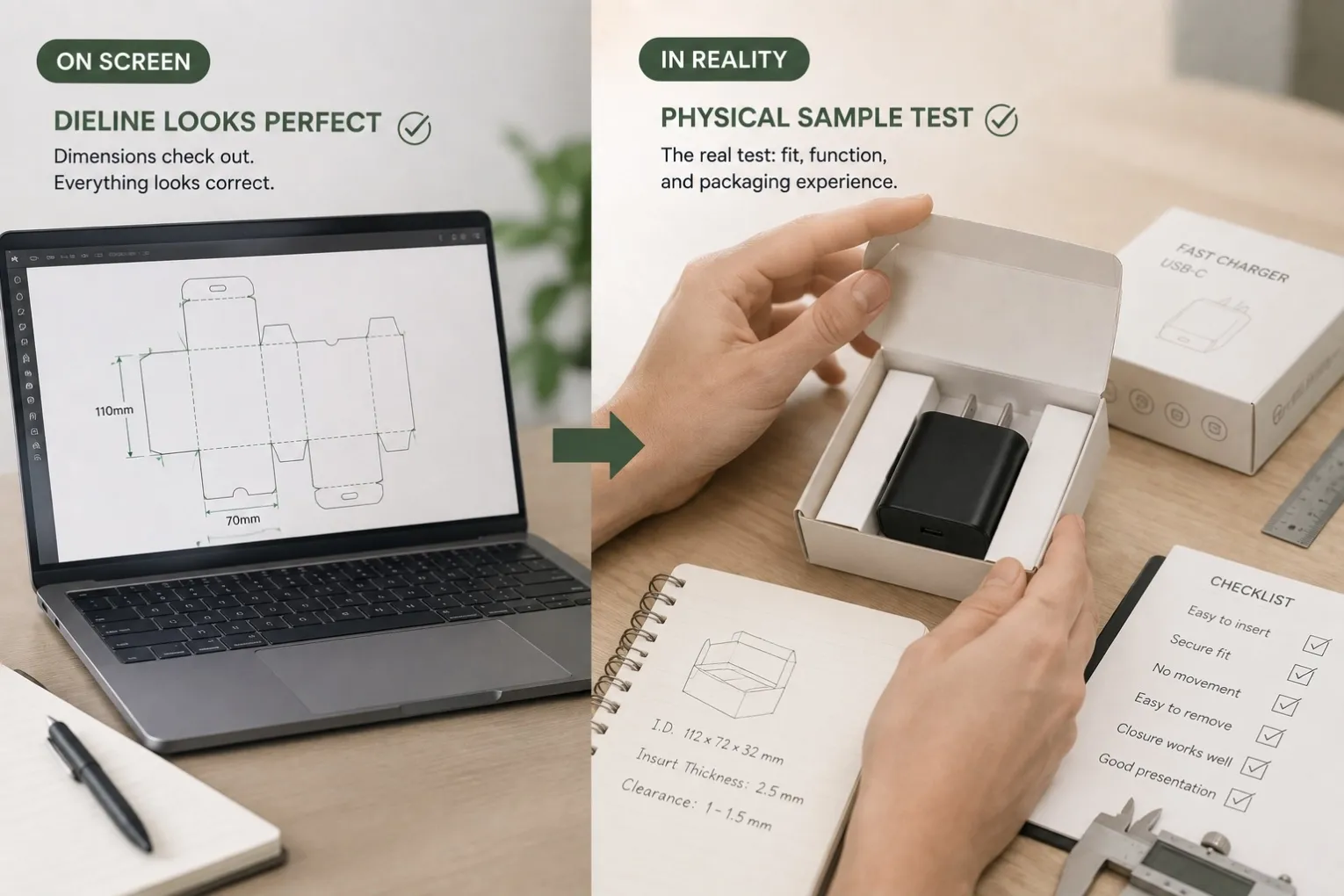
This is why a physical packaging sample can reveal problems that are difficult to see from a dieline alone.
7. Too Much Empty Space Is Also a Problem
Most buyers worry about boxes being too small.
But oversized packaging can create just as many problems.
If the product is significantly smaller than the carton:
- It can move around
- Presentation may look poor
- More insert material may be required
- The box becomes unnecessarily large
- More space may be used during storage and transportation
For premium products, poor internal fit can also affect the unboxing experience.
When customers open the box, the product should feel like it belongs there.
Not like it was placed inside a box that happened to be available.
8. Product Tolerance Can Affect Bulk Packaging
There is another issue that may not appear during the first sample.
Product dimensions can vary slightly between production batches.
For example, the packaging sample may be tested using one product sample.
That sample fits perfectly.
But later, bulk products are slightly larger because of normal manufacturing tolerance.
If the carton was designed with almost zero clearance, those small differences can create problems during packing.
This is particularly important when packaging:
- Molded plastic products
- Electronic accessories
- Bottles
- Containers
- Assembled products with multiple components
Before approving a very tight packaging fit, consider whether the product itself has dimensional tolerance.
Should You Just Make the Box a Little Bigger?
Not automatically.
Adding extra space everywhere is easy.
But good packaging isn't about creating the largest possible safety margin.
The goal is to find the balance between:
Easy packing + Secure fit + Product protection + Efficient box size
Sometimes the answer is a slightly larger carton.
Sometimes it is a better insert.
Sometimes it is changing the loading direction.
Sometimes the original carton dimensions are fine, but the internal structure needs adjustment.
That is why it is better to review the entire packaging system before changing one dimension.
Sample First, Then Confirm the Bulk Order
For products where fit is important, a physical sample can be very useful.
Before approving mass production, test the sample with the real product.
Don't only look at the printing.
Actually pack the product.
Then check:
- Is it easy to insert?
- Is it easy to remove?
- Does the product move?
- Does the insert hold it correctly?
- Do the panels close naturally?
- Does the box bulge after packing?
- Are the locking tabs under too much pressure?
- Does the finished package still look clean?
These checks can prevent much bigger problems during bulk packing.
A Simple Buyer Checklist
Before requesting custom folding cartons, try to provide:
Information | Why It Matters |
|---|---|
Product Dimensions | Determines the basic internal space |
Product Weight | Helps evaluate material and structure |
Product Photo | Shows shape and special features |
Physical Sample | Best for confirming a close fit |
Insert Requirement | Changes the internal dimensions |
Packing Direction | Affects opening and structure |
Quantity | Helps determine production approach |
Artwork | Confirms printing and finishing |
Existing Packaging | Useful reference for improvements |
You don't need to calculate every packaging allowance yourself.
But the more information your supplier has about the actual product, the easier it is to design the carton correctly.
Don't Approve a Folding Carton Based Only on the Dieline
A dieline is important.
But it doesn't tell the whole story.
A packaging design can look perfect on a computer screen and still create problems when:
- The board is folded
- The insert is assembled
- The actual product is loaded
- The box is closed
- Bulk packing begins
That is why product fit should be checked as part of the packaging development process — not after mass production.
Final Thoughts
When a folding carton doesn't fit the product properly, the problem isn't always a wrong length, width or height.
The real cause may be:
- Insufficient clearance
- Too much clearance
- Product dimensional tolerance
- Paperboard thickness
- Folding structure
- Insert design
- Loading direction
- Incorrect product measurements
The most important principle is simple:
Don't design the folding carton around dimensions alone. Design it around how the actual product will be packed and used.
A few millimeters may seem insignificant on a drawing.
But in packaging production, those few millimeters can be the difference between:
a carton that technically fits
and
a carton that works properly.
Not Sure About Your Folding Carton Size?
If you are developing custom folding cartons, send your packaging supplier:
- Product dimensions
- Product weight
- Product photos
- Existing packaging
- Insert requirements
- Required quantity
- Artwork or logo
For projects where the fit is critical, a physical product sample can also help confirm the structure before bulk production.
The goal isn't simply to make a box that is large enough.
For packaging projects that need printed retail boxes, our printed folding cartons page shows common structures, materials, printing options and insert considerations.
It is to create a folding carton that fits, protects and packs efficiently.
Explore Our Printed Folding Cartons
View Electronics Folding Cartons
Request a Custom Packaging Quote