
Oct 12, 2026Buying Guides
Should Fashion Brands Use One Hang Tag for Every Collection?
Should fashion brands use the same hang tag for every collection? Learn when to keep one design and when different collections need their own hang tags.
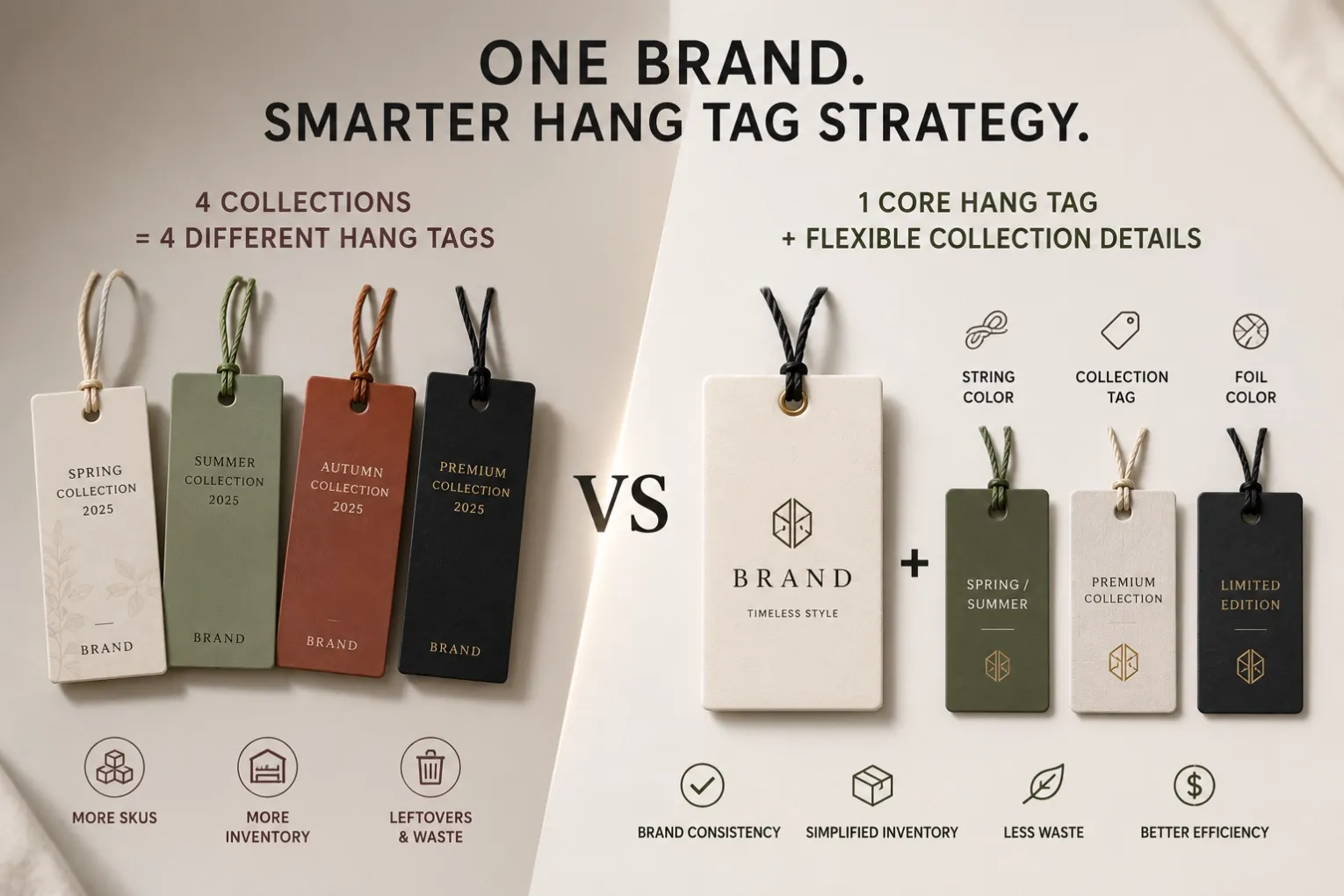
A fashion brand launches a new collection.
The colors change.
The fabrics change.
The price positioning may change.
Even the story behind the collection may be completely different.
Then one small question comes up:
Should we keep using the same hang tag, or design a new one for this collection?
At first, creating different fashion hang tags for every collection may sound like a good branding idea.
But for buyers, it also creates practical questions.
More designs mean more SKUs, more inventory, different production quantities and potentially more leftover tags.
On the other hand, using exactly the same hang tag for every product can make special collections feel less distinctive.
So which approach makes more sense?
The answer is usually somewhere in between.
Why Many Fashion Brands Use One Core Hang Tag
There is a good reason many brands keep their main hang tag consistent.
Your primary hang tag is part of your brand identity.
Customers repeatedly see the same:
- Logo
- Brand colors
- Typography
- Paper style
- Shape
- String or attachment
Over time, those details become recognizable.
Changing everything for every collection can weaken that consistency.
There is also a practical advantage.
If the same custom hang tags can be used across multiple products and collections, the brand can order larger quantities and manage fewer packaging SKUs.
That can simplify:
- Purchasing
- Inventory
- Production planning
- Reordering
- Distribution to different factories
For many brands, keeping a consistent core hang tag is the simplest and most economical solution.
But Not Every Collection Is the Same
Imagine a fashion brand with four collections:
Core Collection
Everyday products that remain relatively consistent.
Spring / Summer Collection
Lighter fabrics, brighter colors and seasonal designs.
Premium Collection
Higher-priced garments using better materials and finishing.
Sustainable Collection
Products with a specific material or sourcing story.
Should all four use exactly the same hang tag?
They can.
But that doesn't necessarily mean they should.
A hang tag can help communicate that a particular product belongs to something special.
The challenge is doing this without losing the main brand identity.
Option 1: Use Exactly the Same Hang Tag for Every Collection
This is the simplest system.
One design.
One material.
One size.
One printing specification.
One string.
The same tag is used throughout the brand.
Advantages
- Strong brand consistency
- Easier inventory management
- Larger combined order quantities
- Easier reordering
- Fewer packaging SKUs
- Lower risk of leftover collection-specific tags
This approach works particularly well for brands where the brand itself is more important than individual collection identities.
It can also work well for smaller fashion brands that don't need a complicated packaging system.
The Limitation
A limited edition or premium collection may not feel very different from the standard range.
The packaging doesn't help communicate the collection's special positioning.
Option 2: Create a Completely Different Hang Tag for Every Collection
At the opposite extreme, every collection gets its own design.
For example:
Spring Collection
Pastel paper + white string
Autumn Collection
Textured brown paper + dark cord
Premium Collection
Thick specialty paper + foil stamping
Limited Edition
Special shape + unique printing
From a creative perspective, this gives designers maximum freedom.
But from a purchasing perspective, it can quickly become complicated.
Instead of managing one hang tag, the buyer may now manage:
- Four artworks
- Four materials
- Four color specifications
- Four order quantities
- Four inventories
- Four reorder schedules
And possibly four different MOQs.
This creates another important problem.
Collection-Specific Hang Tags Can Create Leftover Inventory
This is something designers may not think about when developing the artwork.
Imagine you order:
5,000 hang tags
for a seasonal collection.
At the end of the season, only 3,800 are used.
You now have 1,200 tags printed specifically for a collection that may never return.
They can't easily be used for next year's collection if the name, year, color or design changes.
That leftover inventory is effectively wasted.
For brands launching many collections or testing smaller product runs, this can become a recurring packaging cost.
That's why the most creative solution isn't always the most practical solution.
A Better Approach: Keep the Brand, Change the Collection Detail
For many fashion brands, there is a third option.
And often, it's the most practical.
Keep the main brand hang tag consistent and change only one or two collection-specific elements.
For example, keep the same:
- Tag size
- Paper
- Logo position
- Main typography
- Hole position
- Basic structure
Then change:
- Secondary color
- Collection name
- Small secondary tag
- String color
- Foil color
- Printed sleeve or sticker
This creates collection differentiation without rebuilding the entire hang tag system.
Example: One Main Tag + One Collection Tag
Instead of creating a completely new main tag for every collection, consider a two-tag system.
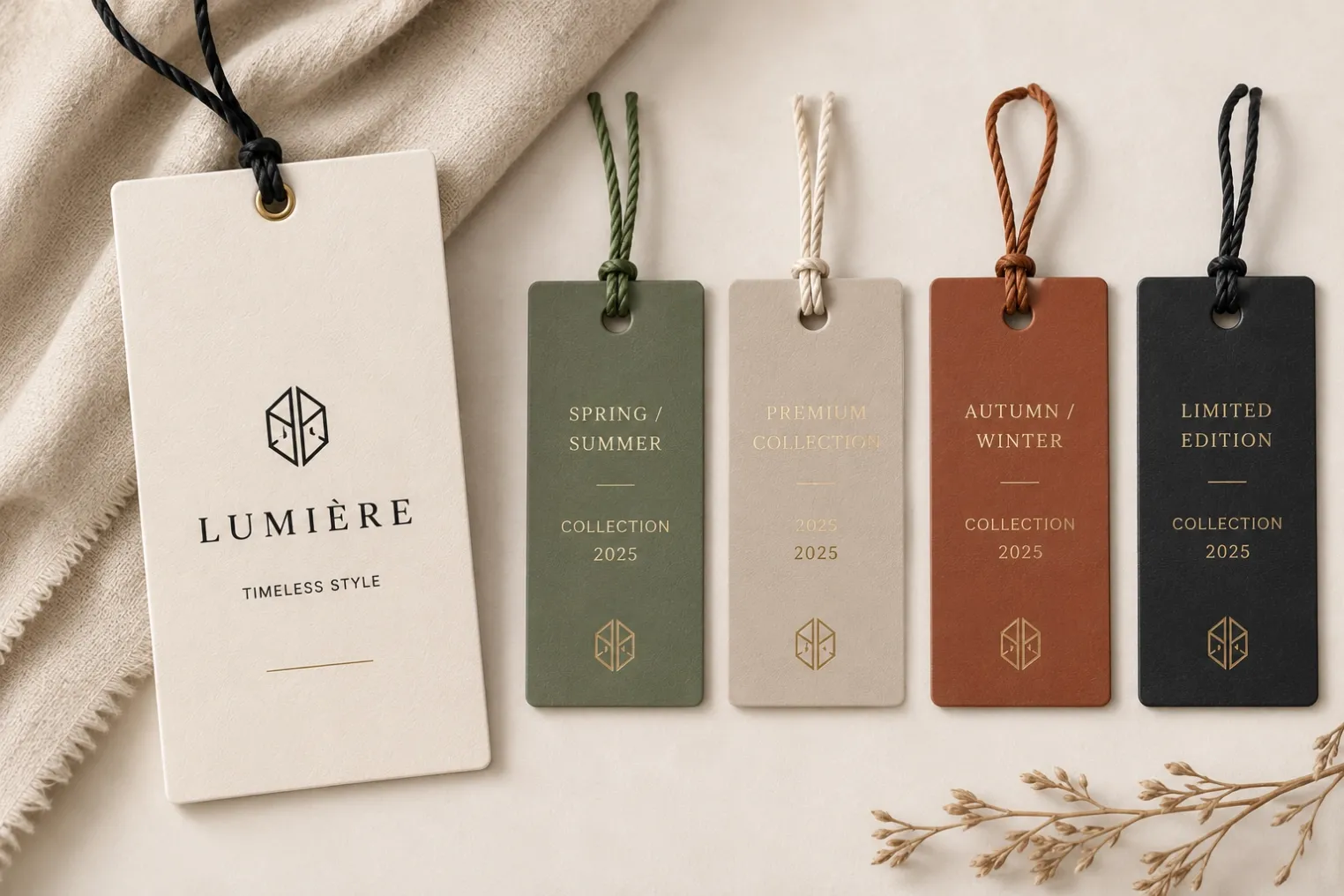
Main Brand Hang Tag
Keep this consistent:
Front
Brand logo
Back
Website / QR code / short brand message
Secondary Collection Tag
Change this depending on the collection:
SPRING / SUMMER 2027
or
LIMITED EDITION
or
PREMIUM COLLECTION
or
RECYCLED MATERIAL SERIES
The main tag can be ordered in larger quantities and used throughout the year.
Only the smaller secondary tag changes.
This can provide both:
Brand consistency + Collection flexibility
Another Simple Option: Change Only the String Color
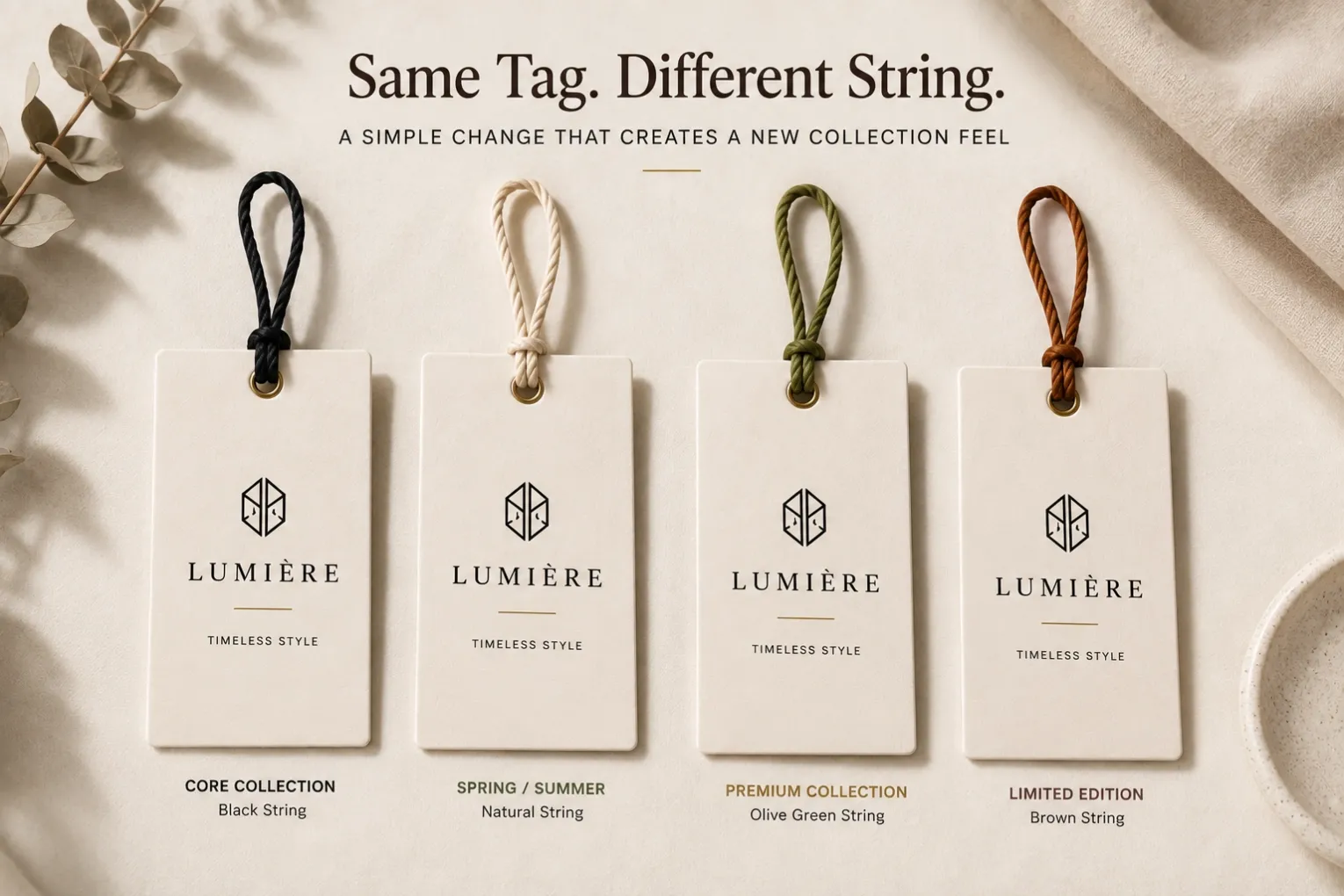
Sometimes the smallest change is enough.
Imagine the same cream-colored hang tag with the same black logo.
For the core collection:
Black string
For Spring / Summer:
Natural cotton string
For a premium collection:
Champagne cord
For a limited collection:
Brand-color string
The printing and paper remain exactly the same.
Only the attachment changes.
From a production perspective, this can be much easier than creating completely different printed tags.
From a design perspective, the collection still receives a subtle visual identity.
Foil Color Can Work the Same Way
Another possibility is keeping the same paper and artwork while changing one finishing detail.
For example:
Core Collection: Black printing
Premium Collection: Champagne gold foil
Special Edition: Silver foil
The overall tag remains recognizable as part of the same brand.
But the finishing creates a visual distinction.
However, buyers should still consider production quantity.
Changing foil usually means separate production runs, so very small quantities may increase the unit cost.
Think About MOQ Before Creating Too Many Versions
This is where design decisions meet purchasing reality.
Imagine a fashion brand needs:
10,000 total hang tags.
If one design is used across all products:
10,000 pcs × 1 design
That's relatively straightforward.
But if the same quantity is divided across five collections:
2,000 pcs × 5 designs
the production situation changes.
Each design may require separate:
- Printing setup
- Plates
- Foil stamping setup
- Die-cutting arrangement
- Quality checks
- Packing
The total quantity is still 10,000.
But the production cost may not be the same.
For buyers, this is an important distinction:
Total quantity and quantity per design are not always the same thing.
Before creating multiple hang tag versions, ask your supplier how different artworks affect MOQ and pricing.
Don't Forget the Garment Factory
Hang tags don't go directly from the printer to the customer.
They often need to reach a garment factory first.
If a brand has several collections, factories need to know exactly which hang tag belongs to which garment.
Too many similar versions can create another risk:
the wrong hang tag being attached to the wrong product.
A good collection system should therefore be easy not only for designers and buyers, but also for production teams.
Clear packaging, SKU identification and simple instructions can help prevent mistakes during garment packing.
When Should You Use the Same Hang Tag?
Using one consistent fashion hang tag may be the better choice when:
- Brand identity is more important than collection identity
- Collections change frequently
- Individual collection quantities are small
- You want to simplify inventory
- You want to reduce leftover packaging
- The same products are sold across multiple seasons
- Cost efficiency is important
In these situations, consistency can be an advantage rather than a limitation.
When Does a Different Hang Tag Make Sense?
A collection-specific hang tag may be worth considering when:
- The collection has a clearly different positioning
- It's a premium or luxury line
- It's a limited edition
- The collection has a specific story
- Materials or craftsmanship need explanation
- The collection targets a different customer group
- Order quantity is large enough to justify separate production
The key word is purpose.
Don't create a different hang tag simply because it's a new season.
Create one when the difference helps communicate something meaningful.
A Simple Decision Framework for Fashion Buyers
Before approving another hang tag design, ask these five questions:
- Does this collection really need to look different?
- Can we keep the main brand tag and change only one element?
- What is the quantity for each design?
- What happens to unused tags after the collection ends?
- Will multiple versions make inventory and garment production more complicated?
If you can't clearly explain why a collection needs its own hang tag, the existing brand tag may already be doing its job.
One Brand Doesn't Necessarily Mean One Tag
The goal isn't to say:
Every collection should use the same hang tag.
Nor is it:
Every collection needs a unique hang tag.
A better principle is:
Keep what makes the brand recognizable. Change only what helps the collection communicate something different.
For many fashion brands, that means creating a core hang tag system rather than designing every tag from scratch.
The core elements remain consistent.
Collection-specific elements become flexible.
Final Thoughts
Hang tags are small, but managing them across multiple collections can become surprisingly complicated.
A completely new design for every collection may look creative on a design board, but buyers also need to consider:
- MOQ
- Unit cost
- Inventory
- Leftover tags
- Reordering
- Garment factory management
- Brand consistency
Sometimes the smartest solution isn't another completely new hang tag.
It may simply be:
the same tag + a different string
or
the same main tag + a small collection tag
or
the same design + one different finishing detail.
Good fashion hang tag design isn't only about how the tag looks.
It's also about creating a system that works for the brand, the buyer and the supply chain.
Planning Hang Tags for Multiple Fashion Collections?
If your brand uses different hang tags across seasonal, premium or limited collections, we can help evaluate how to keep the design flexible while simplifying production.
You can compare different paper, printing, finishing, string and multi-tag combinations before deciding whether each collection really needs a completely separate hang tag.
👉 Explore Our Fashion Hang Tags
👉 Request a Custom Hang Tag Quote