
Sep 23, 2026Blog
Why Does a Mailer Box Keep Popping Open After Assembly? | Buyer Guide
Is your corrugated mailer box popping open after folding? Learn how spring-back, creasing, locking tabs, die cutting and product fit can affect box closure.
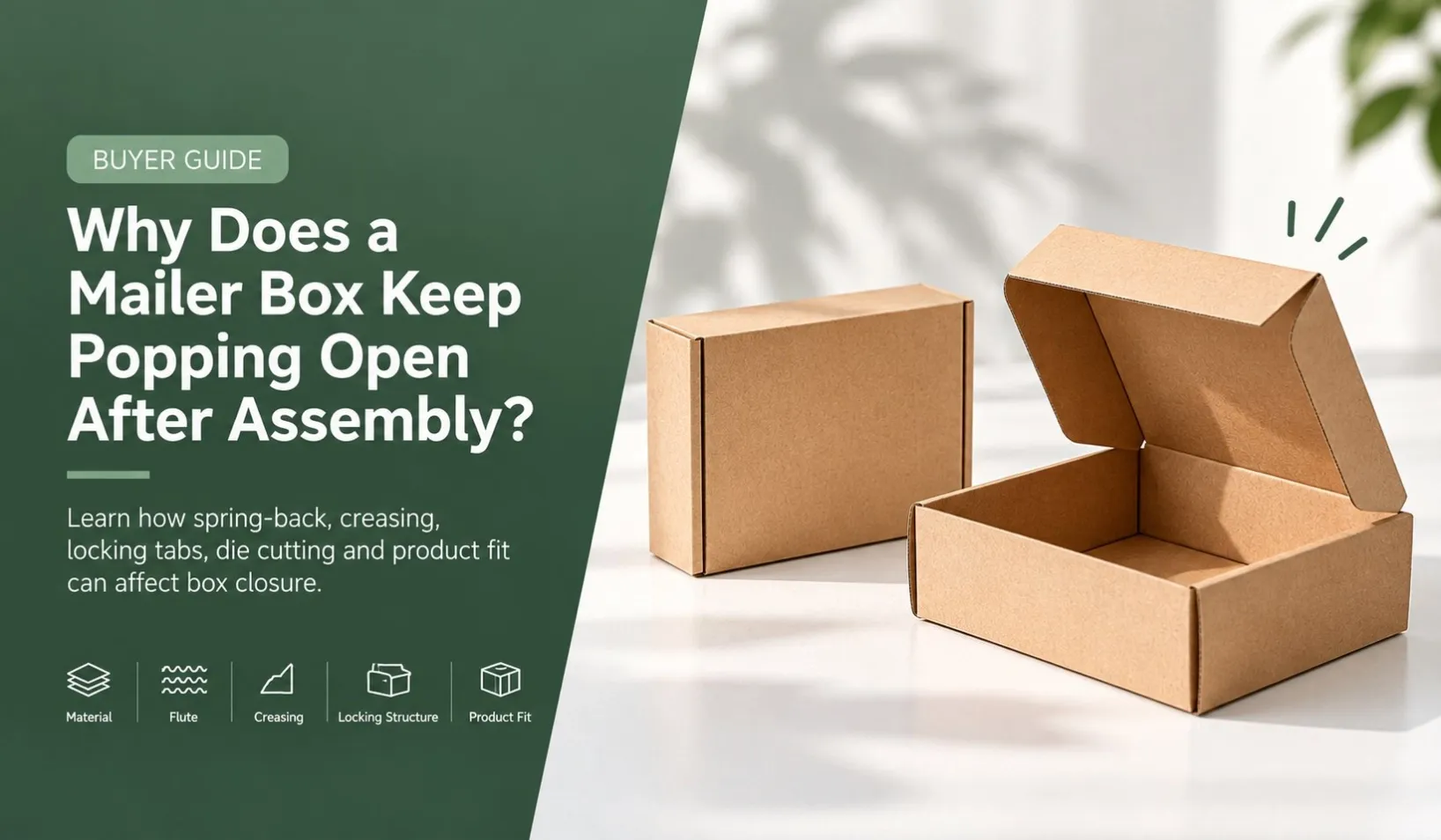
Why Does a Mailer Box Keep Popping Open After Assembly?
A mailer box may look perfectly fine when it is flat.
But after folding and assembly, the lid may not stay closed. The front flap may keep lifting, the side locks may not hold properly, or the entire box may seem to spring back open.
At first, this can look like a simple assembly problem.
But in many cases, the real cause is not just how the box was folded.
The material, flute, creasing, die cutting, locking structure and even the product inside the box can all affect how well a mailer box stays closed.
So when a mailer box keeps popping open, the better question is not simply:
“How can we make the lid tighter?”
It is:
“What is preventing the whole box structure from staying in its designed position?”
What Causes Mailer Boxes to Pop Open After Assembly?
When the box is assembled, the corrugated board is forced to bend along multiple crease lines. At the same time, the side walls, dust flaps, front panel and locking tabs all need to sit in the correct position.
If one part creates too much resistance, the structure may push back against the lid.
This is why a mailer box that looks correct when flat may behave differently after assembly.
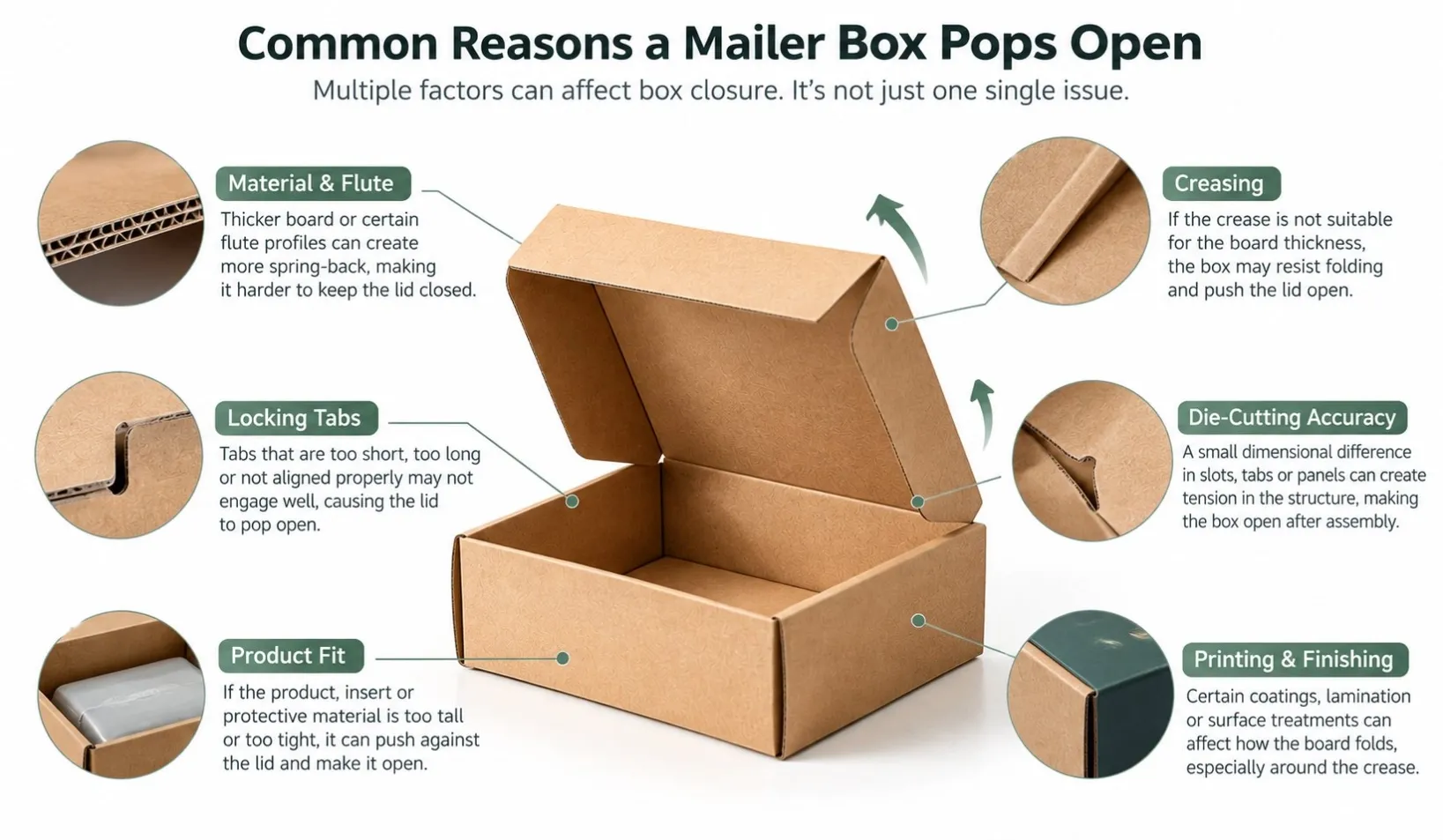
Common causes may include:
- board or flute that is too stiff for the structure
- crease lines that do not fold properly
- locking tabs that do not engage correctly
- dimensional or die-cutting issues
- excessive pressure from the product inside
- a box structure that is not well matched to its size and material
The problem is usually better understood by looking at the complete box rather than one individual flap.
Can Corrugated Flute Cause Spring-Back?
Yes.
When it is folded, the material naturally tries to recover some of its original shape. This is sometimes experienced as spring-back.
The effect can become more noticeable when:
- the board is relatively thick
- the flute profile creates more resistance around the fold
- the box has several closely positioned folds
- the lid needs to bend around multiple panels
- the box is small relative to the board thickness
- the crease does not sufficiently control the fold
This does not mean that thicker corrugated board is always a problem.
A thicker board may provide useful protection and rigidity, but mailer box strength depends on more than board thickness alone.
But more thickness is not automatically better closure performance.
Why Is Creasing Critical for Mailer Box Closure?
Creasing tells the corrugated board where and how to fold.
If the crease is not appropriate for the material thickness, the board may resist folding into its intended position.
For example, a crease that is too shallow may leave too much tension in the folded panel.
The result can be a lid that appears to close when pushed down but gradually lifts again after the pressure is released.
On the other hand, an unsuitable crease can also damage or weaken the board around the fold.
This is why the creasing setup should be considered together with:
Board Thickness → Flute → Crease → Fold
Rather than treating the crease as an isolated production detail.
For mailer boxes with several interacting folds, a small difference in folding behaviour can affect the final assembled shape.
Do Locking Tabs Affect Box Closure?
A mailer box normally relies on its structure rather than adhesive tape to keep the lid in position.
That means the front flap, side tabs or locking points need to engage correctly.
If the locking tab is:
- too short
- too long
- too loose
- too tight
- positioned incorrectly
the closure may not work as intended.
For example, if the tab does not enter far enough into the locking position, the natural spring-back of the corrugated board may push it out again.
But making the tab tighter is not always the solution.
If it becomes too tight, assembly may become difficult and the edges or printed surface may be damaged during folding.
A good closure needs enough engagement to hold the box while still allowing practical assembly.
Does Die-Cutting Accuracy Impact the Box?
Yes.
Mailer boxes contain multiple panels, slots, tabs and crease lines that need to align after folding.
A relatively small dimensional difference in one area can influence another part of the assembled box.
For example, if a slot and its corresponding tab do not align properly, the operator may need to force the box into position.
The box may appear assembled, but internal tension can remain in the structure.
Once released, that tension may push the lid or side panel outward.
This is one reason why checking only the flat die-cut sheet is not enough.
The box should also be evaluated after full assembly.
Can a Packed Product Push the Box Open?
Definitely.
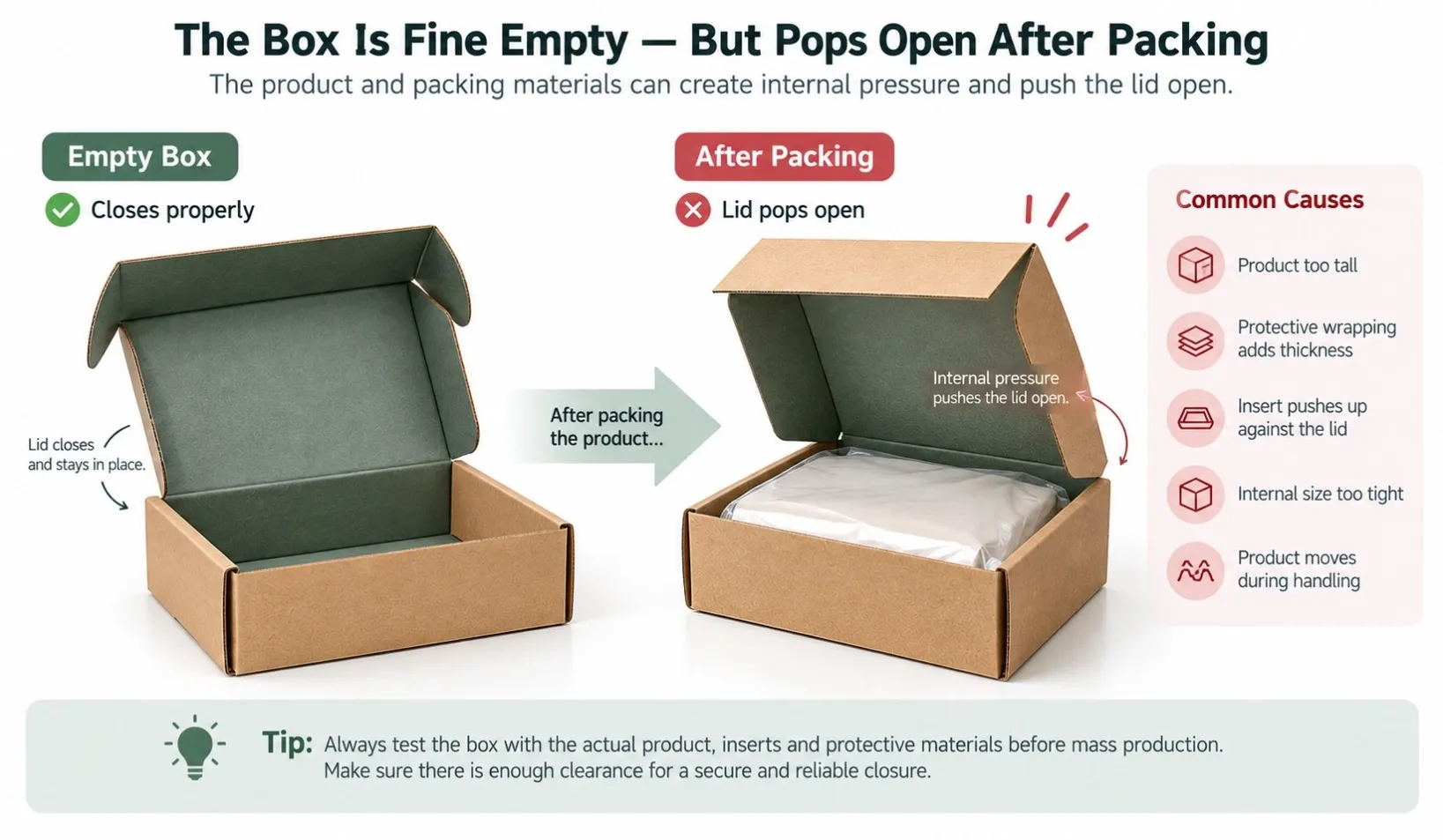
Sometimes the empty box closes correctly, but the same box starts opening after the product is packed.
In this case, the problem may not be the closure itself.
The product may simply be creating too much internal pressure.
This can happen when:
- the internal dimensions are too tight
- the product is taller than expected
- protective wrapping adds extra thickness
- an insert pushes upward against the lid
- multiple products are packed too tightly
- the product moves into the lid area during handling
This is why checking only the product dimensions can sometimes be misleading. Understanding the difference between internal and external box dimensions can also help avoid fit problems before sampling.
The supplier may also need to consider:
Product + Protective Material + Insert + Required Clearance
If these are not considered together, a box that looks correct on paper may become too tight in actual use.
How Does Box Size Influence This Issue?
The same corrugated material can behave differently in different box sizes.
A material that works well for a larger mailer box may feel relatively stiff when used for a much smaller structure.
Likewise, a very large mailer box may need more structural support to maintain its shape.
The relationship between:
Box Size → Material → Flute → Structure
is therefore more useful than choosing the board based only on thickness.
This is also why copying the material specification from another mailer box does not always produce the same result.
The structure and dimensions may be different.
Do Printing and Finishing Change Folding Behaviour?
They can.
Printed mailer boxes may include:
- full-colour printing
- coated surfaces
- lamination
- varnish
- other surface treatments
Depending on the material and finishing process, these can influence how the board behaves around folds.
A heavily finished surface may respond differently from an untreated corrugated board when folded.
The important point is not that printing or finishing automatically causes closure problems.
Instead, they should be considered during sampling because the finished production material may behave differently from an unfinished structural prototype.
This is especially important when both appearance and structure are critical.
Why Passing a Sample Test Doesn't Guarantee Bulk Production
A successful sample is an important step, but buyers should also pay attention to how the sample was made.
A hand-cut or manually adjusted sample may not behave exactly like a production die-cut box.
Many buyers only test hand-made samples and meet closure issues once mass production starts.
During bulk production, factors such as:
- actual production material
- die cutting
- creasing
- printing and finishing
- folding direction
- packing method
all come together.
This does not mean that a sample is unreliable.
It means the most useful sample is one that is as close as practical to the intended production specification.
If closure performance is important, it should be checked again using the final material and structure before mass production.
What Should Buyers Check Before Approving Mailer Boxes?
Do not judge the box only while it is lying flat.
Assemble it and use it the way your customer will.
Check whether:
- the side walls stay in position
- the lid folds naturally
- the front flap enters smoothly
- the locking tabs stay engaged
- the lid remains closed after you release it
- the product fits without pushing against the lid
- inserts or protective materials change the fit
- the box can be assembled without excessive force
Then place the actual product inside and repeat the test.
After assembly, leave the closed box for a period of time and check whether the lid gradually lifts again.
This is useful because some spring-back may become more noticeable after the box has been left assembled rather than immediately after folding.
An empty box and a fully packed box may also behave differently.
Troubleshooting: How to Fix Mailer Boxes That Pop Open
Avoid changing the material immediately.
First identify where the tension is coming from.
A useful troubleshooting sequence is:
1. Test the box empty
If it already pops open, look at the material, flute, creasing, locking structure and die-cut dimensions.
2. Test the box with the product
If the problem appears only after packing, check the internal size, product clearance and insert.
3. Check the locking points
Confirm that tabs and slots are engaging properly rather than simply being forced together.
4. Check the folds
Look for areas where the corrugated board is resisting the intended fold.
5. Compare the sample with the intended bulk specification
Confirm whether the same material, flute, finishing and structure are being used.
Only after identifying the likely cause does it make sense to change the board, crease, dimensions or locking structure.
Final Thoughts
When a mailer box keeps popping open, the lid itself may not be the real problem.
The closure is the result of several factors working together:
Material → Flute → Creasing → Die Cutting → Locking Structure → Product Fit → Final Assembly Test
A thicker or stronger corrugated board does not automatically create a better-closing box.
Likewise, making the locking tab tighter does not necessarily solve the problem.
For buyers, one of the most useful tests is simple:
Assemble the box with the actual product inside, close it normally, release it, and see how the complete structure behaves.
If you are developing a custom mailer box, send us your box size, product dimensions, product weight and packing requirements. These details provide a better starting point for reviewing the material and box structure before sampling.