
Sep 23, 2026Blog
Why Are Packaging Box Dimensions Different From What You Ordered?
Why are packaging box dimensions different from your order? Learn how internal and external size, material thickness, structure and production affect final box dimensions.
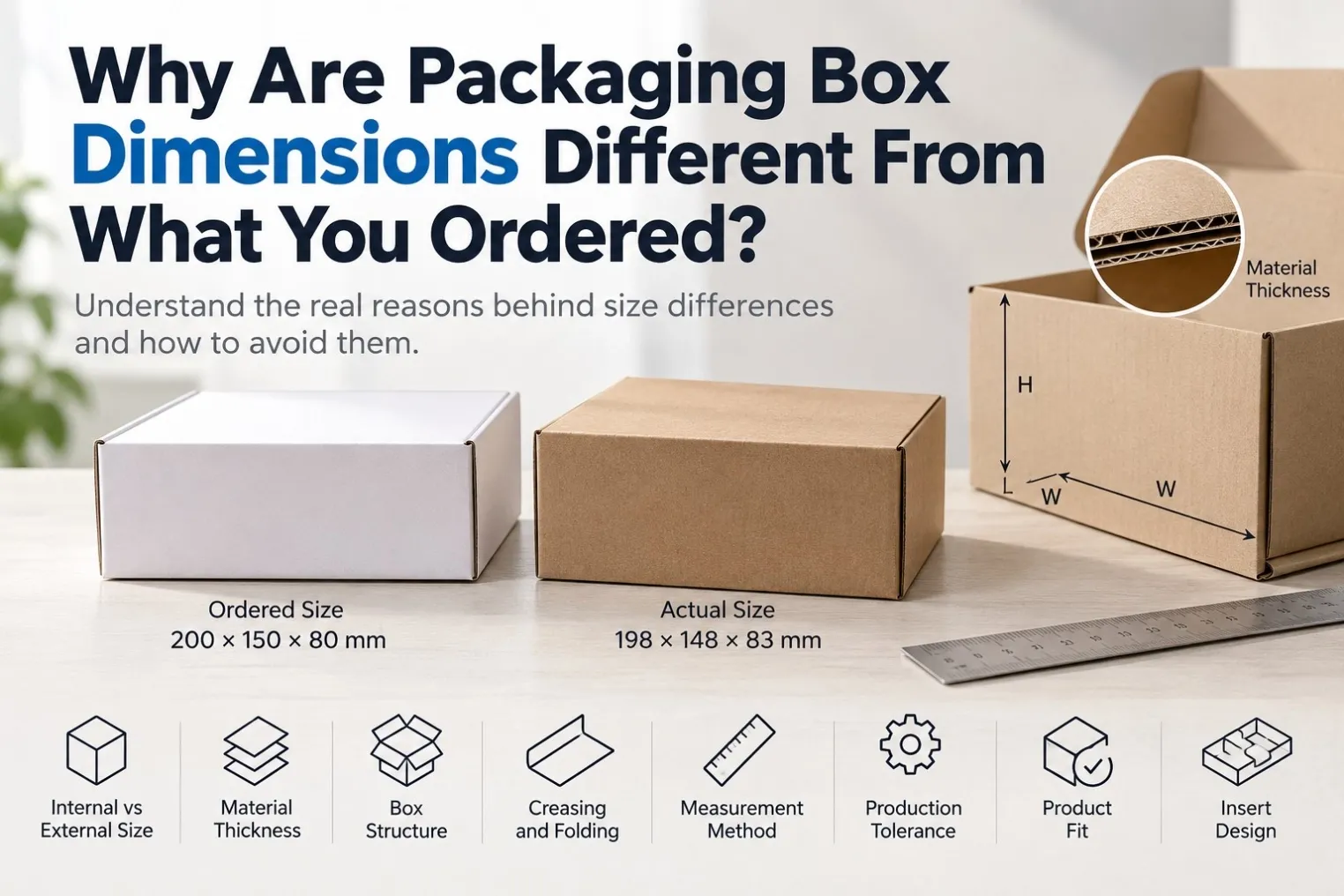
You ordered a custom box at 200 × 150 × 80 mm.
The sample arrives, you measure it with a ruler, and the numbers are slightly different.
The immediate question is:
“Why doesn't the box match the dimensions I ordered?”
Sometimes there may be a production issue. But in many cases, the difference comes from something that was not clearly defined before production.
Box dimensions are affected by more than the three numbers shown on a quotation or drawing. Internal versus external dimensions, material thickness, box structure, creasing, folding and even the way the finished box is measured can all affect the result.
Before deciding that a box has been made to the wrong size, buyers should first check how the dimensions were defined.
1. Are You Talking About Internal or External Dimensions?
This is one of the first things to confirm.
Consider a box specified as:
200 × 150 × 80 mm
Does this mean the usable space inside the box?
Or does it mean the overall dimensions outside the assembled box?
They are not necessarily the same.
Material has thickness. Once the board is folded into a box, that thickness affects the relationship between the inside and outside measurements.
This becomes particularly important when the product needs a close fit.
For example, if a product itself measures approximately 200 mm long, simply ordering a box described as 200 mm long does not automatically mean the product will fit correctly.
The packaging supplier needs to know whether the specified dimensions refer to the product, the internal box space or the external finished size.
2. Material Thickness Changes the Finished Size
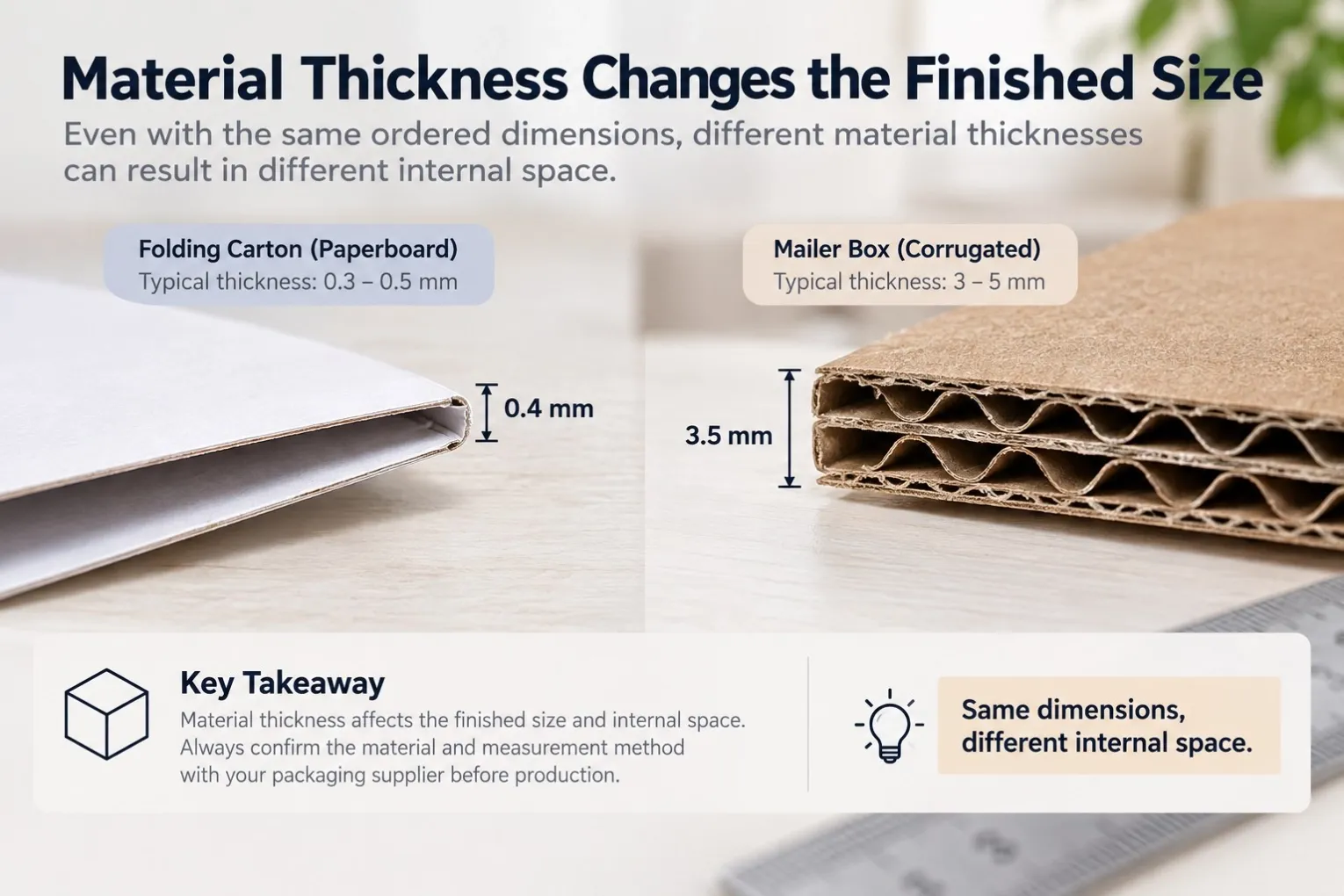
A box is not made from a zero-thickness sheet.
Paperboard used for custom folding boxes may be relatively thin, while corrugated material used for mailer boxes can be considerably thicker.
Once the material is folded, its thickness affects corners, panels and usable internal space.
This is why the same nominal dimensions can behave differently when produced using different materials.
For example, changing from a thinner paperboard to a thicker corrugated board without reconsidering the structure may change the relationship between:
Product Size → Internal Space → Board Thickness → External Size
The thicker the packaging material, the more important it becomes to define which measurement matters most.
3. Different Box Structures Use Dimensions Differently
Not every packaging box is constructed in the same way.
A tuck end folding carton, auto lock bottom box and corrugated mailer box use different panels, folds and locking methods.
Some structures have:
- overlapping panels
- folded side walls
- double-layer edges
- locking tabs
- dust flaps
- reinforced bottoms
These structural elements can affect the finished dimensions after assembly.
This is why copying three dimensions from one box structure and applying them directly to another structure may not produce the same internal fit.
The structure should be developed around the product rather than around three numbers alone.
4. Creasing and Folding Affect the Final Shape
Before a folding carton or mailer box becomes a three-dimensional package, it starts as a flat sheet.
The material is cut and creased so that each panel can fold into position.
But a crease is not simply a mathematical line.
Paperboard and corrugated board have thickness, stiffness and bending characteristics. When they fold along a crease, the material occupies physical space.
This can influence:
- corner position
- panel alignment
- lid fit
- side-wall position
- internal space
A packaging dieline therefore needs to account for both the intended finished size and the material being used.
Changing the material after a structure has already been developed may require the dieline or crease positions to be reviewed.
5. How Are You Measuring the Finished Box?
Another common source of disagreement is the measurement method.
One person may measure the outside edge of the assembled box.
Another may measure the usable space inside.
Someone else may measure a flat panel before the box is fully assembled.
These methods are not directly interchangeable.
For a folding or locking structure, even the way the box is assembled can influence where the ruler or caliper is positioned.
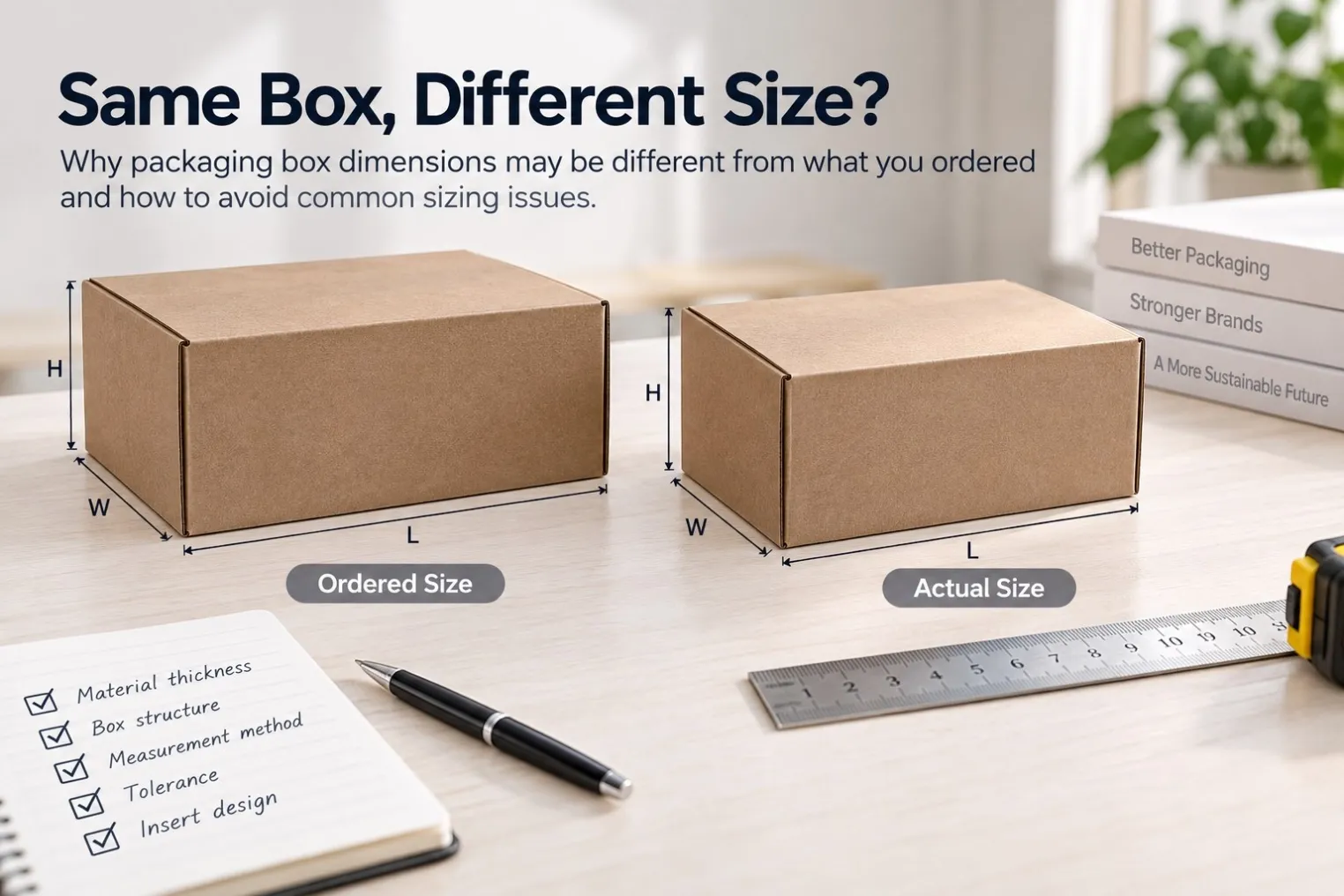
Before comparing a finished sample with an approved specification, both buyer and supplier should ideally use the same measurement definition.
Instead of simply saying:
“The box should be 200 × 150 × 80 mm.”
it is much clearer to define:
Finished internal size: L × W × H
or
Finished external size: L × W × H
depending on what is important for the project.
6. Production Also Has Tolerances
Custom packaging is manufactured through several physical processes.
Depending on the box, these may include:
Printing → Laminating → Die Cutting → Creasing → Folding → Gluing → Assembly
Each process can introduce small variations.
Paper and corrugated board can also respond to moisture, pressure and production conditions.
For this reason, a physical packaging box should not always be evaluated as though it were a precision-machined metal component.
However, this does not mean that any dimensional difference should automatically be considered acceptable.
The appropriate tolerance depends on factors such as:
- material
- box size
- structure
- manufacturing process
- product fit requirements
- agreed inspection standard
If a project requires particularly tight dimensional control, that requirement should be discussed before sampling and bulk production.
Any critical tolerance requirements should be clearly communicated during the sampling stage and confirmed before bulk production.
A fixed tolerance should not be assumed for every type of packaging.
7. The Product Fit Matters More Than the Number Alone
For many packaging projects, the most important question is not:
“Is the box exactly 200 mm?”
It is:
“Does the product fit correctly and perform as intended?”
Imagine a cosmetic bottle, electronic device or gift set that needs to sit securely inside the packaging.
A box can be close to the specified dimensions but still have a poor fit if:
- the product dimensions were measured incorrectly
- an insert was not included in the calculation
- the product needs additional clearance
- accessories were added later
- the board thickness changed
- the box structure changed
This is why product dimensions should normally be considered together with packaging dimensions.
For projects with a close fit, providing the actual product or an accurate product drawing can reduce uncertainty during structural development.
8. Don't Forget the Insert
An insert adds another layer to dimensional planning.
If a box contains a paperboard insert, corrugated insert or another internal support structure, the supplier needs to consider:
Product → Insert → Box
rather than designing each component independently.
An insert that is too tight can make packing difficult.
An insert that is too loose may allow the product to move.
And if the outer box dimensions are fixed before the insert and product arrangement are confirmed, there may not be enough usable space later.
For packaging that requires an insert, it is usually better to develop the product fit and outer box structure together.
9. What Should Buyers Confirm Before Approving a Sample?
Before approving a custom packaging sample, confirm more than the three basic dimensions.
A useful checklist includes:
- Product dimensions
- Product weight
- Box length × width × height
- Whether dimensions are internal or external
- Box structure
- Material and thickness
- Insert dimensions, if applicable
- Required product clearance
- How the finished box will be measured
- Any critical dimensional requirements
For products that require a close fit, it can also be useful to test the actual product inside the physical sample before approving bulk production.
What If the Sample Dimensions Are Different?
If you measure a sample and find a difference, do not start by changing the dieline immediately.
First compare:
Approved Dimension → Internal or External? → Material → Structure → Measurement Method → Actual Product Fit
Then determine whether the difference comes from:
- a different measurement definition
- material thickness
- normal production variation
- assembly
- structural design
- or an actual manufacturing error
Once the cause is identified, it becomes much easier to decide whether the packaging needs to be adjusted.
Final Thoughts
When packaging box dimensions are different from what you expected, the three numbers on the order are only part of the story.
A more useful way to think about box sizing is:
Product → Required Clearance → Insert → Internal Size → Material → Structure → External Size
For buyers, many sizing problems can be avoided by confirming two things before sampling:
Are the dimensions internal or external — and what exactly needs to fit inside the box?
Once these are clear, the supplier has a much better starting point for developing the correct box structure and size.