
Sep 24, 2026Blog
Why Do Paper Bag Handles Tear or Come Loose?
Why do paper bag handles tear or come loose? Learn how handle attachment, top reinforcement and load testing affect custom paper shopping bags.
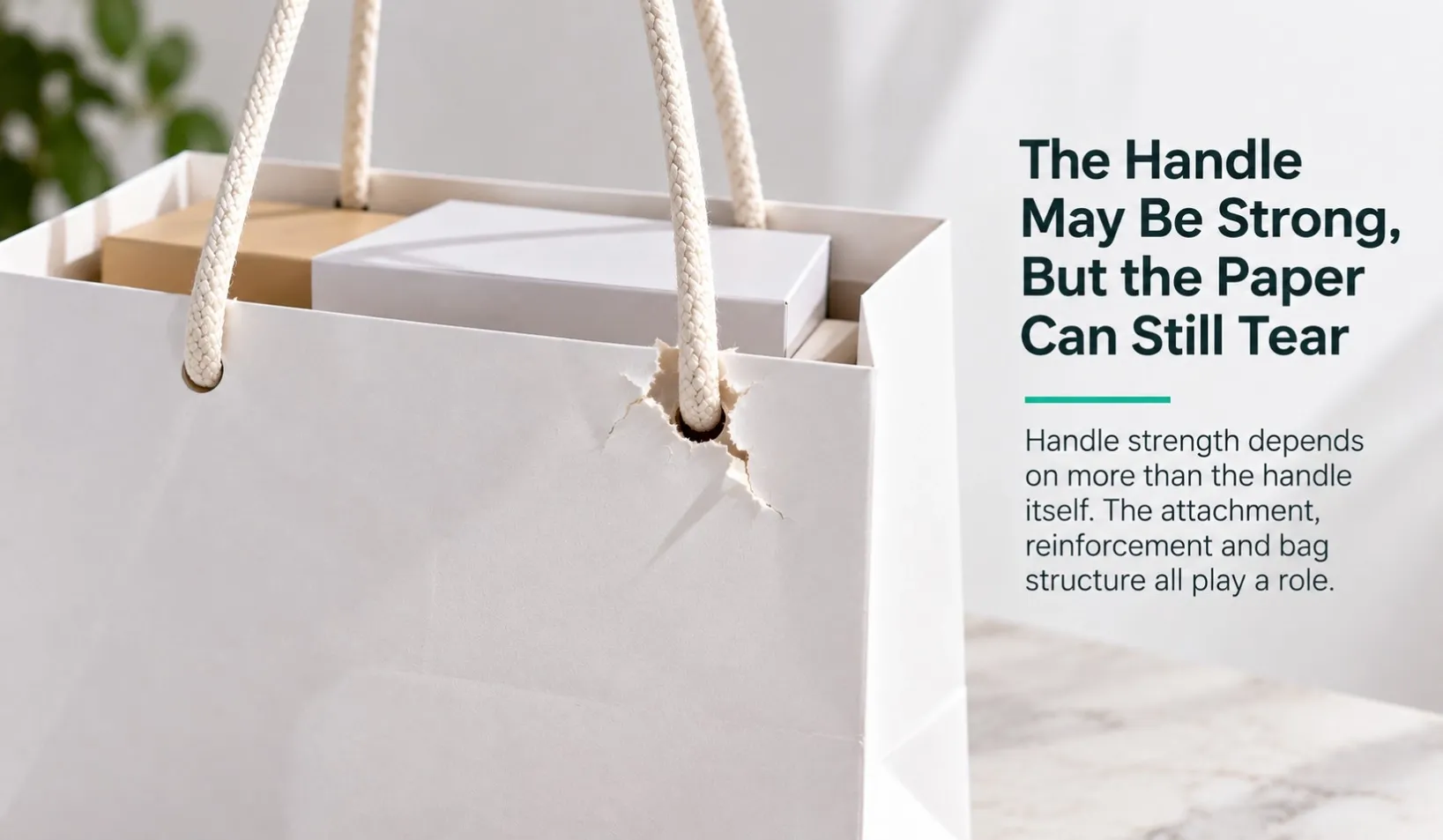
A paper bag may look sturdy, but the handle area can become one of its weakest points once the bag is loaded with real products.
Sometimes the rope or ribbon does not break at all. Instead, the paper around the handle holes begins to tear, the attachment becomes loose, or the reinforced area starts to deform.
This is why choosing a thicker handle — or simply increasing the paper GSM — does not always solve the problem.
A paper shopping bag works as a complete carrying system:
Paper + Handle + Attachment + Reinforcement + Bag Structure + Actual Load
If one part of that system is not suitable for the application, the bag may still fail during use.
There is rarely one single cause.
Handle problems may be related to:
- paper material and GSM
- handle material
- handle attachment method
- handle hole size and position
- top reinforcement
- bag dimensions
- bottom support
- product weight and shape
- how the finished bag is actually carried
For this reason, evaluating only the handle material or paper thickness can miss the real weak point.
What Happens When the Handle Does Not Break?
This is an important distinction.
A buyer may see an intact cotton rope, ribbon or twisted paper handle and assume that the handle was strong enough.
But the failure may have happened somewhere else.
When the bag is lifted, the handle transfers the load into a relatively small area of the paper bag. If that area cannot distribute the force effectively, the paper around the attachment point may stretch, deform or tear.
In other words:
The handle can remain intact while the bag around it fails.
This is also why paper bag weight capacity cannot be judged by the handle or paper GSM alone. The handle attachment, reinforcement, bottom support and load distribution all need to work together.
Why Does the Paper Tear Around the Handle Holes?
A handle hole creates an opening in the paper.
When weight is added, stress is concentrated around this area. The actual performance therefore depends on more than the rope or ribbon itself.
Paper material, hole position, attachment construction and reinforcement all affect how the load is distributed. These are also important specifications to check before ordering custom paper bags.
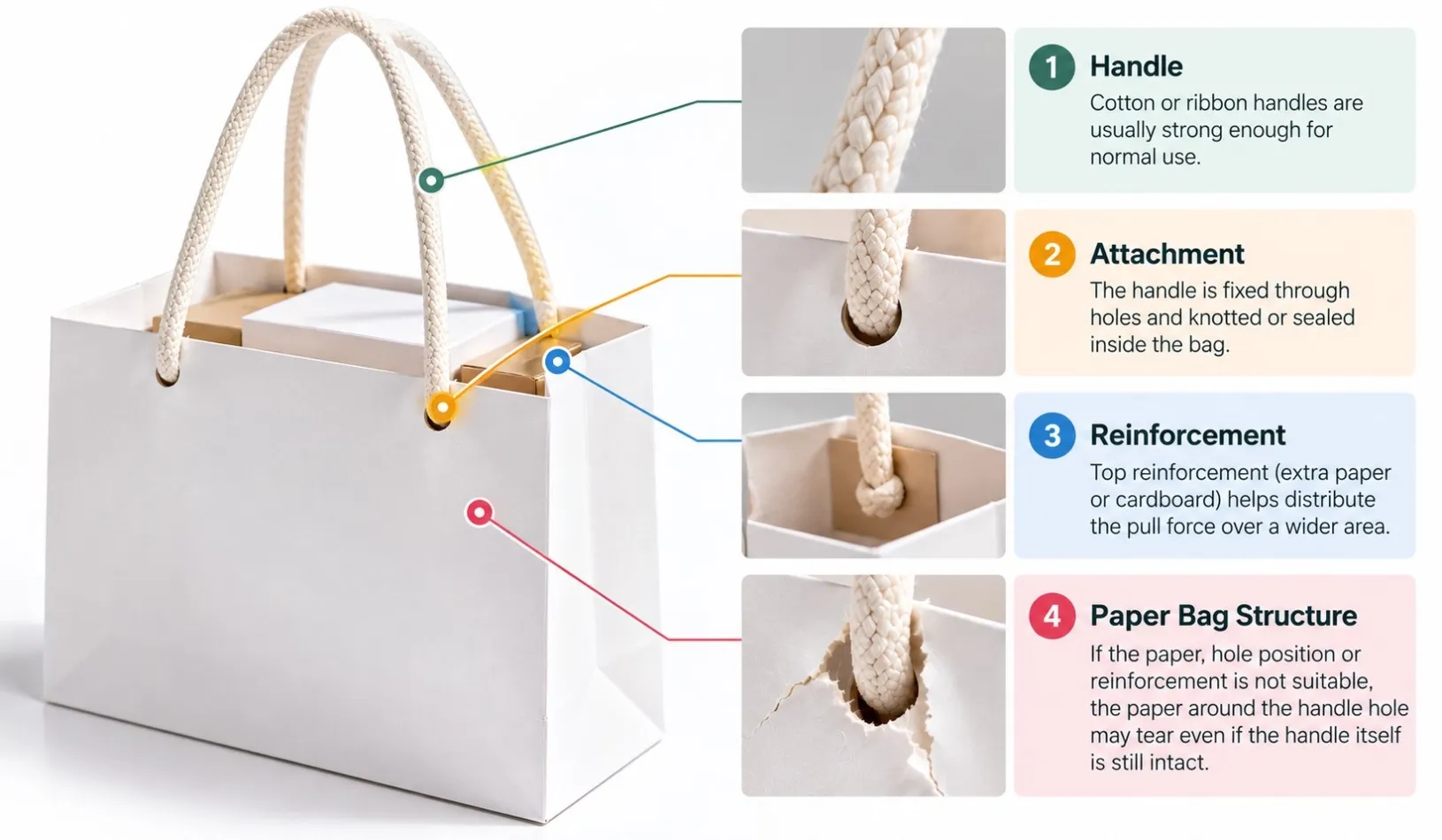
What Does Handle Reinforcement Do?
Many custom paper shopping bags include an additional reinforcement card or reinforced paper section near the top.
Its purpose is to help spread the carrying force across a larger area rather than allowing most of the load to concentrate around the handle attachment points.
However, reinforcement should not be considered in isolation.
Its effectiveness also depends on:
- the bag material
- the reinforcement material and size
- handle construction
- attachment method
- bag dimensions
- expected carrying load
For heavier products, these details should be reviewed together before production.
Does a Thicker Paper Bag Always Have Stronger Handles?
Not necessarily.
Increasing GSM may improve rigidity or strength in some applications, but GSM alone does not determine whether the handle area will perform well.
For example, thicker paper combined with an unsuitable handle attachment or insufficient reinforcement may still tear around the handle area.
Paper also needs to work with the converting process. Folding, creasing, opening and carrying all place different demands on the material.
Instead of asking only:
“Should I use 200gsm, 250gsm or 300gsm?”
a better question is:
“Is the complete bag structure suitable for the product it needs to carry?”
Which Paper Bag Handle Type Should You Choose?
Different handles provide different appearances, carrying experiences and production requirements.
There is no single handle type that is automatically best for every paper bag.
Twisted Paper Handles
They offer a simple paper-based appearance and can work well for many retail applications when matched with a suitable bag structure.
Cotton Rope Handles
Cotton rope handles provide a softer feel and are often selected for more premium shopping bags.
However, using a thicker cotton rope does not automatically increase the carrying capacity of the finished bag.
The attachment and reinforced area still need to support the load.
Ribbon Handles
Ribbon handles are often selected for fashion, cosmetics, gifts and premium retail packaging where presentation is especially important.
The ribbon material, width, attachment and bag construction should all be considered together.
Other Handle Options
Other handle materials and constructions may also be available depending on the bag design and application.
The choice should be based on both appearance and actual use rather than handle material alone.
Why Does Handle Attachment Matter?
Two bags using the same rope can perform differently if the handles are attached differently.
The attachment determines how the carrying force moves from the handle into the bag.
Depending on the construction, handles may pass through holes and be secured inside the bag, work together with reinforcement cards, or use another attachment method.
This is why looking only at handle diameter can be misleading.
The connection between the handle and the bag is just as important as the handle itself.
Does the Bottom Reinforcement Matter Too?
Yes.
Handle strength is only one part of the carrying system.
Once a product is placed inside the bag, its weight also needs to be supported by the bottom structure.
Depending on the bag design and intended use, an additional bottom card may help support the product and improve stability.
A bag with strong handles but an unsuitable bottom structure can still perform poorly under actual use.
Why Does Bag Size Affect Handle Performance?
Two bags carrying the same weight do not necessarily experience the same stresses.
Bag width, height and gusset affect how the product sits inside the bag and how the load moves when the bag is lifted.
Product shape matters as well.
A compact box and a large irregular product of the same weight may place very different demands on the bag.
This is another reason why a simple “GSM = carrying weight” formula is not reliable.
How Should Paper Bag Carrying Strength Be Tested?
For bags intended to carry heavier, valuable or unusually shaped products, actual load testing is more useful than relying only on material specifications.
A practical test should reflect the finished bag as closely as possible, including:
- actual bag dimensions
- selected paper
- finished handles
- handle attachment
- top reinforcement
- bottom reinforcement if required
- expected product weight
- realistic carrying conditions
Where possible, testing the sample with the actual product — or a representative load — gives buyers much more useful information before mass production.
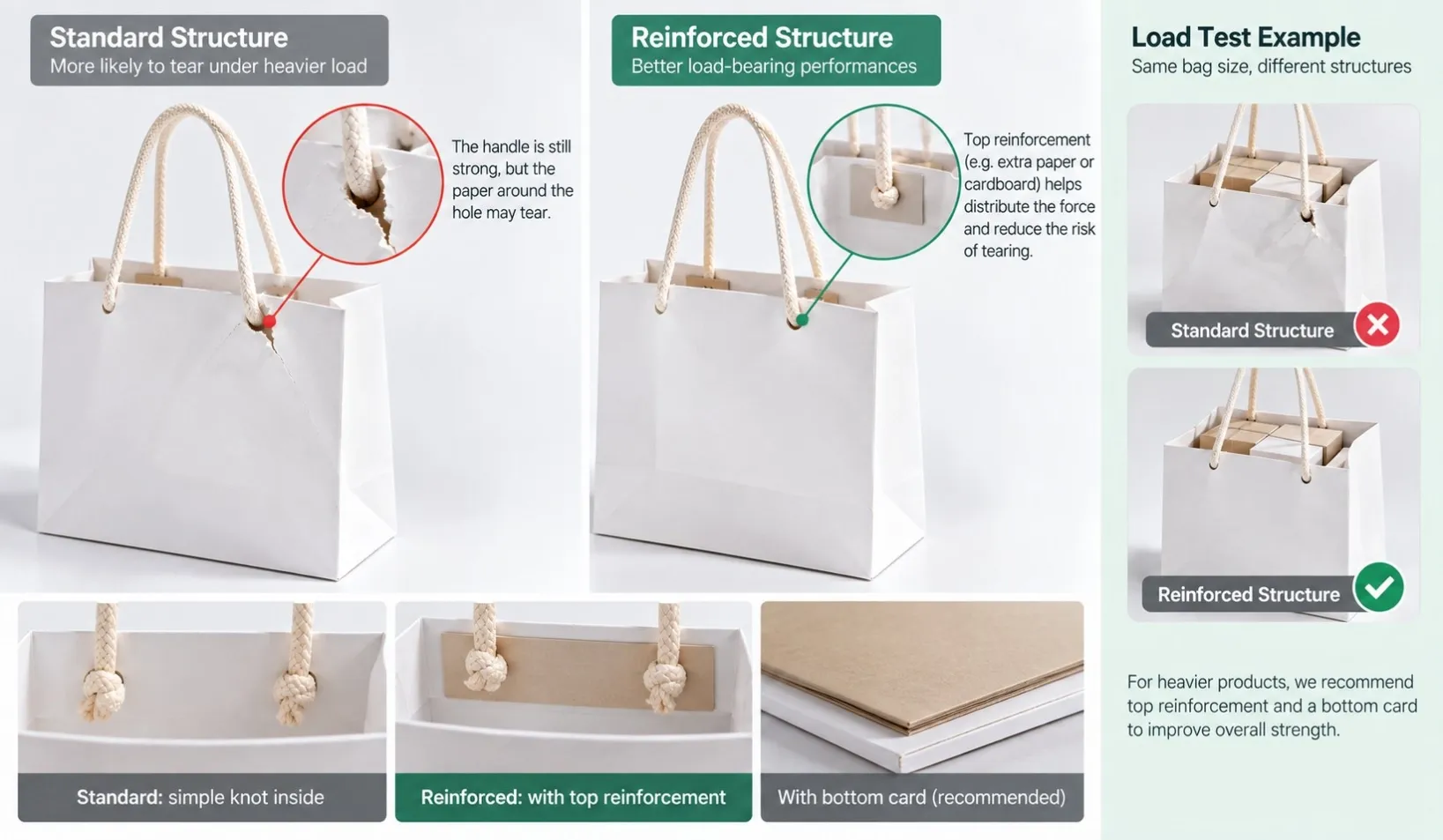
A Common Issue We See in Sampling
A common situation is that a buyer initially focuses on increasing paper GSM because the finished bag needs to carry a relatively heavy product.
But during sampling, the paper thickness may not be the only issue.
Once the bag is tested under load, attention may shift to the handle attachment, reinforcement area or bottom structure.
For example, the handle itself may remain completely intact while the paper around the attachment point begins to deform.
In this situation, simply changing to thicker paper may not address the actual weak point.
The better approach is to review the complete structure and test it again under realistic conditions.
What Should Buyers Confirm Before Mass Production?
Before approving a custom paper shopping bag, buyers should confirm more than the paper GSM.
1. Product Weight
Tell the supplier what the finished bag is expected to carry.
Avoid selecting the bag structure without considering the actual contents.
2. Bag Dimensions
Confirm the finished width, height and gusset.
Bag dimensions affect both product fit and load distribution.
3. Handle Type
Confirm the handle material, size, length and desired appearance.
4. Handle Attachment
Check how the handle will be fixed to the finished bag.
This connection is an important part of the carrying structure.
5. Top Reinforcement
Discuss whether additional reinforcement around the handle area is appropriate for the intended load.
6. Bottom Reinforcement
For heavier or rigid products, confirm whether additional bottom support should be considered.
7. Load Testing
If carrying performance is important, test the finished sample with the actual product or a realistic equivalent load before approving mass production.
FAQ
Does thicker paper always make paper bag handles stronger?
No. GSM is only one factor. Handle attachment, reinforcement, bag dimensions, material properties and actual load also affect carrying performance.
Why does the paper tear around the handle holes?
The handle transfers carrying force into a relatively small area of the bag. If the surrounding paper and reinforcement cannot distribute that force effectively, the area may begin to deform or tear.
Are cotton rope handles stronger than paper handles?
The handle material alone does not determine the carrying performance of the finished bag. Attachment, reinforcement and the overall bag structure also matter.
Do paper shopping bags need handle reinforcement?
Not every bag requires the same reinforcement structure. The decision depends on paper material, bag dimensions, handle construction and expected use.
Should I test a paper bag with the actual product?
For heavier, valuable or unusually shaped products, testing with the actual product or a representative load is a useful step before approving mass production.
Final Thoughts
When a paper bag handle tears or comes loose, the handle itself may not be the real problem.
Reliable carrying performance depends on the complete system:
Paper + Handle + Attachment + Reinforcement + Bag Structure + Actual Load
Instead of choosing a paper bag based only on GSM or handle thickness, buyers should consider how these elements work together and verify the finished structure through realistic sampling and load testing.
If you are developing custom paper shopping bags, send us your bag dimensions, target product weight and preferred handle type. We can review whether the paper, handle attachment and reinforcement structure should be considered before sampling and production.