
Sep 23, 2026Blog
How Much Weight Can a Paper Shopping Bag Hold?
How much weight can a paper shopping bag hold? Learn how paper, bag size, handles, reinforcement, bottom support and product shape affect carrying strength.
A customer may ask:
“Can this paper bag hold 5 kg?”
This is one of the most common questions we receive during custom paper bag quotation.
It sounds like a simple question, but the answer cannot be determined by paper GSM alone.
Two paper shopping bags made from similar paper can perform very differently once products are placed inside.
One may carry the product without a problem. Another may tear around the handle holes, deform at the top, or begin to fail around the bottom.
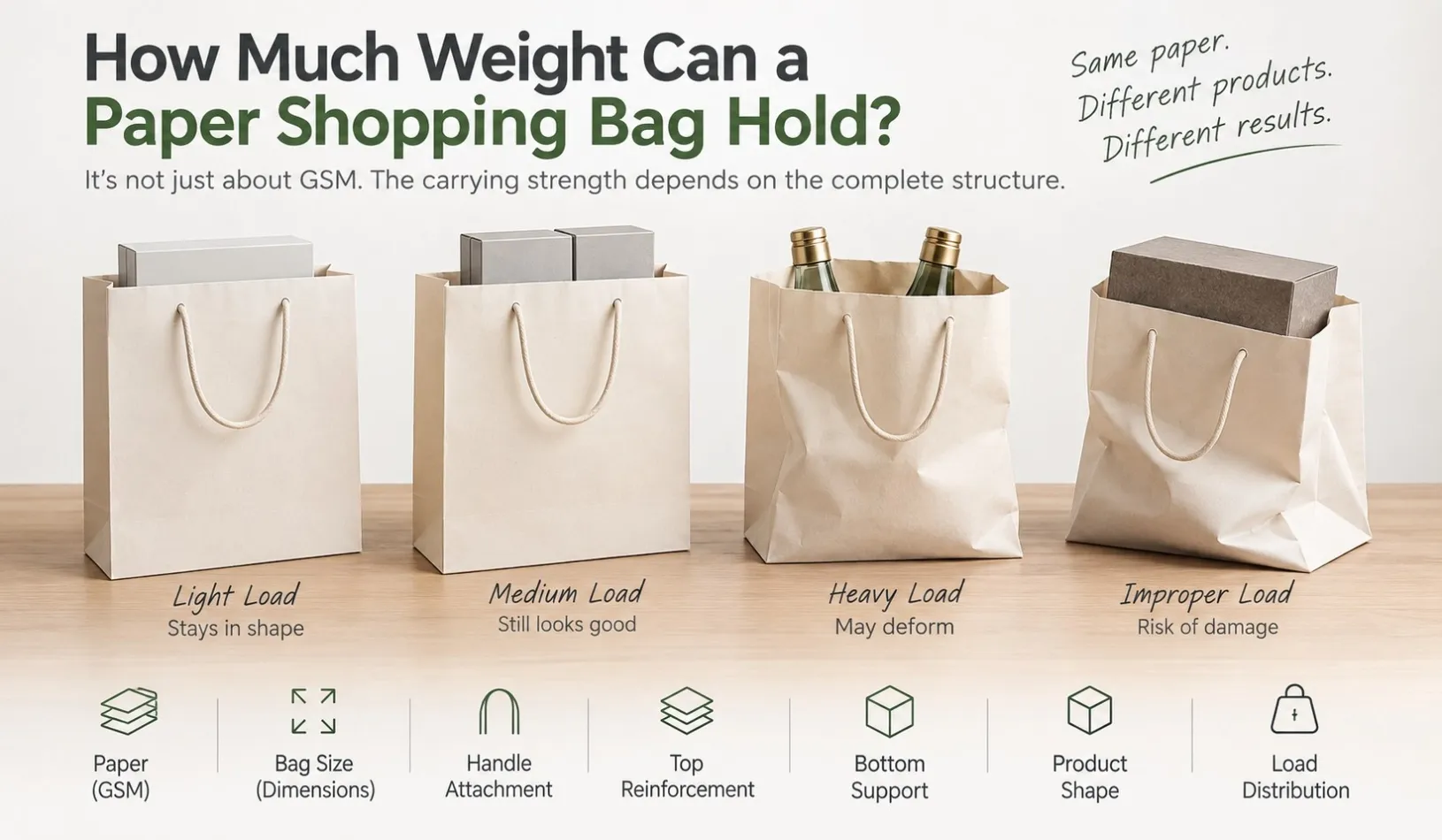
This is because the carrying strength of a paper shopping bag depends on the complete structure:
Paper + Bag Size + Handle Attachment + Top Reinforcement + Bottom Support + Product Shape + Load Distribution
So instead of asking only how many kilograms a paper bag can hold, buyers should look at how the entire bag is designed for the actual product.
Why Can't Paper Bag Weight Capacity Be Judged by GSM Alone?
GSM tells us the weight of the paper per square meter.
It is an important specification, but it does not tell us everything about the finished bag.
For example, increasing the paper from a lower GSM to a higher GSM may improve stiffness or strength in some applications.
But the bag can still fail if:
- the handle attachment is weak,
- the reinforcement area is insufficient,
- the bottom structure is not suitable,
- the bag dimensions do not match the product,
- or the load is concentrated in a small area.
This is why simply asking for “thicker paper” is not always the best way to improve carrying performance.
Does Thicker Paper Always Mean a Stronger Paper Bag?
Not necessarily.
Paper thickness is only one part of the structure.
Different papers with similar GSM can have different stiffness, fiber characteristics and performance after folding and converting.
The finished bag also includes glued areas, folds, handle holes, reinforcement and a bottom structure.
In actual use, failure often begins at one of these structural points rather than across the middle of an undamaged paper panel.
The better question is therefore:
Where will the load be transferred when the bag is lifted?
That helps identify which parts of the bag need attention.
Why Is the Handle Area So Important?
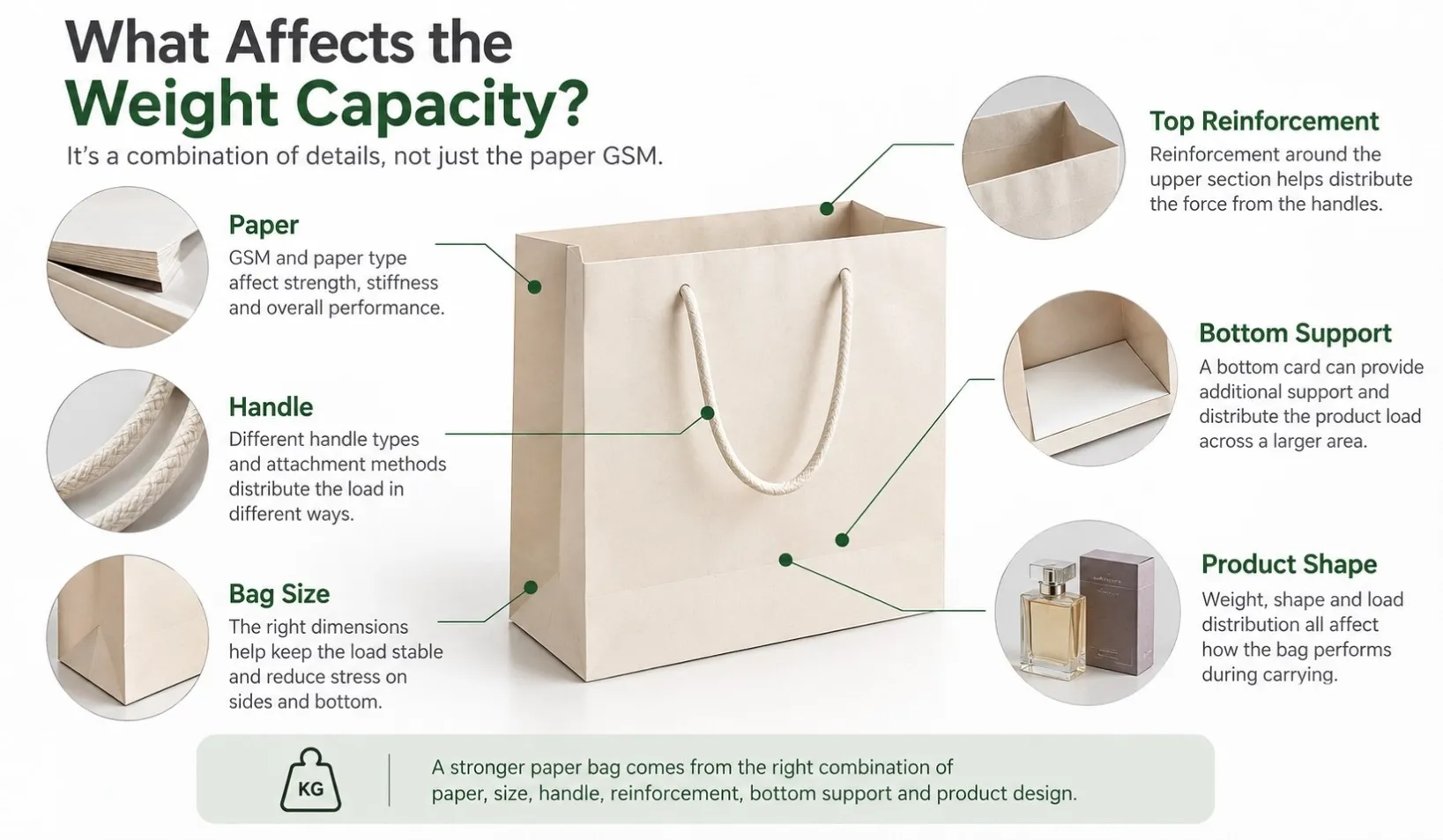
When someone lifts a shopping bag, much of the load is transferred through the handles into the upper part of the bag.
The handle itself may be strong enough.
But the paper around the attachment point may not be.
This is why a bag can fail even when the rope or ribbon remains completely intact.
Paper selection, handle type, attachment method, hole position and top reinforcement all affect how the load is distributed.
If this is a concern for your project, our guide explains in more detail why paper bag handles tear or come loose.
What Does Top Reinforcement Do?
Many paper shopping bags use additional reinforcement around the upper section.
Its purpose is not simply to make the bag feel thicker.
Depending on the construction, reinforcement can help distribute the force from the handles across a larger area instead of concentrating it around a small attachment point.
This can be especially important when the bag carries heavier products.
However, reinforcement should still be considered together with the paper, handle construction and intended load.
Adding reinforcement does not automatically make every bag suitable for every weight.
Why Does the Bottom of the Bag Matter?
The handles are not the only area carrying the load.
The product also transfers its weight to the bottom of the bag.
If the product is relatively heavy or concentrated in a small area, the bottom may begin to deform even when the handles remain secure.
Depending on the bag construction and application, a bottom card may be used to provide additional support.
A bottom card can help:
- create a flatter base,
- distribute the product load across a larger area,
- reduce localized pressure,
- and improve the presentation of the packed bag.
But it should not be treated as a universal solution.
The paper, bottom construction, bag dimensions and actual product still need to work together.
Why Does Product Shape Affect Paper Bag Strength?
Weight alone does not describe how a product loads the bag.
Imagine two products that weigh the same.
One is a wide rectangular box.
The other is a narrow, heavy bottle.
Their effect on the paper bag can be very different.
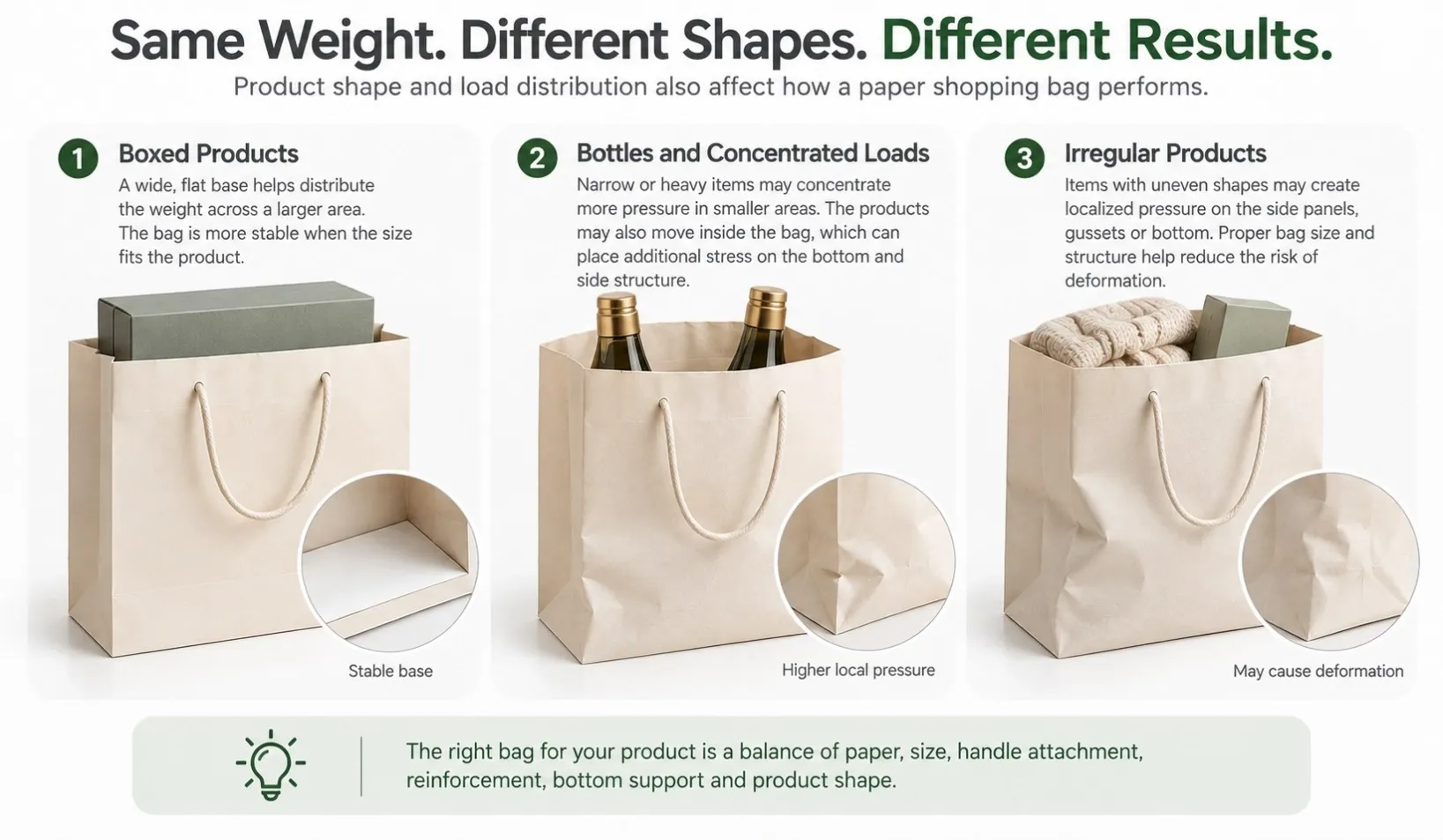
Boxed Products
A box with a relatively wide, flat base may distribute its weight across a larger area.
If the bag dimensions fit the box well, the load can be relatively stable.
Bottles and Concentrated Loads
Bottles or other dense products may concentrate more pressure in smaller areas.
They may also move inside the bag during carrying.
This can place additional stress on the bottom and side structure.
Irregular Products
Products with uneven shapes may create localized pressure against the side panels, gussets or bottom.
This means product dimensions and shape should be considered together with product weight.
Does Bag Size Affect Load Capacity?
Yes.
A larger bag does not automatically mean a stronger bag.
As bag dimensions increase, the structure and load distribution also change.
A bag that is much larger than the product may allow the contents to move around more during carrying.
A bag that is too tight may create pressure against the sides or gussets.
Bag size therefore needs to be selected according to both the product dimensions and the intended presentation.
For a broader overview of size, paper, handles and other purchasing specifications, see our custom paper bag buying guide.
Why Can a Strong Bag Still Lose Its Shape?
There is an important difference between:
Can the bag carry the product?
and:
Does the bag still look good while carrying the product?
A bag may remain intact but still bulge, sag or spread outward after packing.
For retail and luxury packaging, appearance can be just as important as avoiding structural failure.
If this is the issue you are trying to solve, see why paper shopping bags lose their shape after packing.
This is why load capacity and appearance should be evaluated separately during sampling.
How Should Paper Shopping Bag Strength Be Tested?
For projects where carrying performance is important, testing the finished bag is more useful than judging the specification only on paper.
The test should be reasonably representative of actual use.
Ideally, buyers should test the sample using the actual product.
If that is not practical, a representative load with similar weight and distribution can be used.
During testing, check:
Handle attachment — Is the paper around the handle holes beginning to stretch or tear?
Top reinforcement — Does the upper section remain stable when lifted?
Side panels and gussets — Do they deform excessively?
Bottom — Does it remain stable or begin to sag?
Overall shape — Does the bag still present the product as intended?
This provides much more useful information than simply assuming that a certain GSM corresponds to a certain number of kilograms.
Why Should Buyers Avoid Asking Only “How Many Kilograms Can It Hold?”
A fixed weight number can sound reassuring, but it may not represent the buyer's actual application.
For example, the same total weight can behave differently depending on whether it comes from:
- one large box,
- several small boxes,
- glass bottles,
- cosmetics,
- clothing,
- or irregular products.
The way the customer carries the bag can also affect the load on the structure.
For this reason, a meaningful evaluation should include both weight and actual product conditions.
What Information Should Buyers Provide Before Sampling?
If carrying strength is important, provide the supplier with more than just the bag dimensions.
Product Dimensions
Share the approximate dimensions of the product or products that will go inside.
Product Weight
Provide the expected total packed weight rather than only the weight of the empty packaging.
Product Shape
Let the supplier know whether the bag will carry boxes, bottles, clothing or irregular products.
Target Bag Size
If the dimensions are already fixed, provide the finished width, gusset and height.
Preferred Paper
If a paper type or GSM has already been selected, include it for evaluation.
Handle Type
Twisted paper, cotton rope, ribbon and other handle constructions may require different attachment considerations.
Presentation Requirements
If the bag needs to remain particularly crisp or structured after packing, mention this before sampling.
This helps the supplier evaluate the bag as a complete packaging system rather than as a list of individual specifications.
FAQ
How much weight can a paper shopping bag hold?
There is no single weight capacity that applies to all paper shopping bags. Carrying performance depends on paper, bag dimensions, handle attachment, reinforcement, bottom structure, product shape and load distribution.
Does higher GSM increase paper bag strength?
Higher GSM may improve some aspects of strength or stiffness, but it does not guarantee a stronger finished bag. Handle attachment, reinforcement and overall construction also matter.
Why does the paper tear while the handle remains intact?
The handle may be stronger than the paper surrounding its attachment point. When the bag is lifted, concentrated force around the handle area can cause the paper to fail first.
Does a bottom card make a paper bag stronger?
A bottom card can provide additional base support and help distribute the product load, but its effectiveness depends on the complete bag structure and actual product.
How should I test a paper shopping bag before mass production?
Where possible, place the actual product inside the finished sample and evaluate the handles, reinforcement, side panels, bottom and overall shape under representative carrying conditions.
Final Thoughts
The weight capacity of a paper shopping bag should not be reduced to one GSM number or one kilogram rating.
A better way to evaluate carrying performance is:
Paper + Bag Size + Handle Attachment + Top Reinforcement + Bottom Support + Product Shape + Load Distribution
When these factors are considered together, buyers can make better decisions before approving the final specification.
If you are developing custom paper shopping bags, send us your product dimensions, packed weight, target bag size and preferred handle type. We can review the structure and reinforcement requirements before sampling and production.