
Sep 23, 2026Blog
Why Do Kraft Paper Bags Crack Along the Fold?
Why do kraft paper bags crack along the fold? Learn how paper quality, GSM, printing, creasing and finishing affect cracking and how to reduce the risk.
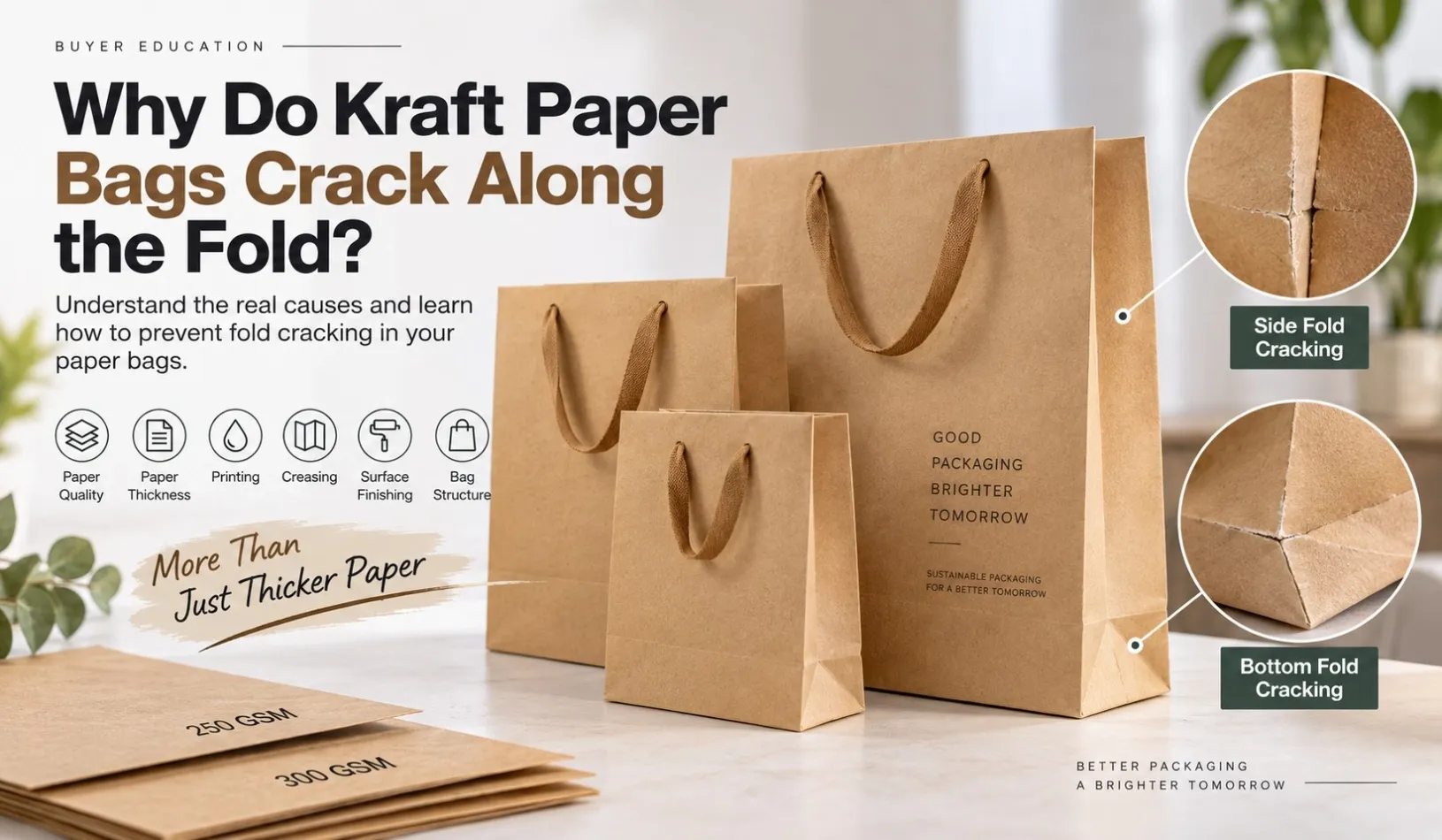
The paper bag looks fine when it is flat.
The printing looks clean. The paper feels thick enough. The handles seem secure.
Then the bag is opened and folded.
A light line appears along the side gusset or bottom fold. In more serious cases, the printed surface or paper itself begins to crack.
The first question is often:
Is there something wrong with the paper?
Possibly—but paper quality is only one part of the problem.
Paper thickness, paper characteristics, grain direction, printing coverage, surface finishing, creasing and folding can all affect how a kraft paper bag behaves along the fold.
This is also why simply changing from 250 GSM to 300 GSM does not necessarily solve the problem.
In some applications, thicker paper is necessary. But thicker and stiffer paper can also require more careful creasing and converting.
Before changing the material, it is better to understand where the cracking occurs, when it appears and what the bag actually needs to carry.
What Causes Kraft Paper Bag Folds to Crack?
A paper shopping bag contains several areas that need to fold repeatedly during production and use.
Typical areas include:
- side gussets
- bottom folds
- top folds
- reinforced areas
When the paper bends, stress is concentrated around these folding lines.
If the paper or printed surface cannot accommodate that deformation properly, the fold may show:
- a light or white line
- surface cracking
- coating or ink cracking
- fiber damage
- in more serious cases, splitting
The possible cause is not always one single factor.
Paper quality, GSM, paper stiffness, grain direction, printing, surface finishing, creasing and the bag structure can all contribute.
That is why the first step should be to identify what is actually cracking rather than immediately increasing the paper GSM.
Is Poor Paper Quality the Main Cause of Fold Cracking?
It can be—but not always.
Different papers with the same GSM can behave differently during folding.
Two papers labeled 250 GSM, for example, may have different:
- thickness
- stiffness
- fiber characteristics
- flexibility
- surface properties
- consistency
The same is true for 300 GSM paper.
This means:
GSM alone does not tell you how well a paper will fold.
If the paper fibers or surface are relatively brittle, cracking may appear more easily.
But even a suitable paper can still show problems if the creasing, printing, finishing or folding conditions do not work well with that material.
So when a fold cracks, changing the paper may be one solution—but it should not be the only thing investigated.
Does Thicker Kraft Paper Prevent Fold Cracking?
Not necessarily.
One of the most common assumptions when sourcing custom paper bags is:
Thicker paper = stronger bag = better quality.
There is some truth behind this.
A heavier paper can provide more stiffness and may be appropriate when a bag needs to support heavier contents.
But increasing GSM also changes how the paper behaves during production.
A thicker and stiffer material can be more demanding to:
- crease
- fold
- form
- glue
- convert into a finished bag
If the paper and converting process are not properly matched, increasing the GSM may not solve the original problem.
It can sometimes introduce another one.
The better question is:
What paper specification is suitable for the actual bag size, product weight and structure?
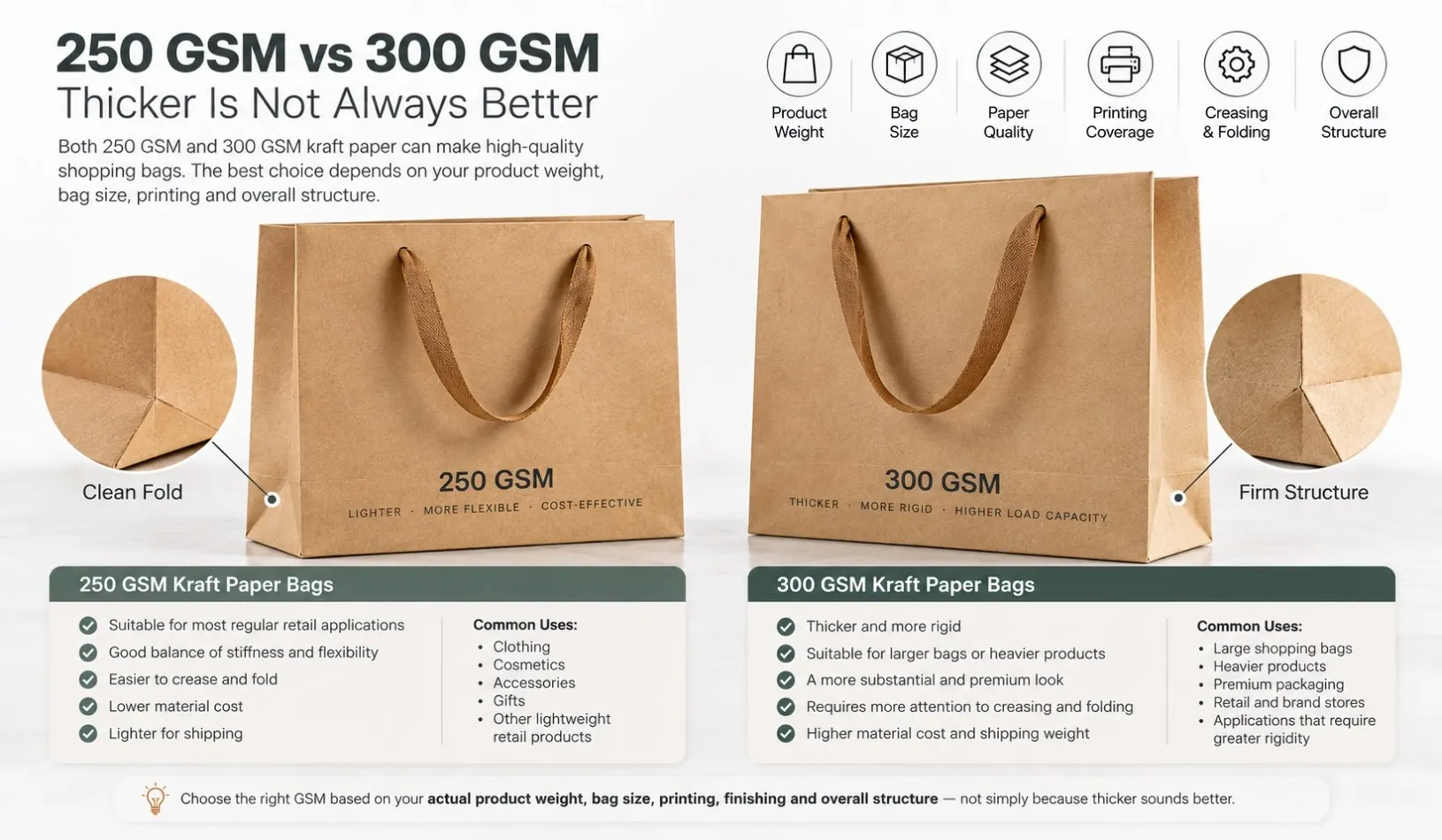
250 GSM vs 300 GSM: Which Is Better for Paper Shopping Bags?
There is no universal answer.
For many regular retail paper shopping bags, 250 GSM paper shopping bags can already provide a good balance of stiffness, appearance, converting performance and cost.
Typical applications may include:
- clothing
- cosmetics
- accessories
- gifts
- other relatively lightweight retail products
Compared with heavier paper, 250 GSM can also be easier to crease and fold.
When Does 300 GSM Make Sense?
300 GSM may be worth considering when:
- the bag is relatively large
- the contents are heavier
- greater rigidity is required
- the bag structure needs additional support
- the desired appearance calls for a more substantial material
However, 300 GSM should not be selected simply because a higher GSM sounds more premium.
The thicker and stiffer the material becomes, the more carefully its folding and converting performance should be evaluated.
A Real Project: 250 GSM vs 300 GSM for a Paper Bag
We recently reviewed a paper shopping bag project for the Japanese market.
The specification used 300 GSM paper, and the buyer was particularly concerned about two issues:
- the handle coming loose under load
- cracking around the folded areas of the bag
At first, it may seem that using thick paper should reduce these risks.
But the two problems actually involve different parts of the bag construction.
For the fold cracking issue, we needed to consider more than GSM:
- paper quality
- paper stiffness
- creasing
- folding
- printing coverage
- surface treatment
For many regular shopping bags, 250 GSM may already provide sufficient stiffness and appearance while being easier to convert.
However, this particular application also involved a relatively high load requirement.
When a bag may need to carry around 5 kg, using a heavier paper can be justified—but the paper itself is still only one part of the solution.
The handles, attachment method, top reinforcement and bottom construction also need to be evaluated.
This project is a useful reminder that:
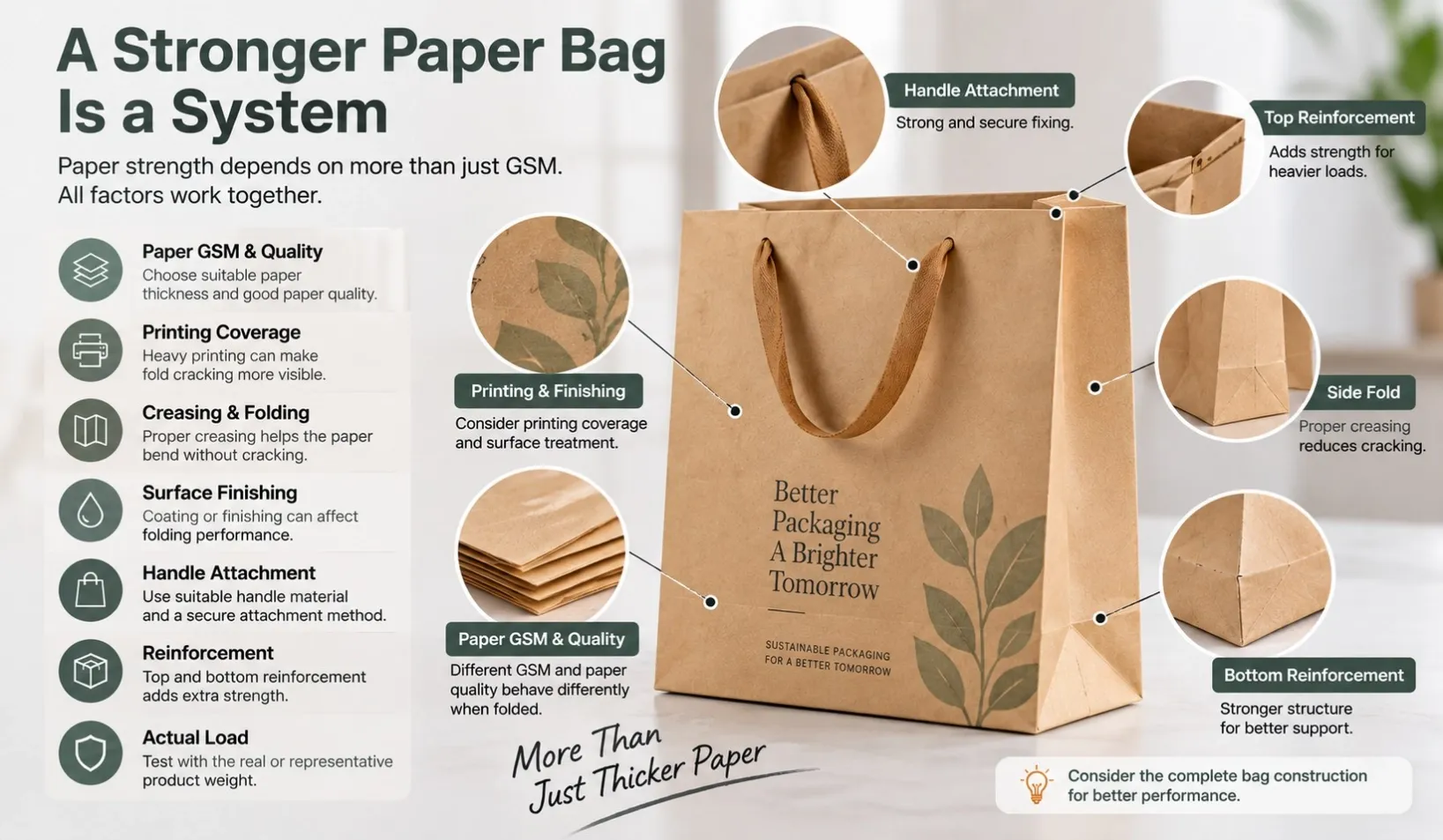
A stronger paper bag is not created by increasing GSM alone.
The complete bag needs to work as a system.
How Can Printing Make Fold Cracking More Visible?
Printing can make a fold problem much easier to notice.
This is particularly common when a dark or heavily printed area crosses a major fold.
Imagine a dark green, navy or black printed area running across the side gusset.
When the paper bends, even a relatively small disturbance in the surface can reveal the lighter paper underneath.
The result may appear as a white or light-colored line.
This does not always mean the entire paper structure has failed.
There is an important difference between:
- visible whitening
- printed surface cracking
- coating damage
- actual paper fiber cracking
Understanding which one is happening helps determine what should be adjusted.
For designs with large dark areas, fold positions should therefore be considered during artwork and sample evaluation—not only after mass production.
How Does Creasing Help Prevent Paper Bag Cracking?
Creasing creates a controlled area where the paper is intended to bend.
For thicker or stiffer materials, this becomes particularly important.
The creasing setup needs to work with the actual:
- paper thickness
- stiffness
- paper characteristics
- fold position
- bag structure
If the crease is not suitable for the selected material, the paper may resist folding and concentrate more stress around the fold.
This can increase the risk of visible cracking.
A useful principle is:
The thicker and stiffer the paper, the more attention the creasing and folding process requires.
This is why changing the paper GSM without reviewing the converting process may not solve the problem.
Why Does Paper Grain Direction Matter?
Paper fibers develop a predominant direction during papermaking.
As a result, a sheet does not behave identically in every direction when it is bent or folded.
Grain direction can influence:
- folding resistance
- stiffness
- crease behavior
- dimensional behavior
- the appearance of the finished fold
However, grain direction should not be treated as one simple rule that solves every cracking problem.
The paper, bag structure, critical folds and production layout need to be considered together.
For buyers, the important takeaway is simple:
Paper selection involves more than color and GSM.
How the material behaves during converting also matters.
Can Surface Finishing Increase the Risk of Cracking?
Surface finishing can also change how the material behaves around a fold.
Depending on the paper bag specification, finishing may include:
- aqueous coating
- varnish
- matte finishing
- gloss finishing
- lamination
- other surface treatments
The paper, ink and surface layer all need to bend together.
This becomes more demanding when several factors are combined:
Thick Paper + Heavy Printing + Surface Finishing + Sharp Folds
A specification may look premium on a flat printed sheet but still need adjustment to perform well after the bag is formed.
This is why the finished bag—not only the flat printed sheet—should be evaluated during sampling.
Why Can a Sample Look Good While Bulk Production Needs Extra Care?
A physical sample is important, but buyers should also understand what the sample is confirming.
A sample may help evaluate:
- dimensions
- structure
- artwork position
- paper appearance
- handle style
- general folding behavior
Bulk production introduces additional variables, including:
- larger quantities
- paper batch variation
- machine settings
- repeated creasing and folding
- normal production tolerances
For demanding specifications, the goal should not simply be:
Can we make one good sample?
A more useful question is:
Can this specification be produced consistently in bulk?
This is particularly important for thick paper, large solid-color printing, demanding finishing and heavy-load paper bags.
What Should Buyers Check Before Approving Kraft Paper Bags?
1. Actual Product Weight
Tell the supplier what the bag will actually carry.
A bag for clothing and a bag carrying several kilograms should not automatically use the same construction.
2. Bag Dimensions
Larger bags can place different stresses on the paper, handles and reinforcement.
3. Paper Type and GSM
Do not automatically choose the highest GSM.
The paper should match the required appearance, structure and load.
4. Printing Coverage
Pay particular attention to dark or heavily printed areas crossing major folds.
5. Surface Finishing
Confirm that the finishing is suitable for the selected paper and structure.
6. Creasing and Folding
For thicker paper, folding performance should be checked carefully during sampling.
7. Handles and Reinforcement
For heavier products, evaluate the handles, handle attachment, top reinforcement and bottom support together.
8. Actual Load Testing
Do not only inspect the bag visually.
Put the actual product—or a representative load—inside and test how the complete bag performs.
For a broader pre-production checklist, see our custom paper bag buying guide, covering size, GSM, handles, printing, finishing and load requirements.
Choosing 300 GSM Kraft Paper for Heavy-Duty Applications
If the bag needs to carry heavier products, 300 GSM may be appropriate.
But the paper is only one part of the load-bearing structure.
The complete construction may also need to consider:
- handle material
- handle attachment
- top reinforcement
- bottom reinforcement
- bag dimensions
- product weight distribution
This is especially important when the expected load reaches several kilograms.
A thick bag with a weak handle connection can still fail.
Likewise, stronger handles cannot compensate for every weakness in the surrounding paper or reinforcement structure.
For heavy-duty applications, the bag should therefore be evaluated as a complete packaging system.
How Handle Reinforcement Improves Heavy Paper Bag Performance
For normal retail applications, a conventional glued handle construction may be suitable depending on the bag design and expected load.
For heavier products, the handle attachment deserves more attention.
Depending on the required load and bag construction, possible options may include:
- stronger handle reinforcement
- reinforced top cards
- reinforced bottom cards
- different handle materials
- strengthened attachment methods
For a heavier-load project, mechanical reinforcement such as fastening may also be evaluated where appropriate.
The important principle is:
Paper bag strength is a system—not just a GSM specification.
Paper and handle selection, reinforcement, dimensions and actual load all work together.
How to Reduce Fold Cracking Risk Before Mass Production
The best time to solve a fold-cracking problem is before bulk production begins.
Provide the packaging supplier with:
- finished bag dimensions
- actual product weight
- preferred paper
- preferred GSM
- artwork
- printing coverage
- surface finishing
- handle requirements
- expected load
Then evaluate the specification as a complete bag.
For more demanding projects, test the bag with the actual product or a representative load.
Pay particular attention to:
- side gussets
- bottom folds
- heavily printed fold lines
- handle attachment points
- top reinforcement
- bottom reinforcement
This helps determine whether the selected material and construction are suitable before mass production.
Final Thoughts
When a kraft paper bag cracks along the fold, the answer is not always:
“The paper is bad.”
And the solution is not always:
“Use thicker paper.”
The finished result comes from the interaction of:
Paper Quality → GSM → Printing → Finishing → Creasing → Folding → Handles → Reinforcement → Actual Load
For many regular paper shopping bags, a suitable 250 GSM paper may provide a good balance of appearance, stiffness, converting performance and cost.
For larger bags or heavier products, 300 GSM may be appropriate.
But when the paper becomes thicker, the creasing, folding, handle attachment and reinforcement also deserve more attention.
So instead of asking:
“Can we make the paper thicker?”
a better question is:
“What paper and bag construction are suitable for the actual product weight and use?”
If you are developing custom kraft paper bags, share your bag dimensions, product weight, paper preference, printing, surface finishing and handle requirements with us. These details provide a better starting point for reviewing the bag construction before sampling and mass production.