
Sep 23, 2026Blog
Why Do Paper Shopping Bags Lose Their Shape After Packing?
Why do paper shopping bags lose their shape after packing? Learn how bag size, paper stiffness, product shape, bottom support and packing method affect the finished bag.
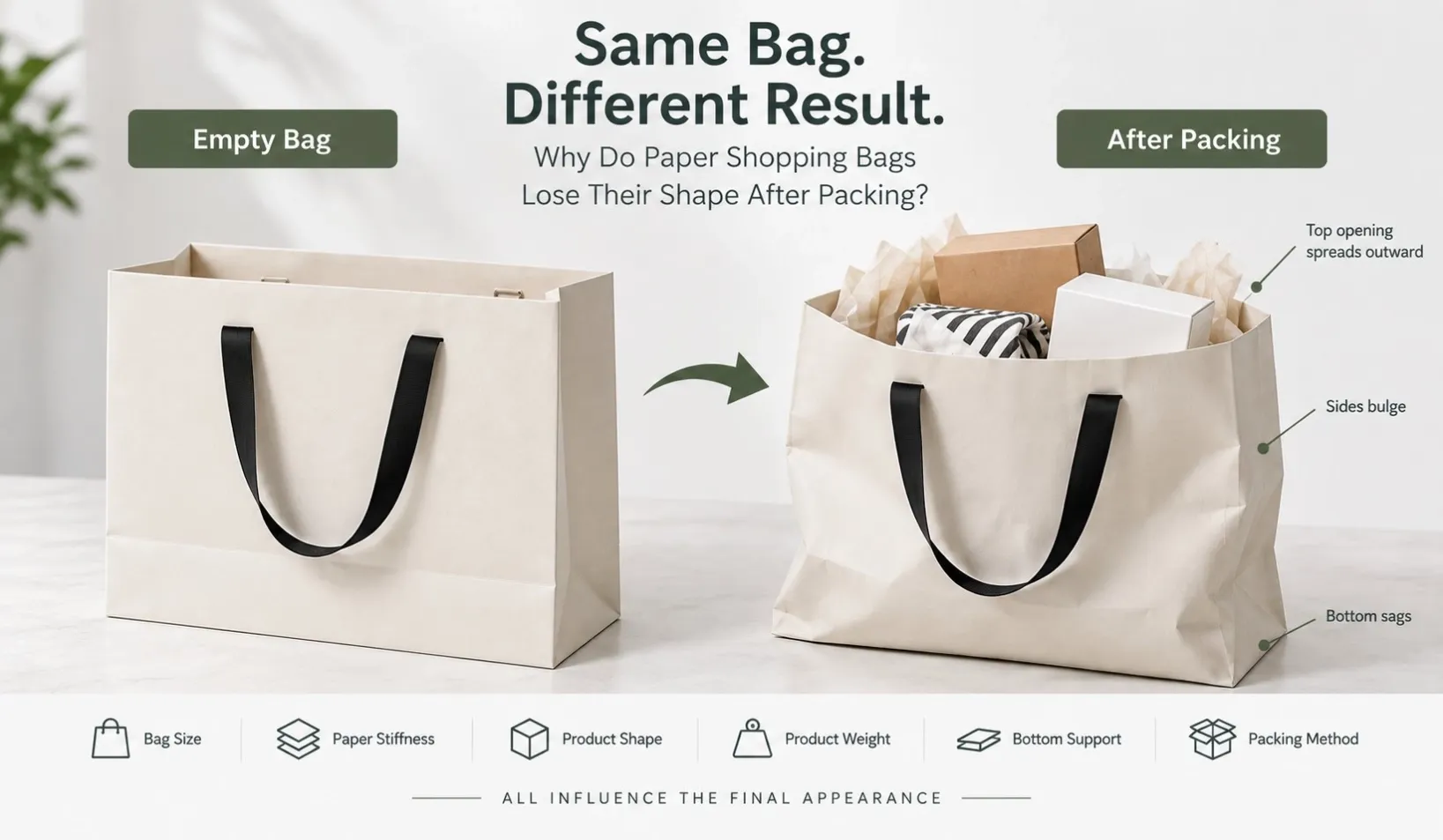
Many paper shopping bags look crisp and well structured when they are empty.
But once products are placed inside, the result can be very different.
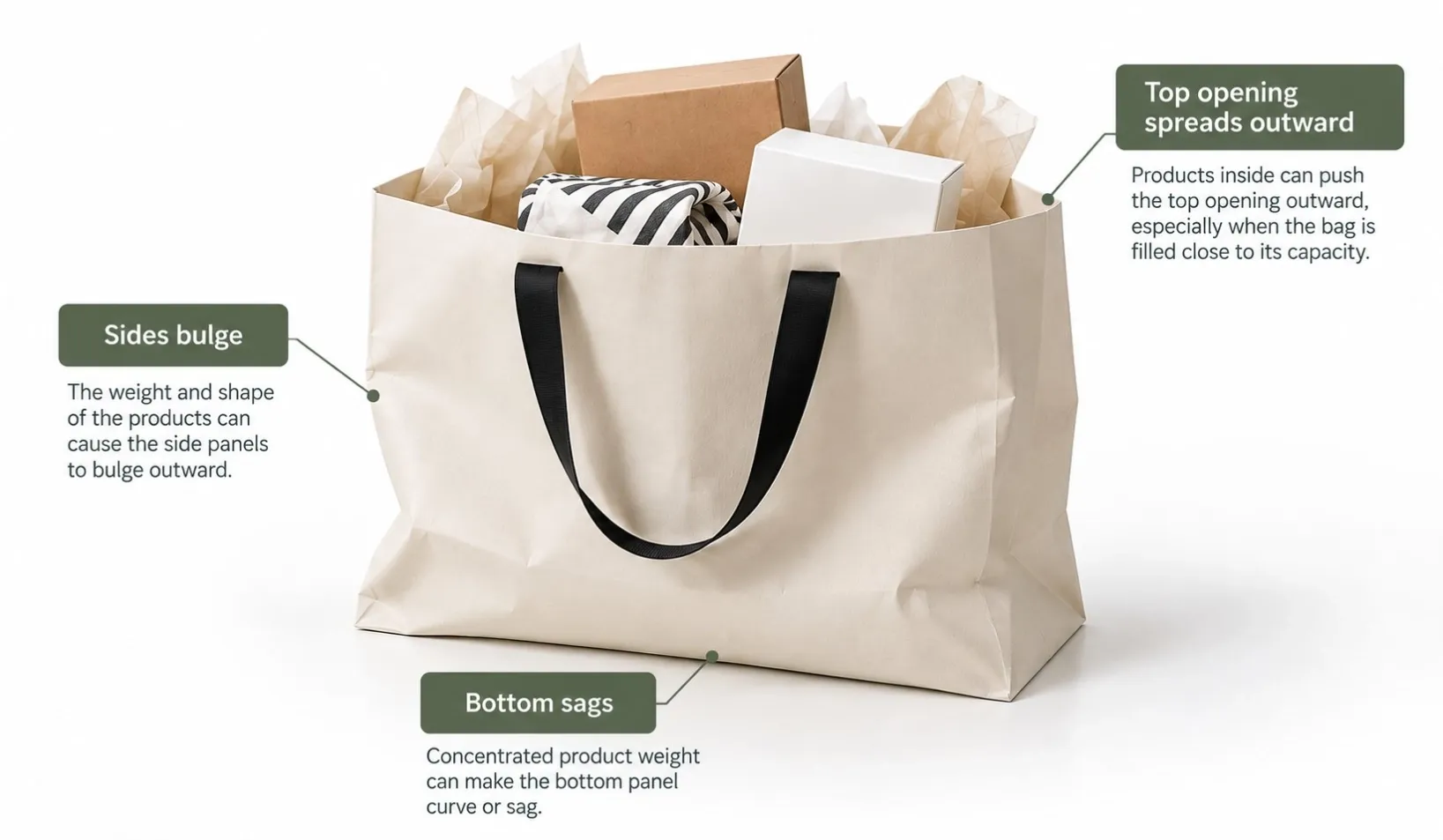
The sides may bulge. The bottom may sag. The top opening may spread outward. A bag that looked premium during sampling may appear softer or less structured once it carries the actual product.
The first reaction is often:
“Should we use thicker paper?”
Sometimes that helps. But paper thickness is only one part of the problem.
A paper shopping bag works as a complete packaging structure:
Bag Size + Paper Stiffness + Product Shape + Product Weight + Bottom Support + Packing Method
If these factors do not work well together, even a bag made from relatively heavy paper may lose its intended shape after packing.
Why Do Paper Shopping Bags Lose Their Shape?
Paper bags are flexible packaging rather than rigid boxes.
Once products are placed inside, their weight and shape create pressure on different parts of the bag. Depending on the product and bag construction, this may cause:
- side panels to bulge outward
- gussets to open unevenly
- the bottom to sag
- the top opening to spread
- corners to become less defined
- the bag to lean instead of standing upright
The important point is that bag appearance after packing depends on more than paper thickness alone.
The dimensions of the bag and the products inside it can be just as important.
Does Thicker Paper Always Keep a Bag in Better Shape?
Not necessarily.
One of the first questions buyers often ask is:
“Should we use a higher GSM?”
Increasing paper weight may improve stiffness in some applications, but GSM alone does not determine how the finished bag will behave.
For example, a relatively large bag carrying a small but heavy product may still experience bottom sagging.
A bag carrying several irregularly shaped products may develop uneven pressure on its side panels even when heavier paper is used.
And a bag that is much larger than the actual product may look loose or collapsed because the contents do not support its intended shape.
Instead of asking only:
“Should we use thicker paper?”
it is often more useful to ask:
“Is the complete bag structure suitable for the products being packed?”
Why Does Paper Stiffness Matter?
Two papers with a similar GSM do not necessarily behave in exactly the same way.
Paper type, fiber characteristics, surface treatment and construction can affect how stiff or flexible the finished sheet feels.
For a shopping bag, stiffness influences how well the front, back and side panels maintain their shape.
However, greater stiffness is not automatically better in every situation.
The paper still needs to fold, crease and form properly during production. Material selection therefore needs to balance appearance, converting performance and the requirements of the packed product.
This is why choosing paper for a shopping bag should not be based on GSM alone. Material selection should also balance structure, production and actual use, as explained in our guide to packaging material selection.
How Does Bag Size Affect the Final Shape?
Bag dimensions are one of the most overlooked factors.
Imagine placing a relatively small product inside a much larger shopping bag.
There may be significant empty space around the product. During carrying, the product can move inside the bag and create uneven pressure against the bottom and side panels.
The result may be a bag that looks less structured than expected.
On the other hand, a bag that is too tight can also create problems. Products may push directly against the gussets or front and back panels, causing visible distortion.
The goal is therefore not simply to make the bag larger.
The goal is to choose dimensions that provide enough packing space while still supporting the intended presentation.
For a broader checklist covering size, GSM, handles, reinforcement and other specifications, see our custom paper bag buying guide.
Why Does Product Shape Matter?
A clothing box, a cosmetics set and a bottle can all have the same weight but behave very differently inside a paper bag.
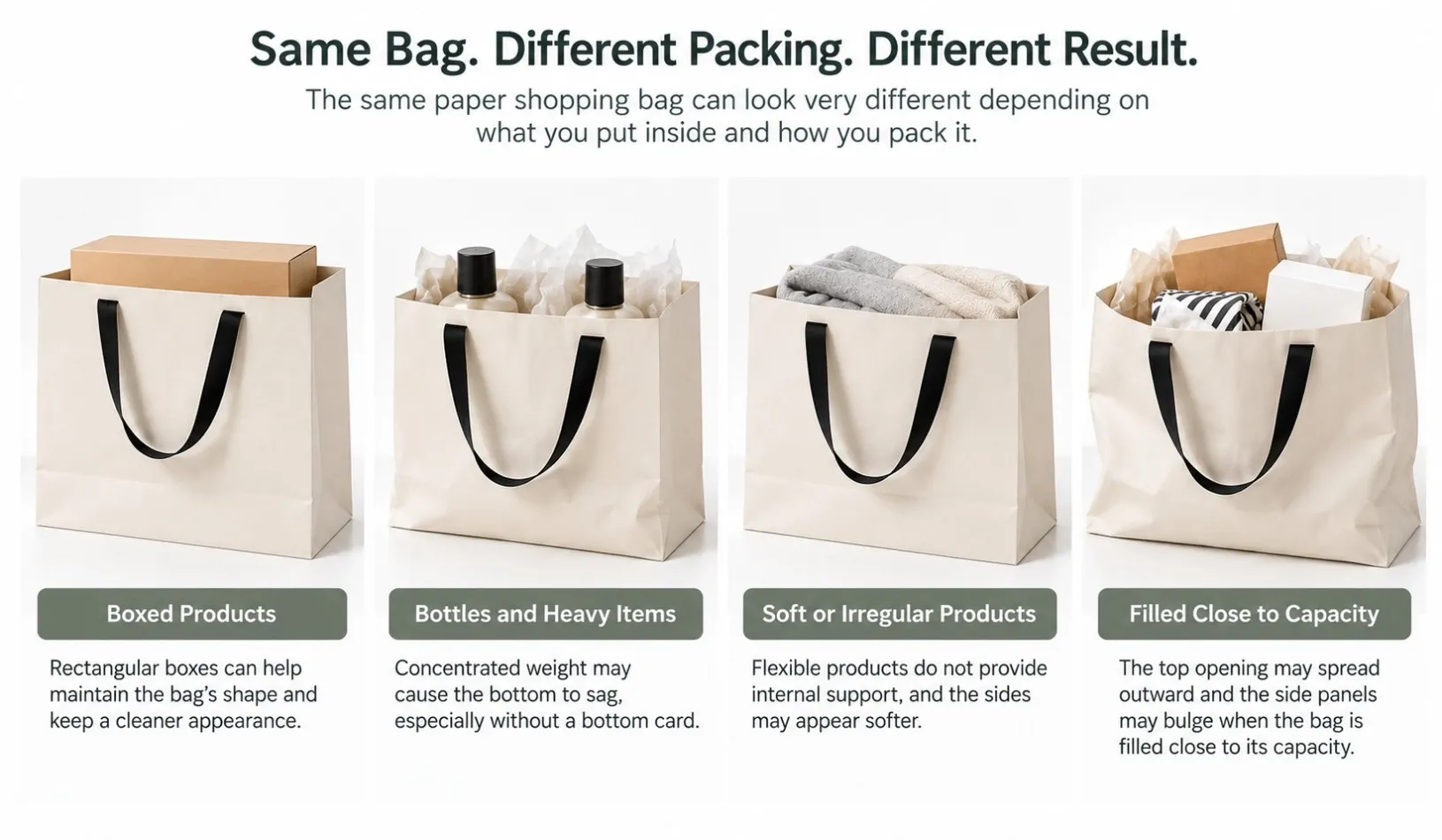
Boxed Products
Rectangular boxes generally distribute their shape more evenly across the bottom of the bag.
If the bag dimensions are reasonably matched to the box, the product itself can help the bag maintain a cleaner appearance.
Bottles and Other Concentrated Loads
Bottles can place more concentrated pressure on a smaller area of the bottom.
Depending on the quantity, weight and arrangement, additional bottom support may need to be considered.
Soft or Irregular Products
Clothing, textiles and other flexible products do not provide the same internal support as a rigid box.
If there is a lot of unused space inside the bag, the side panels may appear softer or less structured.
This is why product shape should be considered together with product weight.
What Does a Bottom Card Do?
A bottom card is an additional piece of paperboard or card placed inside the bottom of the bag.
Its purpose is to help distribute the load across a wider area and provide additional support to the base.
Without sufficient bottom support, concentrated product weight may cause the bottom panel to curve or sag.
A bottom card can be particularly useful when the bag carries heavier or more concentrated products.
However, adding a bottom card does not automatically solve every deformation problem.
If the bag dimensions are unsuitable, the paper lacks the required stiffness, or the products move excessively inside the bag, other parts of the structure may still deform.
Bottom reinforcement supports the bag structure; it does not replace proper bag design.
Why Can the Top of a Paper Bag Spread Outward?
Sometimes the bottom of the bag looks fine, but the top opening spreads outward after products are packed.
This may happen when:
- the products are too wide for the intended bag dimensions
- the contents press against the side gussets
- the bag is filled close to its maximum practical volume
- the product arrangement creates uneven pressure
- the paper is relatively flexible for the bag size
This is especially noticeable on premium retail bags where buyers expect straight panels and a clean silhouette.
Increasing GSM may help in some cases, but adjusting the bag dimensions or product arrangement may be more effective.
Why Does Packing Method Matter?
The same paper shopping bag can look very different depending on how the products are placed inside it.
For example, several small boxes packed neatly across the bottom may distribute weight relatively evenly.
The same boxes stacked on one side may cause the bag to lean, create a paper bag bulge on one panel, or make the bottom appear uneven.
Tissue paper, inserts or other presentation materials can also affect how products sit inside the bag.
For retail and gift packaging, the packing method should therefore be considered during development rather than only after the bags have been produced.
Should Buyers Test the Bag With the Actual Product?
Where practical, yes.
A flat paper sample can show color, printing and material feel, but it cannot fully demonstrate how the finished bag will behave when carrying the intended products.
A more useful evaluation is to test a finished sample using:
- the actual bag dimensions
- the proposed paper
- the final handle construction
- any planned top reinforcement
- the intended bottom card
- the actual product or a representative load
Then check the bag not only immediately after packing, but also while lifting and carrying it.
Look at the front and back panels, gussets, bottom, handle area and overall silhouette.
If the bottom starts sagging, the side panels bulge or the top opening spreads outward, the sample can be reviewed before mass production.
This helps identify whether the issue is more closely related to paper stiffness, bag dimensions, reinforcement, load distribution or the way the product is packed.
A Common Issue We See During Sampling
Buyers sometimes focus first on paper thickness because GSM is easy to compare.
But once the actual product is placed inside the sample, the discussion may change.
The paper itself may feel sufficiently substantial, while the bag still looks too loose, the bottom curves under the product, or the side panels become distorted.
In this situation, simply increasing the GSM may not address the real cause.
The more useful adjustment may be the bag dimensions, bottom support, product arrangement or overall construction.
This is one reason physical sampling can be valuable for paper shopping bags where both carrying performance and appearance after packing are important.
If carrying strength is also important, see how much weight a paper shopping bag can hold and why paper, handle attachment, reinforcement, bottom support and load distribution should be evaluated together.
What Should Buyers Confirm Before Mass Production?
Before approving a custom paper shopping bag, it is useful to confirm the complete packing situation rather than evaluating the empty bag alone.
Product Dimensions
What will actually be placed inside the bag?
The product dimensions help determine whether the bag has too much unused space or is too tight around the contents.
Product Weight
Consider both the total weight and whether the load is evenly distributed or concentrated.
Bag Dimensions
Allow sufficient packing space without making the bag unnecessarily oversized.
Paper Selection
Consider GSM together with stiffness, folding performance and the desired appearance.
Handle and Top Structure
The handle, attachment and reinforcement should be appropriate for the intended carrying conditions.
Bottom Support
Determine whether the product and load distribution justify an additional bottom card.
Finished-Bag Testing
Whenever the structure is important, evaluate a finished sample with the actual product or a representative load.
The goal is not simply to check whether the bag can hold the product, but also whether it maintains an acceptable shape during packing and carrying.
FAQ
Why does my paper shopping bag bulge after packing?
A paper bag may bulge when products press unevenly against the front, back or side panels. Bag dimensions, product shape, packing arrangement and paper stiffness can all contribute to the problem.
Will increasing the GSM stop a paper bag from losing its shape?
Not always. Higher GSM may increase stiffness in some applications, but bag dimensions, paper type, product shape, load distribution and reinforcement also affect the finished structure.
What is a bottom card in a paper bag?
A bottom card is an additional piece of paperboard placed inside the base of the bag. It helps distribute product weight across a wider area and provides additional support to the bottom.
Why does the bottom of a paper bag sag?
Paper bag sagging may occur when product weight is concentrated in a small area or when the bag structure does not provide enough support for the intended load. Paper stiffness, bag dimensions and bottom reinforcement can all affect the result.
Should I test a paper bag with my actual product?
For projects where carrying performance and final appearance are important, testing a finished sample with the actual product—or a representative load—can provide much more useful information than evaluating the empty bag alone.
Final Thoughts
A paper shopping bag should not be evaluated only when it is empty.
The real test begins after the product goes inside.
Paper stiffness, bag dimensions, product shape, product weight, bottom support and packing method all influence the final appearance.
Instead of automatically increasing GSM when a bag loses its shape, look at the complete packaging structure and how the product interacts with it.
If you are developing custom paper shopping bags, send us your product dimensions, product weight and target bag size. We can review the paper stiffness, bag dimensions, bottom support and overall structure before sampling and production.