
Rigid Box Lid Too Tight or Too Loose? Causes and Tolerance Checks
A rigid box lid that is too tight or too loose is usually a clearance problem. Here are the 7 causes, 5 sample checks, and what to tell your supplier.
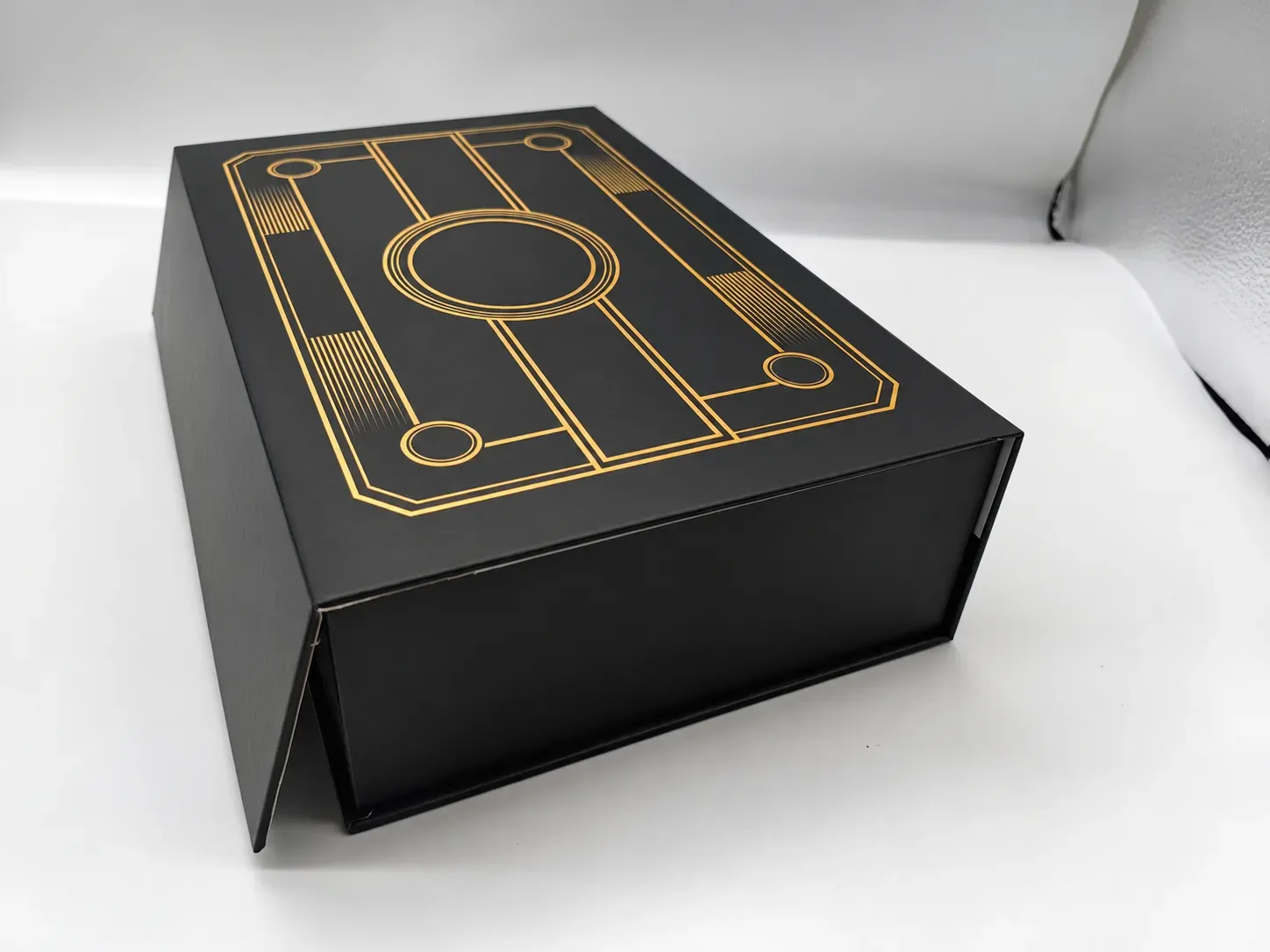
A rigid box lid that is too tight or too loose is almost never a paper quality problem. It is a clearance problem: the gap between the inside walls of the lid and the outside walls of the base was set wrong, or something in production ate into that gap. Lid fit is one of the easiest rigid box faults to diagnose on a sample. Below are the seven most common causes, five checks for any sample, and what to send your supplier so the next sample fits.
What Good Lid Fit Feels Like
A well-fitting lid slides on with light, even resistance and stops at a clean, level line. Lift the closed box by the lid alone: the base should stay put, not drop off or need two hands and a tug to separate. It should not rock when pressed at a corner, nor scuff where the lid rubs the base. Keep your approved sample: it becomes the reference every later batch is judged against. Any lid that jams halfway, falls off when lifted, or sits crooked has failed.
1. The Lid-to-Base Clearance Was Set Wrong at the Dieline Stage
This is the most common cause. A lid-and-base rigid box only works because the lid is made very slightly larger than the base. If the dieline copies the base dimensions one-to-one, the wrapped walls meet with zero gap and the lid binds or will not close at all. If the gap is drawn too generously, the lid slides on with no friction and drops off. The correct clearance depends on the box size, the board thickness and the wrapping paper, so there is no universal number. Ask your supplier to state the clearance used on the approved sample and hold it on repeat orders. Compare the structure with our guide to magnetic closure vs lid-and-base rigid boxes.
2. Greyboard Thickness Varies Between Batches
Rigid boxes are built on greyboard, a natural fibre product whose thickness varies slightly from batch to batch and supplier to supplier. That variation goes straight into the finished size, because the board is the wall. Board that runs slightly thick makes the base wider and the lid tighter; board that runs slightly thin does the opposite. This is why a lid that fitted perfectly on the first order can feel different on the second, even with the same dieline. Ask your supplier to confirm the board grade on the approved sample, and flag any change before production.
3. Wrapping Paper and Lamination Add Thickness
Every layer wrapped around the board adds to the finished dimensions. The base gains thickness on its outside faces, which shrinks the gap the lid slides over, and the lid loses space on its inside faces for the same reason. A heavy coated art paper, a lamination film or a foil-stamped panel each add a little more. If you change the wrapping paper on a repeat order — for example, switching from uncoated paper to a laminated one — expect the fit to change and ask for a new sample first. Our custom rigid boxes are available with foil stamping and other finishes, so raise the finish choice together with the fit requirement at quotation stage.
4. Humidity Makes Board Swell and Shrink
Paperboard absorbs moisture from the air, and gives it back again. A box made in a humid summer workshop can tighten or loosen as it travels to a drier climate, sits in an air-conditioned warehouse, or waits in a shipping container. Suspect humidity first when samples fitted at the factory but the bulk goods feel different on arrival, or when the same batch fits differently in different seasons. Test the sample where the box will actually be used, and store goods in stable, dry conditions. If your market is much drier or more humid than the factory, say so in the brief.
5. Lid Depth and Shoulder Height Do Not Match
Fit is not only about width; depth matters too. A lid that is too shallow grips only a short band of the base wall, so it feels loose and can be knocked off even when the width clearance is right. A lid that is too deep can bottom out on the product or the insert before it seats, leaving a visible gap and a lid that rocks. Confirm lid depth as its own dimension when you brief a new box. On the sample, check that the lid sits level on all four sides and the joint line is even — a lid that seats on one side and gaps on the other points to a depth or squareness problem, not a clearance problem.
6. Glue and Wrapping Tension Pull the Walls Inward
A rigid box is glued together by hand or by machine, and the wrapping paper is pulled tight around the board as the glue cures. If the paper is pulled unevenly, or the glue is applied heavily on one side, the walls can draw inward slightly as everything dries, enough to change the fit. The signs are a lid that fits on three sides and binds on the fourth, or a base that measures square at the bottom and narrower at the top. Try the lid in all four orientations: if the fit changes when you rotate it, the walls are not parallel, and the cause is in the making rather than the design.
7. The Insert or the Product Pushes the Walls Outward
Finally, check what is inside the box. An insert that is even slightly oversized bows the base walls outward, and the lid then has to slide over a base wider than designed. The same happens when the product itself is a tight fit: a jar or bottle pressing against the walls changes the box shape every time it is packed. Always test lid fit with the real product and the real insert inside, not with an empty box. An empty box that fits perfectly and a packed box that jams tells you the insert is the problem, not the lid. See our guide to packaging insert sizing.
How to Check Lid Fit on a Sample: 5 Tolerance Checks
Run these five checks on every sample, and write the results down so the approved sample and the bulk goods can be compared with the same words.
1. The lift test. Close the box and lift it by the lid only. The base should stay in place. If it drops, the fit is too loose; if you have to pull hard to separate them, it is too tight.
2. The ten-cycle test. Put the lid on and take it off ten times. A good fit feels the same on the tenth cycle as on the first. If it gets looser, the paper is wearing; if it gets tighter, something is swelling or shedding fibres into the gap.
3. The rotation test. Try the lid in all four orientations. If it fits in one and binds in another, the walls are not parallel — see cause 6.
4. The gap and light test. Hold the closed box up to a light and look along the joint line: the gap should be even all round. A wedge of light on one side points to a depth or squareness problem.
5. The packed test, after resting. Test with the real product and insert inside, and again after the sample has rested for 24 to 48 hours. A fit that changes overnight is usually humidity or glue curing. Record the inside width of the lid minus the outside width of the base — that number, kept with the approved sample, is your tolerance record.
What to Send Your Supplier So the Next Sample Fits
Send these five things with your next order: the approved sample itself, or a clear statement that the new batch must match its fit; the product and insert dimensions, so fit is judged packed, not empty; the destination climate and storage conditions, if they differ from the factory; the wrapping paper and finishes you want, including any change from the last order; and your acceptance rule in plain words — for example, that the lid must pass the lift test and the ten-cycle test. When you are unsure about any figure — board grade, clearance or finish thickness — ask for it to be confirmed with the quotation rather than guessing.
FAQ
Can a lid that is too tight be fixed without remaking the box?
Sometimes, but rarely reliably. Working the lid on and off can ease a slightly tight fit, and dry storage can help if humidity is the cause. But a wrong clearance at the dieline stage means remaking the box with a corrected dieline.
What clearance should I ask my supplier for?
It depends on the box size, the board grade, the wrapping paper and the finishes — there is no single number. Ask your supplier to state the clearance used on your approved sample, and to hold it on repeat orders.
Does a loose lid mean the box is poor quality?
Not necessarily — a board batch that ran thin, dry conditions, or a clearance set for a dropped finish can all cause it. If the box is well made and the lid is evenly loose, it is a sizing issue, usually correctable on the next run.
Should I test the lid with the product inside?
Yes, always — an empty box can fit perfectly while the packed box jams, because the insert or product bows the walls outward. Test with the real product and insert, and repeat after the sample has rested for a day.
How many samples should I test?
Test at least three to five samples, not one. Glue-tension and board faults often affect only part of a run, and one good sample can hide a problem that appears across the bulk goods.
Get a Rigid Box Quote
If your current rigid box lid is too tight or too loose, send us your box size, product and insert details and we will check the fit and quote a corrected version. Jeeli Packaging makes custom rigid boxes from 500 pcs, in lid-and-base, magnetic closure and drawer styles, with foil stamping and custom inserts. Sampling takes 7–10 days, and every sample is checked for lid fit before it ships. See also how much custom rigid boxes cost and our production timeline. To start, visit our contact page or email info@jeelipackaging.com.
Jeeli Packaging
Jeeli Packaging provides custom paper packaging and commercial printing solutions with a focus on reliable quality, responsive service and dependable delivery. Based in Shenzhen, China, we manufacture custom rigid boxes, folding cartons, mailer boxes, paper bags, hang tags and labels for brands worldwide, from 500 pcs with sampling in 7–10 days.