
Roll Labels vs Sheet Labels: Which Fits Your Packing Line?
Roll labels win on machine-fed lines; sheet labels win for hand packing and small mixed runs. Compare speed, cost and storage before you order.
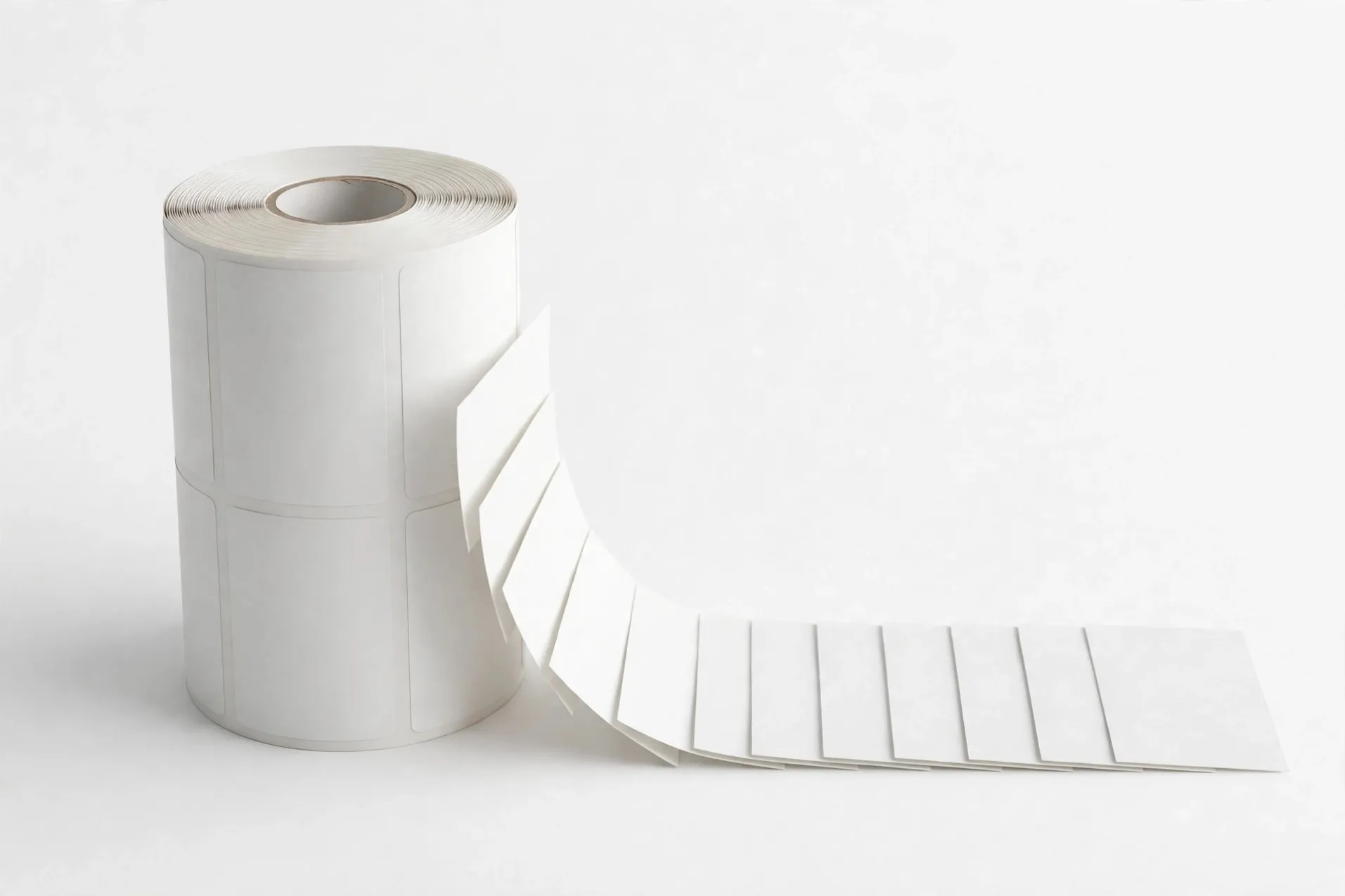
Choose the format by how the label reaches the product, not by how it looks on screen. If a machine applies the label, order rolls. If a person peels and sticks it by hand, order sheets. That single decision drives your applicator setup, your cost per label, how the labels store, and how many designs you can run in one order.
Roll labels are printed on a continuous web and wound on a core, so they feed straight into a labelling machine. Sheet labels are printed on flat sheets — the same format as our custom stickers for hand application — so anyone can peel one off and apply it without equipment. Both formats print in the same materials and finishes. The difference is workflow, not print quality.
What Roll Labels Are — and When They Earn Their Keep
A roll label is a strip of labels wound on a cardboard core. The core size and unwind direction are set to your applicator, so the roll loads and feeds without hand peeling. The gap between labels and the number of labels per roll are set to your run length, so a roll change lands between batches, not in the middle of one. That is the whole point of the format: once the roll is loaded, the line keeps moving.
Rolls suit bottles, jars, boxes and pouches that run through a labelling machine — one design, repeated hundreds or thousands of times. Jeeli prints custom roll labels on coated paper, kraft paper, vinyl or transparent film, with permanent adhesive for product labels and removable adhesive for promotional labels. Adhesive is matched to the surface: glass, plastic, coated board or kraft. Print is offset or digital, CMYK, with Pantone on request, and matte or gloss lamination protects the print from handling and moisture.
Minimum order is 1,000 pieces. We print a physical sample in 7–10 days, and bulk production runs in 15–25 days after you approve the sample. If your line already has an applicator, rolls are almost always the right answer — the question is only which core, unwind direction and gap your machine needs.
What Sheet Labels Are — and When They Are the Smarter Buy
A sheet label is printed on a flat sheet, and the sheet is what you store, cut and hand out at the packing table. Nobody needs a machine, a core or a setup step. That makes sheets the better buy whenever a person does the applying: small batches, market stalls and pop-ups, gift packs, box seals, and any job where the same operator packs several different products in one shift.
Sheets also win when one order carries many designs. A single print run can hold several artworks — different scents, flavours, sizes or languages — and you peel only the design you need. On a roll, each design is its own roll, with its own setup and its own changeover on the line. For short runs and mixed SKUs, sheets keep the cost and the complexity down.
The materials are the same as rolls: coated or kraft paper for indoor use and gift packaging, vinyl where the label must survive water, scuffing, outdoor use or cold storage. Round stickers run from 25 mm to 88 mm, and custom die-cut shapes are cut to your artwork outline. Finishes are matte or gloss lamination and foil stamping. Sheets ship packed flat, so they store in a drawer, split easily across two packing locations, and travel without a core taking up carton space. Minimum order is 1,000 pieces, with the same 7–10 day sampling and 15–25 day bulk production as rolls.
Roll vs Sheet: The Six Differences That Decide It
| Roll Labels | Sheet Labels | |
|---|---|---|
| Application | Machine-fed through a labeller | Hand-peeled and applied |
| Speed | Line speed, no peeling step | Limited by hand — fine for small runs |
| Volume | High, repeat runs of one design | Low to medium, mixed runs |
| Designs per order | One design per roll | Several designs on one print run |
| Storage | Rolls need core space and dry storage | Flat, stackable, easy to split |
| Cost driver | Setup per roll; cheaper per label at volume | Setup per sheet; cheaper for small mixed orders |
Per-label pricing is quoted per specification — size, material, finish and quantity all move it — so confirm the exact figure with the quotation rather than comparing format list prices. As a rule of thumb: if you apply more than a few thousand of the same label, rolls pull ahead; below that, or across many designs, sheets usually cost less in total once you count the applicator setup and the changeover time.
5 Questions to Answer Before You Order
Send these five answers with your enquiry and the quote comes back accurate the first time. They are the same details we confirm on every label order.
1. Does a machine apply the label? If yes, it is a roll job. Tell us the core diameter, which way the label should face out (unwind direction), the gap between labels and how many labels your run needs per roll. Our guide to labels for labeling machines explains each setting. If no machine is involved, say so — sheets skip all four settings.
2. What surface does the label stick to? Glass, plastic, coated board and kraft each take adhesive differently, and a label that sticks well to a rigid box can lift off a cold glass jar. Permanent adhesive suits product labels; removable adhesive suits promotions and seasonal marks. Tell us the container material and whether the product is chilled, wet or handled often.
3. How many labels per run — and how many designs? One design in the thousands points to rolls. Several designs in the hundreds point to sheets. If your volumes are small, read our guide to small first orders before deciding — splitting a small order across many rolls wastes setup on every changeover.
4. Where will the labels live? Bathroom shelves, fridges, outdoor packs and shipping cartons all punish paper labels. Vinyl with lamination survives water and scuffing; paper is right for dry, indoor use. If the label will be handled, rubbed or splashed, say so before we confirm the material.
5. What does the artwork need? Send the label size, the artwork, and whether the colour must match a Pantone reference or your existing box print. CMYK covers most work; Pantone is available on request. Foil stamping and lamination are decided at artwork stage, not after printing. For timing, see our production timeline: sampling takes 7–10 days and bulk production 15–25 days after sample approval.
Common Mistakes When Switching Formats
Ordering rolls without confirming the core. A roll wound the wrong way, on the wrong core, will not feed — and the whole run has to be rewound or reprinted. Confirm core diameter and unwind direction against the applicator manual before the order, not after the delivery.
Ordering sheets for a 50,000-piece run. Hand-applying tens of thousands of labels is a staffing cost, not a saving. If the volume grows past a few thousand per design, price the roll version — including the applicator time you save — before you reorder sheets.
Assuming one adhesive fits every surface. The adhesive that holds on kraft can peel off glass, and the one that grips a jar can tear a coated box on removal. Test the sample on the actual product, not on a desk.
Forgetting the gap and labels per roll. If the roll change falls in the middle of a batch, the line stops while the operator swaps rolls. Set labels per roll to your batch size when you order.
Approving print without a physical sample. Colour on screen and colour on your material are different things, and adhesion cannot be judged from a PDF. Always test the physical sample on the real container for feed, adhesion and print before approving bulk.
Frequently Asked Questions
Can the same artwork run on both rolls and sheets?
Yes. The same artwork can run across roll labels, sheet labels and hang tags, so the shelf look stays consistent. Only the format, core and cutting change.
What is the minimum order for roll and sheet labels?
The minimum order is 1,000 pieces for both formats. Send the size and quantity for a quote.
How long do samples and bulk production take?
Sampling takes 7–10 days, and bulk production takes 15–25 days after you approve the sample, for both roll and sheet labels.
Are roll labels more expensive than sheet labels?
It depends on size, material, finish and quantity, and prices are quoted per specification. Rolls are usually cheaper per label at high volume; sheets are usually cheaper in total for small, mixed orders. Confirm the exact figure with the quotation.
Can I switch from sheets to rolls later?
Yes — the artwork and materials carry over. Confirm the core size, unwind direction, gap and labels per roll against your applicator before the first roll order, and run a physical sample on the line first.
Get a Custom Quote
Send the label size, the material, the quantity — and for rolls, the core size and unwind direction. We confirm material and adhesive, print a physical sample in 7–10 days, and run bulk production in 15–25 days after you approve it. Contact Jeeli Packaging for a quote — we reply within 24 hours.
Jeeli Packaging
Jeeli Packaging is a custom packaging manufacturer in Shenzhen, China, founded in 2009. From our own 12,000 m² factory we print custom roll labels, sheet labels, stickers, folding cartons, rigid boxes, paper bags and hang tags, with physical sampling in 7–10 days and bulk production in 15–25 days after sample approval. Send your specification for a quote — we reply within 24 hours.