
Buying Guides
E-Flute Folding Cartons for Cosmetics: Small Batch Guide
E-flute cartons for cosmetics: 1.5 mm corrugated that protects glass, prints like paperboard, and runs from 500 pcs. Specs, tests and small-batch costs.
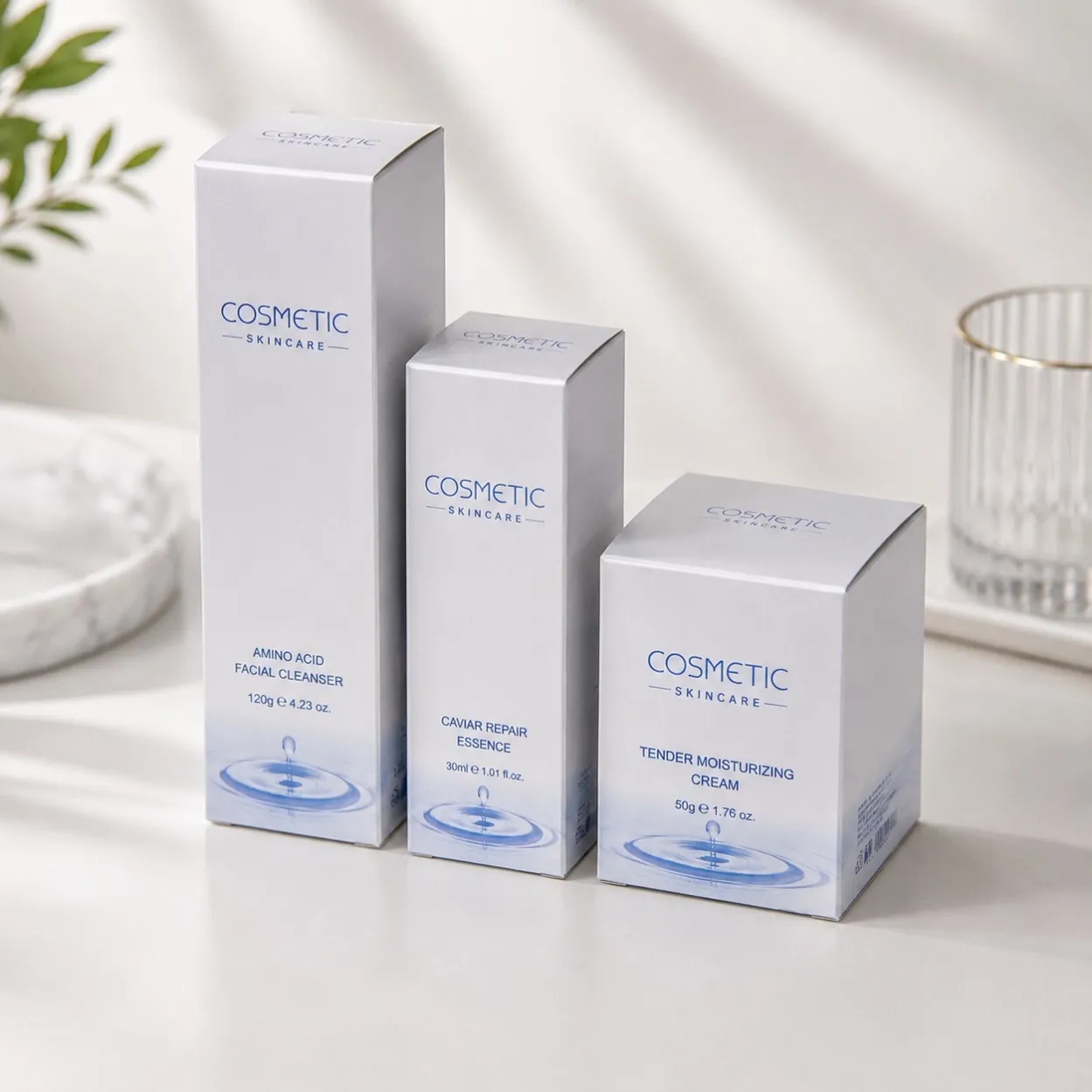
An E-flute carton is 1.5-1.6 mm corrugated board built with folding-carton closures - tuck end, auto-lock bottom, or sleeve and tray. For cosmetics it is the step up from paperboard when the product is glass, when the box ships directly to the customer, or when the carton has to survive being handled in a store. Small batches start at 500 pieces per design with digital printing, 7-10 days for samples, 12-18 days for production.
The confusion worth clearing up first: an E-flute carton is not a paperboard folding carton. Paperboard is 0.4-0.6 mm solid board; E-flute is 1.5 mm with a fluted core between two liners. Both fold, both print, both ship flat - but they behave differently under load, and that difference is usually the reason a buyer switches.
What is an E-flute folding carton, exactly?
E-flute is a single-wall corrugated grade: two flat liners with a fluted medium between them, 1.5-1.6 mm thick with roughly 90-96 flutes per 300 mm. It is the thinnest common corrugated grade that still prints well, which is why premium retail and e-commerce beauty boxes use it.
- Paperboard folding carton: 0.4-0.6 mm, 250-400 gsm - cheapest, best print, no real cushioning
- F-flute: about 0.8 mm - near-paperboard feel, limited protection, fewer suppliers
- E-flute: 1.5-1.6 mm, 90-96 flutes per 300 mm - the sweet spot for beauty retail boxes
- B-flute: 3.0-3.2 mm, 47-50 flutes per 300 mm - shipping strength, visibly coarser print surface
The printable surface is a liner, usually 200-250 gsm white-top for graphics or kraft for a natural look. That liner is what takes the ink, so print detail on a white-top E-flute approaches paperboard quality; print on kraft is deliberately softer and less saturated. If you are choosing between corrugated grades rather than between board and flute, our A-flute versus B-flute comparison explains why the same flute name can measure differently between mills.
Why choose E-flute for cosmetics instead of paperboard?
Three problems paperboard cannot solve: glass breaking in transit, a box that doubles as the shipping carton, and a gift set heavy enough to bow a 350 gsm carton in the hand.
E-flute adds about 1 mm of cushioning on every face and, more importantly, edge crush resistance. A 1.5 mm fluted wall resists stacking and corner impact in a way solid board at 0.5 mm does not, so a 50 ml serum bottle inside an E-flute box survives a parcel network that would concertina a paperboard carton. The trade is cost: expect roughly 1.5-2.5 times the unit price of a paperboard carton at the same print coverage and quantity.
Where the maths flips is direct-to-consumer. If the E-flute carton is strong enough to ship as the outer parcel, you delete the mailer and the labour of packing twice. Per unit, that often saves more than the board upgrade costs - see our comparison of E-flute versus B-flute for mailer boxes for where that boundary sits.
Which beauty products suit E-flute, and which do not?
Match the board to what the package has to survive, not to the product category.
- Good fit: 30-100 ml glass bottles, perfume, gift and discovery sets, PR boxes, subscription kits, travel kits, candles in glass
- Good fit: any SKU sold online where the carton is also the shipping box
- Poor fit: lipstick, mascara, and single-compact cartons - paperboard is cheaper and the extra millimetre steals shelf space
- Poor fit: cartons narrower than 30 mm, where the flute direction fights the fold and the box twists
A practical rule from our own line: if the packed unit weighs more than 250 g or contains glass, quote both E-flute and 350-400 gsm paperboard and compare the landed cost including the outer shipper. Under 250 g with a plastic or aluminium primary pack, paperboard usually wins on price and print.
What does small batch actually mean for E-flute?
Small batch is a printing method, not a discount. Quantities below a few thousand pieces are made digitally or by short-run litho lamination, and the minimums differ by process:
- Digital print direct on E-flute: from 500 pcs per design, CMYK only, no metallic spot colours
- Litho-laminated E-flute: economical from about 1,000-3,000 pcs, allows spot colours, foil, and tight registration
- Tooling: one die per size, charged once, reusable across reorders
- Typical first run: 500-3,000 pcs per design, with a reorder planned inside 6 months
- Lead time: 7-10 days for samples, 12-18 days production, plus 5-7 days if a new die is needed
Unit cost at 500 pcs is roughly 2-3 times the cost at 5,000 pcs for the same box, because the die and make-ready are spread over a tenth of the volume. The honest way to read that number is to compare total first-run cost against the risk of committing to 5,000 units of a design you have not tested in market.
How do you keep a small E-flute run affordable?
Five decisions move the price more than any negotiation:
- Use a standard die shape - tuck end or auto-lock bottom from a catalogue - instead of a custom structure
- Print one or two colours plus white on kraft; white ink under colour is what makes a kraft box look premium
- Skip foil and emboss on the first run; add them on the reorder once the design is proven
- Consolidate SKUs: two designs at 1,000 pcs beat four designs at 500 pcs on almost every cost line
- Keep the same footprint across a range so one die serves several products
If small quantity is the whole point, our guide to custom packaging MOQ for a first order covers the general rules; the E-flute version adds one constraint - flute thickness means the dieline has to be designed for 1.5 mm from the start, not converted from a paperboard drawing.
What specs belong on an E-flute carton drawing?
Most first-run problems come from a drawing copied from a paperboard carton. An E-flute dieline needs its own numbers:
- Internal dimensions = product outer dimensions plus 2 mm total clearance; 3-4 mm if the product sits in an insert
- Flute direction vertical on the front panel - flutes running vertically carry stack load; horizontal flutes look fine and crush early
- Score width sized for 1.5 mm board, and no score across a flute crest that lands on a printed detail
- Glue tab 15-20 mm, wider than paperboard because the fluted edge absorbs adhesive
- Tuck flap 20 mm with a 3 mm corner radius, or the flap will catch on the flute edge when closed
- Insert: 1.5 mm E-flute or 350 gsm paperboard, with the bottle neck supported, not just the base
- Dimension tolerance of plus or minus 0.5 mm on the die, stated rather than assumed
Ask for the dieline as a vector file with the flute direction marked. A supplier who cannot show flute direction on the drawing is guessing at the structure.
How do you test a small E-flute batch before scaling?
Samples are cheap; a bad reorder is not. Five checks cover what fails in the field:
- Drop test: six faces from 760-800 mm with the real product inside, then open the box and inspect the bottle and the corners
- Compression: stack 20-30 kg on a closed carton for 24 hours and measure deflection; more than 2 mm of sag means the flute direction or liner grade is wrong
- Print inspection: check registration against the flute, because a flute crest under a thin halftone shows as a light line
- Fold check on the score: 180 degrees open and close, then look for liner cracking at the fold
- Humidity: 48 hours at 40 degrees Celsius and 75% relative humidity, then repeat the compression check - this is the test that predicts a container in a tropical port
Our sample approval checklist covers the paperwork side of the same process, including what to keep as a retained standard.
What do E-flute cosmetic cartons cost compared with paperboard?
Roughly 1.5-2.5 times the unit price of a paperboard carton of the same size and print coverage, at the same quantity. The gap narrows at volume and widens when you add litho lamination, foil, or a custom die.
Three lines decide whether the upgrade pays for itself: the outer shipper you may be able to delete, the breakage rate on glass you are currently absorbing, and the labour saved by packing once instead of twice. If none of those apply, paperboard remains the better buy and there is no reason to pay for fluting.
Frequently asked questions
Can you print full colour on 500 E-flute cartons? Yes, digitally in CMYK, including a white ink base if the liner is kraft. Metallic spot colours, foil, and embossing are not available at that quantity - those need litho lamination from about 1,000-3,000 pcs.
Can an E-flute carton ship as the e-commerce parcel? If it is designed for it: 1.5 mm E-flute, a glued or auto-lock closure, and a drop test passed with the real product. Many beauty brands ship subscription boxes this way and skip the mailer entirely.
Is E-flute recyclable? Yes - it is a paper-based board and recycles in standard paper streams, provided the surface is not film-laminated. Water-based varnish and uncoated kraft keep it in the normal stream; soft-touch film does not.
Get a small-batch quote
Send the product dimensions and weight, a photo of the item, the quantity per design, and whether the carton ships on its own or inside a mailer. We will come back with an E-flute structure, a board and liner recommendation, and a quote that separates die, printing, and finishing - MOQ from 500 pcs. Reference structures are on our cosmetic folding cartons page, and if the product is heavy glass, compare it with cosmetic rigid boxes before deciding. Ready to price it? Send the specs here - quotes within 24 hours.