
Buying Guides
Floor Display vs Counter Display: Which Retail Display Should You Choose?
Floor displays hold volume at aisle ends; counter displays close the sale at checkout. Compare size, board grades, load and order quantities before you order.
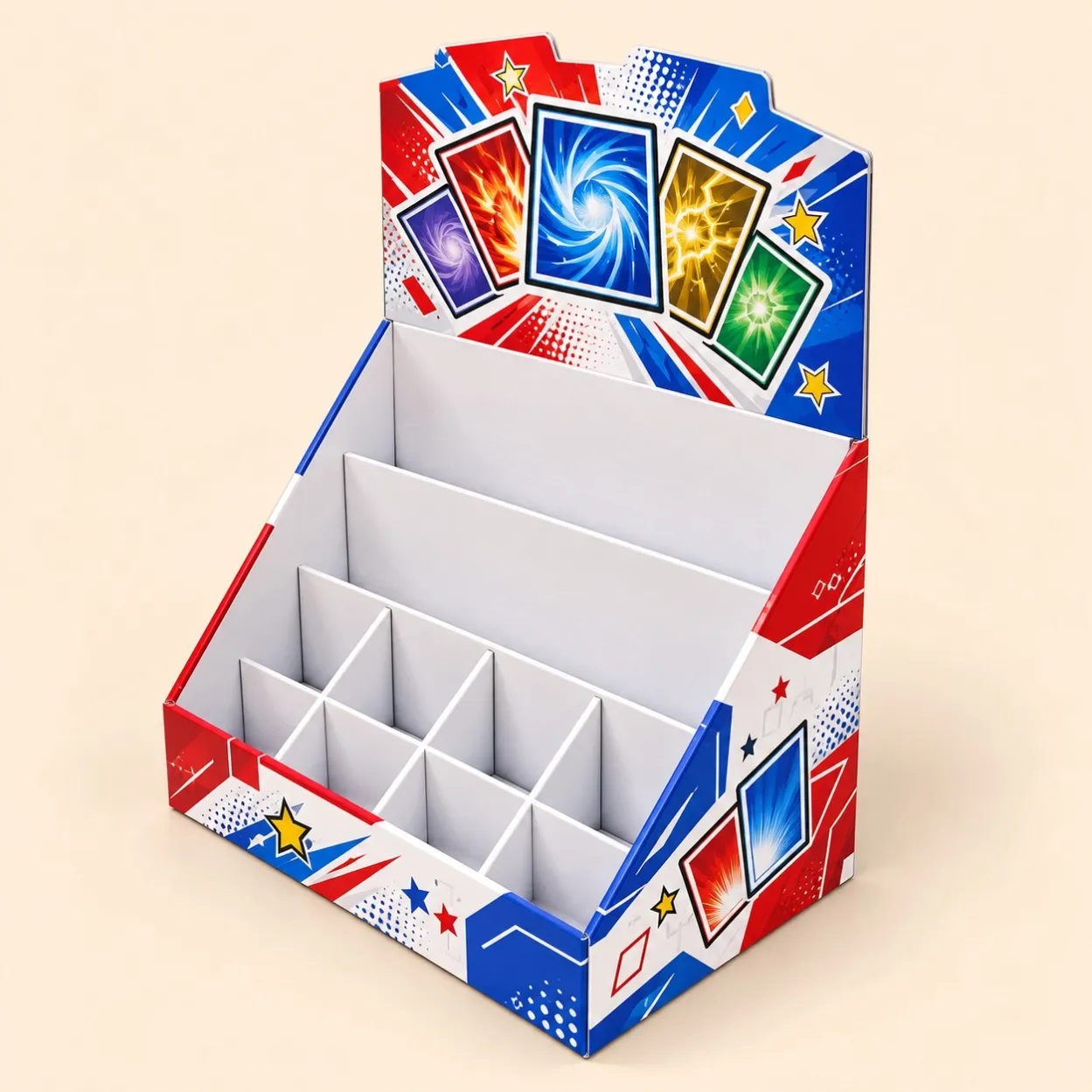
A floor display stands on the ground, usually 150–180 cm tall, and holds fifty to two hundred units at an aisle end or shop window. A counter display sits on the checkout counter or a shelf top, holds roughly a dozen to fifty units, and works because the customer is already standing there. The right choice depends on how much product you want to move per store, who pays for the floor space, and how the display ships.
The short rule: small, light, impulse products start with counter displays; volume promotions with retailer floor space go to floor displays. The rest of this guide compares the two with real dimensions, board grades and quantity bands, so you can brief either one without guesswork.
What is the difference between a floor display and a counter display?
Placement and scale. A counter display is a small printed corrugated box that sits at the checkout or on a shelf top and shows one or two facings of product. A floor display is a self-standing structure on a base, with several shelves or peg hooks, that acts as both rack and billboard. Counter displays cost less per unit; floor displays carry 5–10 times the product and can be seen across the shop.
- Counter display: 20–35 cm footprint, 12–50 units, one or two facings, sits on a counter or shelf edge
- Floor display: 40–60 cm base, 150–180 cm tall, 50–200 units, multi-shelf or peg-hook layout
- Both ship flat and fold up without tools; neither needs retailer assembly equipment
Which products sell better from a counter display?
Small, light, low-price products where the decision takes seconds: lip balm, hair ties, phone cables, earbud accessories, stationery, travel-size skincare. The customer is already at the till with money out, so the display only has to be noticed, not argued with. If your product needs explanation or a demonstration, a counter display is the wrong tool.
Check the loaded weight before you brief one. A full counter display should stay under about 10 kg so shop staff can move or refill it with one hand. Weigh the product plus its inner packaging, multiply by the units per display, and if the total passes 10 kg, cut the facing count or move to a floor model.
How much floor space does a floor display need?
Plan one square metre per display including restock access. The base itself is usually 40 × 60 cm or 50 × 50 cm, but a display nobody can walk past or refill gets pulled by the store. Aisle ends (end caps) are the premium position and often need the retailer’s approval, so ask for their display rules before you design.
Verify the footprint at home before committing: print the base outline at 1:1 scale, tape it to the floor and walk past it with a shopping bag. If you clip it every time, the store will clip it too, and a display that blocks an aisle gets removed in the first week.
What corrugated board does each display use?
Counter display bodies usually run on E-flute (about 1.5 mm) or B-flute (about 3 mm) — thin, smooth boards that take direct offset or litho-laminated graphics. Floor displays need double-wall board, typically BC or BA flute (6–7 mm), for the base and uprights, because the structure carries its own weight plus the product load and gets nudged by trolleys.
- Counter display body: E-flute or B-flute, direct-printed or litho-laminated for photographic graphics
- Floor display base and uprights: BC or BA double wall for compression and trolley bumps
- Header cards: E-flute with litho lamination, the standard combination for large photographic panels
Flute geometry changes both strength and print surface, and the differences between profiles are bigger than most buyers expect — our A-flute vs B-flute comparison covers it in detail, and how corrugated displays are printed explains when direct offset works and when lamination is safer.
How many units does each display hold?
Plan by facing, not by hope. A facing is one visible unit; shoppers buy the front one and the rest slide forward.
- Counter display: 12–50 units, one or two facings deep
- Small floor display (two shelves): 60–100 units
- Full-height floor display (four to five shelves or peg hooks): 100–200 units
- Restock: a floor display with no refill pack sells out its front row and looks empty by week two
Order per-store quantities in multiples of the display fill plus one refill. A display that empties and stands there half-loaded does more brand damage than no display at all.
What order quantity makes sense for printed displays?
Custom display boxes behave like other custom corrugated: the set-up cost (dieline, plates, sample) is fixed, so the unit price falls fast over the first few thousand. Our MOQ for fully custom displays is in the usual 500–1,000 piece band, and a pre-production sample is approved before bulk so you can load it with real product before committing.
The maths that matters is cost per store, not cost per display. A counter display programme across 200 stores at one display plus one refill each is a different order from 50 floor displays for flagship sites — same spend, completely different exposure strategy.
How do PDQ, POP and shelf-ready packaging fit in?
These terms overlap, and suppliers use them loosely, so pin down the structure rather than the label.
- PDQ display: a printed display shipped with product already packed inside, so the store opens one carton and puts it straight out — see PDQ display boxes
- POP (point of purchase): the umbrella term for any printed piece that sells at the till area, from a small box to a full stand — see POP display boxes
- Shelf-ready packaging: a shipping case that converts into a shelf display without unpacking the units — see shelf-ready packaging
Before you brief any of these formats, get the numbers right: how to size a PDQ display covers shelf measurement, loaded board grades and the checks to run on the sample.
How do you brief a display before ordering?
A complete brief prevents the two classic failures: a display that looks good empty and collapses loaded, and a display that fits the product but not the store. Send all of this with the inquiry.
- Product dimensions and weight, with packaging
- Units per display and facings, plus refill plan
- Placement: counter, shelf top, end cap or window, and the retailer’s display rules if you have them
- Loaded weight target: under 10 kg for counter models
- Artwork or brand guidelines, and whether photography needs litho-lamination quality
- Deadline: in-store date minus shipping, so sampling time is protected
Before approving bulk, ask for a photo of the assembled sample loaded with the actual product weight, and load it yourself if the sample ships to you. Push down on the top shelf with a flat hand: a floor display should take that pressure without rack; a counter display should not bow when you lift it from one end.
Floor and counter displays from Jeeli Packaging
We make both formats at our Shenzhen factory, from single counter units to full-height floor stands, printed flexo, direct offset or litho-laminated to match the artwork. The cardboard display stands page covers floor models and structures, and counter display boxes covers the checkout formats. Send your product details, units per store and in-store date through the contact form and we will come back with structure options and a quotation.