
Packaging Knowledge
Foldable Rigid Boxes: The Freight Maths of Shipping Flat vs Assembled
Foldable rigid boxes can cut freight volume five to seven times versus the same box shipped assembled — if your packing line can absorb the assembly time.
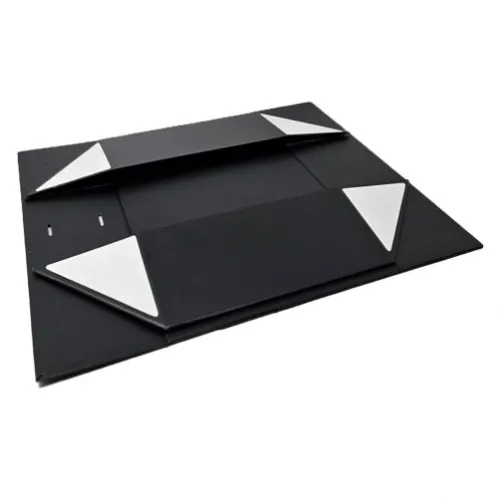
A foldable rigid box can cut the freight volume of your packaging by roughly five to seven times compared with the same box shipped assembled. For a 5,000-piece order of a typical gift box, that is the difference between about 16 cubic metres and about 2.5 cubic metres — more than half a 20 ft container versus less than a tenth of one.
But the saving is only real if your packing line can absorb the assembly work, and only if the box was designed to fold in the first place. This article works the numbers on one example box, shows where the saving can leak away, and lists exactly what to put in your request for quotation so that two suppliers' prices can be compared like for like. Every figure below is a worked example, not a quotation: run your own box dimensions through the same formula, and confirm freight rates and lead times with the quotation.
The worked example: one box, two shipping states
Take one example order. It is deliberately ordinary — a size many gift, cosmetics and accessories brands use:
- Box: lid-and-base rigid gift box, 200 × 150 × 80 mm
- Board: 1.5 mm greyboard, wrapped with printed art paper, magnetic closure
- Order quantity: 5,000 pieces
- Export carton: 600 × 400 × 400 mm
First, the volume of a single box. Shipped assembled, the box occupies its full outside dimensions: 0.20 × 0.15 × 0.08 = 0.0024 cubic metres. Folded flat, the same box collapses to a stack about 12 mm thick — two board walls plus wrapping paper and the closure, an assumption to check against your own structure. Its flat volume is 0.20 × 0.15 × 0.012 = 0.00036 cubic metres. One box, two volumes, a ratio of about 6.7 to 1.
Next, how many boxes fit in one export carton. The carton holds 3 boxes along its length, 2 across its width, and 5 layers high when the boxes are assembled — 30 boxes per carton. Flat, the same carton still holds 3 by 2, but 33 layers high — 198 boxes per carton.
| Assembled | Shipped flat |
Volume per box | 0.0024 CBM | 0.00036 CBM |
Boxes per export carton | 30 | 198 |
Cartons for 5,000 boxes | 167 | 26 |
Total freight volume | 16.0 CBM | 2.5 CBM |
The ratio survives every step: about six and a half times less volume, about six and a half times fewer cartons to handle, count and load. If your box is larger, the ratio grows; if it is smaller and flatter, the ratio shrinks — but the method is the same. Measure your own box, divide its assembled volume by its folded volume, and you have your number.
What 5,000 boxes occupy in a container
A 20 ft container holds roughly 28 cubic metres of loaded cartons in practice — confirm the usable figure with your forwarder, because it varies with carton size and loading method. Against that:
- 5,000 assembled boxes at 16.0 CBM fill about 57% of the container.
- 5,000 flat boxes at 2.5 CBM fill about 9%.
- 10,000 assembled boxes at 32 CBM need more than one container.
- 10,000 flat boxes at 5.0 CBM still leave most of a container free for other goods.
For sea freight, the saving is easy to price. Take your forwarder's per-CBM rate and multiply it by the gap — 13.5 CBM on a 5,000-piece order in this example. We do not publish a freight rate here, because rates move with season, route and fuel surcharges; the gap in cubic metres is the part you control by choosing the structure.
For air freight, the effect is similar but works through chargeable weight. Airlines charge on the greater of actual weight and volumetric weight, and volumetric weight is calculated from the shipment's volume. A flat-packed shipment has the same actual weight but far less volume, so its chargeable weight falls. Each carrier applies its own divisor in the volumetric formula, so confirm it with your forwarder before you promise a saving to your finance team.
The same logic applies to warehousing between shipments. Flat boxes need roughly one sixth of the shelf or pallet space, which matters when a brand holds packaging stock for several months of fulfilment. If you are weighing a trial run against a bulk order, the storage difference is part of the same calculation — our guide to routing an order by quantity explains how small trial runs and larger repeat orders are handled differently.
Four places the saving can leak away
Flat shipping is not free money. Four costs sit on the other side of the calculation, and a good quotation accounts for all of them.
- Assembly labour at your end. Somebody has to form each flat box into shape, square the corners and lock the closure before the product goes in. Time it on your sample run — the figure varies by structure, and a first run is always slower than a practised one. As an illustration only: if one trained packer averages 20 seconds per box, 5,000 boxes take about 28 working hours. Compare that labour cost with the freight saving before you decide. If your packing is done by a third-party fulfilment centre, ask them to quote the forming step separately.
- Protection for flat stacks. A folded stack is thinner but its corners and edges are exposed. Flat boxes usually need dividers, edge protectors or a sturdier export carton than assembled boxes do. Add the volume and cost of that protection to the flat side of the calculation, or the saving will be overstated.
- Inserts and accessories travel separately. A fitted insert, a ribbon or a magnetic lid may ship flat, assembled, or as a separate item that needs its own forming step. Decide the state of every component in the quotation, not just the outer box, and confirm whether the insert is formed at the factory or at your warehouse.
- Not every rigid box can fold. This is the most common misunderstanding. A standard set-up rigid box cannot be flattened without breaking it. The foldable construction — the folding panels, the locking corners, the closure that holds the box square — has to be designed into the box from the start, and the materials and finishes must not interfere with the folding areas. If your current box is a conventional rigid box, switching to flat shipping means developing a new structure and approving a new sample. Our foldable rigid boxes page explains how the structure works, and our guide to flat-packed versus assembled packaging covers the wider decision — who assembles, who inspects, and who owns the quality risk — which this article deliberately does not repeat.
Make the quotation like-for-like
Two quotations can only be compared when both suppliers are pricing the same delivery state. Before you send a request for quotation, write these five lines into it:
- Delivery state: flat-packed or assembled, for the box and for each insert and accessory.
- Export carton size and the number of boxes per carton for that state.
- Assembly instructions and the time per box, measured on the sample by your own packing team.
- Who supplies edge protection, dividers and any forming jigs.
- Freight term — FOB or DDP changes who pays for the volume you just calculated, so the term belongs in the same comparison.
With those five lines agreed, the CBM maths above turns into a real price comparison. Without them, the cheaper unit price may simply be the quotation that quietly moved the forming work to your warehouse. Sampling takes 7–10 days for rigid boxes, and bulk production typically runs 15–25 working days — confirm both with the quotation, and trial the flat-packed state with the team that will actually pack it before you award the order.
FAQ
How much volume does flat shipping really save?
For typical gift-box sizes, roughly five to seven times. The exact figure comes from your own dimensions: assembled volume divided by folded volume. Run both through the formula above before you believe any supplier's claim.
Do foldable rigid boxes look cheaper than standard rigid boxes?
No. A foldable rigid box uses the same greyboard wall and the same wrapped paper as a standard rigid box, so shelf presence and the unboxing feel stay premium. Only the corner construction changes — and that is what cuts the freight volume. Greyboard thickness still matters: a small, light gift box usually works on 1.5 mm board, while larger or heavier boxes need thicker board, as our greyboard thickness guide explains.
Can any rigid box ship flat?
No. Only a box designed as a foldable or collapsible structure can be supplied flat. A conventional set-up rigid box keeps its shape through shipping and storage, and flattening it would damage it.
What is the minimum order for foldable rigid boxes?
Rigid boxes start from 500 pieces. Confirm the exact minimum and the price steps for your size and structure with the quotation.
Does flat shipping help with air freight?
Yes, through volumetric weight: less volume means a lower chargeable weight at the same actual weight. Confirm the carrier's volumetric divisor with your forwarder, because it changes the result.
How long does sampling take?
Sampling for rigid boxes takes 7–10 days. Bulk production typically runs 15–25 working days — confirm both with the quotation.
Get a Custom Quote
Send us your box size, order quantity, artwork and printing requirements, and tell us whether you want the boxes delivered flat or assembled. We will review the structure, materials, printing and packing requirements together — including the assembly step — before we quote. Contact us for a custom quotation, or start from our foldable rigid boxes page.
Jeeli Packaging
Jeeli Packaging is a custom packaging manufacturer in Shenzhen, China, making rigid boxes, folding cartons, mailer boxes, paper bags, hang tags and labels for brands worldwide. Rigid boxes start from 500 pieces, with sampling in 7–10 days. Contact us at info@jeelipackaging.com.