
Sep 23, 2026Blog
Why Do Folding Cartons Have Gaps After Assembly?
Why do folding cartons develop gaps after assembly? Learn how paper thickness, creasing, dielines, gluing and box structure can affect the final fit.
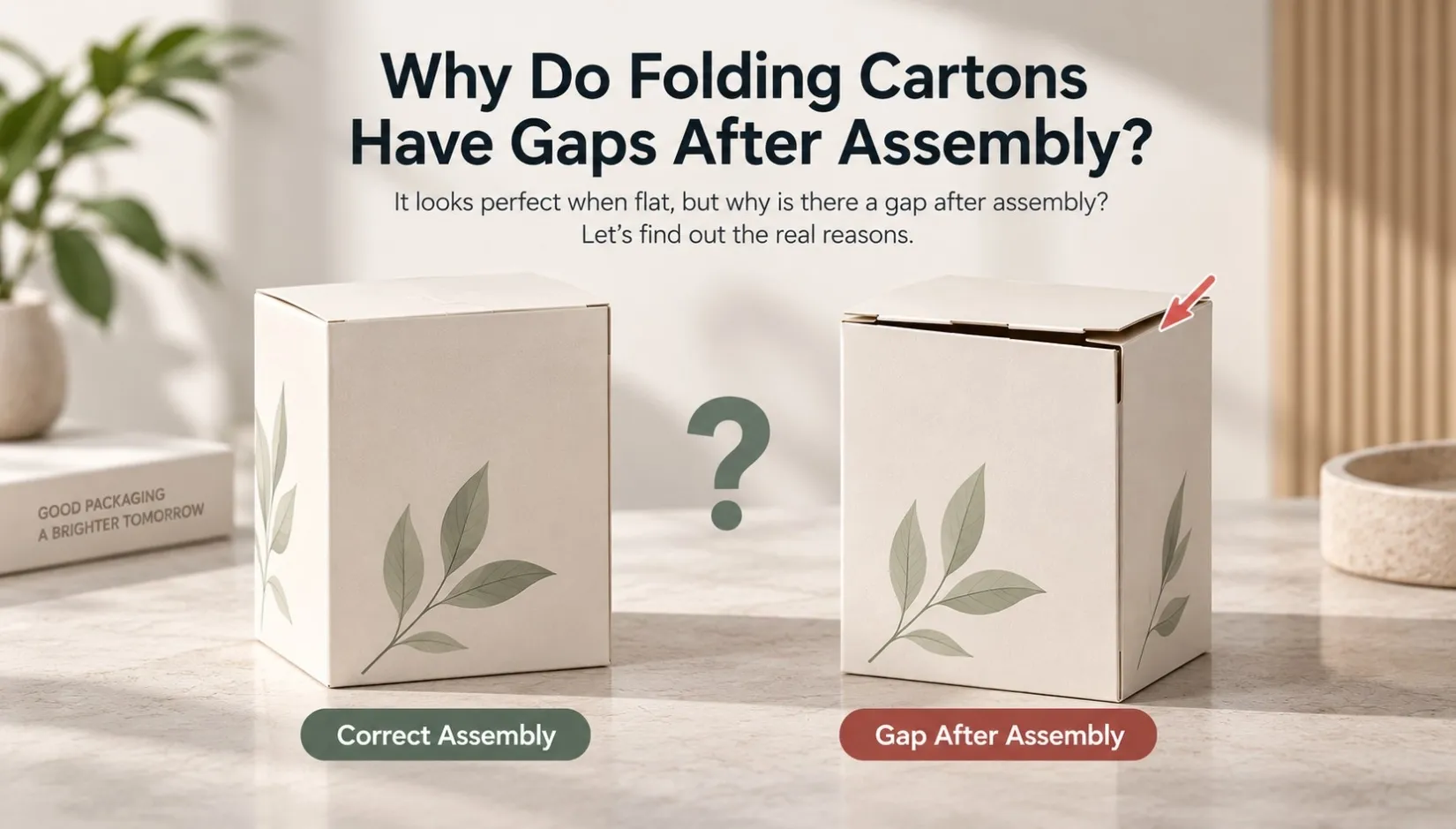
The printed cartons look fine when they arrive flat.
But after the buyer folds and assembles the box, something does not look right.
One side may have a visible gap. The top flap may not sit tightly. Or the carton may look slightly twisted after assembly.
The first reaction is often:
“Is the box size wrong?”
Sometimes it is.
But not always.
A folding carton is not simply a flat piece of paperboard cut to a certain size. The final assembled shape depends on how the material thickness, crease lines, dieline dimensions, locking structure and glued areas work together.
A visible gap is usually the result buyers notice. The actual cause may begin much earlier in the packaging design or production process.
This article looks at six common reasons folding cartons develop gaps after assembly and how buyers can identify where the problem may be coming from.
<!-- HERO IMAGE -->
<!-- Filename: folding-carton-gaps-after-assembly.jpg -->
<!-- ALT: Folding carton with visible gap after assembly compared with correctly assembled carton -->
What Does a Gap After Assembly Actually Tell You?
A gap does not automatically mean the finished box dimensions are wrong.
The first question should be:
When does the gap appear?
Does the empty carton already have a gap?
Does it appear only after the product is placed inside?
Does every carton have the same problem?
Or do only some cartons show the gap?
These differences are important because they can point to very different causes.
For example, if every empty carton develops the same gap in the same position, the structure, dieline or material allowance may need to be reviewed.
If the empty carton closes correctly but starts to open after the product is inserted, the internal fit may be the more important issue.
Instead of changing the box dimensions immediately, it is better to identify when and where the problem begins.
1. The Dieline Does Not Fully Allow for Paperboard Thickness
Paperboard has thickness.
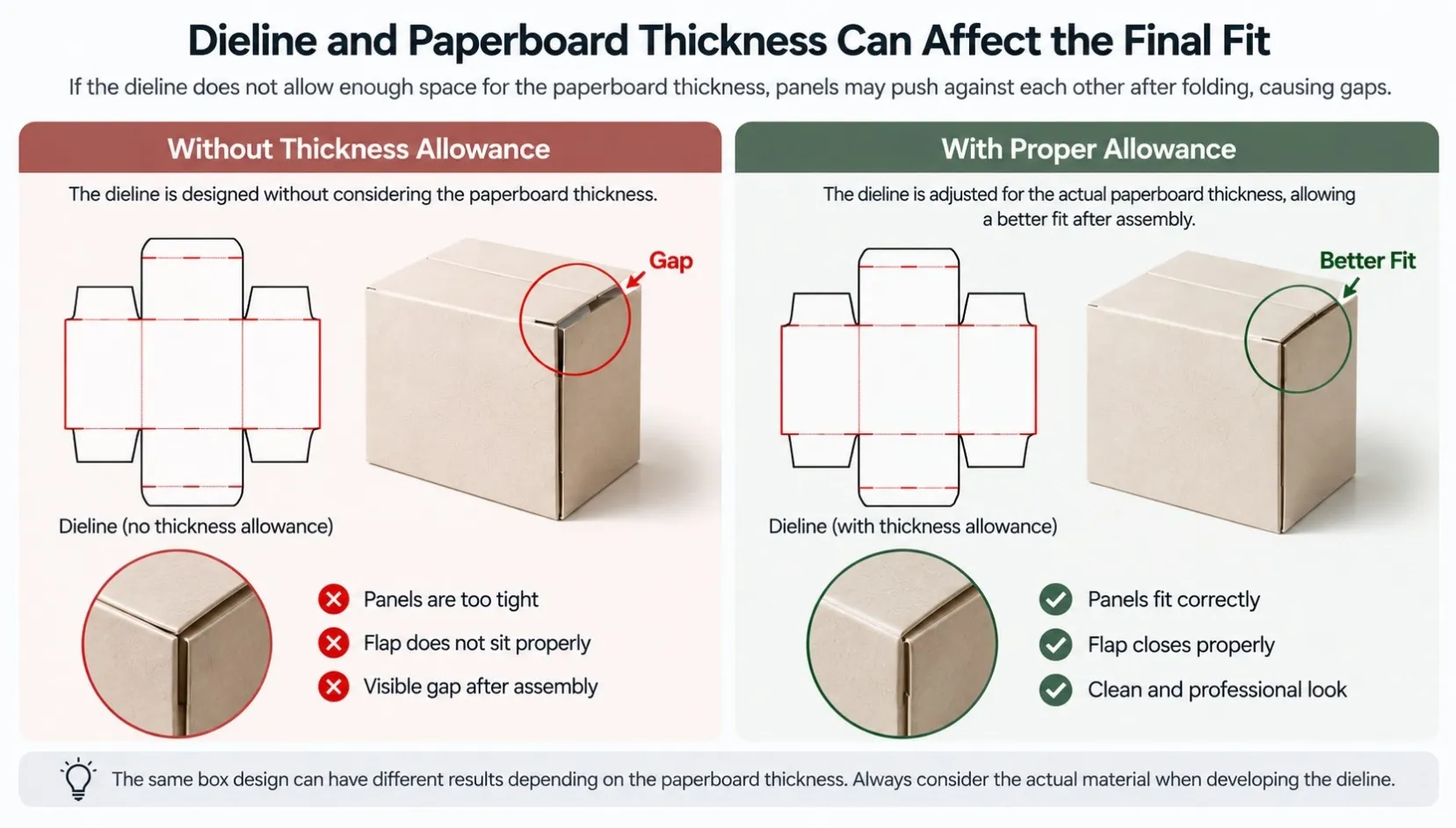
This sounds obvious, but it becomes important when a flat dieline is converted into a three-dimensional box.
A folding carton may use 300gsm, 350gsm, 400gsm or another paperboard specification depending on the product and packaging requirements.
The panels do not simply meet at mathematical lines after folding. The material itself occupies space, particularly around corners and areas where several panels overlap.
This can affect:
- tuck flaps
- dust flaps
- side walls
- locking areas
- glued seams
- double-layer sections
If the dieline does not provide suitable allowance for the actual material, one panel may push against another after folding.
The result may be a flap that does not sit properly or a visible gap between panels.
This is why a dieline developed for one material should not automatically be assumed to work exactly the same way with a significantly different paperboard.
A thicker paperboard does not only change how the box feels. It can also change how the structure folds and fits.
2. The Crease Lines Are Not Matched to the Material
Creasing is another important part of folding carton performance.
A crease line helps the paperboard fold in the intended position.
But the appropriate crease depends on factors such as:
- paperboard thickness
- paper characteristics
- grain direction
- crease width
- crease depth
- folding direction
If the crease is too shallow or not suitable for the material, the board may resist folding.
Instead of forming a clean corner, the panel may try to return toward its original flat position.
This can create pressure elsewhere in the structure.
The buyer may then see:
- a top flap that lifts slightly
- a side panel that pushes outward
- corners that do not align cleanly
- a gap that appears after the carton is assembled
This is also why simply switching to a thicker board without reviewing the creasing and structure can create unexpected problems.
3. The Tuck Flap or Locking Structure Is Too Tight
A tighter carton is not always a better carton.
Tuck-end folding cartons rely on several parts working together, including the main flap, tuck flap, dust flaps and sometimes locking tabs or slots.
If one of these areas is too tight, closing the box can force another panel outward.
For example:
Tuck flap too tight → extra pressure during closing → side panel moves outward → visible gap
The same problem can occur when a locking tab is too large for its slot or when dust flaps interfere with the closing area.
This is especially important when the material is changed after the original structure has already been developed.
A structure that works well with one paperboard may feel considerably tighter with a thicker material.
The objective should not be to make every locking area as tight as possible.
It should be secure enough to hold the packaging correctly while remaining practical to assemble consistently.
4. The Glued Side Seam Is Not Properly Aligned
Many folding cartons are supplied flat with one side seam already glued.
When the carton is opened, that glued seam becomes part of the geometry of the finished box.
If the gluing position varies, even a relatively small shift can affect how other panels align after assembly.
The carton may appear slightly skewed, or the top and bottom flaps may no longer meet in exactly the intended position.
This does not mean every small production variation will automatically create a visible problem.
The effect depends on the box size, structure, material and tolerance of the design.
However, when only part of a production batch shows alignment problems, gluing consistency is one of the areas worth checking.
It is also useful to compare several affected cartons rather than judging the issue from only one piece.
5. The Product or Insert Is Pushing Against the Carton
Sometimes the empty carton is perfectly fine.
The problem appears only after the product is placed inside.
This is an important clue.
If the internal dimensions are too tight, the product can push against the side walls of the carton.
The same thing can happen with an insert.
For example:
Product or insert too tight → carton wall pushed outward → flap alignment changes → gap appears
This can happen when:
- the product dimensions changed
- the packaging clearance is too small
- an insert is slightly oversized
- several components are packed too tightly
- the product is placed in the wrong orientation
In this situation, increasing the strength of the paperboard may not solve the real problem.
A useful test is simple:
Assemble and close the carton without the product first.
If the empty carton closes correctly but the gap appears after the product or insert is added, internal fit should be checked before changing the overall box structure.
6. The Carton Is Not Being Assembled as Intended
Not every assembly problem comes from manufacturing.
Some folding carton structures need to be assembled in a particular sequence.
This is especially relevant for structures with:
- auto-lock bottoms
- crash-lock bottoms
- multiple locking tabs
- interlocking panels
- sleeves
- more complex closures
If panels are folded in the wrong sequence or a locking tab is forced into position, the carton may become distorted.
This can make a correctly produced carton look as though the structure is wrong.
Before changing the dieline, it is therefore worth confirming that the packaging is being assembled in the intended way.
For an unfamiliar box structure, a simple assembly sample, photo sequence or short instruction can sometimes prevent unnecessary confusion.
How Can You Tell Where the Gap Comes From?
The location of the gap is useful, but when the gap appears can provide even more information.
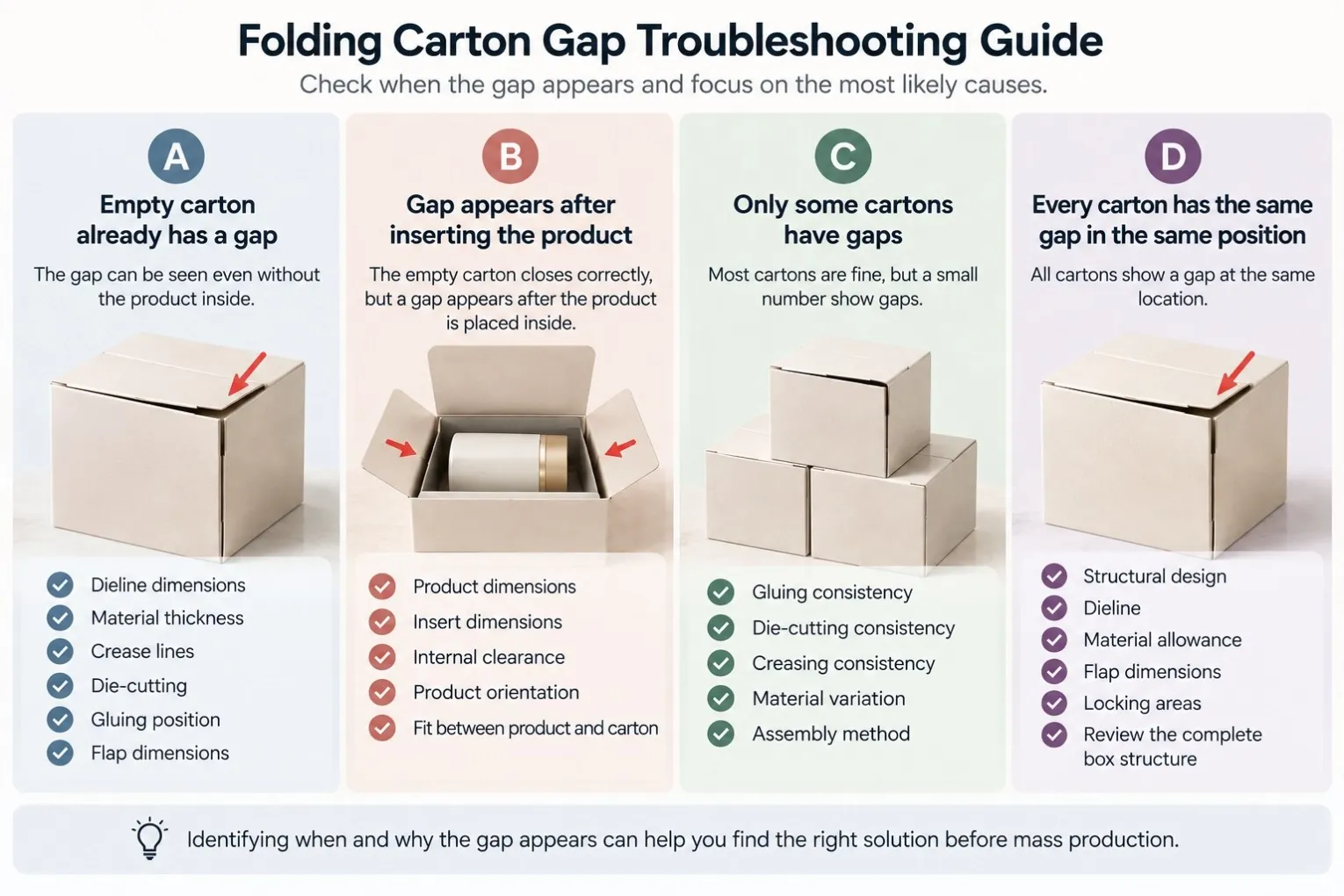
Here is a simple troubleshooting guide.
Situation A: The Empty Carton Already Has a Gap
Check:
- dieline dimensions
- material thickness
- crease lines
- die-cutting
- gluing position
- flap dimensions
The issue may be related to the carton structure or production rather than the product inside.
Situation B: The Gap Appears After the Product Is Inserted
Check:
- actual product dimensions
- internal carton dimensions
- insert dimensions
- internal clearance
- product orientation
- fit between the product and carton
The product or insert may be changing the shape of the assembled carton.
Situation C: Only Some Cartons Have Gaps
Check:
- gluing consistency
- die-cutting consistency
- creasing consistency
- material variation
- assembly method
When most cartons assemble correctly but a smaller number do not, production or assembly variation deserves closer attention.
Situation D: Every Carton Has the Same Gap in the Same Position
Check:
- structural design
- dieline
- material allowance
- flap dimensions
- locking areas
A consistent problem in the same location may indicate that the structure itself needs adjustment.
Why Should the Carton Be Tested With the Actual Product?
An empty assembled carton can confirm more of the structure.
But neither test completely shows how the packaging will perform with the actual product inside.
For packaging where fit is important, a better review is:
Product + Insert + Folding Carton
Testing these components together can reveal issues that may not be obvious from the dieline alone.
For example, the carton may close perfectly when empty but become slightly distorted when a bottle, device or insert is added.
This is particularly useful for:
- cosmetics
- skincare bottles
- small electronics
- accessories
- products with inserts
- multi-component products
The objective is not simply to make the box match the specified dimensions.
The objective is to make the complete packaging system work with the actual product.
What Should Buyers Check Before Mass Production?
Before approving a folding carton for mass production, it is useful to review more than the artwork.
Check the assembled sample with the actual product whenever possible.
Pay attention to:
- Does the empty carton assemble squarely?
- Do the top and bottom flaps close naturally?
- Are there visible gaps before the product is inserted?
- Does the carton change shape after inserting the product?
- Is the insert pushing against the carton walls?
- Are locking tabs easy to assemble without excessive force?
- Does the paperboard fold cleanly along the crease lines?
- Does the glued side seam remain properly aligned?
If a problem appears during sampling, identify the cause before simply changing the finished box dimensions.
A structural problem and a dimensional problem are not always the same thing.
A Small Gap Can Point to a Bigger Structural Issue
A visible gap is usually the result you see, not necessarily the original cause.
The cause may begin with:
Dieline → Material → Creasing → Gluing → Product Fit → Assembly
That is why changing only one dimension may not always solve the problem.
Before making adjustments, identify when the gap appears:
Before assembly?
After assembly?
After inserting the product?
Only on some cartons?
The answers help narrow down where to investigate.
A well-developed folding carton should consider the product, material and structure together rather than treating each one as a separate decision.
Need Help Reviewing a Folding Carton Structure?
If you are developing a folding carton and are not sure whether the material, structure or product fit is suitable, send us the basic project information.
For an initial review, you can provide:
- product dimensions
- product weight
- product photos
- required quantity
- box dimensions, if available
- artwork or logo
- preferred material
- insert requirements
Jeeli Packaging can review the product and packaging requirements together and help identify a practical structure before mass production.