
Packaging Knowledge
Consumer Electronics Packaging Guide: Rigid, Folding Carton or Mailer Box - and Which Insert Protects It?
Match earbuds, wearables, chargers and smart-home devices to the right box and insert, with the checks that catch a failing sample before production.
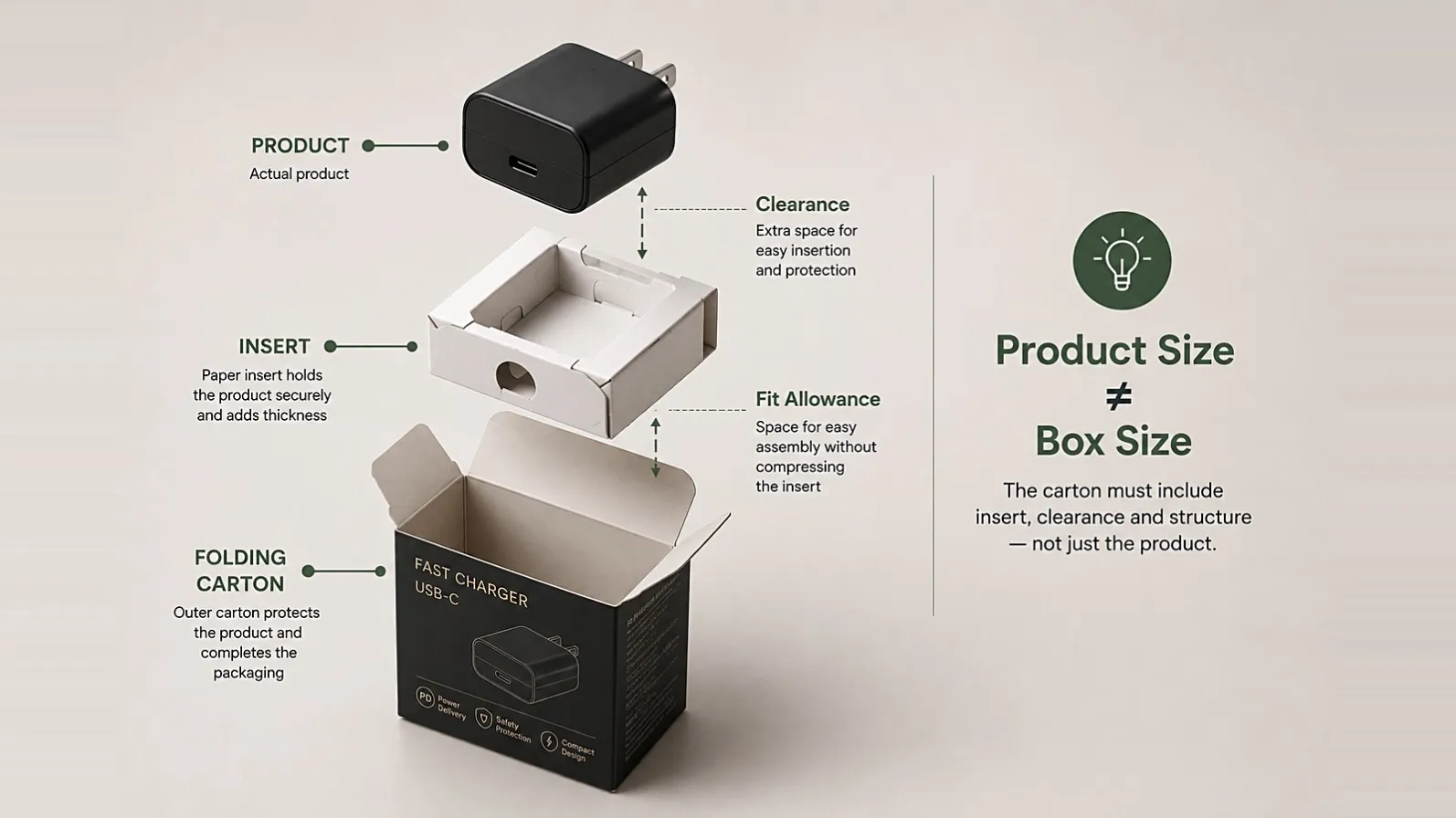
For most consumer electronics the answer is a folded carton inside a corrugated mailer, not a rigid box. The carton carries the brand on a shelf, the mailer survives the courier network, and the insert - a die-cut paperboard tray or moulded pulp - holds the device so it cannot rotate. A rigid box earns its place only when the box itself is kept: a premium audio product, a gift set or a press kit.
The choice starts with the route the product takes. A retail shelf carton, a direct-to-consumer parcel and an Amazon FBA shipment are three different specifications, and most packaging failures come from using one for another.
Which box type fits each kind of electronics?
Work from the device and its accessories together, because the cable, the charger and the paperwork are what usually break the fit:
- Earbuds, small chargers, cables - a 350-400 gsm folding carton with a paperboard tray or a simple die-cut collar; the cheapest structure that still prints well
- Smartwatches and wearables - a folding carton with a fitted pulp insert, or a rigid lid-and-base box if the product is sold as a gift
- Speakers and smart-home devices - a B-flute corrugated mailer with a moulded pulp tray; these are heavier and ship direct more often
- Phone cases, adaptors and multi-item kits - a folding carton inside an outer mailer, so the retail face stays clean in transit
- Launch kits and PR boxes - a rigid box, but shipped inside a protective outer carton
The structures are shown on our electronics folding cartons page, with the mailer and rigid ranges linked at the end of this guide. A rigid box shipped alone through a parcel network is the most expensive way to get a dented corner.
What does the insert actually have to do?
Three jobs, in order of importance:
- Immobilise the device at two contact points, with 1-2 mm clearance at the widest point so it can be lifted out without prising
- Stop rotation on the second and third impact - a cavity that holds the base but lets the top swing will crack a screen or a lens
- Separate accessories from the product, so a USB brick cannot rub a glossy surface for three days in a truck
Card collars are cheap and recyclable and suit light devices; moulded pulp (0.8-1.5 mm wall) cushions better and keeps the set single-material; EVA foam protects best but complicates a plastic-free claim. The trade-offs are in our insert material guide, and the sizing rules in the packaging insert sizing guide.
One specification to settle explicitly: if your device needs electrostatic protection, say so in the RFQ and ask what the supplier can actually supply. Standard paperboard and standard pulp are not anti-static treatments, and a tray that looks right in a sample can be wrong for the component.
How do you know the box will survive the journey?
Pack three real units by hand and drop them from 800 mm onto a hard floor - once per face, edge and corner. Open them after each sequence. What you are looking for is a lid that pops open, an insert that lets the device rotate, and a carton wall that creases and loses stacking strength after the first corner impact.
If the carton is also the shipping container, the test gets harder: it needs to stay presentable after vibration and compression, not just a drop. Decide that before the board grade is chosen. Our folding carton versus corrugated box comparison explains why a shelf carton is not a shipper.
What changes for retail, DTC and Amazon FBA?
- Retail shelf - the carton carries the brand and the barcode; it never travels alone, so protectiveness is a secondary concern
- Direct to consumer - the mailer is the first thing the customer sees, so inside print and the opening sequence matter; the insert has to survive the parcel network
- Amazon FBA - one scannable FNSKU in the artwork or on a flat label, no second barcode visible, and a drop-tested closure; confirm the current requirements in Seller Central before a production run, since they change
Barcode placement is the avoidable defect: a code printed across a seam or next to a visible UPC gets rejected after the goods have already shipped. Our guide to common electronics carton problems covers the assembly-side faults we see most often.
What belongs on the dieline and artwork?
- Internal dimensions in millimetres, measured on the device with its cable and any insert in place
- A flat, uncreased area for the barcode, away from lid lines and edges
- Space for the regulatory marks your product requires (CE, UKCA, FCC, WEEE) - the brand's responsibility to specify, not the box maker's to invent
- Pantone references for brand colours, and foil or spot UV called out as separate artwork layers
- A dieline that shows the insert as well as the box, so the two are approved together
Artwork is where dimension errors get locked in; our dieline guide sets out the order to do it in. Decide the insert before approving the artwork, not after.
What should you check on the sample?
- Load the real device, cable and paperwork, then run the ten-drop sequence; nothing should move or scuff
- Open and close the box twenty times - a whitening crease will split in a customer's hands
- Rub a glossy device against the insert for a minute and check for transfer marks on the housing
- Compare foil registration and the printed barcode under store lighting, with a scanner rather than by eye
- Weigh the packed unit and compute volumetric weight; electronics boxes are often billed on the space the accessory tray takes
Approve one physical sample and keep it with the dieline. A digital proof tells you what the artwork looks like; it cannot tell you whether a charger brick rattles.
Frequently asked questions
Is a rigid box worth it for electronics? Only when the box is part of the product experience - premium audio, a gift set, a press kit - and when it ships inside an outer carton. For a single device going DTC, a printed mailer with a good insert costs less and survives more.
Do I need an insert for a small accessory? Not always. If the device fits its carton with 1-2 mm clearance and cannot rotate, a paper wrap is enough. Inserts are worth it as soon as there are two loose objects in the same cavity; see when packaging needs an insert.
Can the same box serve retail and e-commerce? Yes, as a folding carton inside a mailer. The inner carton stays clean for the shelf, the outer mailer takes the courier damage - at the cost of a second component.
How Jeeli can help
Send the device dimensions, the accessories that ship with it, the weight and the sales channel, and we will recommend a structure, a board grade and an insert rather than a box. We manufacture electronics folding cartons, custom mailer boxes and two-piece rigid boxes in our Shenzhen factory, with paperboard, pulp and foam inserts; minimum 1,000 pieces for cartons and mailers, 500 for rigid boxes, sampling in 7-10 days and bulk production in 15-25 days.
Ready to start? Get a Custom Quote — send your specification, including size, quantity, material and print requirements. We reply within 24 hours.
Susan Hou is Business Development Director at Jeeli Packaging in Shenzhen. She has spent 13 years working with overseas customers, from home & lifestyle products to energy storage, and now helps brands with custom boxes, paper bags, hang tags and labels. Behind her is Jeeli's professional production team, who handle printing, structure and quality control, from sampling to bulk production.