
Sep 23, 2026Blog
Folding Carton vs Corrugated Box: Which One Should You Choose?
Compare folding cartons and corrugated boxes by product weight, protection, printing, shipping and cost to choose the right packaging structure.
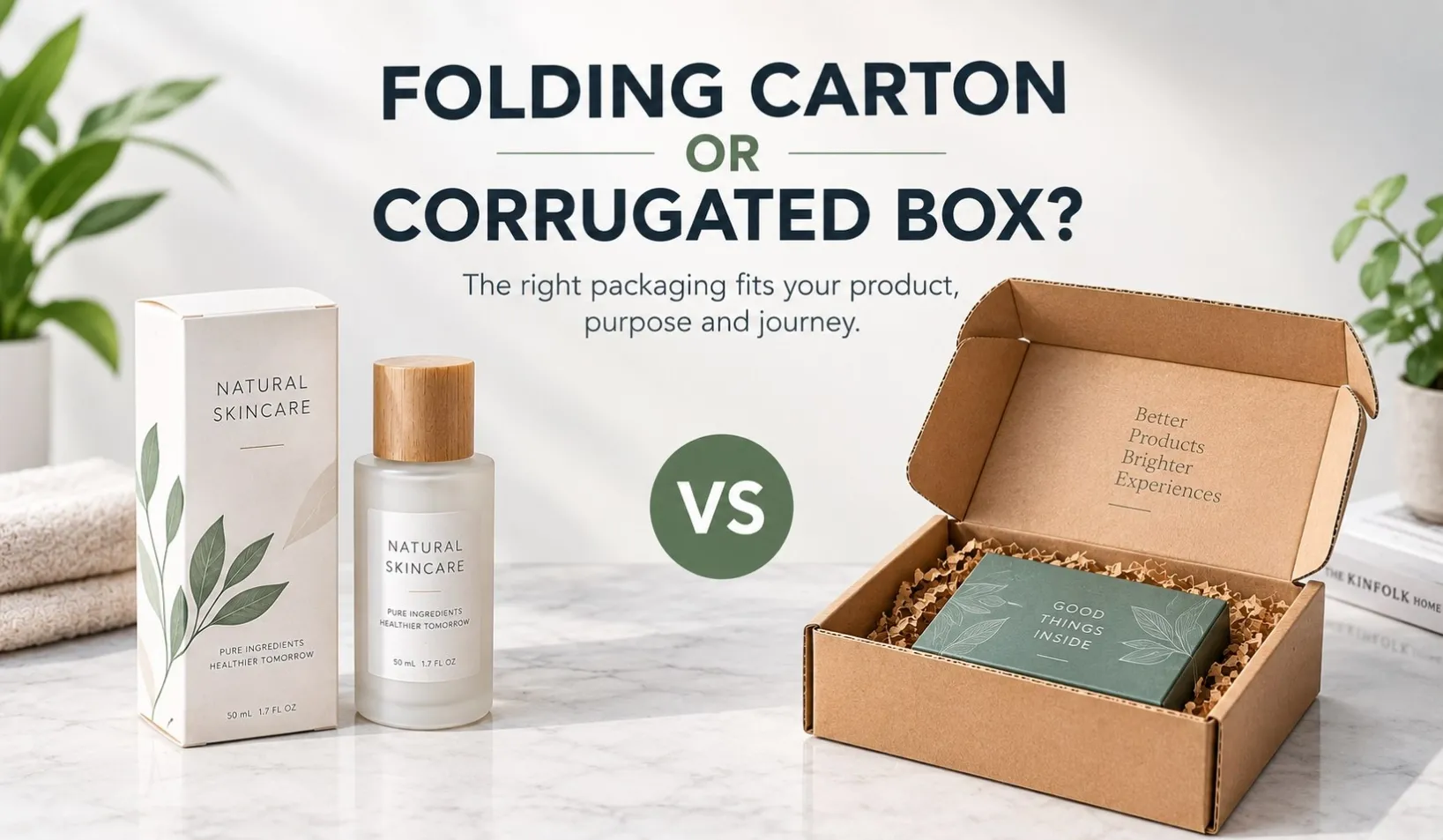
A buyer sends us a box photo and asks for a quotation.
Before discussing price, one of the first questions we need to understand is:
What will be packed inside?
Why?
Because two boxes may look similar in a photo but require very different materials and structures.
A lightweight skincare product may work perfectly in a paperboard folding carton.
A heavier product shipped directly to customers may need a corrugated structure for additional protection.
So the real question is not:
Which box looks better?
It is:
Which packaging structure is more suitable for the product, presentation, production and shipping requirements?
This guide explains the practical differences between folding cartons and corrugated boxes from a buyer's perspective.
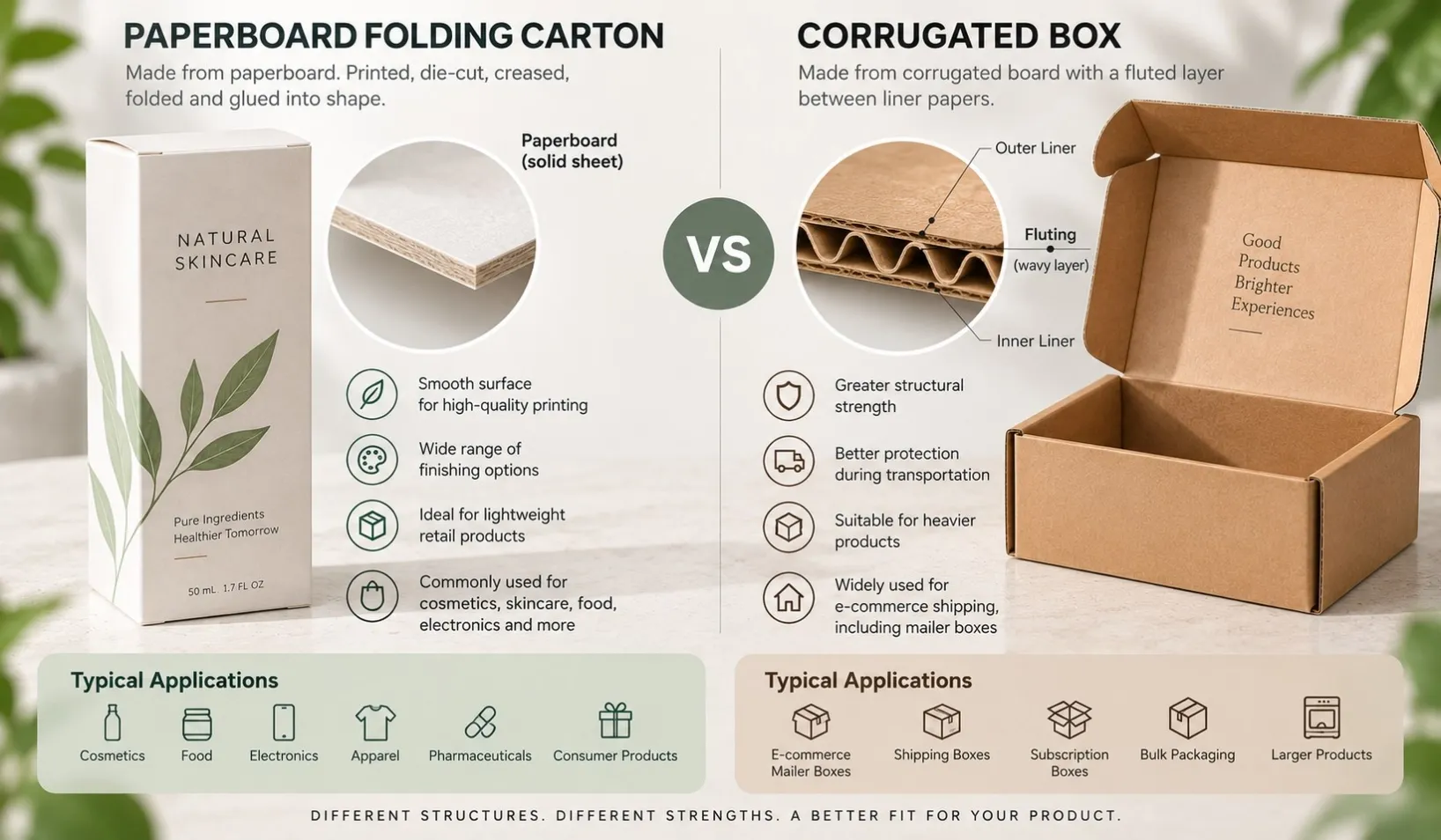
The Quick Difference: Paperboard vs Corrugated Structure
The biggest difference starts with the material.
A folding carton is generally made from paperboard that is printed, die-cut, creased, folded and glued into shape.
It is commonly used for products such as:
- cosmetics
- skincare
- food
- small electronics
- pharmaceuticals
- apparel accessories
- retail consumer products
A corrugated box uses corrugated board made with a fluted layer between liner papers.
This structure creates additional thickness and cushioning.
Corrugated packaging is commonly used when the box needs:
- greater structural strength
- better protection during transportation
- additional resistance to handling
- ecommerce shipping capability
Many mailer boxes are made from corrugated board, but a mailer box is only one type of corrugated packaging structure.
The two terms are related, but they are not exactly the same thing.
1. What Product Are You Packing?
The product itself should usually come before the box design.
Before choosing between a folding carton and corrugated packaging, consider:
- product size
- product weight
- product shape
- fragility
- number of components
- whether an insert is required
For lightweight retail products, paperboard folding cartons are often sufficient.
They provide a clean printed surface while keeping the packaging relatively compact.
For heavier or more fragile products, corrugated board may provide additional support.
But heavier material is not automatically better.
Using more structure than the product actually needs can increase material usage, packing volume and cost without providing meaningful additional value.
The objective is to match the packaging structure to the actual product.
2. How Much Protection Does the Product Need?
Protection is one of the main reasons buyers move from paperboard to corrugated packaging.
A folding carton provides basic product containment and presentation.
However, it may normally be packed inside a larger shipping carton before transportation.
A corrugated mailer box can sometimes serve both as branded packaging and as part of the shipping protection.
This makes corrugated structures especially useful for ecommerce products.
Before deciding, ask:
Will this box sit on a retail shelf, or will it be shipped directly to the customer?
These are very different packaging situations.
For retail products, the outer transport carton may provide most of the shipping protection.
For direct ecommerce shipping, the individual box may experience significantly more handling.
The correct choice therefore depends on the complete supply chain, not only the appearance of the individual box.
3. Is Retail Presentation or Shipping Protection More Important?
Folding cartons are widely used when presentation is a major priority.
Paperboard provides a relatively smooth surface for:
- printed graphics
- Pantone colors
- foil stamping
- embossing
- debossing
- spot UV
- matte or gloss finishes
- window structures
This makes folding cartons especially useful for retail environments where the box is part of the product presentation.
Corrugated boxes can also be custom printed and branded.
For ecommerce brands, a printed corrugated mailer box can create a strong unboxing experience while also providing a more substantial structure.
The important point is not that one material always looks better.
Instead, think about where the customer will interact with the packaging.
If the box needs to sit beside competing products on a retail shelf, a folding carton may make more sense.
If the packaging is delivered directly to the customer, a printed corrugated mailer box may provide both presentation and protection.
4. How Do Printing Requirements Affect the Choice?
Printing requirements can also influence the structure.
For a folding carton, printing is usually an important part of the overall retail presentation.
The artwork may include:
- product information
- branding
- ingredients
- instructions
- barcodes
- regulatory information
- decorative graphics
For corrugated mailer boxes, branding may be simpler or more focused on the unboxing experience.
Some brands only print the exterior.
Others add interior printing, patterns or messages inside the lid.
The printing method should be considered together with the board type, order quantity and required appearance.
A design that looks excellent on screen may need adjustment once it is applied to the actual packaging material and dieline.
5. How Does Box Structure Affect Assembly?
Material is only one part of the decision.
The box structure also affects how easily the packaging can be assembled.
Common folding carton structures include:
- reverse tuck end
- crash-lock bottom
- sleeve packaging
- window cartons
These structures may use tuck flaps, glued seams or automatic bottoms.
Corrugated mailer boxes usually rely more on folding panels, locking tabs and structural interlocking.
This can reduce the need for glue in some designs, but it also means the score lines and locking areas need to work correctly.
If the structure is poorly designed for the material thickness, buyers may see problems such as:
- gaps after assembly
- flaps that do not close correctly
- cartons that spring open
- mailer box tabs that do not lock properly
- distorted box shapes
This is why the dieline should be developed according to the actual material and box structure rather than only the finished dimensions.
6. How Will the Packaging Be Shipped?
This is one of the most important questions and is often considered too late.
A beautiful retail carton may perform perfectly on a shelf but still require additional protection during transportation.
For example:
Retail model
Product
→ Folding Carton
→ Master Corrugated Carton
→ Shipping
Ecommerce model
Product
→ Corrugated Mailer Box
→ Customer
These supply chains are different.
When comparing packaging structures, buyers should also consider:
- cartons per master carton
- product movement
- warehouse space
- shipping volume
- handling
- stacking
- transportation conditions
The individual unit price is only one part of the total packaging cost.
Sometimes a slightly more expensive box structure can reduce other packing requirements.
In other situations, a simple folding carton packed efficiently into a master carton may be the better solution.
7. What About Packaging Cost?
Buyers naturally compare quotations.
But comparing only the unit price can be misleading if the structures are different.
Packaging cost can be influenced by:
- material type
- paperboard weight
- corrugated flute
- box dimensions
- printing
- finishing
- die cutting
- gluing
- assembly
- inserts
- packing method
- order quantity
Shipping also matters.
A structure that takes up more space may increase logistics costs even if its unit production cost looks attractive.
So instead of asking only:
Which box is cheaper?
A better question is:
Which structure gives the right balance of product protection, presentation and total cost?
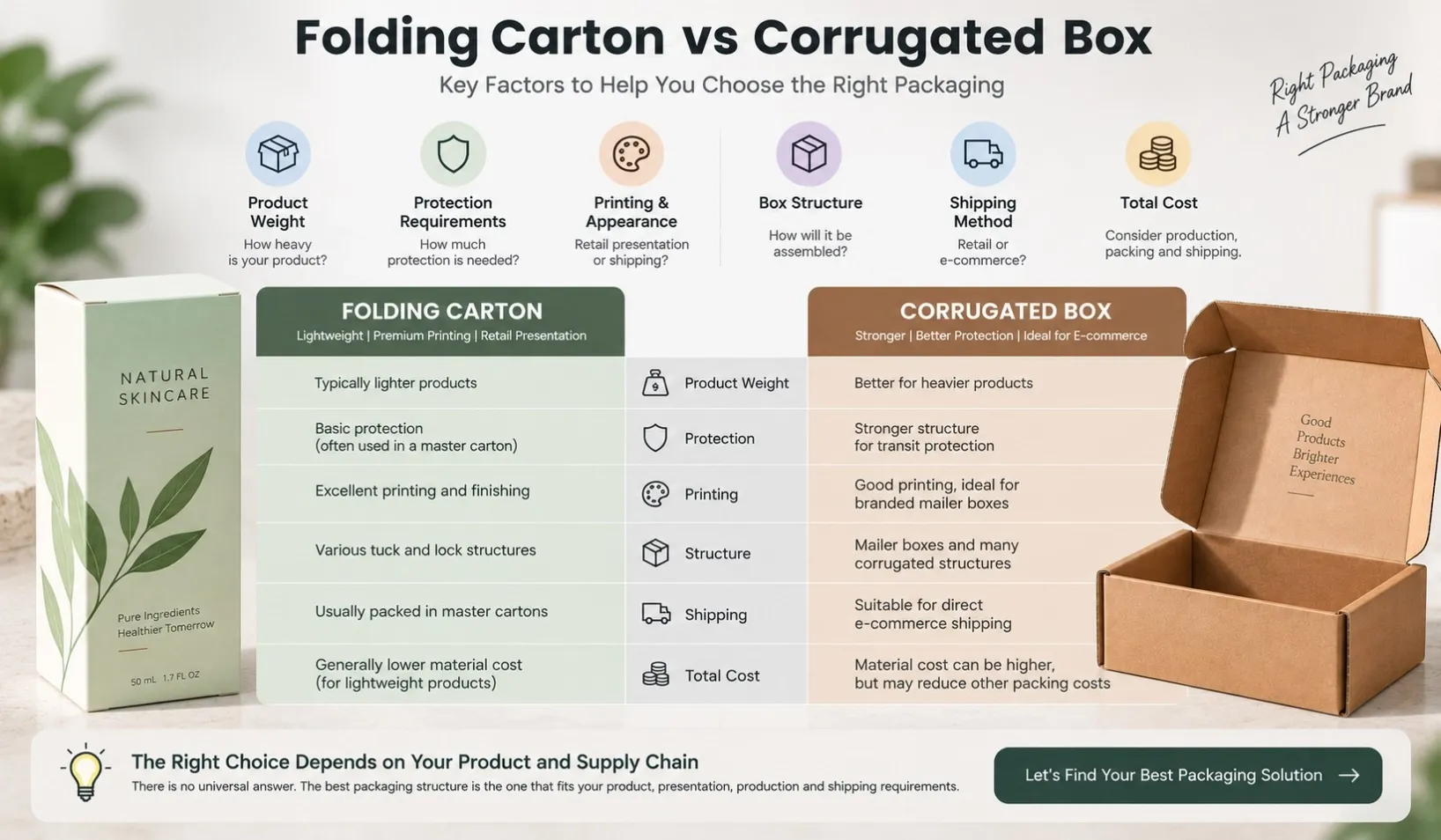
Folding Carton vs Corrugated Box: Quick Buyer Decision Guide
The following table provides a simple starting point.
Packaging Requirement | Usually Consider |
|---|---|
Lightweight retail products | Folding Carton |
Cosmetics and skincare | Folding Carton |
Small electronics retail packaging | Folding Carton |
Detailed retail graphics | Folding Carton |
Compact retail packaging | Folding Carton |
Ecommerce direct shipping | Corrugated / Mailer Box |
Heavier products | Corrugated Structure |
Greater transit protection | Corrugated Structure |
Subscription packaging | Corrugated Mailer Box |
Strong unboxing presentation | Printed Mailer Box |
Presentation + higher protection | Evaluate printed corrugated or combined structures |
These are not absolute rules.
Product weight, dimensions, shipping conditions and structure should still be reviewed before production.
<!-- BODY IMAGE 2 -->
<!-- Filename: folding-carton-corrugated-box-selection-guide.jpg -->
<!-- ALT: Buyer guide for choosing between folding cartons and corrugated boxes -->
Sometimes the Right Answer Is a Combination
The choice is not always simply paperboard or corrugated board.
Some packaging projects use several layers of packaging.
For example:
Product → Folding Carton → Corrugated Shipping Box
This allows the folding carton to handle branding and retail presentation while the corrugated outer carton provides transportation protection.
Another project may use a printed corrugated mailer box directly, eliminating the need for an additional retail carton.
The correct packaging system depends on how the product is sold and delivered.
This is why packaging should be evaluated as part of the supply chain rather than as an isolated box.
What Should Buyers Confirm Before Choosing?
Before asking a supplier to recommend a folding carton or corrugated structure, prepare as much of the following information as possible:
- Product dimensions
- Product weight
- Product photos
- Order quantity
- Retail or ecommerce use
- Shipping method
- Artwork or logo
- Printing requirements
- Finishing requirements
- Protection requirements
The more complete this information is, the easier it is to recommend a practical structure.
For example, knowing only the finished box size may not be enough.
The supplier may also need to understand:
- what sits inside
- how tightly it needs to fit
- how the packaging will be packed for shipping
This helps reduce unnecessary adjustments later in sampling or mass production.
The Best Box Is the One That Fits the Product and Supply Chain
Folding cartons and corrugated boxes both have important roles in custom packaging.
The question is not which one is universally better.
A well-designed folding carton can be an excellent solution for lightweight retail products and premium printed presentation.
A corrugated structure may be more appropriate when transportation protection, structural strength or direct ecommerce shipping becomes more important.
The right decision should balance:
Product → Protection → Presentation → Production → Packing → Shipping → Cost
Choosing the structure early can also make later decisions about materials, printing, finishing and inserts much easier.
Not Sure Which Box Structure Fits Your Product?
If you already have a product, reference box or packaging idea, send us the basic project information.
For an initial packaging review, you can provide:
- product dimensions
- product weight
- product photos
- required quantity
- artwork or logo
- shipping method
- preferred packaging style
Jeeli Packaging can help review whether a folding carton, corrugated structure or another paper packaging solution is more suitable for your project.