
Sep 28, 2026Blog
How to Choose the Right Folding Carton Structure
How do you choose the right folding carton structure? Compare tuck end, auto-lock and snap-lock cartons based on product, weight, packing and assembly.
Why Does Folding Carton Structure Matter?
A folding carton may look simple when it is flat.
But once it is folded, filled and closed, the structure has to perform several jobs at the same time.
It needs to:
- hold the product securely;
- protect the product during handling;
- open and close properly;
- remain practical to assemble;
- support the required packing process;
- work with the selected paperboard.
So choosing a folding carton structure should not start with:
“Which box style looks best?”
A better question is:
“What does the product need the carton to do?”
The right folding carton structure depends on the product, packing process and required performance — not simply on the box style.
Start With the Product, Not the Box
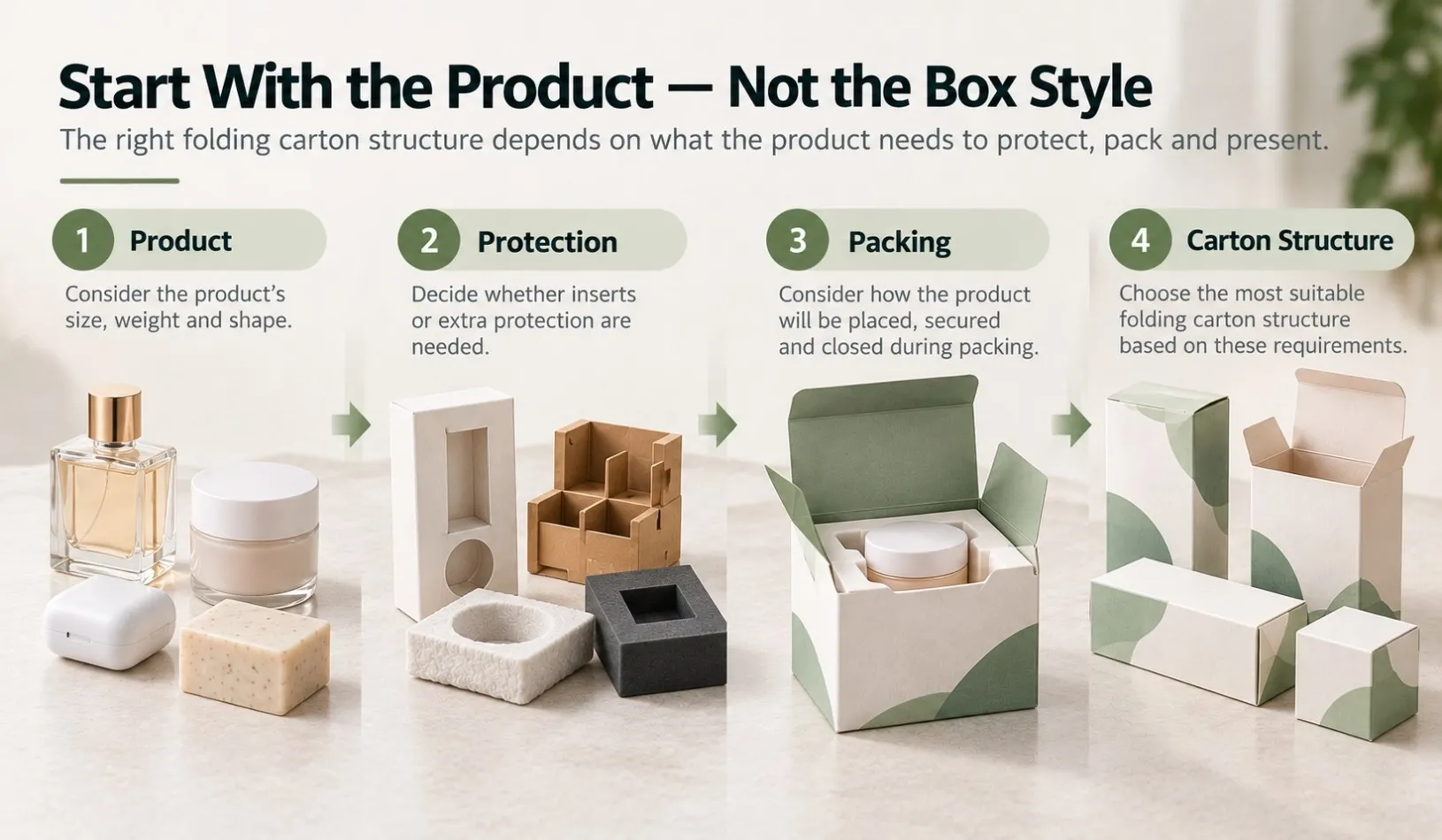
Before choosing a structure, look at the actual product.
Two products with similar dimensions may still require different carton structures because their weight, shape, packing method and opening requirements are different.
Product Size
Product dimensions determine the basic internal space required by the carton.
However, the carton should not simply copy the product dimensions exactly.
The design may also need to consider:
- packing clearance;
- paperboard thickness;
- inserts;
- product tolerance;
- folding structure;
- loading direction.
As explained in our guide to folding carton product fit, product dimensions and finished carton dimensions are not always the same thing.
Product Weight
A lightweight accessory may work well with a relatively simple tuck-end structure.
A heavier product may place more stress on the bottom of the carton.
In these cases, a structure with additional bottom support may be considered.
However, product weight alone should not determine the structure.
Carton dimensions, paperboard, packing method and product shape also need to be considered.
Product Shape
A regular rectangular product may be relatively straightforward to pack.
An irregular product may require:
- an insert;
- additional internal support;
- a larger opening;
- a different loading direction;
- a custom die-cut structure.
The carton should therefore be developed around the actual product rather than only its nominal dimensions.
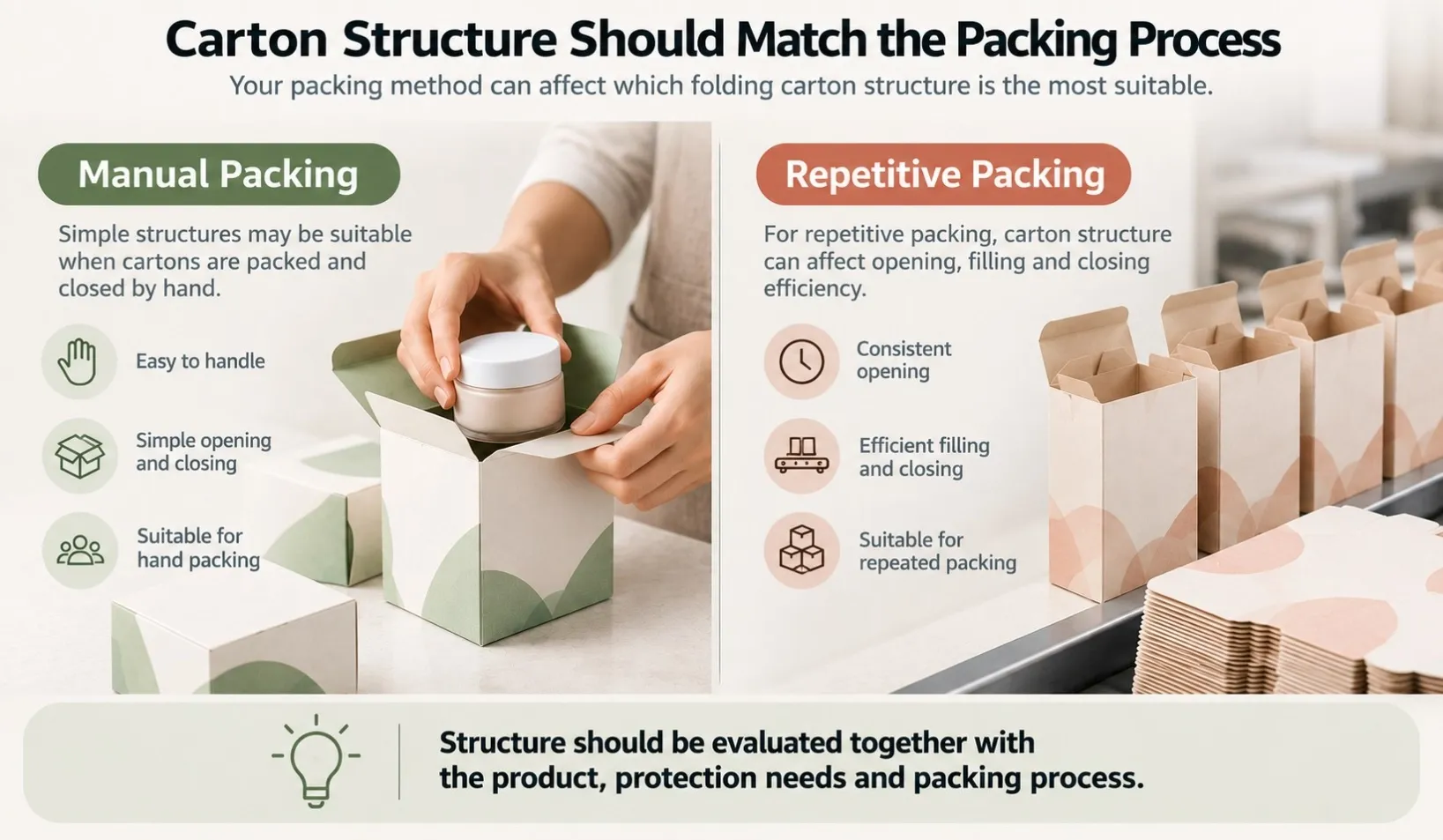
How Will the Carton Be Packed?
This is one of the questions buyers can easily overlook.
A carton can be easy to manufacture but inconvenient to pack.
Before selecting a structure, consider whether the product will be packed:
- manually;
- semi-automatically;
- automatically;
- by the packaging supplier;
- by the buyer or a third-party packing facility.
Packing one sample by hand is very different from packing thousands of products in production.
For example, a pre-glued auto-lock bottom can reduce the amount of manual bottom assembly required.
The question is therefore not simply:
“Which structure is stronger?”
It is also:
“Which structure works efficiently with the way the product will actually be packed?”
What Are the Most Common Folding Carton Structures?
There is no single folding carton structure suitable for every application.
Some common options include:
Structure | Typical Consideration | Often Considered For |
|---|---|---|
Straight Tuck End | Simple opening and common retail use | Cosmetics, electronics accessories and lightweight retail products |
Reverse Tuck End | Opposite tuck direction and efficient panel arrangement | General printed retail cartons |
Auto-Lock Bottom | Pre-glued bottom and faster box forming | Products requiring additional bottom support or faster packing |
Snap-Lock Bottom | Interlocking bottom panels | Products requiring additional bottom support |
Sleeve | Outer sleeve around a tray or inner package | Gift sets and presentation packaging |
Custom Structure | Developed around a specific product or use | Irregular products, special opening or display requirements |
These are general applications rather than fixed rules.
The same product may work with more than one structure.
Straight Tuck vs Reverse Tuck: What's the Difference?
Straight Tuck End and Reverse Tuck End cartons can look similar after assembly.
The main difference is the arrangement of the top and bottom tuck flaps.
With a Straight Tuck End structure, the tuck flaps generally close in the same direction.
With a Reverse Tuck End structure, the top and bottom tuck flaps close in opposite directions.
Both structures are commonly used for printed retail packaging.
The choice may depend on:
- opening direction;
- panel layout;
- artwork position;
- product loading;
- manufacturing layout;
- packing requirements.
This is why the decision should not be based only on appearance.
When Should You Consider an Auto-Lock Bottom?
An auto-lock bottom has a pre-glued bottom structure that forms as the carton is opened.
It may be worth considering when:
- additional bottom support is useful;
- the product has more weight;
- faster box forming is important;
- repeated manual bottom assembly would be inconvenient.
However, a heavier product does not automatically require an auto-lock bottom.
The complete packaging system still needs to be evaluated.
What Is the Difference Between Auto-Lock Bottom and Snap-Lock Bottom?
Both structures can provide more bottom support than a basic tuck-end carton, but they are assembled differently.
An Auto-Lock Bottom is normally pre-glued during production. When the flat carton is opened, the bottom panels move into position to form the base.
A Snap-Lock Bottom uses interlocking bottom panels that are manually folded and locked together.
In practical terms:
Auto-Lock Bottom
- faster box forming;
- pre-glued structure;
- useful when packing efficiency matters.
Snap-Lock Bottom
- manually interlocked bottom;
- no automatic bottom forming;
- can provide additional base support without the same pre-glued bottom construction.
Neither option is automatically better.
The choice depends on the product, quantity, packing process and required support.
Does a Heavier Product Always Need a More Complex Structure?
Not necessarily.
It is tempting to assume:
heavier product → thicker paper → stronger structure
But packaging performance is more complicated.
A carton works as a complete system:
Product + Size + Paperboard + Structure + Creasing + Packing
A small heavy product may behave differently from a large lightweight product.
Similarly, simply increasing paperboard thickness does not guarantee better performance.
If the board, crease lines and locking areas are not properly matched, thicker material can even make assembly more difficult.
Our guide to why folding cartons develop gaps after assembly explains how material thickness, creasing, dielines and locking structures can interact after the carton is folded.
How Does Box Size Affect Structure Selection?
A structure that works well for a small carton may not behave exactly the same way when scaled up.
Larger cartons may involve:
- larger unsupported panels;
- greater total product weight;
- more internal movement;
- greater pressure on the bottom;
- different folding behaviour.
This is why simply enlarging an existing dieline does not always produce the same performance.
The structure should be reviewed together with the finished carton dimensions and actual product.
How Does Paperboard Affect the Structure?
Paperboard is not only a material specification.
It is part of the carton structure.
Board thickness and characteristics can affect:
- folding resistance;
- crease performance;
- tuck flap insertion;
- locking areas;
- glued seams;
- finished internal dimensions.
For example, a dieline developed around one board thickness may need adjustment when the material changes.
This is especially important for smaller cartons with tight product fits or more complicated folding areas.
The paperboard, dieline and creasing process should therefore be considered together.
Problems such as crease cracking can also occur when the paperboard, grain direction and creasing conditions are not properly matched.
Why Can the Same Structure Work for One Product but Not Another?
Consider two products.
Product A
- small;
- lightweight;
- rigid;
- manually packed.
Product B
- larger;
- heavier;
- irregularly shaped;
- packed with an insert.
Both products might technically use a tuck-end carton.
But their packaging requirements are very different.
The second product may require different:
- paperboard;
- internal clearance;
- bottom support;
- insert design;
- packing sequence.
The box style is therefore only one part of the packaging decision.
How Does Structure Affect Packaging Cost?
A more complicated carton structure may affect more than the unit price of the paperboard.
It can also affect:
- tooling;
- die-cutting;
- creasing;
- gluing;
- material usage;
- assembly time;
- packing speed;
- storage;
- shipping volume.
This is why the simplest-looking carton is not always the lowest-cost option in actual use.
For example, a carton that takes significantly longer to assemble may increase packing time.
On the other hand, a complicated structure may add unnecessary production cost when a simpler carton already performs well.
The objective should be to balance:
Product Protection + Packing Efficiency + Structure + Appearance + Total Cost
Why Should You Test the Structure Before Mass Production?
A carton can look correct on a dieline and behave differently after it is physically assembled.
A physical sample can help evaluate:
Product Fit
Place the actual product inside whenever possible.
Check whether the product:
- fits comfortably;
- moves excessively;
- pushes against the carton;
- interferes with an insert;
- changes the shape of the box.
Opening and Closing
Check whether the flaps:
- fold naturally;
- lock correctly;
- require excessive force;
- spring open;
- interfere with other panels.
Packing Speed
If thousands of cartons will be packed, test how easily the structure can be assembled repeatedly.
Bottom Support
For products that place more load on the base, check whether the bottom closes correctly and remains stable during normal handling.
Structural Stability
Finally, look at the finished carton as a complete package.
Does it stay square?
Does it maintain its intended shape?
Does the product remain in the correct position?
Testing the physical sample can reveal issues that are difficult to identify from a flat dieline alone.
What Information Should Buyers Provide Before Choosing a Structure?
The more information available at the beginning, the easier it is to evaluate the carton correctly.
Information | Why It Matters |
|---|---|
Product dimensions | Determines the basic internal space |
Product weight | Helps evaluate structural requirements |
Product photos | Shows product shape and special features |
Product sample | Useful when fit is critical |
Required quantity | Helps evaluate the production approach |
Packing method | Influences assembly and structure |
Target carton dimensions | Defines the available packaging space |
Opening requirements | Helps determine the closure |
Paperboard preference | Affects folding and structural behaviour |
Artwork | Confirms printing requirements |
Existing packaging | Provides a useful reference |
For custom folding cartons, these details can be reviewed before sampling so that the structure is developed around the actual product and packing requirements.
FAQ
What is a folding carton structure?
A folding carton structure is the way a flat paperboard sheet is die-cut, creased, folded, closed and sometimes glued to form the finished carton.
What is a tuck end box?
A tuck end box uses tuck flaps to close the carton.
Straight Tuck End and Reverse Tuck End are two common variations.
What is the difference between Straight Tuck and Reverse Tuck?
The main difference is the direction and arrangement of the top and bottom tuck flaps.
The choice can also affect panel layout, artwork position, loading and production.
What is the difference between Auto-Lock Bottom and Snap-Lock Bottom?
An Auto-Lock Bottom is normally pre-glued and forms as the carton is opened.
A Snap-Lock Bottom uses bottom panels that are manually folded and interlocked.
The appropriate choice depends on the product and packing process.
Is a more complicated folding carton structure always better?
No.
Additional structural features may provide useful support or packing convenience, but they can also increase manufacturing and assembly complexity.
The structure should match the actual packaging requirement.
Should I make a sample before bulk production?
For custom folding cartons, a physical sample is especially useful when product fit, bottom support, inserts, opening or packing method is important.
Whenever possible, test the sample with the actual product before approving mass production.
Final Thoughts
Choosing a folding carton structure is not simply a matter of selecting a box style from a catalogue.
The structure should be developed around the complete application:
Product → Protection → Packing → Structure → Material → Production → Cost
A Straight Tuck End may be suitable for one product.
A Reverse Tuck End may work better for another.
An Auto-Lock Bottom may provide useful support or packing efficiency for a different application.
And some products may require a custom structure rather than a standard option.
So instead of asking:
“Which folding carton structure is best?”
Ask:
“Which structure works for my product, packing process and required performance?”
If you're developing a custom folding carton, send us your product dimensions, weight, photos and packing method. We can help evaluate the folding carton structure and sample requirements before bulk production.