
Packaging Knowledge
How Are Custom Hang Tags Made? Production Process & Terms
From artwork to strung and packed: the six stages of hang tag production, the factory terms on your quote, and the checks to run before approving bulk.
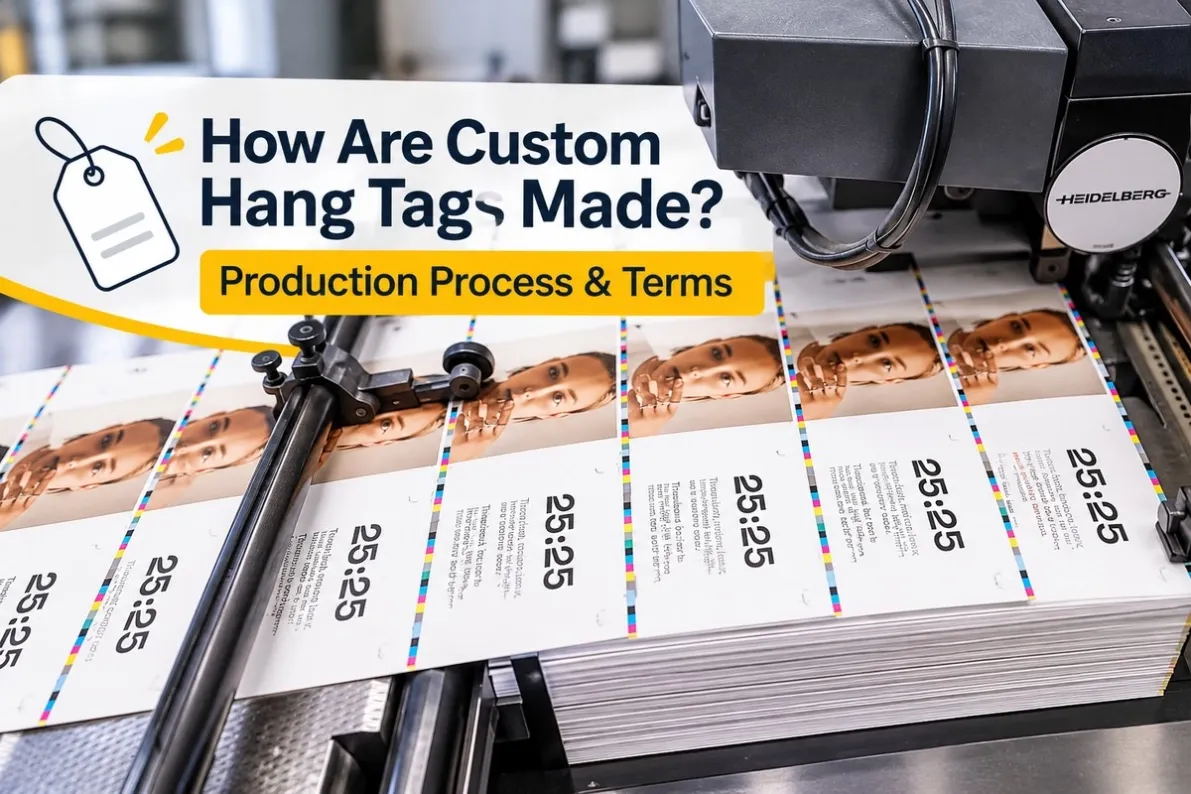
A custom hang tag passes through six stations between approved artwork and a packed carton: printing, surface finishing, die cutting, waste stripping, hole punching, and stringing or bundling. A typical order runs 500 to 5,000 pieces on 250-400 gsm board, with 7-10 days for a printed sample and 12-15 days for production once the die is cut. Knowing the sequence matters because the expensive decisions - which finish, how the shapes nest on the sheet, whether tags ship strung or loose - all lock in before the press starts.
This guide walks the production route the way a factory plans it, translates the terms that appear on quotes, and lists the checks worth running on the sample before bulk approval.
What are the stages of hang tag production?
One tag, end to end, touches the following stations:
- Artwork proof and platemaking - colour proof approved, printing plates or digital file prepared
- Printing - the sheet or roll of tag board is printed with the design
- Surface finishing - foil, embossing, or spot varnish applied while the sheet is still whole
- Die cutting - a steel-rule die cuts every tag shape out of the printed sheet
- Waste stripping - the skeleton of leftover board is peeled away, leaving only cut tags
- Hole punching and stringing - the hang hole is punched, then cord or ribbon is attached or left for the brand
- Counting and packing - tags are counted, bundled, and boxed for shipment
The order is not negotiable: finishing happens before cutting, because a whole sheet can be foil-stamped or embossed in one pass while a loose 40 x 80 mm tag cannot be registered in the machine.
Sheet-fed or roll-to-roll - how are hang tags printed?
The quantity decides the press:
- Digital sheet-fed: from about 500 pcs per design, no plates, CMYK, the fastest route to a first run
- Offset sheet-fed (litho): economical from roughly 1,000-3,000 pcs, allows spot colours and tighter registration
- Roll-to-roll flexo: for very large runs of simple designs, printed from a web rather than sheets
For a brand ordering its first hang tags, digital covers 500-2,000 pieces with no platemaking cost, and the trade-off is a slightly softer fine detail than litho. If the design is one or two spot colours with a Pantone reference, litho is worth quoting from 1,000 pieces up because mixed-ink matching beats CMYK builds.
What do die cutting and waste stripping actually mean?
Die cutting is the step that turns a printed sheet into tag shapes. A steel-rule die - sharp blades set in a plywood base - is pressed through the printed sheet in one stroke, cutting every tag on the sheet simultaneously. Waste stripping (also called matrix stripping) then removes the skeleton of unused board around the cut edges, so only finished tags remain.
- One die per shape, charged once and reused on every reorder of that shape
- Cut tolerance of about plus or minus 0.5 mm against the dieline
- How shapes nest on the sheet drives material cost - our custom shape clothing tag design guide shows which outlines waste board and which do not
Sharp, clean edges are the visible difference between a well-made die and a tired one: a worn blade leaves a feathered edge or a hairline burr that catches light and lint in the retail environment.
Which finishes are added before the tags are cut?
Finishing runs on the full printed sheet, in this order: print first, then hot foil, then embossing, then spot varnish, and die cutting last. Each step registers to the print, so a foil logo that must sit exactly on the printed wordmark depends on the press holding registration through every pass:
- Hot foil stamping - metallic or pigment foil pressed on with a heated die; the standard premium upgrade for fashion tags
- Blind or foil embossing - a raised relief pressed into the board; depth is subtle on 250 gsm and pronounced on 350-400 gsm
- Spot UV varnish - a high-gloss patch over a matte base, felt as texture before it is seen
- Combination work - foil plus emboss on the same logo needs both dies aligned within about 0.3 mm
How foil behaves on dark boards, and when spot UV is the better choice, is compared in our hot foil versus spot UV guide; embossed effects in context are on our embossed hang tags page.
The three effects buyers mix up most - embossing, debossing, and multi-level sculptured embossing - are untangled in our guide to the difference between embossing and debossing, including the factory terms that decide the die.
How are the hang hole and string attached?
The hole is punched in the same die-cutting pass or a following punching station - it is part of the tooling, not an afterthought:
- Hole diameter 3-5 mm; a 5 mm hole suits cotton cord and ribbon, 3 mm suits thin elastic or safety-pin attachment
- Hole position at least 5 mm from the top edge - closer and the board tears out under a firm pull
- Metal eyelets (reinforcement rings) for heavy tags on metal ball chains, added after punching
- Stringing: cotton cord, jute, ribbon, or poly loop, attached by hand or semi-automatic stringing machine
Tags can ship strung or unstrung. Pre-stringing adds labour cost per piece but saves the brand's warehouse from handling 5,000 loose tags; unstrung ships flatter and is standard for brands that string at the point of retail.
How are finished hang tags counted and packed?
The unglamorous last station decides how many arrive usable:
- Counting by weigh-count machine with a manual recount on sampled bundles
- Bundling in kraft paper - typically 100 or 500 pieces per bundle
- Polybag or inner box per bundle, then master cartons for shipment
- Finish-sensitive tags (foil, spot UV) packed with interleaving paper so surfaces do not scuff in transit
Ask the factory to state the count tolerance on the packing - plus or minus one percent is the normal commercial standard, and it is cheaper to accept it than to pay for exact counting on a 500-piece order.
What do the Chinese factory terms on your quote mean?
Most hang tag production happens in Chinese plants, and quotes often carry floor terms alongside the English. The ones worth recognising:
- 模切 (mó qiē) - die cutting; usually appears next to the one-off die charge
- 排废 (pái fèi) - waste stripping; if billed as a separate line it is a labour cost, not a tooling cost
- 烫金 / 烫银 (tàng jīn / tàng yín) - gold foil / silver foil stamping
- 击凸 (jī tū) - embossing; 击凹 (jī āo) is its recessed counterpart, debossing
- 打孔 (dǎ kǒng) - hole punching; 穿绳 (chuān shéng) is stringing
- 点数 (diǎn shù) - counting; 捆扎 (kǔn zhā) is bundling
A quote that separates die cutting, stripping, finishing, and stringing into visible lines is a factory quoting from a real process; a single lump sum gives you nothing to negotiate or compare against the next supplier.
How do you inspect hang tags before approving bulk?
The sample stage is the last cheap checkpoint. Six checks, none needing equipment:
- Edge check under raking light: no burr or feathering at the die-cut edge, especially on the top edge customers touch first
- Hole check with a ruler: diameter and distance from the edge against the dieline, within 0.5 mm
- Colour check against the signed proof under daylight - not under a warm desk lamp, which flatters reds
- Foil adhesion tape test: press clear tape on the foil, peel once - lifting flakes mean the foil die temperature or dwell was wrong
- String pull test: pull the strung tag firmly ten times; the cord should hold and the hole should not elongate
- Count and bundle check on the packing sample: confirm the stated bundle quantity is what the carton labels say
For the broader paperwork - retained standards, tolerances to state on the PO - our packaging RFQ checklist lists the fields worth specifying before the order goes in, and tag dimensions have their own guide in clothing hang tag sizing.
Frequently asked questions
What is the minimum order for custom hang tags? From 500 pieces per design printed digitally, with the die charged once and reused on reorders. Volume pricing starts to bite from about 3,000 pieces where litho takes over from digital.
Can tags have variable data - barcodes or sequential numbers? Yes, on digitally printed runs, since each sheet can differ without new plates. On litho runs, variable data is overprinted in a second pass or moved to a label applied by the brand.
Do kraft and recycled boards take foil and embossing well? Foil needs a smooth surface to bond cleanly, so it sits best on coated or lightly textured board; on rough recycled kraft, foil can show pinholes. Embossing, by contrast, works beautifully on uncoated kraft because the relief reads strongly without ink.
Get a hang tag production quote
Send the tag size and shape, board preference, quantity, and the finishing you want - foil, emboss, spot UV, strung or unstrung - and we will quote each process as its own line so you can see exactly what each upgrade costs. Reference designs are on our custom hang tags page and our gold foil hang tag page. Ready to price a run? Send the artwork here - quotes within 24 hours.