Why Do Custom Folding Carton Quotes Vary So Much Between Suppliers?
Why do custom folding carton quotes vary between suppliers? Learn how paperboard, structure, printing, finishing, quantity, tooling and packing affect the final price.
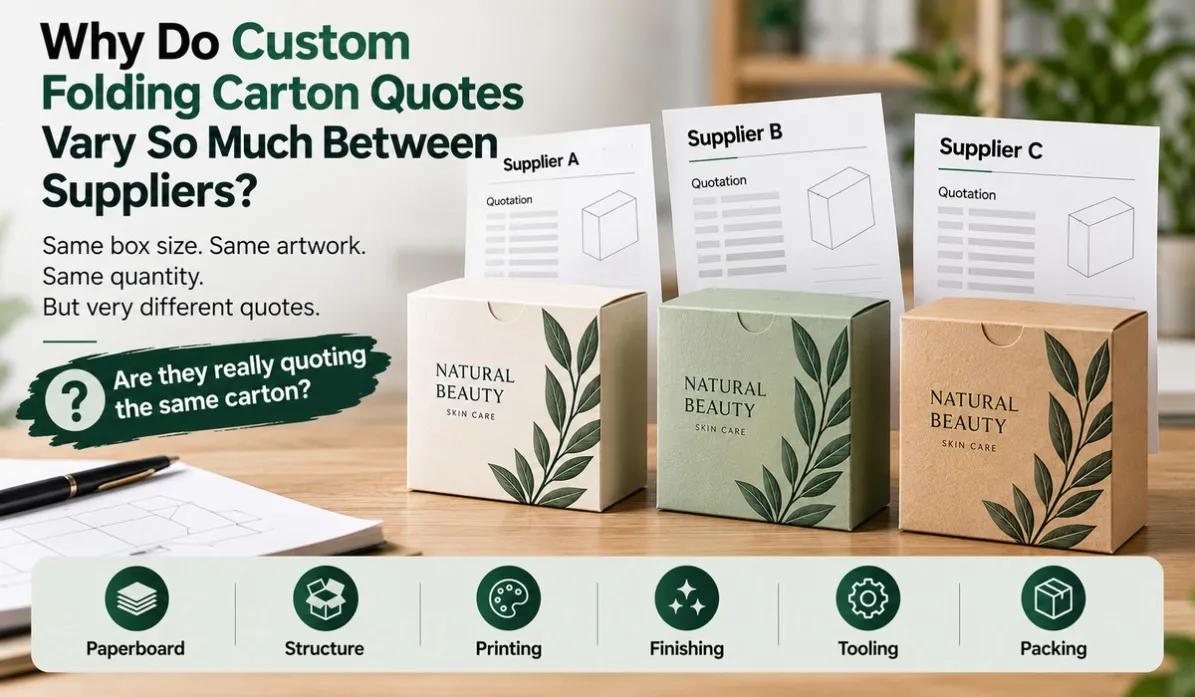
A buyer sends the same folding carton inquiry to three suppliers.
The box size is the same.
The artwork is the same.
The quantity is the same.
But the quotations are very different.
Why?
The first reaction is often:
“Why is one supplier so much more expensive?”
But before comparing prices, there is a more important question:
Are all three suppliers actually quoting the same carton?
Two quotations can look similar on the surface while being based on different paperboard, structures, printing methods, finishing processes, packing requirements or production assumptions.
That is why comparing custom folding carton quotes requires more than looking at the final unit price.
Why Can the Same Folding Carton Have Different Quotes?
Imagine you send three suppliers the following specification:
Box size: 120 × 80 × 40 mm
Material: 300gsm paperboard
Printing: CMYK
Finish: matte
Quantity: 10,000 pcs
This may look complete, but several important questions are still unanswered.
What type of 300gsm paperboard?
What thickness and stiffness?
What carton structure?
Does “matte” mean varnish, aqueous coating or lamination?
Is tooling included?
How will the finished cartons be packed?
What quality requirements are expected?
If these details are not defined, suppliers may be calculating different packaging solutions.
Before comparing prices, make sure the specifications are comparable.
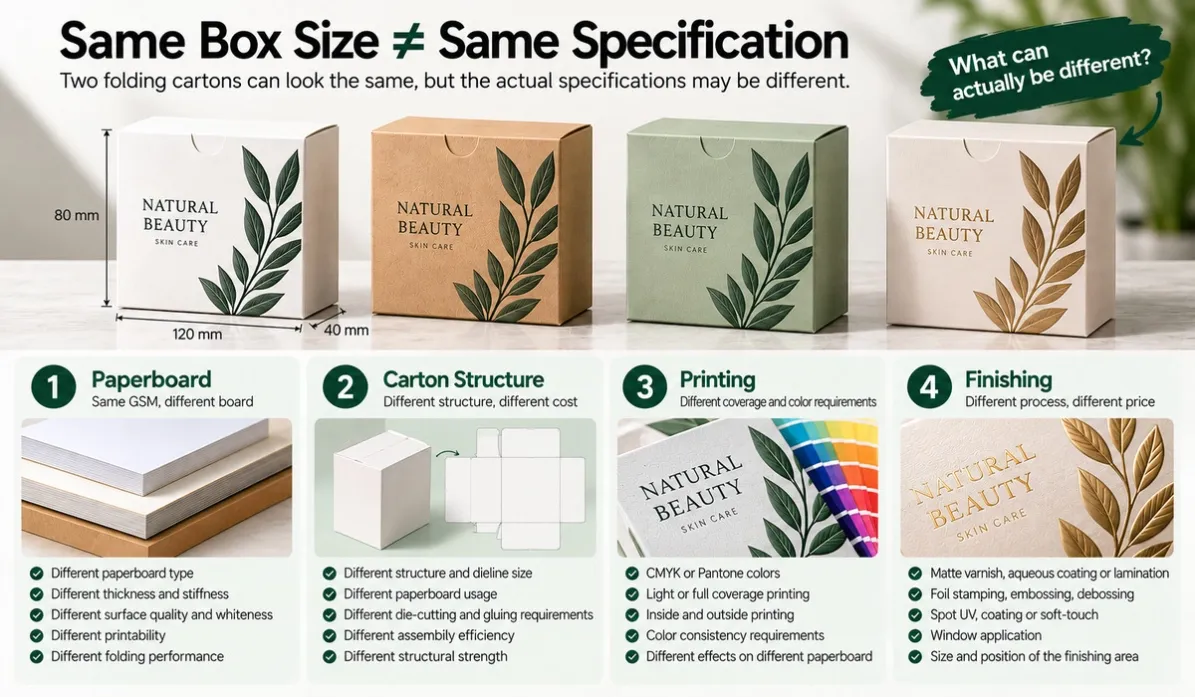
1. Paperboard Specification: The Same GSM Does Not Mean the Same Board
A quotation may simply say:
300gsm paperboard
But GSM only tells you the material weight per square metre.
It does not fully describe:
paperboard type
thickness
stiffness
fibre composition
surface quality
printability
folding performance
Two 300gsm boards can therefore perform differently in the finished carton.
One may feel relatively stiff. Another may feel softer. One may provide a smoother printing surface, while another may be selected mainly for cost efficiency.
This means two suppliers can both write “300gsm” on their quotations while calculating different materials.
2. Carton Structure: Similar Size Does Not Mean the Same Construction
Two boxes can have the same finished dimensions but use different structures.
Common examples include:
straight tuck end
reverse tuck end
auto-lock bottom
snap-lock bottom
custom locking structures
window cartons
cartons with inserts or partitions
Structure can affect:
paperboard usage
dieline size
die-cutting
gluing
assembly time
packing efficiency
structural performance
For example, a simple tuck-end carton and an auto-lock-bottom carton may have similar dimensions but different material usage and production requirements.
Before comparing quotations, confirm that the suppliers are quoting the same structure — or understand why they are recommending different ones.
3. Printing Requirements: “CMYK” Does Not Describe the Whole Print Job
A quotation that says:
4-color printing
can still leave important details unclear.
Printing requirements may also depend on:
CMYK or Pantone colors
number of spot colors
ink coverage
inside printing
outside printing
color consistency requirements
paperboard surface
A carton with a small four-color graphic is not necessarily the same production job as a carton covered with dark, full-color artwork.
Likewise, a brand requiring a specific Pantone color may need a different production approach from a design where standard CMYK reproduction is acceptable.
For a more reliable comparison, each supplier should be quoting from the same artwork and printing requirements.
4. Finishing: What Does “Matte” Actually Mean?
This is another common source of quotation differences.
A buyer may request:
Matte finish
But this could refer to:
matte varnish
aqueous coating
matte lamination
soft-touch treatment
another surface coating
These processes do not necessarily have the same cost, appearance or production requirements.
The same applies to decorative finishing such as:
foil stamping
embossing
debossing
spot UV
window application
The size and position of the finishing area can matter too.
A small foil logo is different from a large foil-covered panel.
When comparing quotations, confirm exactly which finishing process is included rather than relying only on words such as “matte” or “premium finish.”
5. Tooling and Production Setup: What Is Included in the Quote?
Custom folding cartons normally require production setup and, depending on the design, specific tooling.
This may include:
cutting dies
foil stamping dies
embossing or debossing dies
printing plates where applicable
special tooling for windows or other features
machine setup
One supplier may list tooling separately.
Another may include certain setup charges in the quotation.
This can make the totals look different even when the actual production price is relatively close.
When reviewing a quotation, check:
Which costs are one-time charges, and which are included in the unit price?
This is particularly important when comparing the first order with repeat orders.
6. Quantity and Production Efficiency Affect the Unit Price
Folding carton production includes setup work before thousands of cartons are produced.
These setup costs are spread across the order quantity.
That is why:
500 pcs
and
50,000 pcs
will not normally have the same unit price.
But quantity is not the only factor.
Production efficiency can also depend on:
sheet size
number of cartons per sheet
paperboard utilization
material waste
printing efficiency
die-cutting efficiency
finishing setup
Two suppliers may use different equipment or sheet formats, so the same carton may fit their production systems differently.
For larger quantities, even a relatively small difference in material utilization can affect the final quotation.
7. Assembly and Packing Requirements Can Change the Cost
Most folding cartons are shipped flat because this reduces packing volume.
But the quotation can change if the buyer requires:
pre-assembly
partial assembly
special inner packing
protective wrapping
dividers
specific quantities per export carton
carton labels or barcode labels
palletization
A quotation based on flat-packed cartons should not be compared directly with one based on assembled cartons.
Packing requirements should therefore be confirmed before comparing the final unit price.
8. Quality Requirements May Not Be Visible on the Quotation
Two suppliers may quote the same:
box size
GSM
printing
finishing
quantity
But their production assumptions can still differ.
Quality requirements may include:
color tolerance
printing registration
die-cutting consistency
crease quality
gluing consistency
finished dimensions
surface cleanliness
scratch tolerance
inspection requirements
This does not mean the highest quotation automatically provides the highest quality.
It also does not mean the lowest quotation automatically provides lower quality.
The important point is that the expected standard should be clear.
Whenever possible, evaluate the finished and assembled sample rather than relying only on the written specification.
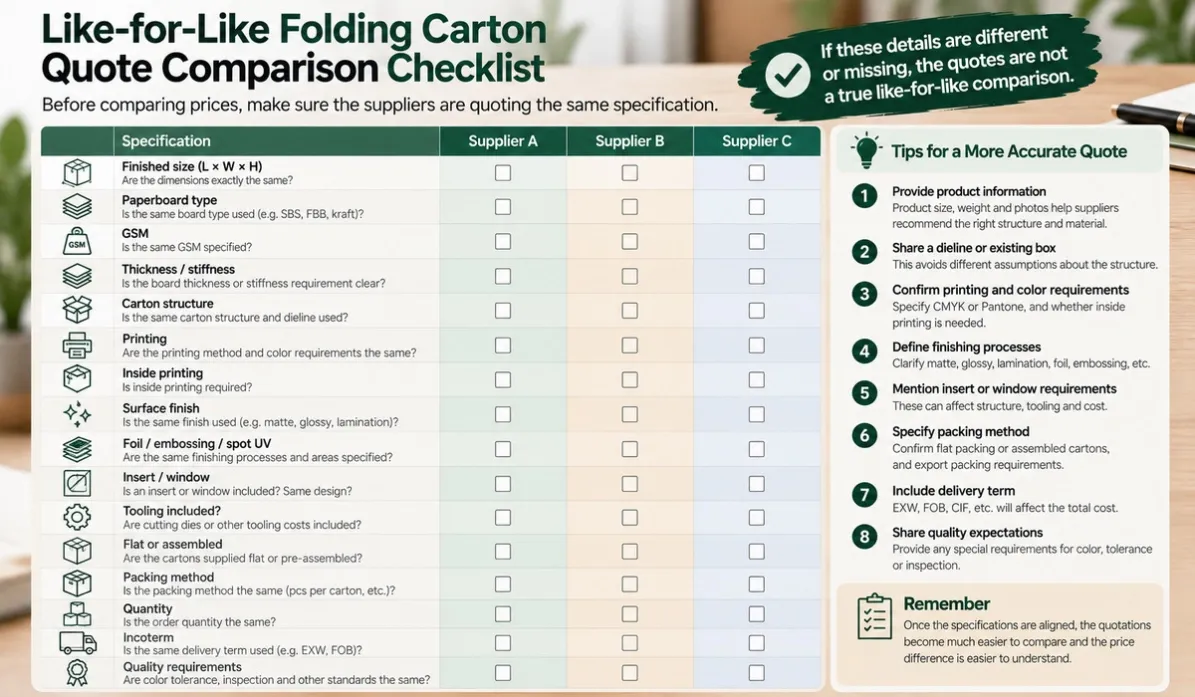
Before deciding whether one quotation is really cheaper than another, check:
Finished dimensions are the same
Paperboard type is confirmed
GSM is confirmed
Thickness or stiffness requirements are understood
Carton structure is the same
The same artwork is being quoted
CMYK / Pantone requirements are confirmed
Inside printing is confirmed
Finishing processes are clearly defined
Tooling charges are identified
Flat packing or assembly is confirmed
Export packing requirements are the same
Quantity is the same
Incoterm is the same
Quality expectations are understood
If several of these items are different or missing, the quotations should not yet be compared only by unit price.
FAQ
Why Can Two Suppliers Quote Different Prices for the Same 300gsm Folding Carton?
Because 300gsm describes paper weight, not the complete paperboard specification.
Board type, thickness, stiffness, surface characteristics and printability can differ. The suppliers may also be quoting different structures, finishing processes, tooling or packing requirements.
What Is a Like-for-Like Quote for Custom Folding Cartons?
A like-for-like quote means each supplier is pricing the same technical specification.
The paperboard, structure, printing, finishing, tooling, packing, quantity, quality requirements and delivery terms should be comparable before the prices are evaluated.
Does Thicker Paperboard Always Make a Folding Carton More Expensive?
Not necessarily.
Paperboard cost depends on more than thickness. Board grade, GSM, construction, sheet utilization and production requirements can all affect the final cost.
A thicker board can also change creasing, die-cutting and folding requirements.
Why Is My Sample Cost Much Higher Than the Bulk Unit Price?
A sample is produced in a very small quantity while still requiring material preparation, cutting, finishing and labor.
Bulk production spreads setup costs across a much larger quantity.
The sample cost therefore should not be compared directly with the bulk unit price.
Should Tooling Be Included in the Unit Price?
There is no single quotation format used by every supplier.
Some suppliers list tooling separately, while others include certain setup costs in the quotation.
The important thing is to confirm what is included before comparing total costs.
Can I Compare Quotes Using Only Box Size, GSM and Quantity?
You can obtain an initial estimate, but it may not be a reliable like-for-like comparison.
For a more accurate quotation, also confirm the carton structure, paperboard type, printing, finishing, insert or window requirements, packing method and relevant quality requirements.
Why Does a Supplier Ask About the Product Before Quoting the Box?
Because the product can affect carton size, board selection, structure, insert requirements and packing method.
A folding carton should be evaluated as part of the complete packaging system rather than as an isolated printed box.
Final Thoughts
When custom folding carton quotes vary significantly, do not begin by asking:
“Which supplier is cheaper?”
Ask first:
“Are these suppliers actually quoting the same specification?”
Once these factors are aligned, the quotation becomes much easier to understand.
If you are preparing an RFQ for custom folding cartons, send us your product dimensions, box size or dieline, quantity, artwork, paperboard preference, printing and finishing requirements.
If some specifications have not yet been finalized, we can review the product, carton structure and material requirements first so that the quotation is based on a clearer and more comparable specification.