

Hang Tags
Custom Clothing Hang Tags for Fashion Brands
Custom clothing hang tags for fashion brands: choose paper, finished size, printing, foil, embossing, strings and attachments. Dieline and sample support.
Custom Clothing Hang Tags for Apparel Brands
Clothing hang tags need to do more than carry a logo. Depending on the garment, they may also need space for sizing, product information, barcodes, QR codes, care information or brand messaging.
Jeeli Packaging produces custom clothing hang tags for fashion brands, apparel manufacturers and retail collections. Size, paper, printing and attachments can be adjusted around the garment and the information that needs to appear on the tag.
Choosing the Right Paper for Clothing Hang Tags
Paper choice affects the stiffness, print appearance and overall feel of a clothing tag.
Common options include:
- Coated paper for detailed graphics and printed colors
- Uncoated or textured paper for a more tactile finish
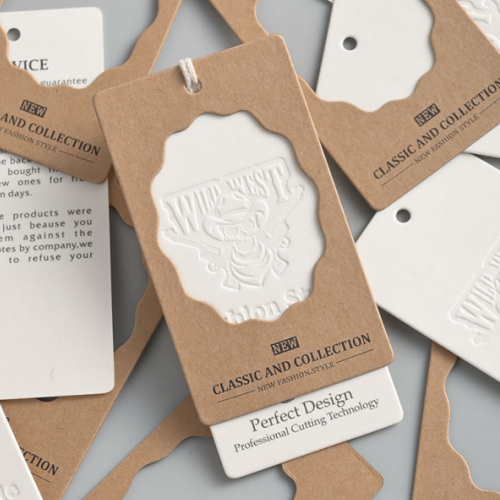
- Kraft paper for a natural appearance
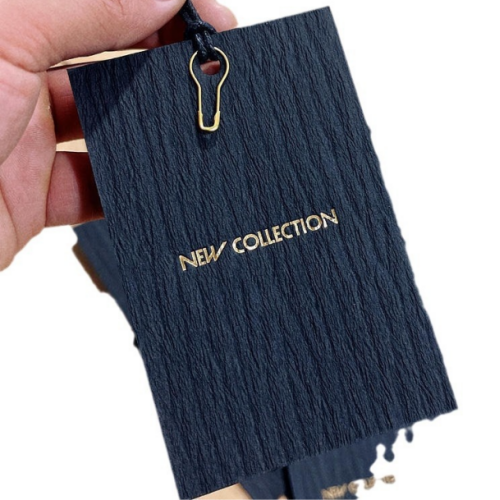
- Black or colored specialty paper for foil and simple artwork
- Thicker paperboard when additional stiffness is needed
There is no single paper weight that works for every garment. A small tag for a lightweight T-shirt may need a different construction from a larger tag set used on coats, denim or premium apparel.
Size and Information Layout
The finished tag size should be decided after considering how much information needs to fit on the tag.
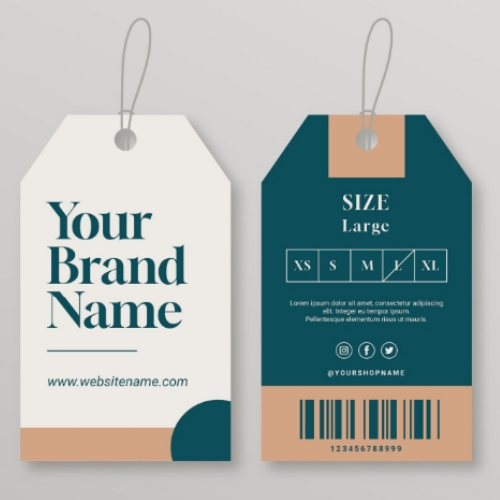
A clothing hang tag may include:
- Brand name or logo
- Product or collection name
- Size
- Material or care information
- Barcode
- QR code
- Website or social information
- Price or retail information where required
Trying to fit too much information onto a small tag can make the design difficult to read.
Our clothing hang tag size guide explains how tag dimensions, artwork and hole position work together.
If your garments ship in boxes rather than on hangers, the tag also has to fit the box — our hang tag size for apparel boxes guide covers the 40-60 percent width rule, loop lengths and hole placement for boxed garments.
Hang Tag Measurements: Finished Size, Shape and Tolerance
A hang tag is specified by its finished flat size, and almost every other measurement follows from it. Most clothing tags fall somewhere between roughly 2 × 2 in (50 × 50 mm) for a minimal logo tag and 3.5 × 5 in (90 × 130 mm) for a tag that also carries care details, a barcode and a price field. Rectangular tags are the most economical; a shaped tag costs the same to print but needs its own cutting form.
Three measurements are worth fixing on the drawing rather than deciding later: the cut size, the hole diameter, and the distance from the hole centre to the nearest edge. That last figure decides whether the tag tears when a garment is pulled off a crowded rail.
Production tolerance on a die-cut paper tag is normally around ±0.5–1 mm on the cut edge, and hole position is held to a similar range. If a tag has to sit in a jig, on a clip strip or inside a printed sleeve, tell us the clearance you need and we will quote to that instead of to the default.
Printing and Finishing
Printing and finishing should support the artwork rather than compete with it.
Depending on the paper and design, options can include:
- CMYK or spot-color printing
- Foil stamping
- Embossing
- Debossing
- Spot UV
- Die-cut shapes
- Matte or soft-touch finishes where suitable
For a more understated fashion direction, Custom Minimalist Clothing Hang Tags may also be useful for comparison.
Working From a Hang Tag Dieline
A dieline is the flat outline of the tag, drawn to finished size. It shows the cut path, the hole and its centre point, any rounded corners or internal cut-outs, and the safe area where text and barcodes must stay. Supplying a dieline instead of only a width and height removes most of the back-and-forth before sampling.
The same logic applies to any packaging that is cut to shape rather than folded from a standard blank — why a dieline should be agreed before the design is finalised.
Shaped tags are worth planning early, because a contour cut changes how the tag stacks, hangs and packs. See what changes once a clothing tag is die-cut to a custom shape before committing the outline.
Strings, Eyelets and Attachments
The attachment is part of the finished tag, so it should be confirmed together with the tag itself.
Options may include cotton or polyester strings, waxed cords, ribbons, metal eyelets and suitable fasteners.
Before production, check:
- Hole position
- Hole diameter
- String length
- String color
- Eyelet size and finish
- How the tag will be attached to the garment
The attachment should work with the garment without making packing or retail handling unnecessarily difficult.
Embossing, Debossing and Foil on Clothing Tags
Raised and recessed effects read best on paper with enough body to hold the impression. On a thin coated sheet the same artwork can look flat; on a soft, bulky sheet the fibres may spring back and soften the edge.
Paper choice matters more than the artwork here — why embossing looks better on some hang tag papers than others. Uncoated and cotton-like stocks usually take a deeper impression than a heavily coated one.
Foil is the other common upgrade, and the finish changes the result: a matte foil reads as a soft metallic block, a gloss foil as a hard shine.
If metallic detail is the main element of the design, compare our custom gold foil hang tags, and read how matte and gloss gold foil differ on garment tags before you pick the finish.
For the finish decision itself, see the buyer's guide to matte vs gloss gold foil stamping on custom garment tags.
For a recessed logo instead of a raised one, our debossed clothing hang tags page covers the same decision from the other direction.
Common Problems With Clothing Hang Tags
Three issues account for most reprints, and all three are avoidable at specification stage.
The string hole tears because the hole is too close to the edge or the paper is too light for the garment weight.
The bulk run looks different from the approved sample because colour, foil coverage or die pressure shifted between runs.
The tag looks cheaper than the design suggested, usually because paper, finish and edge quality were value-engineered separately instead of together.
The first is the most common. See why hang tags tear around the string hole, and the hole position, reinforcement and paper weight changes that prevent it.
For the second, why a bulk hang tag can differ from the approved sample explains what is realistic to hold and what is not.
What Should Be Checked on a Sample?
A physical sample is useful for checking details that may be difficult to judge from artwork alone.
Review the finished size, paper feel, print colors, text readability, hole position, attachment and any foil, embossing or debossing.
QR codes and barcodes should also be tested at the actual finished size.
FAQ
What size should a clothing hang tag be?
It depends on how much the tag has to carry. A logo-only tag can be as small as 2 × 2 in (50 × 50 mm); once care details, a barcode and a price field are added, something closer to 2.75 × 4.7 in (70 × 120 mm) is usually more readable. Our tag size guide walks through the trade-off between size, artwork and hole position.
Do I need a dieline for custom clothing hang tags?
Not strictly — we can work from a finished size, hole preference and artwork. But a dieline is the fastest way to get an accurate first sample, and it is essential for shaped tags or anything with an internal cut-out.
Can clothing hang tags be embossed, debossed or foiled?
Yes, and the paper determines how well. Embossing and debossing need a sheet with enough body to hold the impression; foil can be applied to most stocks. Send the artwork and we will confirm which combination survives packing and retail handling.
Request a Clothing Hang Tag Quote
For a quotation, send us the tag size, quantity, artwork or logo, preferred paper and any printing, finishing or attachment requirements.
If the material or construction has not been finalized, we can review the project information before sampling.